AI Music
Suno v6 Sounds Muffled: What Changed in the Mix, and How to Get the Top End Back
You rendered the same idea you have rendered a hundred times, and Suno v6 handed back something that sounds like it is playing through a closed door. The vocal sits behind the band instead of on top of it, the cymbals have lost their air, and the whole thing has what one of the most-upvoted comments on the subject called a "blanket over the speakers" quality.
You also cannot go back and check, because Suno retired every model before v6 when the new generation shipped on 9 September 2026. So this piece does the two things that are actually available: it translates the complaint out of adjectives and into frequency bands you can act on, and it separates what the label deals genuinely changed from what people have assumed they changed. We read Suno's own launch material, the settlement reporting on all three majors, and what Suno published by way of measurements — which turns out to be the most interesting part.
Key takeaways
The complaint is consistent and unusually specific. Buried vocals, missing high end, "blanket over the speakers" — different people, the same three descriptions.
Those three are one problem in mix terms. A shortage of energy above roughly 8 kHz plus a build-up around 200–400 Hz produces every one of them.
Nobody can show you a measured before and after. Suno retired v3.5 through v5.5 on 9 September 2026, so the "before" was withdrawn on the same day the "after" arrived.
Suno published no listening tests and no benchmark scores. There is nothing official to check either "it got worse" or "it got better" against.
The "all three majors signed" claim is wrong. Only Warner has deals with both Suno and Udio. Universal's suit against Suno is still live and Sony has settled with neither.
No, it is not just you
The loudest thread on the subject ran to 175 upvotes and 263 comments on r/SunoAI within two days of the v6 release, and the comment that carried it put the problem plainly: "It sounds… muffled. I can't explain it. Like you're listening on shitty headphones." That is a listener describing a tonal balance without the vocabulary for it, and it is the single most repeated description in the whole conversation.
One of the larger review round-ups of the launch collected the same thing from a wider pool and summarised the reports as "muffled, dull or overly processed mixes" with "vocals that feel buried, harsh, generic or artifact-heavy". Two independent descriptions converging on the same adjectives is worth taking seriously.
It is worth being straight about the other side, though, because the reports are not unanimous. The same threads contain people describing cleaner vocals, wider mixes and stronger results on particular genres, and a separate recurring complaint is that quality falls off in the back half of long generations — which is a different problem with a different cause. If your v6 renders sound fine, nothing here is telling you they do not.
Vote and comment counts above are as of our 13 September 2026 pull of the subreddit. Reddit blocks automated re-checks from our environment, so treat them as a snapshot of scale rather than a live figure.
What "muffled" actually means in frequency terms
Every description in that thread is a tonal-balance complaint, and the useful move is to stop treating them as three separate faults. "No high end", "buried vocals" and "blanket over the speakers" are what a single pair of problems sounds like from three different listening positions: not enough energy at the top, too much in the lower midrange.
High-frequency content above about 8 kHz is what your ear reads as air, detail and proximity. Take it away and cymbals lose their shimmer, breath disappears from a vocal, and the whole mix feels like it is behind something. Separately, the 200 to 400 Hz region carries the body of almost every instrument at once, so a few decibels too much there makes a mix thick, boxy and congested — and that congestion is precisely what stops a vocal cutting through.
| What people say | Frequency region | What it actually is | Corrective move |
|---|---|---|---|
| "The high end feels almost completely gone" | 8 kHz and above | High-frequency rolloff — no air, dull cymbals, no breath detail | Gentle high shelf, +2 to 3 dB from ~8 kHz |
| "Blanket over the speakers" | 200–400 Hz plus HF loss | Lower-midrange build-up combined with the rolloff above | Wide cut of 2 to 4 dB in the low mids, then the shelf |
| "The vocals are buried" | 1–4 kHz | Masking — the bed occupies the range the voice needs for intelligibility | Cut the bed at 250–350 Hz, add 1.5 to 3 dB presence at 2–5 kHz |
| "Dull and strangely lifeless" | Broadband | Usually the two above heard together, sometimes over-compression | Fix tone first, then re-check dynamics |
| "Falls apart in the back half" | Not tonal | Generation consistency over long durations — a different fault | Regenerate or edit the section; EQ will not fix it |
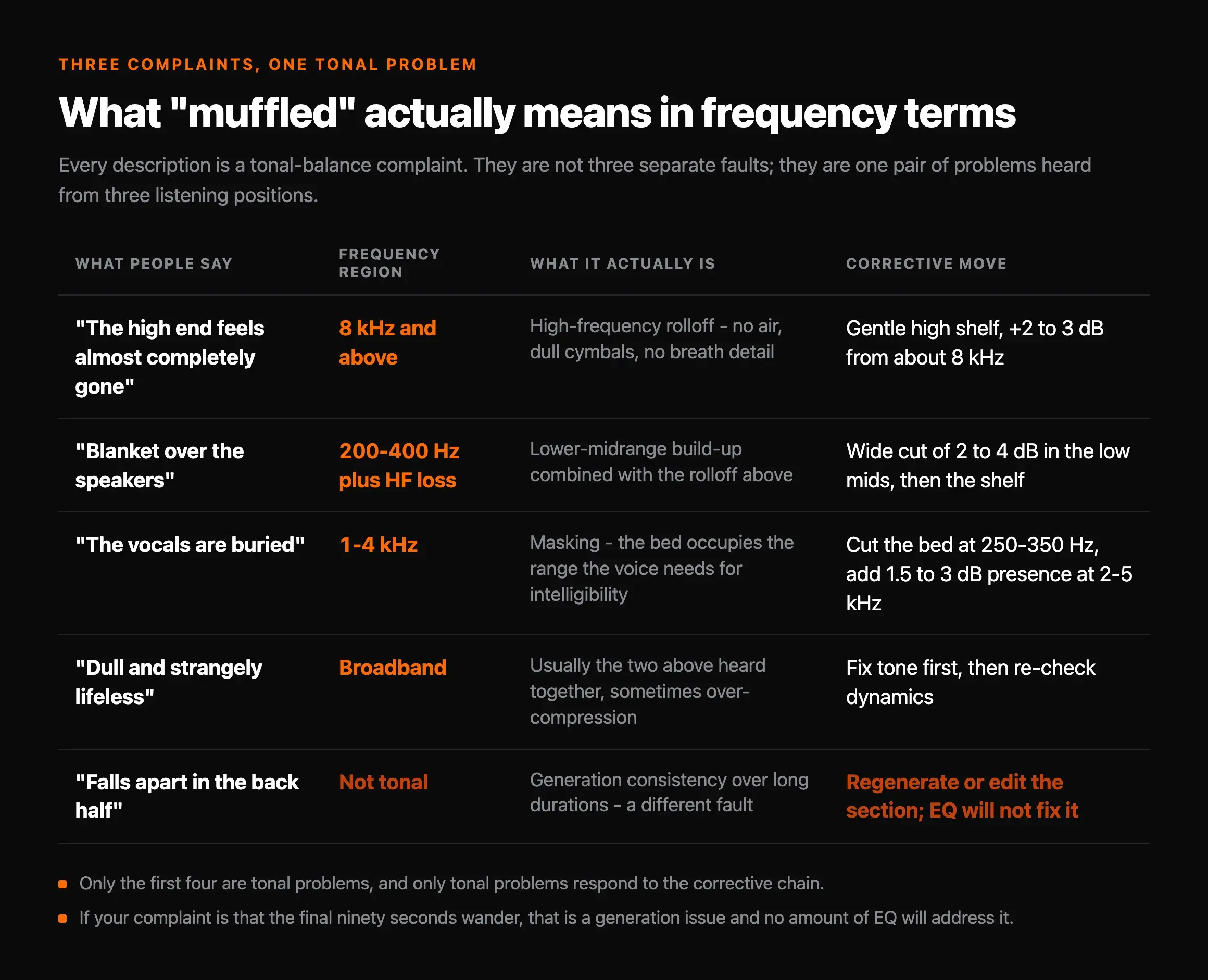
That last row matters for expectation-setting. Only the first four are tonal problems, and only tonal problems respond to the chain further down this page. If your complaint is that the final ninety seconds wander, that is a generation issue and no amount of EQ will address it.
Why nobody can show you a measured before and after
The obvious way to settle "is v6 actually duller" is to render the same prompt on v5.5 and on v6 and measure the difference across frequency bands. That test is no longer available to anyone, and the reason is the most underreported fact of the whole launch: Suno retired every model before v6 as part of the rollout. v3.5 through v5.5 are gone for new generations. The "before" was withdrawn on the same day the "after" arrived.
The second half of the problem is that Suno filled the gap with nothing checkable. As one of the more careful launch write-ups noted, Suno published no benchmark scores, no listening-test results and no parameter counts for any of the three models, and did not say which catalogues are in the training data or what share of the training set is licensed. Every confident claim in either direction — yours, ours, the subreddit's — is therefore a listening impression.
| What would settle the argument | Does it exist? | Why not |
|---|---|---|
| Same prompt rendered on v5.5 and v6, measured | No | Every pre-v6 model was retired on 9 September 2026 |
| Suno's own listening tests or benchmark scores | No | None published for v6, v6-wild or v6-mini |
| Published spectral analysis of v6 output | Not as of writing | The model is days old; no independent measurement has appeared |
| Your own v5.5 library as a reference | Yes | Existing tracks stay in your library and remain playable |
The bottom row is the practical one, and it is the only A/B left. Your own back catalogue is now the only v5.5 reference in existence that is specific to your material, your genre and your ear. Pull your best pre-v6 master into the same session as a v6 render of a similar idea and listen to them switched, level-matched — that comparison is real, even though it is not a controlled test. It is also an argument for getting those files onto your own drive rather than leaving them in a library, which the per-tier download caps introduced on 3 September made considerably more awkward than it used to be.
What the label deals did and did not change
A widely shared version of this story says the lawyers ruined the sound: that the three major labels have now signed with the AI generators and the models were degraded to suit them. The sentiment behind it is understandable and the factual claim is wrong, so it is worth putting the actual position on the table.
| Label | Status with Suno | Status with Udio |
|---|---|---|
| Warner Music Group (major) | Settled November 2025, licensing deal | Settled November 2025, licensing deal |
| Universal Music Group (major) | Suit still live | Settled October 2025, licensing deal |
| Sony Music (major) | No settlement — still litigating | No settlement — still litigating |
| BMG (not a major) | Licensing deal, v6 partner | — |
| Believe (not a major) | Licensing deal, v6 partner | — |

So one major has deals with both platforms, one has a deal with Udio while its case against Suno continues, and one has settled with neither. The v6 partners are Warner Music Group, BMG and Believe, and only the first of those is a major label. Warner's settlement with Suno was announced in November 2025, a week after the same label settled with Udio. Status current as of 14 September 2026.
On the causal claim itself: licensed training data changes what a model has learned from. It is not a mixing stage, not a mastering stage, and there is no published mechanism connecting a licensing agreement to high-frequency rolloff. Suno also changed several things simultaneously — three new models, a new default and the retirement of the entire back catalogue of models — so even if the tonal shift is real, attributing it specifically to the deals is picking one variable out of several for reasons that are about mood rather than evidence. Our day-two review of the v6 launch covers the rest of what changed.
The five-step fix, with numbers
This is a corrective chain, not a creative one, and the order matters: each step changes what the next one is reacting to. Every figure below is a starting point to be moved by ear on your own material. If a step does not obviously improve things, undo it rather than compounding it.
High-pass at around 30 Hz. Generated tracks often carry inaudible low energy that eats headroom and makes everything below it sound thicker than it is.
A wide cut of 2 to 4 dB centred between 200 and 400 Hz. Sweep to find where the boxiness lives before you commit — it is rarely in the same place twice.
Cut the instrumental 2 to 3 dB around 250 to 350 Hz, then add 1.5 to 3 dB of presence to the vocal between 2 and 5 kHz. Fix the bed before you touch the voice.
A gentle high shelf of 2 to 3 dB from about 8 kHz. Shelf rather than peak, and stop as soon as cymbals sound right — past that you are lifting hiss.
Brightening a track raises true peak. Re-check integrated LUFS and true peak after the chain, not before, and adjust the ceiling if needed.
| Step | Target | Typical starting value | What it addresses |
|---|---|---|---|
| 1. High-pass | ~30 Hz | 12–18 dB/octave slope | Headroom, inaudible sub energy |
| 2. Low-mid cut | 200–400 Hz | −2 to −4 dB, wide Q | Boxiness, "blanket" quality |
| 3. Vocal presence | 2–5 kHz | +1.5 to +3 dB | Buried, unintelligible vocals |
| 4. High shelf | from ~8 kHz | +2 to +3 dB | Missing air and detail |
| 5. Loudness check | ≈ −14 LUFS | −1 dBTP true peak | Playback normalisation |
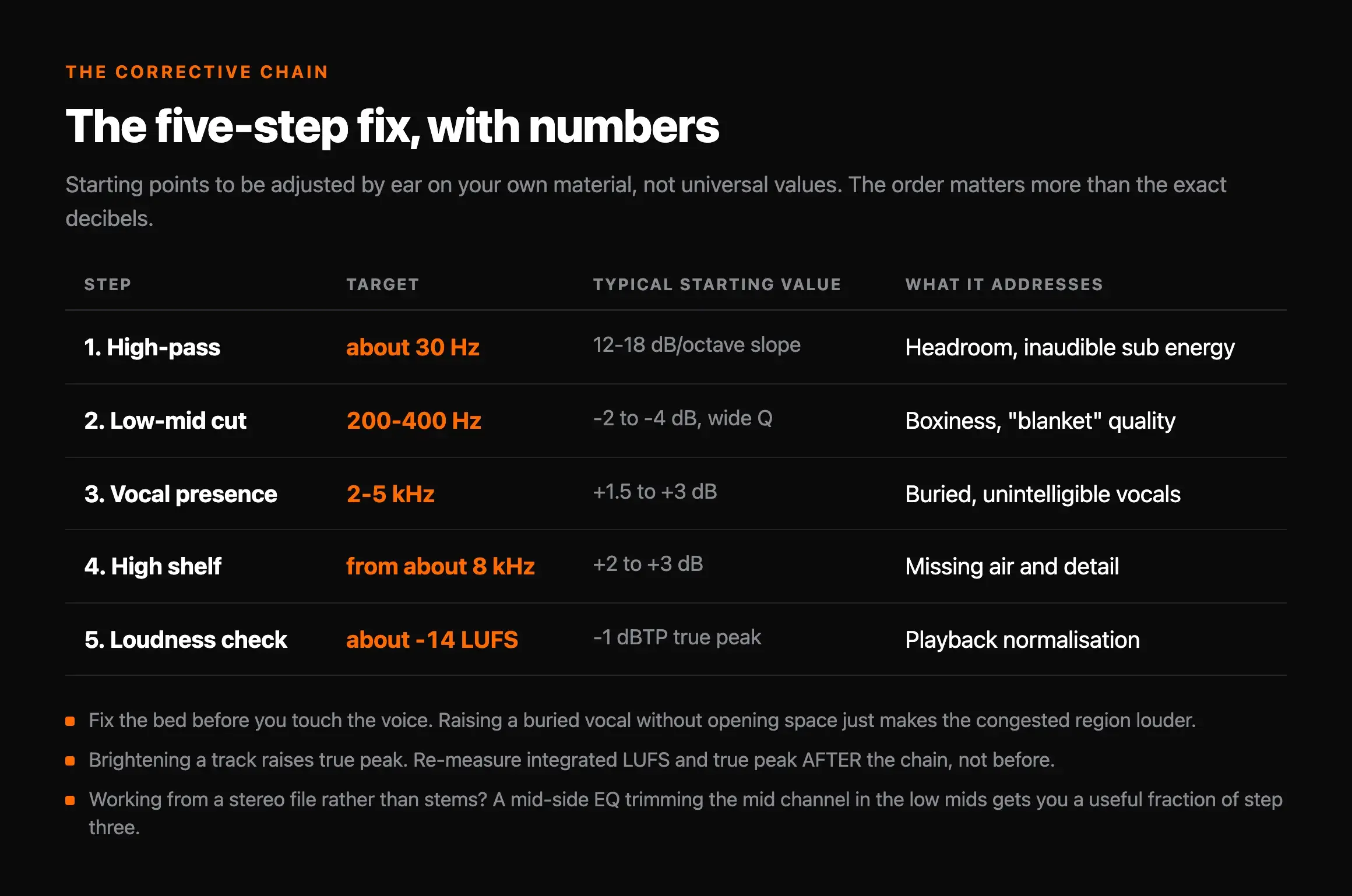
If you are working from a stereo file rather than stems — which is most people — step three is the compromised one. A mid-side EQ that trims the mid channel slightly in the low mids will open space around a centred vocal without touching the sides, and it gets you a useful fraction of the way there. Our guide to mastering AI music goes through the rest of the one-pass chain in more detail.


Check LUFS before you upload
The step people skip is the one that undoes the other four. Adding a high shelf adds energy, and energy raises both integrated loudness and true peak — so a master that measured safely before the chain can arrive at a distributor clipping on playback.
Spotify normalises playback to roughly −14 LUFS integrated, Apple Music to around −16 and Deezer to about −15, so a single file at approximately −14 LUFS with true peak at or below −1 dBTP normalises acceptably everywhere without you cutting a master per platform. Measure integrated loudness across the whole track rather than a loud section, because integrated is the number platforms read. The full LUFS reference for every streaming platform has the per-service targets and peak ceilings in one table.
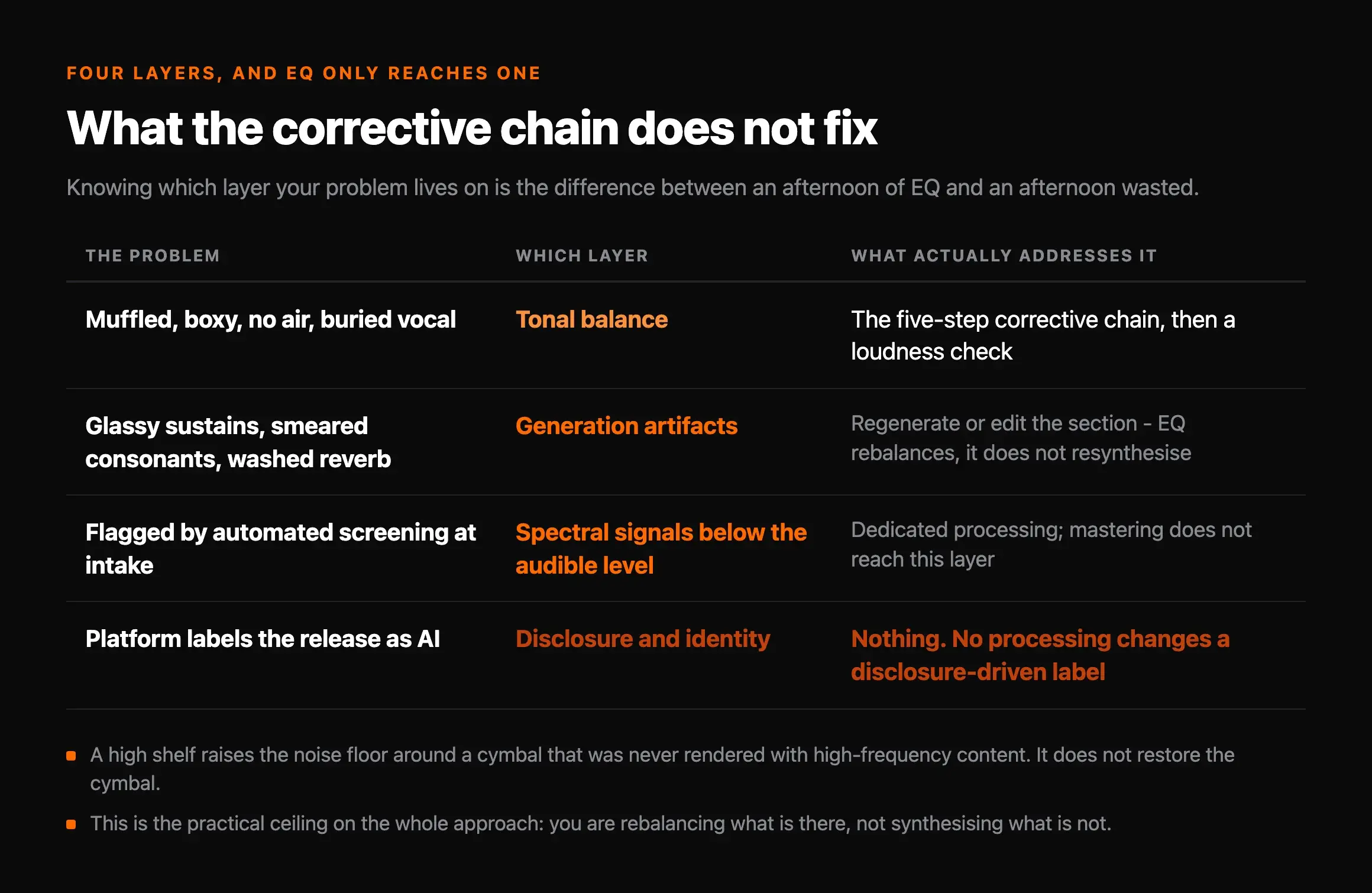
What this does not fix
Three honest limits, because the chain above is narrower than it looks.
It cannot restore what was never generated. A high shelf rebalances the content in a file. If a cymbal was rendered without high-frequency detail, the shelf lifts the noise floor around it rather than bringing the cymbal back. This is the ceiling on the whole approach and it is worth knowing before you spend an evening on it.
Tonal balance is not the same as generation artifacts. The glassy sustains, smeared consonants and washed reverb tails people describe are a separate layer with a separate cause — we pulled those apart in the AI sound signature, which also covers the third layer, the one no human ear resolves at all.
And none of it touches screening. The spectral signals distributors screen for sit at a level of the signal that corrective EQ is not aiming at and does not meaningfully alter. That is the step Undetectr is built for — it targets the watermark signals and generation artifacts automated intake reads, which is a different job from making a track sound right. It does not make your track stop being AI-generated, and it cannot affect how a platform labels your release; nothing can.
| The problem | Which layer | What actually addresses it |
|---|---|---|
| Muffled, boxy, no air, buried vocal | Tonal balance | The five-step corrective chain above, then a loudness check |
| Glassy sustains, smeared consonants, washed reverb | Generation artifacts | Regenerate or edit the section — EQ rebalances, it does not resynthesise |
| Flagged by automated screening at intake | Spectral signals below the audible level | Dedicated processing such as Undetectr; mastering does not reach this layer |
| Platform labels the release as AI | Disclosure and identity | Nothing. No processing changes a disclosure-driven label |
Tone is one gate, screening is another
Fixing the mix does not clear the screening step.
Undetectr targets the watermark signals and generation artifacts distributors screen for at intake. It will not change how a platform labels your release — nothing can — and it is not a substitute for getting the mix right first. €39 one-time, no subscription.
Once it actually sounds right
Worth saying plainly: a fixed mix is not a solved problem. Getting distributed is the part that already works, and the wall most people hit is that nobody hears the release afterwards. If you would rather not depend on algorithmic discovery for that, pitching for paid sync placements in TV, film, games and ads is where the money conversation in this niche actually is — and a mix with its top end intact is a great deal easier to place than one with a blanket over it.
Keep reading
- The AI sound signature: what you hear vs what machines measure
- LUFS for Spotify and every streaming platform
- How to master AI music: loudness, LUFS and one-pass cleanup
- Suno V6 review: what changed, and why users revolted
- Suno V6 sliders: variety, style influence and weirdness explained
- Cleaning AI music for release: the 12-step checklist
Frequently asked questions

Eddie Mathews — AI Music Editor, Erasy
Eddie covers the craft side of AI music for Erasy — prompting, arrangement, vocal direction and the workflow between a generation you like and a file you can release. They test on their own material and say plainly where a technique stops working.
Why does Suno v6 sound muffled?+
Is Suno v6 actually worse than v5.5, or is it in people's heads?+
Can I still generate on Suno v5.5 or an older model?+
How do I fix buried vocals on a Suno v6 track?+
Does mastering fix the muffled sound?+
Did the Warner, BMG and Believe deals make Suno sound worse?+
What EQ settings should I start with on a muffled AI track?+
Disclosure: Erasy is an independent guide to AI music cleanup, and Undetectr is the tool we recommend and link to. This article contains no measured spectral comparison of v5.5 against v6, because Suno retired every pre-v6 model on 9 September 2026 and published no listening tests or benchmark scores — where the text describes the reported tonal shift, it is reporting listener descriptions and the mix-engineering reading of them, not a measurement, and it says so. Reddit vote and comment counts are from our 13 September 2026 pull and could not be re-verified from our environment. Settlement status and launch details are from TechCrunch and contemporaneous launch coverage, current as of 14 September 2026.