AI Music
Suno V6: Warner Music Helped Build It. The Top Post on r/SunoAI Is a Cancellation Notice.
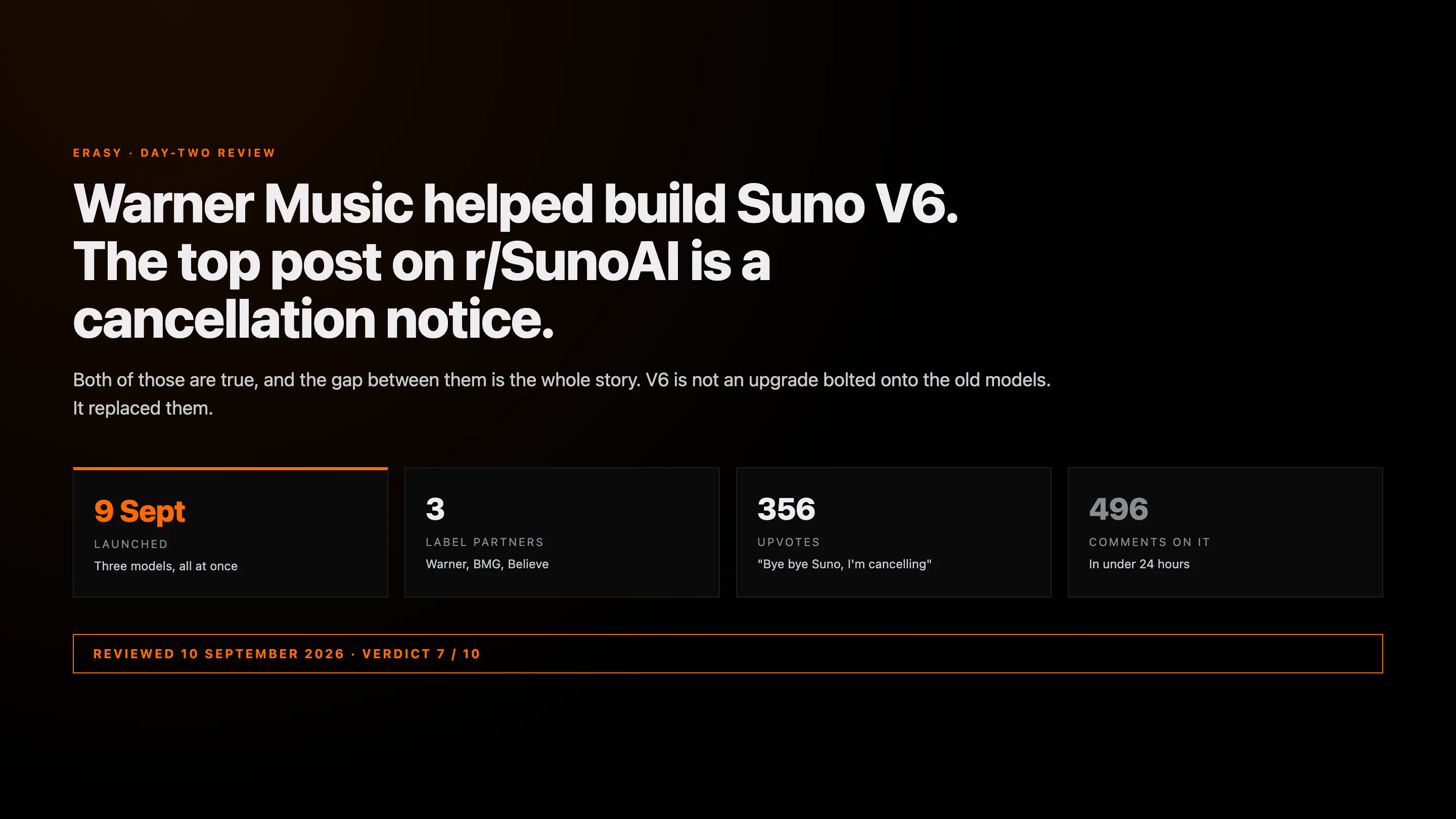
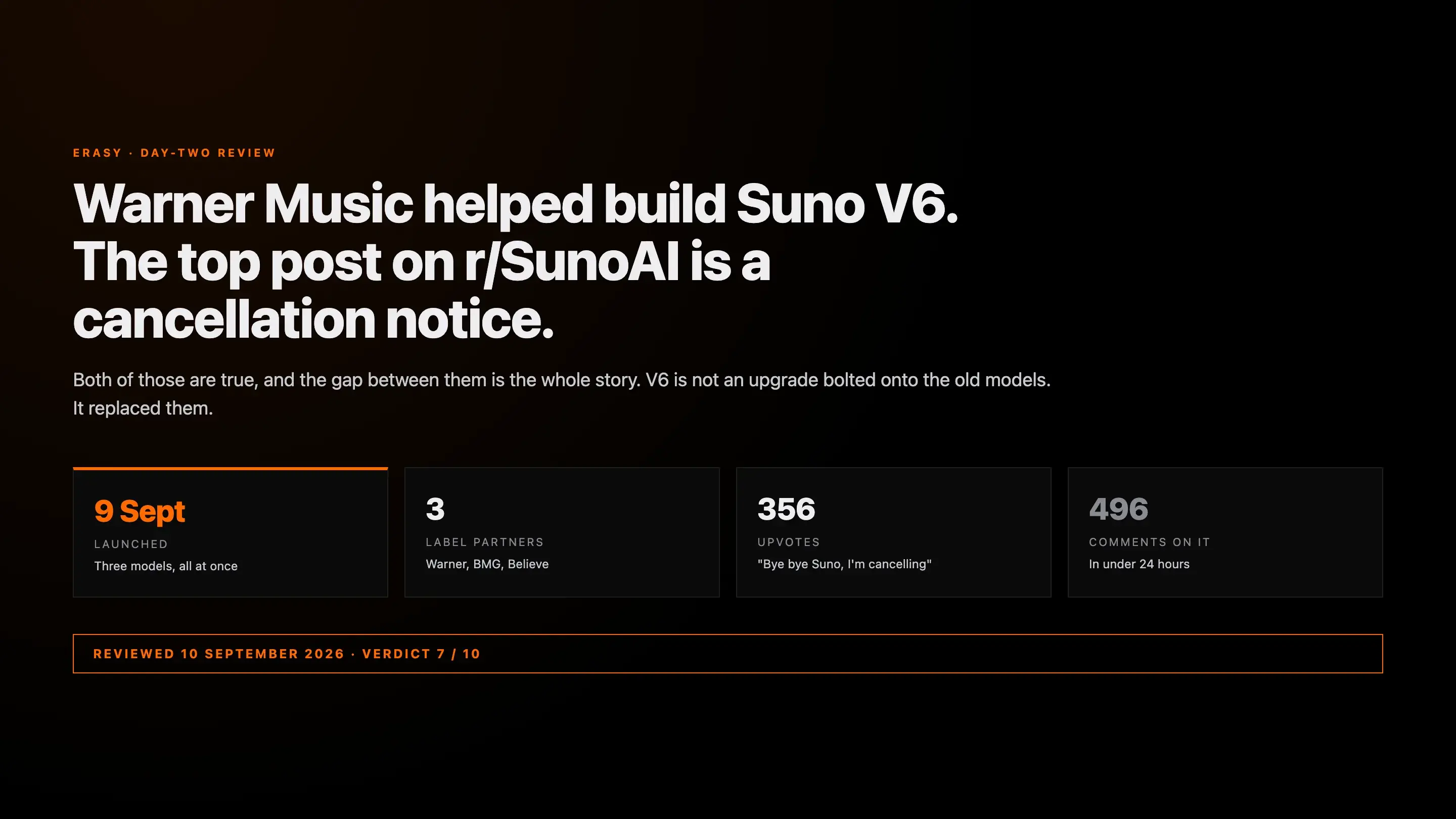
On 9 September 2026 Suno shipped v6, the first generation of its music models built with the record industry rather than in court against it — developed with Warner Music Group, BMG and Believe. Within twenty-four hours the top post on r/SunoAI was titled "Bye bye Suno, I'm cancelling my subscription", with 356 upvotes and 496 comments under it. Both of those things are true, and the distance between them is the actual story of this launch.
This is a day-two review written from Suno's own announcement, its launch walkthrough, and the first wave of community reaction rather than from the press release. The short version: v6 is a genuine capability jump that most coverage is under-selling, and the backlash is about something almost none of that coverage has correctly identified.
The verdict in short
7 / 10. A real capability jump, landed the same way the download cap was landed — abruptly, on people who had built around the old thing.
Three models, not one. v6 and v6-wild on paid tiers, v6-mini free for everyone.
The big change is workflow, not audio. Section editing, mashups and multimodal input matter more than the fidelity bump.
The anger is about replacement, not quality. The old models went away. That is a different complaint from "the new one sounds worse".
Nothing downstream got easier. Distributor screening does not care which model made the file.
What actually shipped on 9 September
Suno did not release "v6". It released a family of three models simultaneously, and which one you are using changes the experience enough that most of the argument online is people comparing different models to each other without realising it.
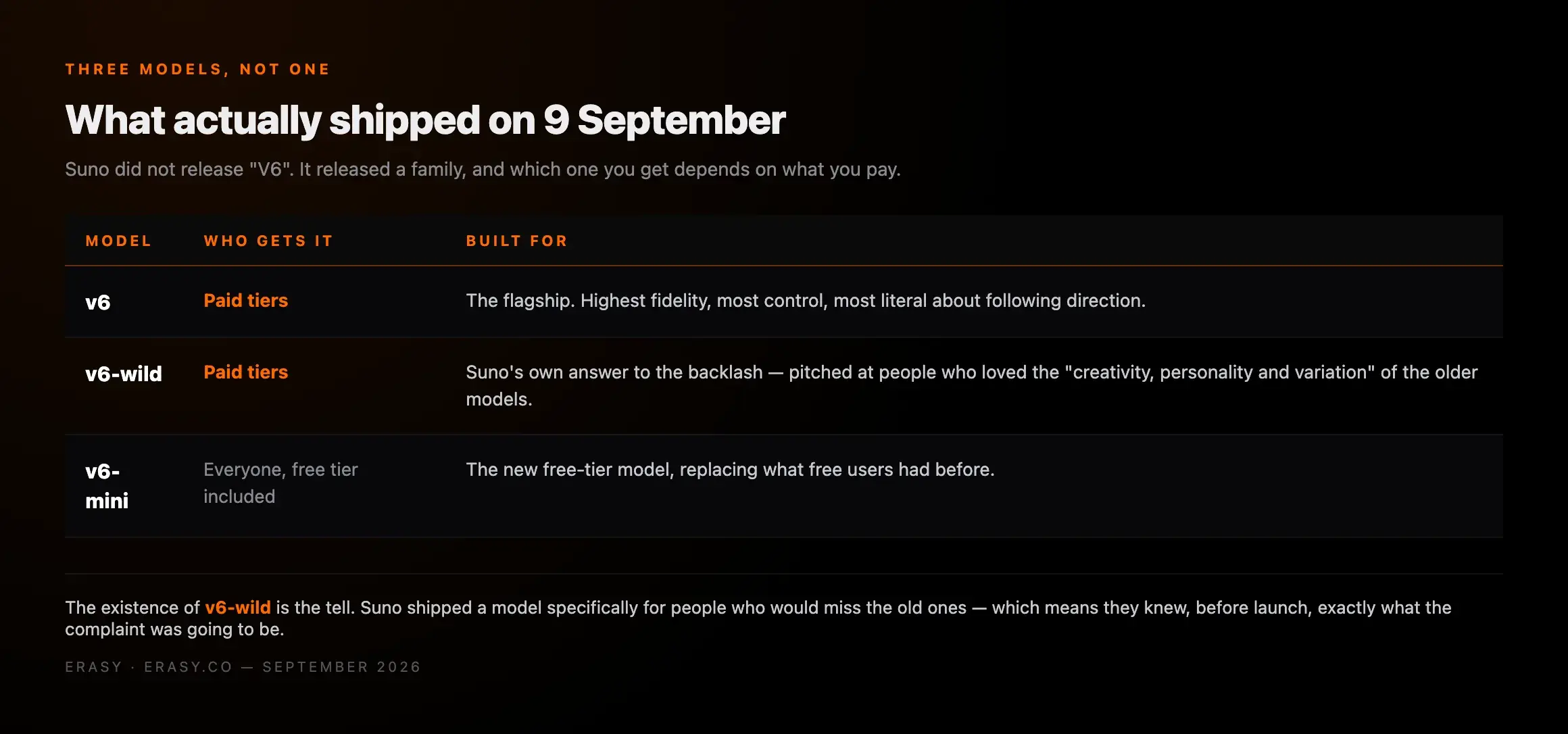
| Model | Availability | What it is for |
|---|---|---|
| v6 | Paid tiers | The flagship — highest fidelity, most control, most literal about following direction |
| v6-wild | Paid tiers | For people who preferred the looser character of the older models |
| v6-mini | Everyone, free tier included | The new free-tier model |
The existence of v6-wild is the most informative detail in the entire launch, and it has been almost universally skipped. Suno's own walkthrough puts it plainly: "If you're someone who loved the creativity, personality, and variation of Suno's older models, V6 Wild is probably the first model I'd try." A company does not ship a model for the people who will miss the old ones unless it already knows that complaint is coming. Suno saw the backlash in advance and shipped the mitigation on day one.
The label partnership, and what is actually confirmed
Suno says v6 was developed with industry partners including Warner Music Group, BMG and Believe. TechCrunch framed the release more bluntly: Suno replacing its AI models with a new one trained on licensed music as copyright suits pile up. Warner Music Group CEO Robert Kyncl circulated a note about the launch, which users promptly posted to r/SunoAI where it drew 92 upvotes and 260 comments.
The significance is easy to state and easy to overstate. Suno spent 2025 and 2026 as a defendant — it settled with Warner in November 2025, lost GEMA v Suno in Munich on 31 July 2026, and is still facing Universal and Sony actions. v6 is the first model built on the other side of at least some of those relationships. That is a real change in what the company is.
What it is not, on any evidence currently available, is a change to your licence. Commercial use rights on paid plans work the way they did last week. We will update this piece if that changes, but we are not going to infer a rights change from a training-data change, and neither should anyone else.
Why "replaced" is the word that matters
Here is the sentence that explains the entire backlash, and it is TechCrunch's framing rather than Suno's: Suno replaces its AI models. Not adds to. Not extends. Replaces.
If you have been generating on Suno for a year, you did not just have an account. You had a model version you knew the behaviour of, a prompt library tuned to that behaviour, personas that responded a particular way, and a sound you had learned to hit reliably. That is real work, and it is version-specific work. On Wednesday the thing all of it was calibrated against stopped being the thing you get.
This is exactly the shape of the download-cap complaint from August: the policy itself was defensible, and the way it landed put the cost on people who were not the target. Suno has now done this twice in five weeks. We reviewed the first instance in our piece on the download limits, and the pattern is becoming the story.
What is genuinely new
Set the controversy aside for a moment, because the capability jump is real and it is being under-reported by people busy covering the fight.
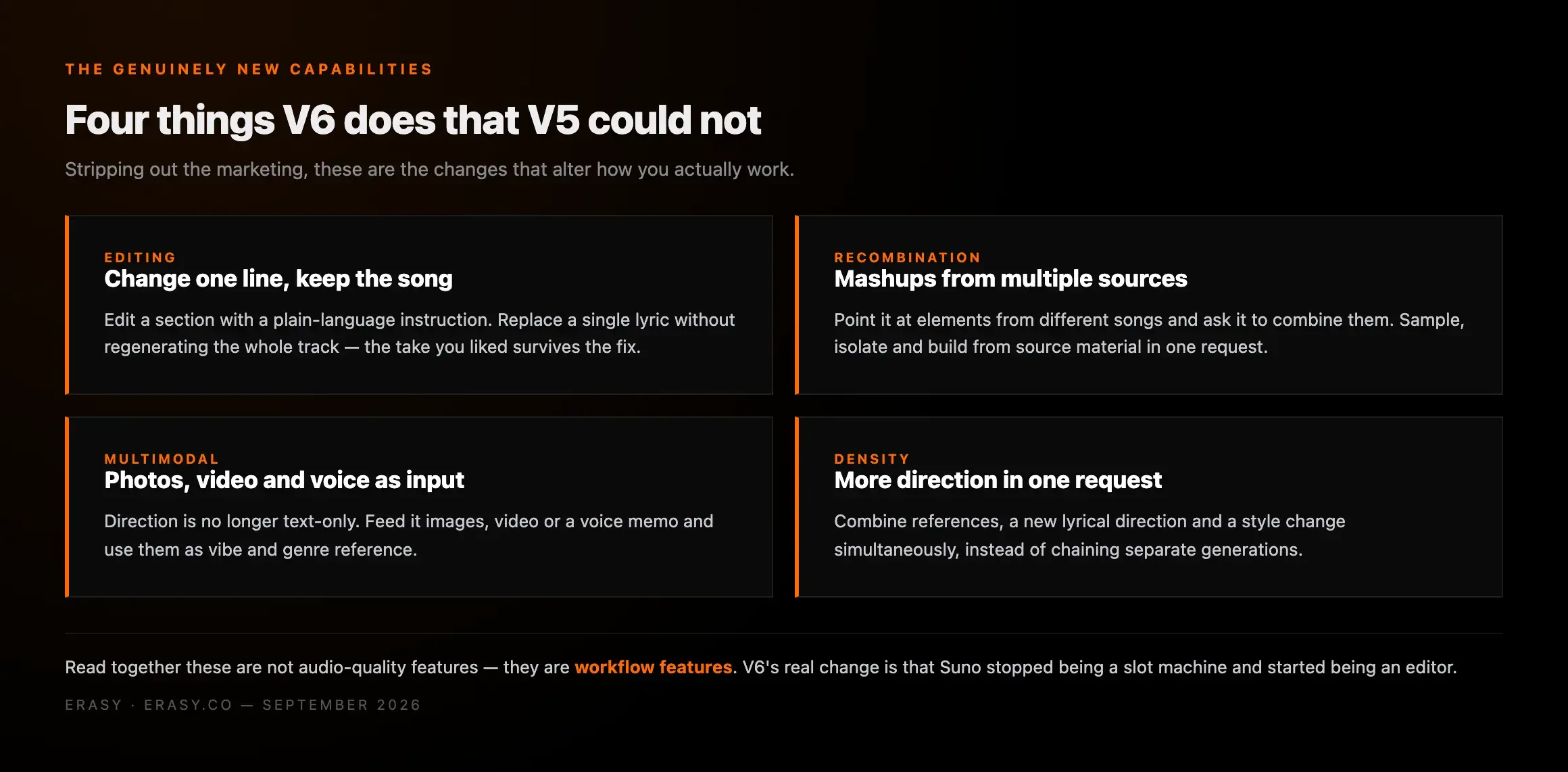
Editing without regenerating
You can edit a section using a plain-language instruction, and replace a single lyric without rebuilding the whole song. For anyone who has ever had a near-perfect take with one wrong word in the second verse and had to roll the dice again, this is the headline feature of the release. The take survives the fix.
Mashups and recombination
You can point v6 at elements from multiple songs and ask it to combine them. Suno's walkthrough describes doing this while simultaneously giving a new lyrical direction and changing the overall style — one request instead of a chain of generations.
Multimodal direction
Photos, video and voice memos can now serve as input. Direction is no longer text-only, which matters most for people who know the feeling they want and have never been able to describe it in a prompt.
Read together, these are not audio features. They are workflow features, and they represent a change in what Suno is: less a slot machine you pull until something good falls out, more an editor you can actually direct. That is the genuinely interesting thing about this release and it is getting maybe a fifth of the attention the label story is getting.
The community split, with the actual numbers
Most coverage has picked a side. The evidence does not support either one cleanly.
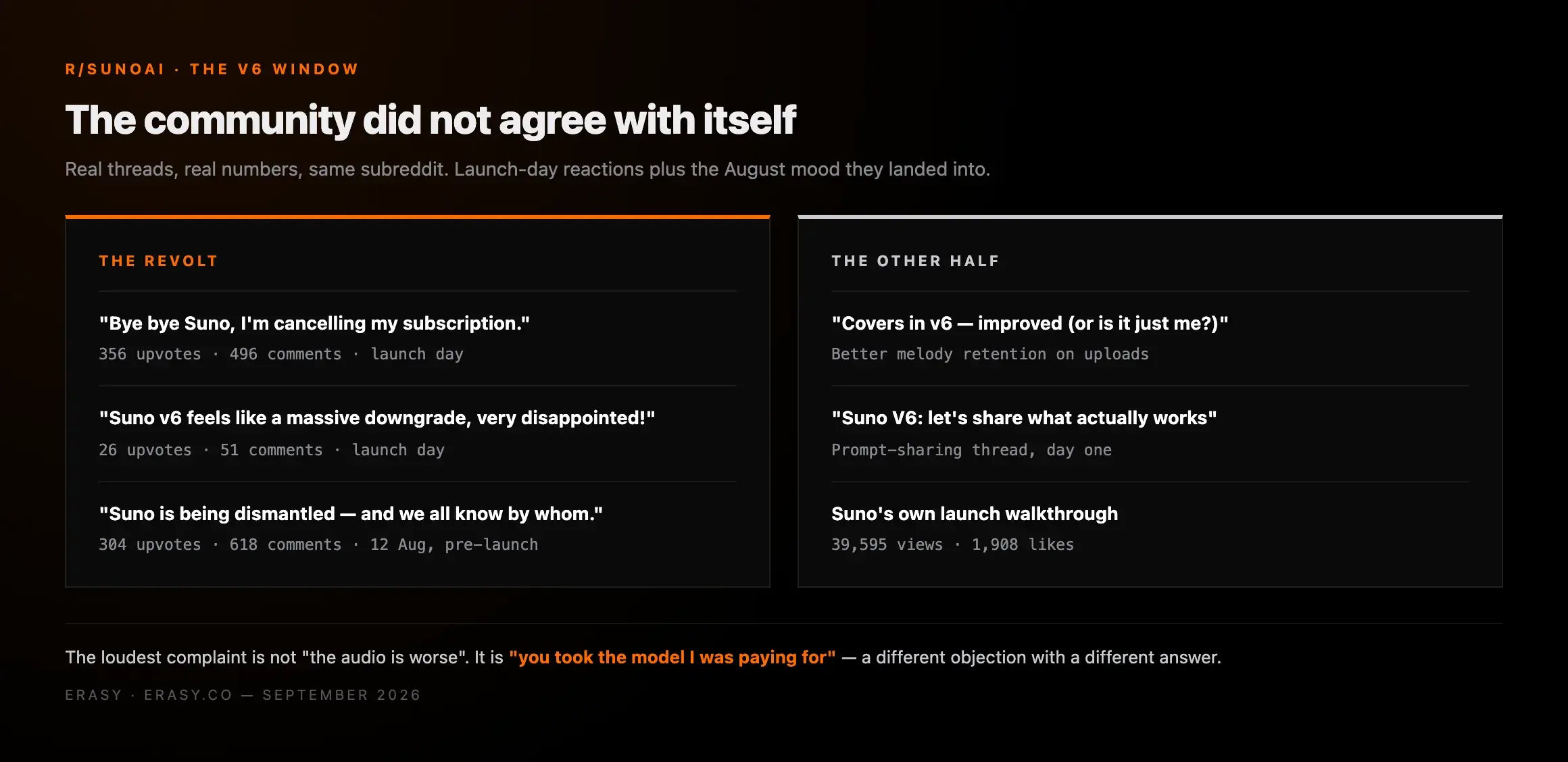
On the negative side: "Bye bye Suno, I'm cancelling my subscription" is the highest-engagement launch-day thread at 356 upvotes and 496 comments. "Suno v6 feels like a massive downgrade, very disappointed!" ran alongside it. And v6 landed into a subreddit that was already angry — the 12 August thread "Suno is being dismantled, and we all know by whom" drew 304 upvotes and 618 comments a month before v6 existed.
That August thread is worth reading for the mood rather than the model, because it explains why a technically strong release landed badly. u/bananasareforfun put the industry-capture argument at 117 upvotes: "The reality is that Chinese models will inevitably be released and open sourced and there is nothing these major labels can do about it - and this terrifies them. they are just prolonging the inevitab[le]." u/PissdCentrist got 50 upvotes for a single line of institutional memory: "anyone remember MP3.com and when it got bought but UMG?"
On the positive side, and much quieter: a producer thread titled "Covers in v6 - Improved (or is it just me?)" reports materially better melody retention when covering clean instrumental uploads. "Suno V6: Let's Share What Actually Works" appeared on day one and filled up. Suno's own walkthrough took 39,595 views and 1,908 likes against 901 comments. There is also a strand of pre-launch scepticism that aged badly — a 3 September thread argued "There's no V6. The Pro models are the same ones as before", six days before there was.
The case for V6
What we liked
- ✓Section editing with plain-language instructions — the most requested capability Suno has ever shipped
- ✓Mashups and multi-source recombination in a single request rather than a chain of generations
- ✓Multimodal direction from photos, video and voice memos, not just text prompts
- ✓v6-wild exists specifically to preserve the looser character of the old models
- ✓Better melody retention on covers of clean instrumental uploads, per launch-day producer reports
- ✓Licensed training with named partners is a genuine reduction in the platform's legal risk, which is your risk too
Where it stops
- —The previous generation was replaced, not kept alongside — version-specific workflows broke with no migration path
- —Prompt libraries and personas tuned to older models need re-testing from scratch
- —Second abrupt change in five weeks, after the 3 September download cap
- —A section of the user base reads label involvement as industry capture and will not be argued out of it
- —Free tier gets v6-mini only, so the free experience is a different model from the one being reviewed
- —Nothing about distributor screening got easier
The case against, taken seriously
It would be easy to write the cancellation threads off as noise. We think two of the objections are correct and one is not.
Correct: replacing rather than retaining is a real cost borne by the most invested users. Someone with a year of prompt engineering against a specific model version lost something with commercial value, and "try v6-wild" is a mitigation, not a restoration.
Also correct: the cadence is the problem. A download cap on 3 September and a model replacement on 9 September is two structural changes in five weeks, both landed without much runway. Trust is a function of predictability and Suno is currently spending it.
Not correct: the claim that licensed training necessarily means a worse or more restricted model. That is an assumption doing a lot of work. The capability list went up, not down, and nobody posting it has produced a licence change to point at. Being angry about how this landed is reasonable. Inferring a rights grab from a training-data change is not, and we would rather say so than farm the outrage.
So who is right
Both, about different things — which is why the argument is not resolving.
The people saying v6 is a major step forward are right about the product. Section editing, mashups and multimodal input are the biggest functional jump Suno has shipped, and in six months the workflow change will be the thing everyone remembers about this release.
The people cancelling are right about the relationship. They are not really reviewing the model. They are responding to a platform that has now twice changed the terms of something they had built on, with days of notice, while getting steadily closer to the industry those users thought they were routing around. That is a coherent position and "but the audio is better" does not answer it.
Seven out of ten. Strong release, second bad landing in five weeks.
What V6 changes downstream — and what it does not
This is the part almost nobody is covering, and it is the part that decides whether your tracks earn anything.
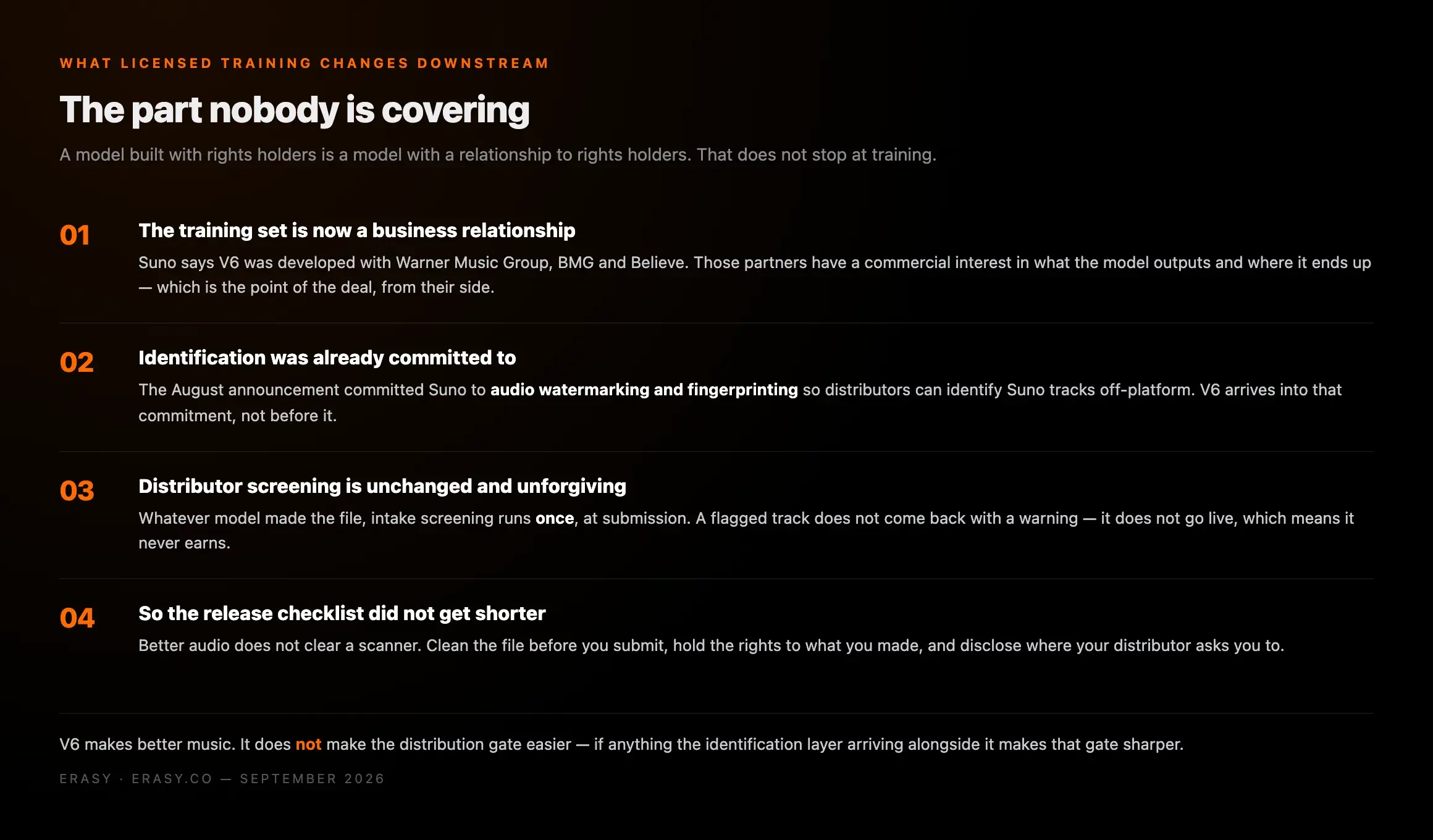
- ✕Distributor AI screening still runs once, at submission, with no warning and no second look
- ✕The 3 September download caps are still in force — 7 lifetime free, 20/month Pro, 60/month Premier
- ✕Your commercial licence on a paid plan works exactly as it did
- ✕Files you already downloaded remain yours
- ✓The model now has a commercial relationship with three named rights holders
- ✓It arrives into Suno's August commitment to audio watermarking and fingerprinting
- ✓Better fidelity means fewer audible tells — and screening was never listening for those anyway
- ✓Workflow moves from generate-and-hope to direct-and-edit
The trap here is assuming better audio means easier distribution. It does not, because distributor screening does not evaluate quality — it looks for signal-level markers, and a higher-fidelity file carries those just as well as a rough one. We set out what those systems actually detect in our piece on what AI music detectors really see, and what Suno committed to on identification in the watermark explainer.
Does V6 output work with Undetectr?
The short answer is that Undetectr states on its homepage that it is tested with Suno V6, as of this article's publication two days after launch. We are flagging that as the vendor's own claim rather than our independent measurement, because that is what it is, and a day-two claim about a day-one model deserves that label.
What is straightforwardly true is the mechanical part. Undetectr operates on the exported audio file rather than on anything Suno-specific: it targets vocoder spectral peaks, phase-entropy anomalies, embedded watermark signals, C2PA provenance metadata and noise-floor signatures. A v6 export is an audio file with those same classes of artifact in it, so the processing path is unchanged by the model version. Output comes back as MP3, WAV or FLAC, processing takes roughly ninety seconds a track, and it is a €39 one-time Lifetime plan rather than a subscription.
The honest caveat, same as the one we gave about the watermark: a higher-fidelity model can shift where the artifacts sit, and no independent bench test of v6 output exists two days after launch — anywhere, by anyone. If you are releasing v6 tracks commercially this week, process them and check the result rather than assuming it. That is good practice regardless of model version.
V6 changed the model, not the gate
Better audio does not clear a distributor's scanner.
Undetectr removes generation artifacts, embedded watermarks, C2PA metadata and noise-floor patterns before a distributor sees the file — and its bulk Suno playlist import gets your back catalogue onto your own drive while you are at it. €39 one-time.
What to do this week
Four things, in order, whether you are delighted or furious.
| Priority | Action | Why |
|---|---|---|
| 01 | Test v6-wild before you judge v6 | Most launch-day disappointment is people comparing the flagship to a model they preferred stylistically. Wild is the one built for you. |
| 02 | Re-test your prompt library, do not rebuild it | Version-specific prompts degrade rather than break. Find which ones still land before you throw the file away. |
| 03 | Export your back catalogue if you have not | The cap has been live since 3 September. A platform that replaces models twice in five weeks is one to keep a local copy against. |
| 04 | Clean anything headed to a distributor | Screening runs once, at intake, and a flag is silent. Model version does not enter into it. |
And one thing not to do: cancelling in week one is the most expensive way to register a complaint, because you lose access while the thing you are angry about carries on. Test wild, keep a local copy of your catalogue, and decide in a fortnight with actual data.
Keep reading
- Suno's new watermark: what lands, when, and what to do first
- Suno download limits review: what changed on 3 September 2026
- Suno downloader: how to bulk export your entire library
- Suno vs Udio 2026: which should you actually use?
- How to distribute AI music without getting flagged
- How to sell Suno music: generation to sold in ~15 minutes
Frequently asked questions

Cara Whelan — Policy Editor, Erasy
Cara covers platform policy for Erasy — pricing changes, terms updates and the rules that decide what you can actually do with the music you generate. They work from primary announcements and FAQs rather than the coverage of them, and date every figure so you know when it was last checked.
What is the newest version of Suno?+
What is the difference between v6, v6-wild and v6-mini?+
Is Suno v6 better than v5?+
What is the new Suno model trained on?+
Why are Suno users angry about v6?+
Can Suno AI be used commercially?+
Does Suno v6 output still get flagged by distributors?+
Should I cancel my Suno subscription over v6?+
Disclosure: Erasy is an independent guide to AI music cleanup, and Undetectr is the tool we recommend and link to. We have labelled the V6-compatibility statement as Undetectr's own claim rather than our measurement, because no independent bench test of v6 output exists two days after launch. Model details and capabilities verified against Suno's 9 September 2026 announcement and its own launch walkthrough; community reaction figures are live thread counts from r/SunoAI captured on 10 September 2026 and will have moved since. Figures current as of 10 September 2026.