AI Music
LUFS for Spotify and Every Streaming Platform (2026 Targets)
Master your track at -6 LUFS and Spotify will turn it down by eight decibels before anyone hears it. You will have crushed your dynamics to win a competition that stopped existing years ago.
Here are the actual numbers for every major platform, what normalisation does to a master that ignores them, and why this matters more than usual when the track was AI-assisted.
Key takeaways
Spotify targets roughly -14 LUFS integrated. Apple Music sits around -16. Keep true peak at or below -1 dBTP.
Louder no longer wins. Normalisation turns loud masters down, so over-limiting costs you dynamics and buys nothing.
One master is usually enough. Roughly -14 LUFS with -1 dBTP normalises acceptably everywhere.
Off-spec loudness reads as low effort — a signal worth avoiding on an AI-assisted release that is already getting a closer look.
What LUFS actually measures
LUFS means Loudness Units relative to Full Scale. It measures how loud something sounds to a human over time, rather than how tall the signal gets at any instant.
That distinction is the whole reason the standard exists. A peak meter tells you your loudest sample. It cannot tell you that a dense, limited mix at the same peak level sounds dramatically louder than a sparse, dynamic one. Streaming platforms need to compare tracks the way ears do, so they normalise on perceived loudness.
The number you care about is integrated LUFS — the average across the whole track. Short-term and momentary readings are useful while you work, but integrated is what the platform reads and what decides how much it moves your file.
The target for every platform
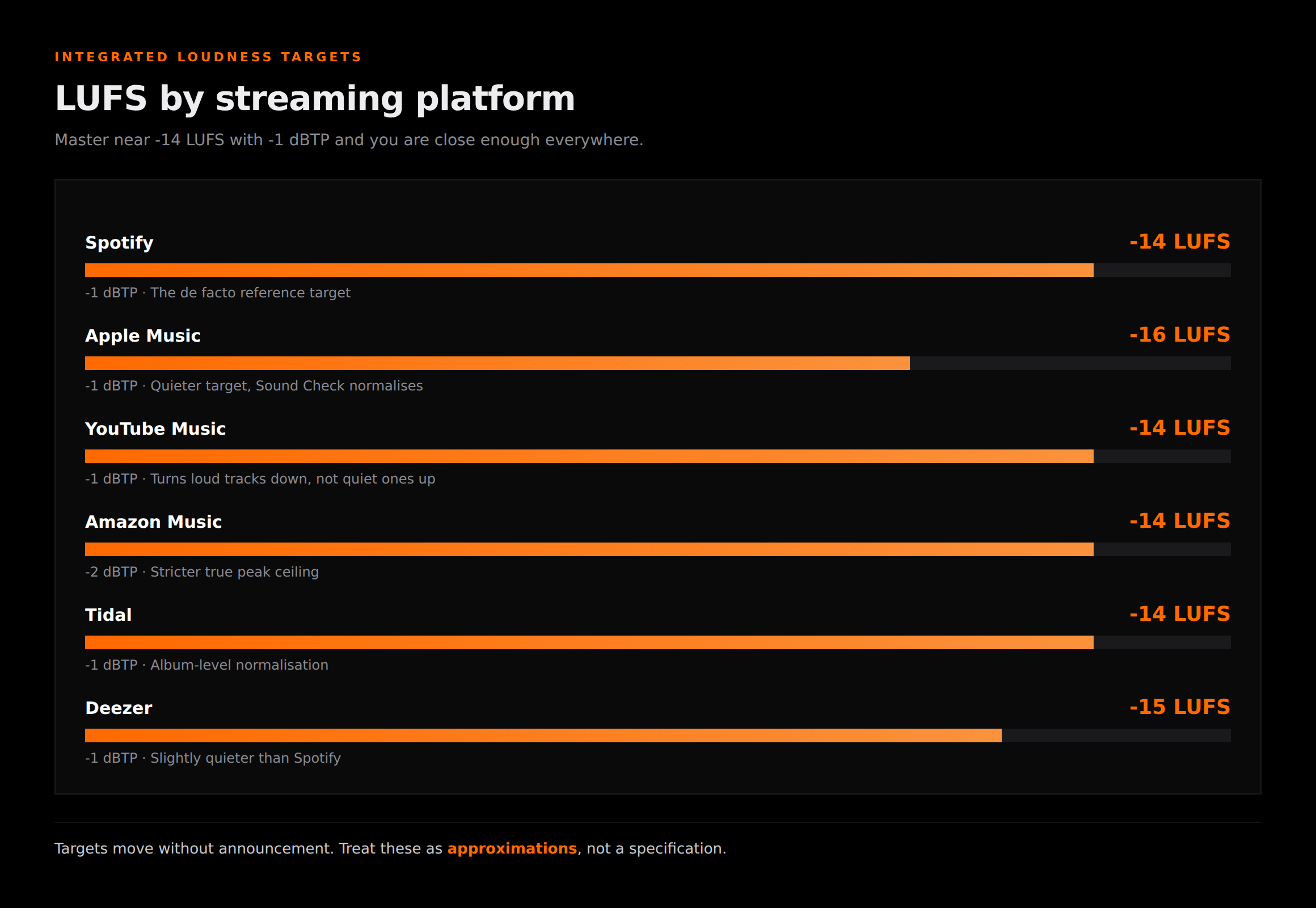
| Platform | Integrated LUFS | True peak | Note |
|---|---|---|---|
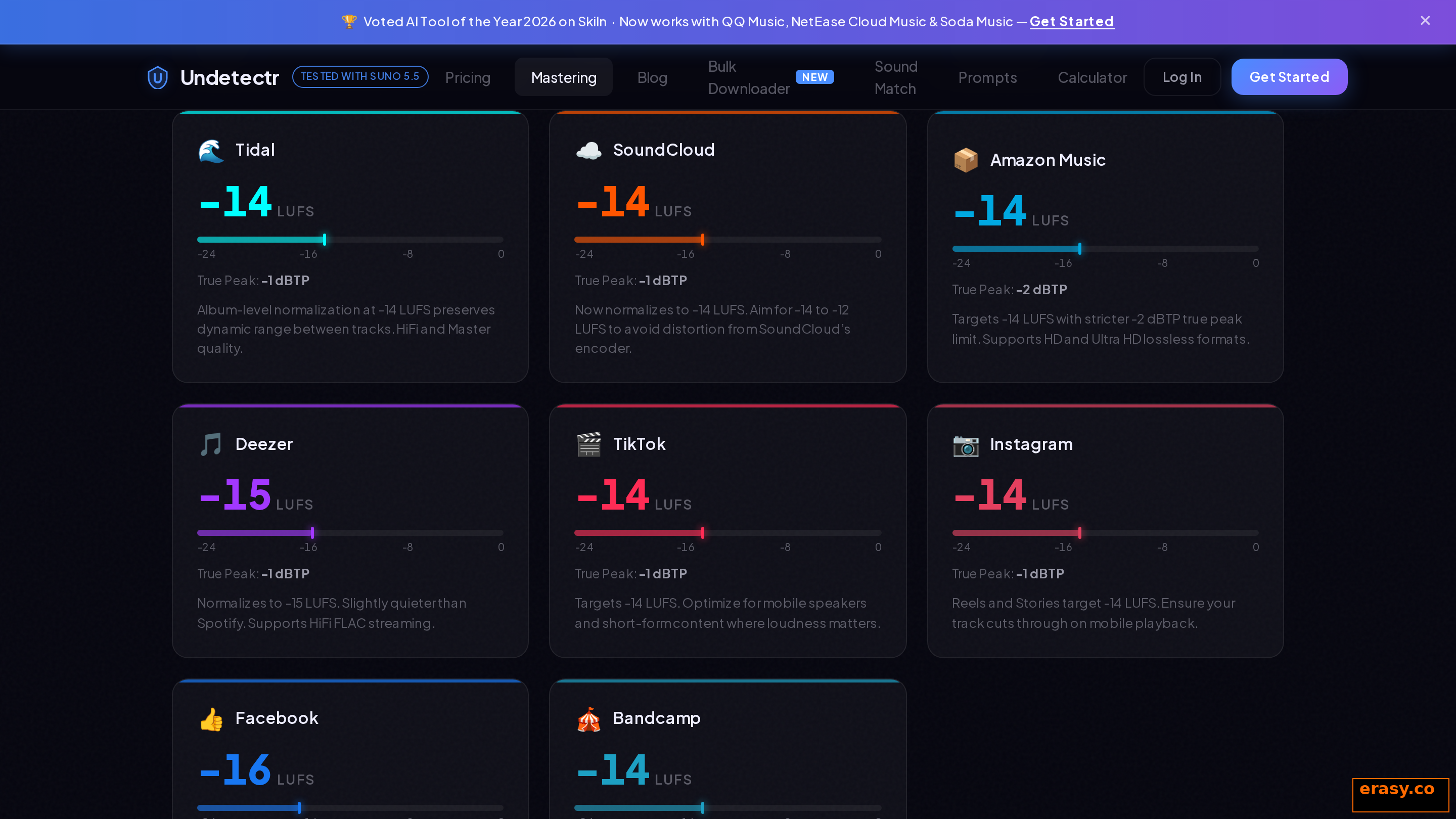
| Spotify | ≈ -14 | -1 dBTP | The de facto reference target |
| Apple Music | ≈ -16 | -1 dBTP | Quieter target, Sound Check normalises |
| YouTube / YouTube Music | ≈ -14 | -1 dBTP | Normalises down, does not turn quiet tracks up |
| Amazon Music | ≈ -14 | -2 dBTP | Stricter peak ceiling |
| Tidal | ≈ -14 | -1 dBTP | Album-level normalisation preserves dynamics |
| Deezer | ≈ -15 | -1 dBTP | Slightly quieter than Spotify |
| TikTok / Instagram | ≈ -14 | -1 dBTP | Mobile playback, loudness matters for cut-through |
Treat these as approximations that move. Platforms adjust their targets and rarely announce it loudly. The engineering conclusion does not move though: land near -14 integrated with -1 dBTP of headroom and you will be close enough everywhere that normalisation does nothing dramatic.
What normalisation does to a loud master
Here is the mechanism, because it is worth being precise. The platform measures your integrated loudness, compares it to its target, and applies a gain offset on playback.
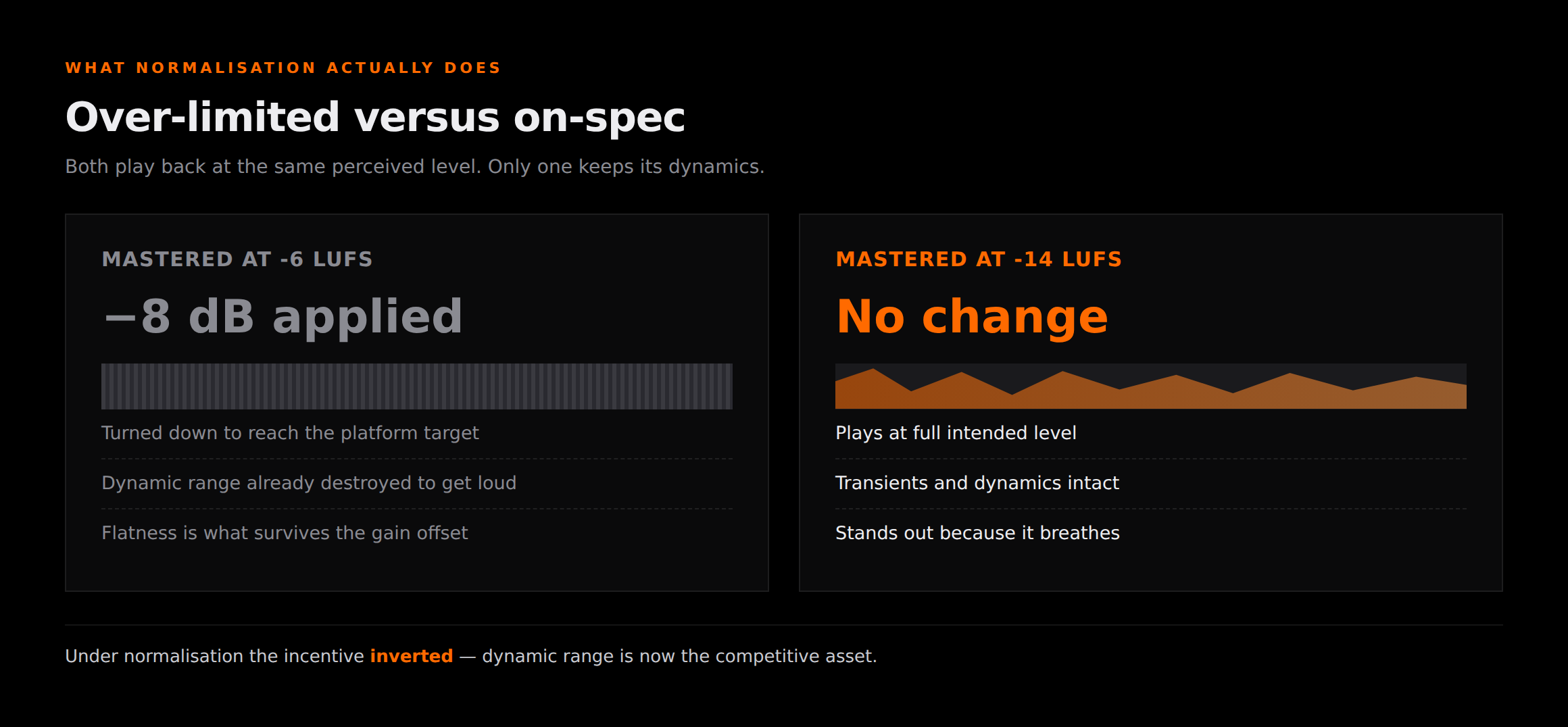
Deliver at -6 LUFS to a -14 target and roughly 8 dB of gain reduction is applied. Your track now plays at the same perceived level as everything else — but with whatever dynamic range you destroyed to reach -6 still destroyed. You paid the price and received nothing.
The reverse case is gentler. A track delivered at -20 LUFS gets turned up on most platforms, though YouTube historically only turns loud tracks down rather than raising quiet ones. Being too quiet is a smaller error than being too loud, because at least your dynamics survived.
True peak, and why -1 dBTP matters
True peak measures the real analogue waveform between digital samples, which can rise above the highest sample your meter displays. Lossy encoding makes this worse — converting to MP3 or AAC shifts the reconstructed waveform and can push inter-sample peaks higher still.
Leave a ceiling at -1 dBTP and the encoder has room to work. Master to 0 dBFS and the encoded file can clip on playback while your original looked immaculate in the DAW. Amazon asks for -2 dBTP, so if you want one master that satisfies everything, -2 is the conservative choice and -1 is the common one.
Why louder stopped winning
The loudness war made sense in a world of radio and CD changers, where a louder master genuinely jumped out against the track before it. Producers pushed limiters harder every year because the reward was real.
Normalisation ended that. Once every platform matches perceived loudness on playback, the only thing a hyper-limited master carries into the comparison is its own flatness. The incentive did not just weaken, it inverted — dynamic range is now the competitive asset, because it is the thing that survives the gain offset.
Why this matters more on an AI release
Raw generator output frequently lands well off spec. It is not mastered for anything in particular, and nothing in the generation process is aiming at a delivery target.
On a conventional release that is a minor quality issue. On an AI-assisted release it is worth more attention, because the upload is already getting a closer look and you do not want to hand anyone an additional reason to treat it as low-effort. Off-spec loudness is not a detection marker — it will not get you flagged as AI — but it is a carelessness signal, and those accumulate.
The two problems are genuinely separate and worth keeping separate in your head. Loudness is a quality question. The identifying material in the file is the detection question, and mastering does nothing whatsoever about it.
How to actually hit the target
Measure integrated, not momentary
Run a loudness meter across the whole track. Most DAWs include one now. A loud chorus reading -9 short-term tells you nothing about where the integrated value lands.
Get there with the mix, not the limiter
If you need heavy limiting to reach -14, the mix is fighting itself. Balance and arrangement do this job better than a limiter ever will, and the result survives normalisation intact.
Or let the mastering pass target it for you
Automated mastering that accepts a platform target removes the manual step. If you are already cleaning an AI track before release, Undetectr masters to the destination platform's specification during the same pass, which means the file that comes out is at delivery spec without a separate mastering job.
Check the encoded file, not just the master
Encode to AAC or MP3 and re-measure true peak. That is where inter-sample clipping shows up, and it is the version listeners actually receive.
Clean and mastered in one pass
Hit the platform spec without a separate mastering job
Undetectr removes the identifying marker layers and masters to each platform's LUFS target in the same browser pass. Works with Suno, Udio and ElevenLabs Music.
Verdict
Master to roughly -14 LUFS integrated with -1 dBTP of true peak headroom and you are correct nearly everywhere. Apple sits quieter at -16 and Amazon wants -2 dBTP, but a single sensible master survives all of it without audible damage.
The instinct worth unlearning is that louder competes. Under normalisation it does the opposite: it hands away the dynamic range that would have made your track stand out, in exchange for a gain offset the platform immediately reverses. And if the track is AI-assisted, remember that hitting the spec is a quality decision — the detection side is a completely different problem with a completely different fix.