AI Music
1,000 Streams vs One Sale: What AI Music Pays in 2026
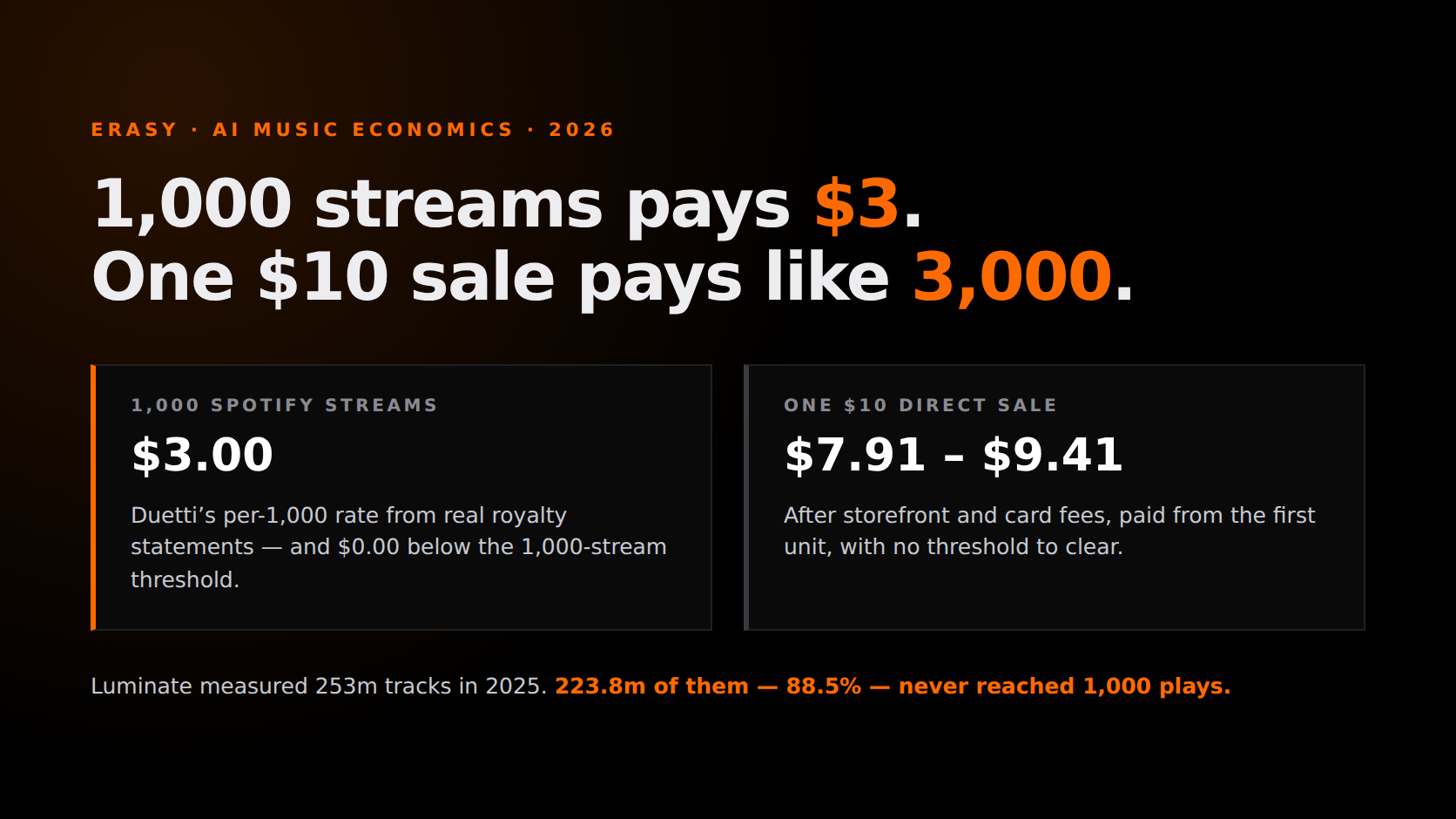
Every calculator on the internet will tell you what 1,000 streams pays, and every one of them stops at the easy half. Three to five dollars, they say, and leave you to assume the number scales. For an AI release it does not scale, because 1,000 is not a quantity in this business — it is a turnstile, and 88.5% of the tracks measured last year never got through it.
So here is the whole ledger for one track, both sides. What a thousand plays actually pay once you use royalty statements instead of a calculator; what Spotify does to a track that falls short; what the track cost you before it earned a cent; and what one direct sale nets after every fee, in streams, so the two numbers can sit in the same column. We checked the rates, the thresholds, the platform fees and the policies at source on 26 September 2026, and where a figure is our arithmetic rather than someone's published number, it says so.
The short version
- 1,000 streams paid $3.41 on average across platforms in the last study built on real statements (Duetti, 2024 data) — $3.00 of it on Spotify, $8.80 on Amazon Music.
- Under 1,000 streams a year, Spotify pays zero — not less. The threshold has been live since April 2024, with an undisclosed unique-listener minimum on top.
- 88.5% of tracks never clear it. Luminate measured 253 million tracks in 2025 and 223.8 million took 1,000 plays or fewer.
- AI is over half the supply and 1–3% of the demand. Deezer receives ~90,000 fully AI-generated tracks a day and says they account for 1–3% of streams.
- One $10 sale beats 2,600 plays — and Bandcamp, the storefront that advice usually points at, banned AI music outright on 13 January 2026.
What 1,000 streams actually pays
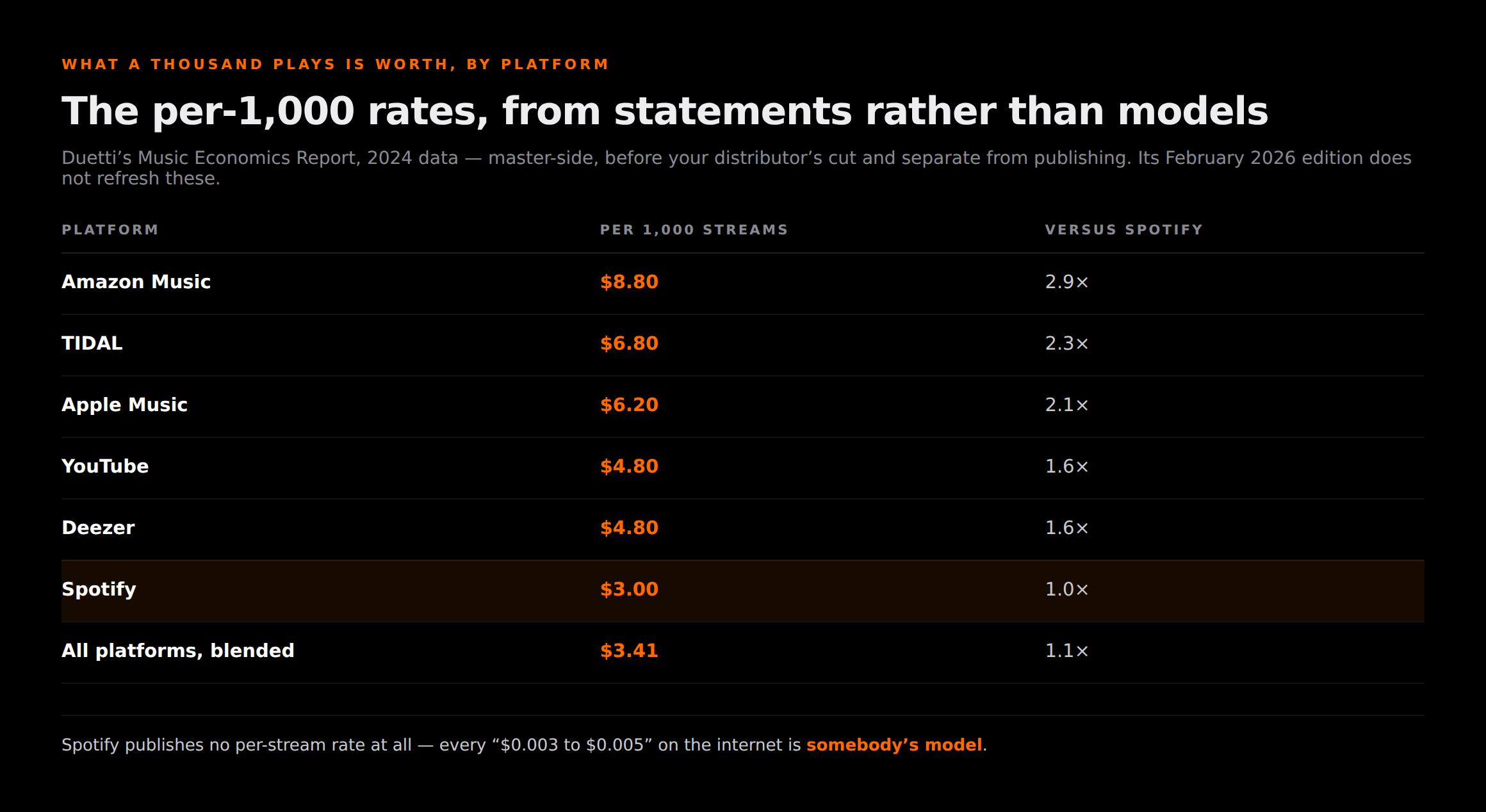
Spotify has never published a per-stream rate and says plainly that it does not pay one — royalties are a share of a pool, so the effective rate moves with the listener's country, their plan and the month. Which means every “$0.003 to $0.005” you have read is somebody's model. The exception is Duetti's Music Economics Report, which is built from the royalty statements of independent artists whose catalogues it buys, and which happens to report in the exact unit this article is about.
| Platform | Paid per 1,000 streams | Vs Spotify |
|---|---|---|
| Amazon Music | $8.80 | 2.9x |
| TIDAL | $6.80 | 2.3x |
| Apple Music | $6.20 | 2.1x |
| YouTube | $4.80 | 1.6x |
| Deezer | $4.80 | 1.6x |
| Spotify | $3.00 | 1.0x |
| All platforms, blended | $3.41 | 1.1x |
Two things about that table are worth more than the numbers in it. First, these are master-side figures: the recording half of the money, before your distributor takes anything and separate from the publishing royalty, which only reaches you if you have registered the composition. If you have not, read how MLC registration works for AI music before you write that money off.
Second, the data is from 2024, and that is not us being lazy. Duetti published its next report on 11 February 2026, across six million tracks, and it is about catalogue durability rather than payouts — the per-platform rate table did not come back. So the most recent real-statement figures available to anyone in September 2026 are the 2024 ones, and every 2026 page quoting a fresher-sounding rate is quoting a model. Treat $3 per 1,000 Spotify streams as the working number and anything above it as upside.
Why 1,000 is a gate, not a round number
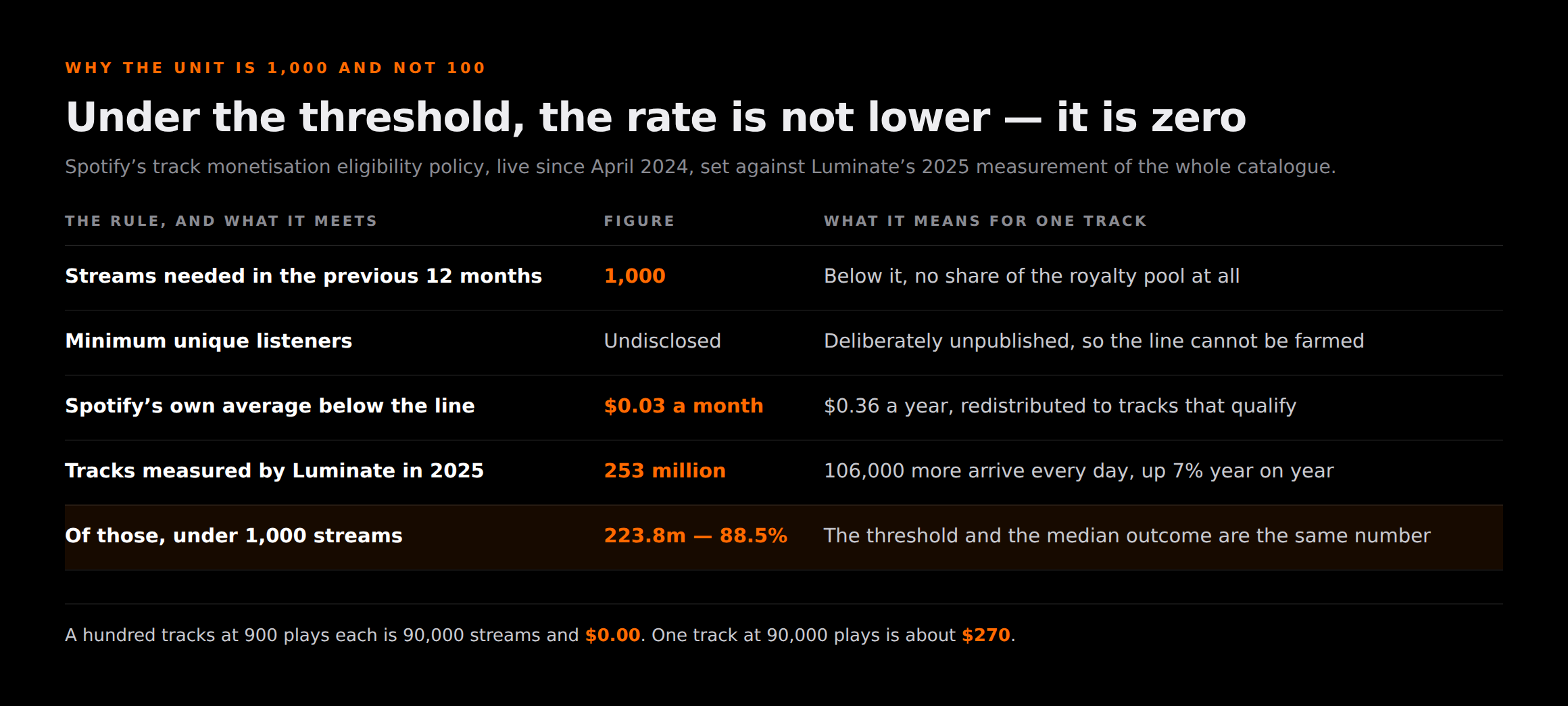
The reason this article is denominated in a thousand plays rather than a hundred or a million is that Spotify chose the number first. Its track monetisation policy reads: “Starting in April 2024, tracks must have reached a threshold of at least 1,000 streams in the previous 12 months to be included in the recorded music royalty pool calculation.” There is a second condition underneath it — “a minimum number of unique listeners” that Spotify deliberately does not publish, so that nobody can farm their way over the line.
Below that line the rate is not reduced. It is nothing, including on the streams the track did earn. Spotify's own justification is that tracks between 1 and 1,000 annual streams “generate $0.03 per month on average” and represent 0.5% of its total streams and royalties, and that redirecting those fractions adds about $1 billion to everyone else over five years. Both halves of that are true at once: the sums involved per track are trivial, and a rule that turns $0.36 a year into $0.00 is still the difference between a royalty line and a blank.
The practical consequence for anyone releasing at volume: a hundred tracks at 900 plays each is 90,000 streams and $0.00. One track at 90,000 plays is about $270. Same audience, same year, and the only variable is how concentrated the listening was — which is the opposite of the spray-and-pray strategy an unlimited generator invites.
Most tracks never get there — AI tracks least of all
Luminate measured 253 million tracks by ISRC in 2025. 223.8 million of them — 88.5% — took fewer than 1,000 streams, and 120.5 million managed ten or fewer. Meanwhile 106,000 new tracks arrive at the streaming services every day, up 7% on the 2024 average. The threshold and the median outcome are the same number, which is why “what does 1,000 streams pay” is the only stream-count question worth doing arithmetic on.
| What the supply looks like | Figure | Source |
|---|---|---|
| Tracks measured in 2025 | 253 million ISRCs | Luminate, 2025 year-end |
| Tracks under 1,000 streams | 223.8m (88.5%) | Luminate, via MBW |
| Tracks with 10 streams or fewer | 120.5 million | Luminate, via Music Ally |
| New tracks delivered per day | 106,000 (+7% YoY) | Luminate, 2025 year-end |
| Fully AI tracks reaching Deezer per day | ~90,000 | Deezer, 21 July 2026 |
| AI share of Deezer daily uploads | Over 50% at June 2026 peak | Deezer, 21 July 2026 |
| AI share of Deezer streams | 1–3% of total | Deezer, 21 July 2026 |
Those last three rows are the part that is specific to this catalogue, and they are Deezer's own published figures rather than an estimate. Fully AI-generated music passed half of everything delivered to Deezer in June 2026 while accounting for between 1% and 3% of what anyone played. Put the two shares side by side and the average AI upload is competing for something in the order of one-fiftieth of the plays the average non-AI upload gets — our arithmetic on Deezer's two published percentages, not a measured per-track figure, and it flatters nobody.
Deezer adds a third number that gets quoted less and matters more: up to 85% of streams on fully AI-generated tracks in 2025 were identified as fraudulent and demonetised. If you are buying plays to reach the threshold, that is the wall you hit — and on Spotify the unique-listener condition exists for exactly this reason.
The costs on the other side of the ledger
Nobody who publishes a streams-to-dollars calculator ever puts anything in the cost column, which is how “$3 per 1,000” gets mistaken for profit. An AI release has a real unit cost, and since 3 September 2026 it has a new one: Suno meters downloads, and commercial rights attach to the download rather than the song, so every track you can legally release has consumed a slice of your subscription.
Suno's pricing page displays $8 and $24 with the annual toggle selected; its own savings lines (“Saves $24 by billing yearly”, “Saves $72”) only reconcile against $120 versus $96 and $360 versus $288, so the monthly rates are $10 and $30. Pro allows 20 downloads a month, Premier 60 — which makes the cost per releasable track identical on both plans.
| Cost line | Billed monthly | Billed yearly |
|---|---|---|
| Suno Pro, per downloadable track ($10 or $8 ÷ 20) | $0.50 | $0.40 |
| Suno Premier, per downloadable track ($30 or $24 ÷ 60) | $0.50 | $0.40 |
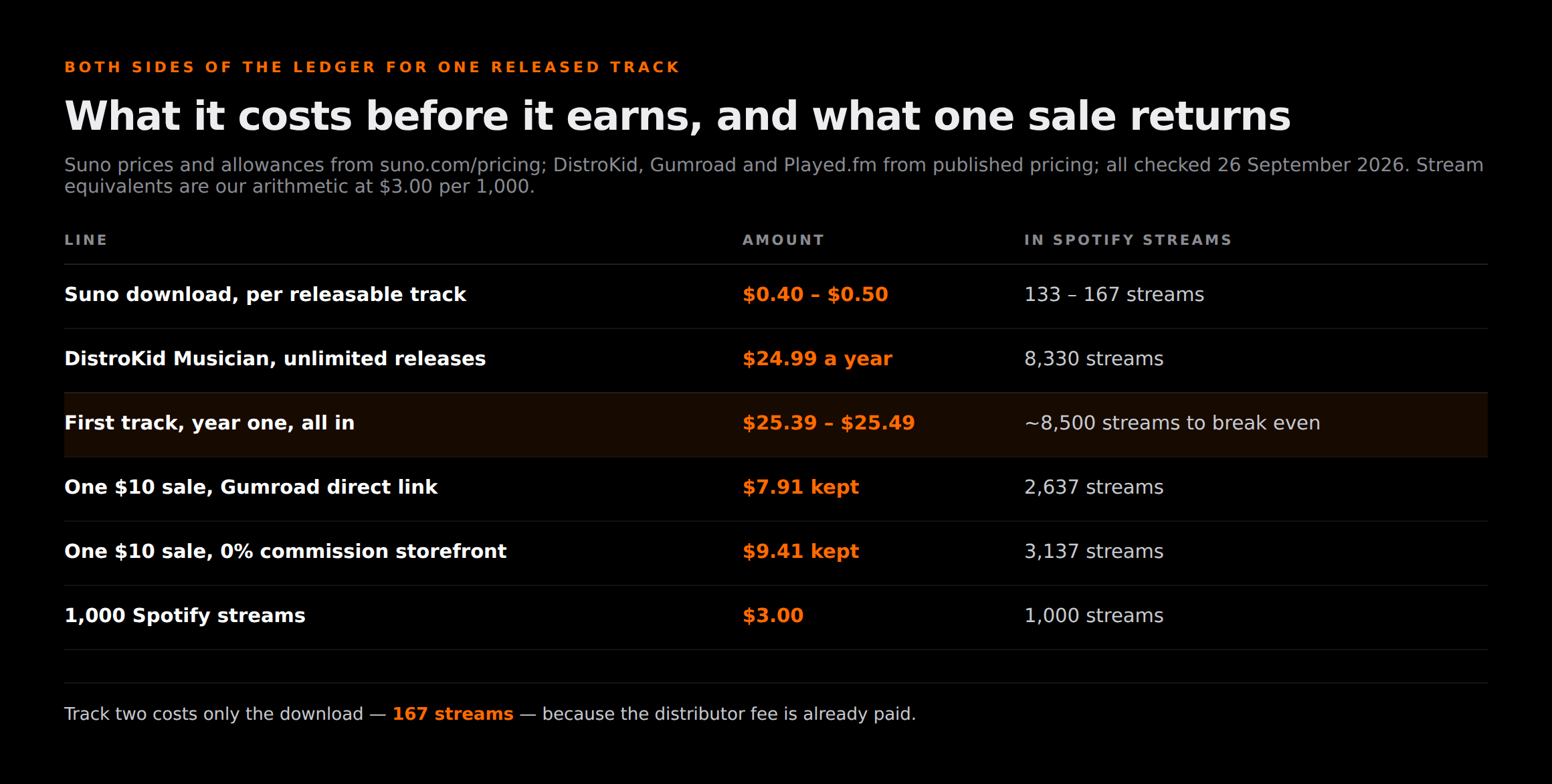
| DistroKid Musician, unlimited releases | $24.99 / year | $24.99 / year |
| First track, year one, all in | $25.49 | $25.39 |
| Every track after that | $0.50 | $0.40 |
| Spotify streams to break even on track one | ~8,497 | ~8,463 |
| Spotify streams to break even on track two | ~167 | ~133 |
The break-even rows are ours, at Duetti's $3.00 per 1,000 Spotify streams, and they carry the sting of this whole piece: track one needs roughly 8,500 plays to get your money back, and it earns nothing at all until it has 1,000. Track two needs 167, because the distributor fee is already paid — which is a genuine argument for releasing more, and not at all the same as the argument for generating more. What the download caps changed is worth reading if your plan predates them.
There is one more cost that only shows up when it bites. Distributors screen uploads automatically, and a track that is rejected or quietly pulled has spent a download and a slot for nothing. That failure used to be free. It is now metered, which makes checking a file before you submit it the cheapest line on the whole ledger.
The screening step, before you spend the download
A rejected upload costs you the download, the release slot and the run at 1,000 plays.
Undetectr targets the watermark signals and generation artifacts distributors screen for at intake. It does not change how a platform labels or credits your release, and no tool can. €19 for 10 tracks, or €39 one-time for unlimited.
One sale versus a thousand plays
Now the other side. A direct sale pays from the first unit, has no threshold, and is not a share of a pool — but it is not 100% of the sticker price either, because someone always processes the card. Here is what a single $10 digital sale actually nets on the three routes open to an AI release, and the same figure expressed in Spotify streams at $3.00 per 1,000.
| Route | Fees on a $10 sale | You keep | Equivalent Spotify streams |
|---|---|---|---|
| Gumroad (direct link) | 10% + $0.50, plus ~2.9% + $0.30 card | $7.91 | ~2,637 |
| Played.fm (0% commission) | Payment provider only, ~2.9% + $0.30 | $9.41 | ~3,137 |
| Bandcamp (for reference — AI not permitted) | 15% share, plus 4–6% processing | ~$8.00 | ~2,667 |
| 1,000 Spotify streams | Pool share, no fee to you | $3.00 | 1,000 |
One sale of one track to one person who chose it is worth two and a half to three thousand plays. That is the number to keep, and it reframes what a small audience is worth: forty people buying a $10 release once a year is roughly 100,000 Spotify streams' worth of income, and 100,000 streams is a figure almost nobody in this catalogue sees.
The honest asterisks. Played.fm charges 0% commission but sells you a plan — $12.99 a month for the artist tier, up to $29.99 for a label — so it is a fixed cost against a per-unit saving: at $9.41 net a sale, the artist plan pays for itself at about 1.4 sales a month, against the 4,330 Spotify streams a month you would need to cover the same $12.99. Gumroad has no plan fee but charges a flat 30% on sales that come through its own Discover marketplace rather than your link. And Bandcamp's 15% drops to 10% once you have passed $5,000 in sales, which is academic here for the reason in the next section.
The default “just sell direct” route is closed
Almost every article that reaches the conclusion “sell direct instead” points at Bandcamp, and for AI music that advice expired on 13 January 2026. Bandcamp's generative-AI policy, “Keeping Bandcamp Human”, does not permit music generated wholly or in substantial part by AI, bans using AI to impersonate other artists, and reserves the right to remove music on suspicion. There is no classifier at upload — enforcement is human and reactive, usually triggered by reports or by bulk uploading — but a policy you are relying on not to be enforced is not a business model. Our sister site has the full reading of what the ban covers.
This is also why the streaming side of the comparison is not a like-for-like fight. Six distributors take AI releases with a plain yes or a declaration step, three now apply a licensing test to the model rather than the track, and Bandcamp — a storefront, not a distributor — is a flat no. The question is never “is AI music allowed” in general; it is which specific door you are standing at. Our route-by-route breakdown goes through them.
Selling direct does not fix the actual problem
Here is the part the per-unit arithmetic cannot rescue. A storefront does not hand you listeners. A $10 sale is worth 3,000 plays and it is also harder to get, because it needs somebody who already knows your name. The loudest, most repeated complaint in the AI-music communities is not that distribution is blocked — it is that distribution is solved and nobody is listening. Artifactr has the numbers behind that, and they are worse than the vibe.
What is specific to 2026 is that the machinery that used to deliver strangers is being switched off for this catalogue at both ends. Deezer excludes tracks it detects as AI from algorithmic recommendations and editorial playlists. Spotify's AI Persona badge, announced on 11 August 2026 and rolling out from mid-September, keeps badged profiles out of editorial and algorithmic recommendations by default. Read that one precisely: it labels an AI-generated artist identity, not the use of AI tools in production, and the two get conflated constantly — our Spotify policy page separates them. But the net effect on the arithmetic above is the same: the surface that used to carry a track from 200 plays to 1,000 is the surface being withdrawn.
Which is the argument for the routes that pay per use
If recommendation is not going to deliver the thousandth play, the money has to come from somewhere that does not depend on it. That is why paid sync placements in TV, film, games and ads keep coming up in this niche: a placement is one buyer making one decision, it pays once and properly, and no algorithm votes on it. Selling direct to the people who already follow you is the same shape of transaction at a smaller size. Neither is a growth strategy. Both are ways of being paid by an audience you have, rather than waiting for one you have not.
The order that makes the maths close
Put the two columns together and the sequence falls out of them. It is not the sequence an unlimited generator suggests.
| Step | Why it comes here | What it is worth |
|---|---|---|
| 1. Fewer, better tracks | Concentration beats volume under a per-track threshold | 90,000 plays on one track pays ~$270; spread over 100 tracks it pays $0 |
| 2. Clear screening before you spend the download | A rejected upload costs a metered download and the release slot | Protects $0.40–$0.50 per track and the run at 1,000 plays |
| 3. One distributor, unlimited releases | The annual fee is fixed, so it amortises across everything you ship | $24.99/year, then $0.40 a track |
| 4. A storefront for the audience you already have | Pays from unit one, no threshold, no recommendation dependency | One $10 sale ≈ 2,600–3,100 Spotify streams |
| 5. Pitch sync | One buyer, one decision, priced per use rather than per play | A single placement outpays most catalogues' streaming year |
| 6. Treat streaming as the shop window | Cheap to be there, honest to expect nothing under 1,000 plays | $3.00 per 1,000, once you are over the line |
None of that is a promise that the arithmetic closes. For most releases it will not, and the reported cases where it does are built on play counts in the millions — we took one $15,000 month apart and it needed nine million plays. What the ledger does do is tell you which lever is worth pulling. The per-stream rate is not a lever: it is set by a pool you do not control, and it has been drifting down for years. The number of plays a single track concentrates, the cost you spend to get a track releasable, and whether anyone can buy directly from you — those are all yours.
Keep reading
- AI music earnings 2026: inside a reported $15,000 month
- Can you sell AI-generated music? Where, and what it pays
- Spotify AI music policy 2026: what is allowed and what is not
- MLC royalties for AI music: how to register in 2026
- Suno refund 2026: can they cap downloads you already paid for?
- Cleaning AI-generated music for release: the checklist
Frequently asked questions

Eddie Mathews — Editor, Erasy
Eddie runs the numbers on AI music release economics and checks every rate against a published statement rather than a calculator. Where a figure is arithmetic rather than a source's own, he says so in the line.
How much does 1,000 streams pay in 2026?+
Why did my track earn nothing on Spotify?+
How many streams equal one $10 sale?+
Can I sell AI music on Bandcamp?+
Does an AI track earn less per stream than a human one?+
How much does it cost to release one AI track?+
Is streaming worth it at all for an AI release?+
Disclosure: Erasy is an independent guide to AI music cleanup, and Undetectr is the tool we recommend and link to. Figures were checked at source on 26 September 2026: per-1,000-stream rates from Duetti's Music Economics Report (2024 data, restated by Duetti versus its 2023 report; the February 2026 edition does not refresh them); the monetisation threshold, unique-listener condition and $0.03 monthly average from Spotify's track monetisation eligibility page and its royalty-system announcement; track counts from Luminate's 2025 year-end report as reported by Music Business Worldwide and Music Ally; upload, stream-share and fraud figures from Deezer's newsroom of 21 July 2026; the AI Persona badge from Spotify's newsroom of 11 August 2026; Bandcamp's policy and fee schedule from its own help centre; Suno's prices and download allowances from suno.com/pricing, where the monthly-versus-annual split is derived from the page's own stated savings; DistroKid, Gumroad and Played.fm fees from their published pricing. Break-even figures, streams-equivalent figures and the upload-to-stream ratio are our arithmetic on those published numbers and are labelled as such in the text. Per-stream payouts vary by country, plan and month, and nothing here is financial advice.