AI Music
Spotify AI Music Policy 2026: What's Allowed, What Isn't
Every few weeks someone tells us Spotify has banned AI music, and every time it is wrong — the Spotify AI music policy has never prohibited AI-assisted tracks, and Spotify says outright that it does not down-rank them for being declared. What changed in 2026 is quieter and costs more: a new AI Persona badge, deploying from mid-September 2026, pulls tagged profiles out of editorial and algorithmic recommendations by default. That is not a ban. For an independent release it is worse than one, and we have read every primary announcement behind it rather than the coverage of them.
This is the whole policy in one place: the four things Spotify actually enforces, which of them apply to a track and which to an artist identity, what the September badge does to your reach, and the six-step pass we run before submitting an AI-assisted release. Every figure is dated to the announcement that published it.
Key takeaways
AI music is allowed. Spotify's own wording: the policy is not about "punishing artists who use AI responsibly", and "all music is treated equally, regardless of the tools used to make it".
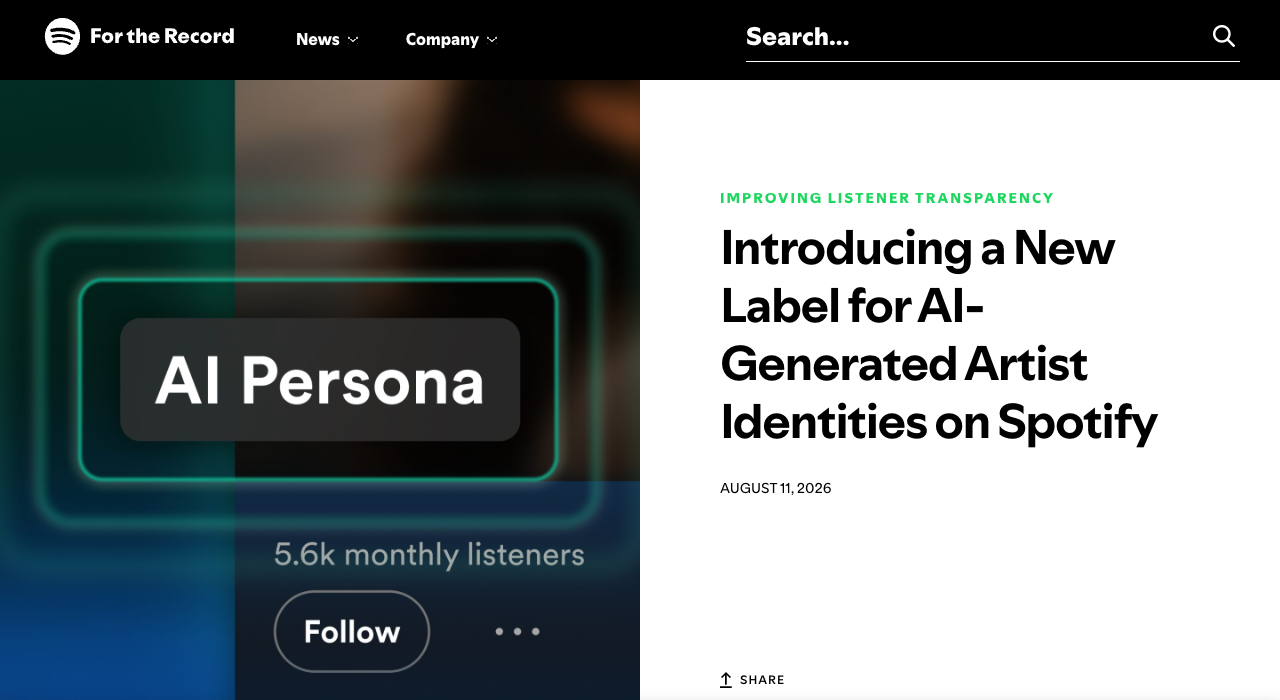
The AI Persona badge lands mid-September 2026. Announced 11 August 2026. It marks an artist identity, not a track, and shows on the profile, in search and on track rows.
The badge costs you discovery, not revenue. Spotify will not include AI Personas in editorial or algorithmic recommendations by default — only listeners who follow you still get served.
Enforcement targets behaviour, not generation. Over 75 million spammy tracks removed in twelve months for mass uploads, duplicates, metadata SEO hacks and artificially short tracks.
Declaring AI is the low-risk move. The DDEX AI credits beta went live 16 April 2026, and Spotify does not rely on self-disclosure alone — so the choice is a badge you declared or one you did not.
The short answer, and the part it hides
You can release AI-generated music on Spotify. You can earn royalties on it. You do not need permission, a special account, or a human co-writer. If that were the whole answer this article would be three sentences long.
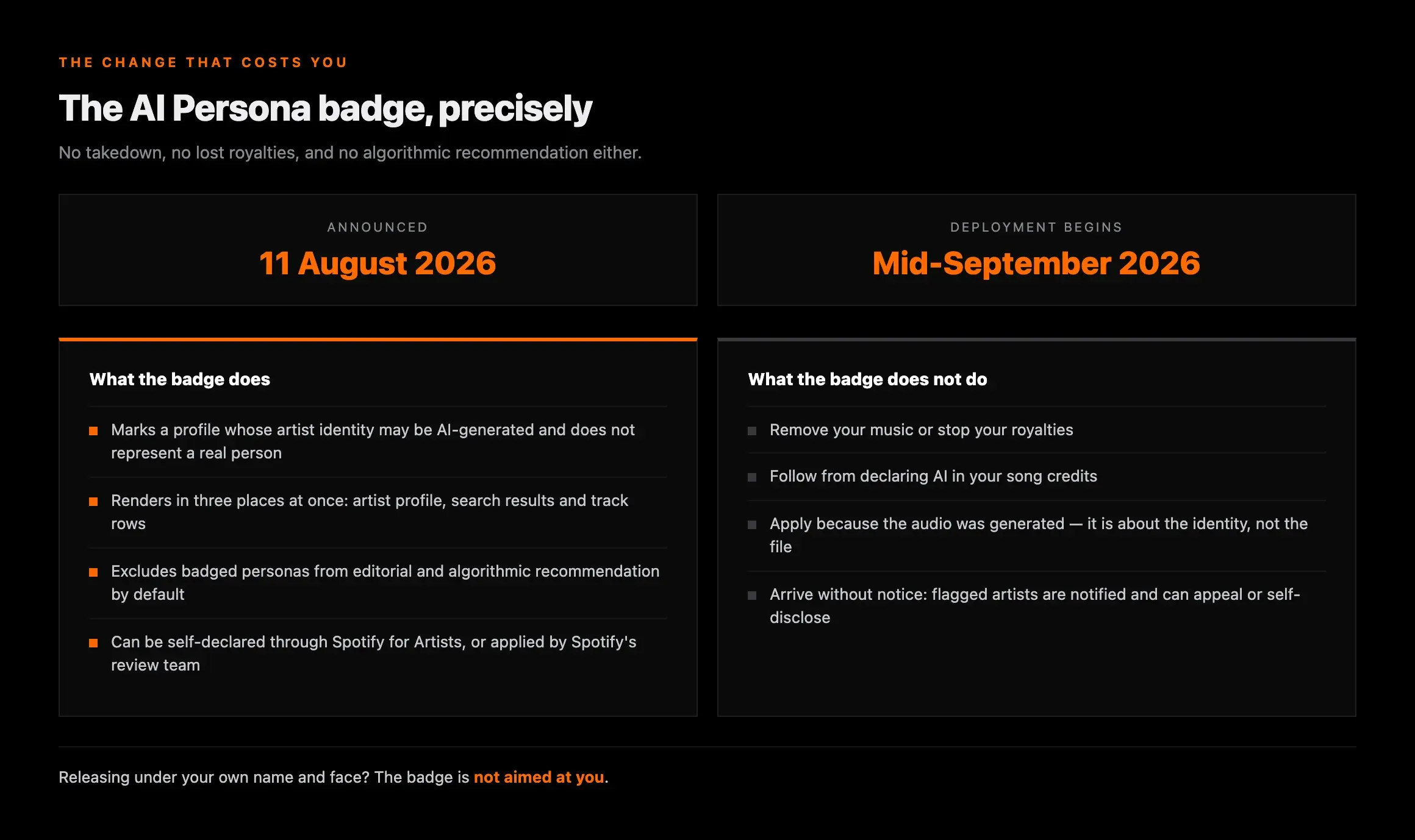
The part that matters is that Spotify runs four separate systems that an AI release can collide with, and only one of them is about AI at all. They were built at different times, for different reasons, and they punish different things. Treating them as one "AI policy" is why people end up surprised.
| System | What it targets | What it does to you | Live since |
|---|---|---|---|
| Music spam filter | Mass uploads, duplicates, metadata SEO hacks, artificially short tracks | Uploader tagged, tracks stop being recommended; removal in volume cases | Rolling out from autumn 2025 |
| Impersonation policy | Unauthorised vocal impersonation of a real artist, fraudulent uploads to official profiles | Track removed; formal claims route for the impersonated artist | 25 September 2025 |
| AI credits (DDEX) | Nothing — it is a disclosure field, not an enforcement system | Shows an AI tag in Song Credits. Spotify states it is not used to down-rank | Beta, 16 April 2026 |
| AI Persona badge | Artist identities that appear to be AI-generated rather than a real person | Badge on profile, search and track rows; excluded from editorial and algorithmic recommendations by default | Deploying from mid-September 2026 |
Read that table column by column and the shape of the policy appears. Three of the four systems care about what you do — how many files you upload, whose voice you used, what you declared. Only the fourth cares about what you are, and it is the newest. That is the change worth planning around.
The AI Persona badge: what actually lands in September
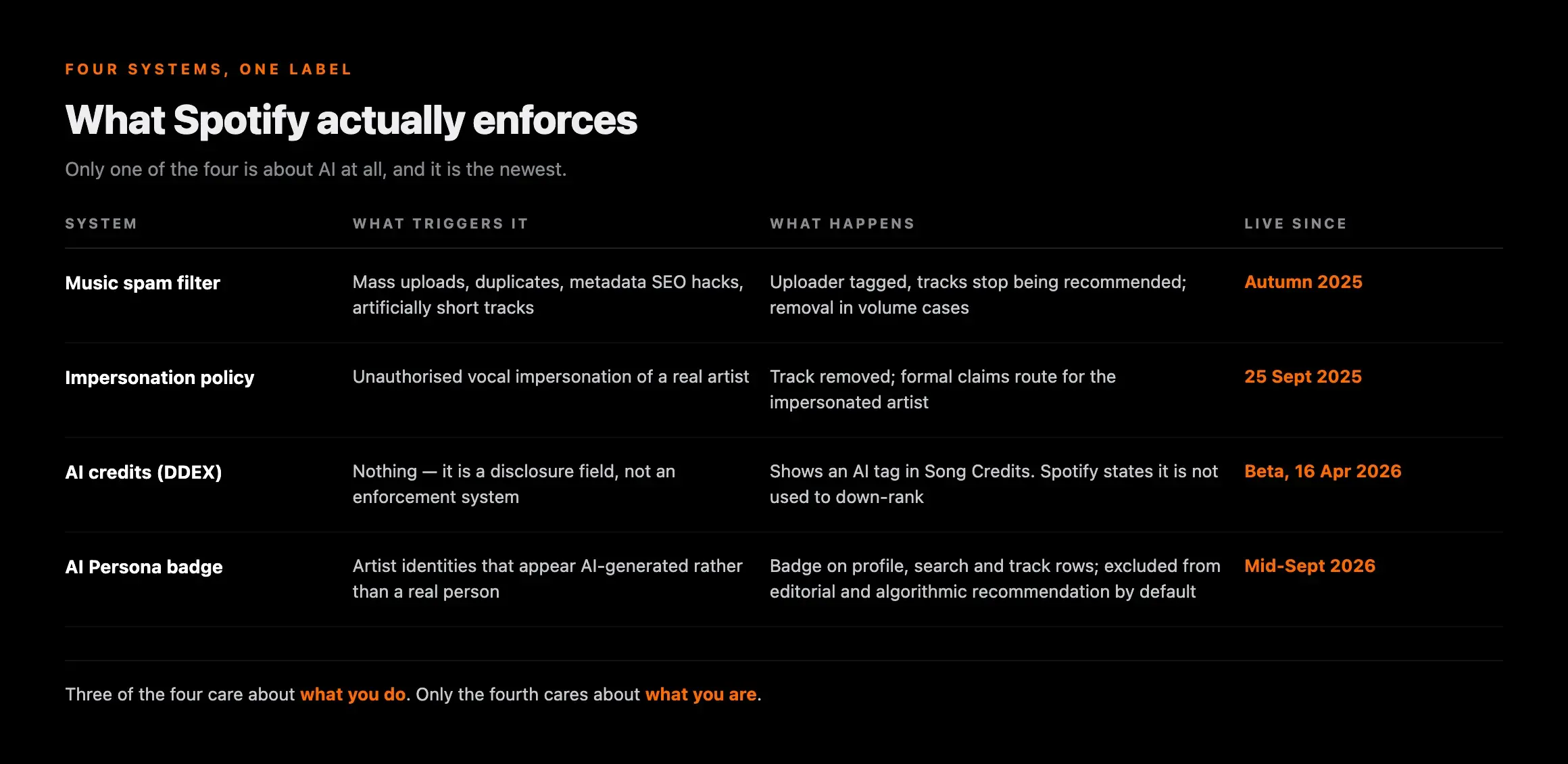
On 11 August 2026 Spotify announced a label for AI-generated artist identities. In its own framing the badge signals that an artist's identity may be AI-generated and does not represent a real person, and it renders in three places at once: the artist profile, search results, and the track rows where your music appears. Deployment begins in mid-September 2026.
There are two routes to getting one. Artists can declare an AI Persona themselves through Spotify for Artists, which is available now. And Spotify's review team applies the badge independently to profiles whose public identity appears to represent a photorealistic AI-generated person, starting with artists who have met defined audience thresholds — the announcement does not publish the numbers, only that the thresholds cover the vast majority of artist profiles listeners actually visit. Flagged artists are notified, and can appeal or self-disclose.
The sentence that decides whether this matters to you is the one about recommendations. By default, Spotify will not include AI Personas in any editorial or algorithmic recommendations unless a listener already follows the profile. Nothing is taken down. Streams still pay at the same rate. You are simply not in Discover Weekly, Release Radar, autoplay or editorial consideration any more.
For an established artist with a following, that is survivable. For a new project with no followers, algorithmic recommendation is the distribution — and being outside it means your release reaches the people you personally send it to and nobody else. Read that as the real price of the badge, because the badge itself is cosmetic and the exclusion is not.
- ✕Remove your tracks or your profile
- ✕Change your royalty rate or withhold payouts
- ✕Apply to individual songs — it marks the artist identity
- ✕Follow from declaring AI in your song credits
- ✕Trigger automatically on AI-assisted production
- ✓Label the profile in three places listeners see
- ✓Remove you from editorial and algorithmic recommendation by default
- ✓Apply after Spotify review even if you never declared
- ✓Arrive with a notification and an appeal route
- ✓Leave followers' feeds and direct links working normally
One distinction is worth holding onto because almost every summary blurs it: an AI Persona is a fabricated artist — a name, a face, a biography that no person stands behind. A real person releasing music they made with Suno is not an AI Persona, and nothing in the announcement suggests they are. If you release under your own name with your own photograph, this policy is not aimed at you.
The music spam filter, and why it catches non-AI artists too
This is the system that has actually removed music at scale, and it predates the badge by a year. Spotify reported removing over 75 million spammy tracks in the twelve months to September 2025 — a number worth sitting with, because it is roughly the size of the entire catalogue a decade earlier.
The filter identifies uploaders and tracks engaging in four specific tactics, tags them, and stops recommending them: mass uploads, duplicate uploads, search-engine-optimisation hacks in metadata, and artificially short tracks designed to farm per-stream payouts. Notice that none of those four words is "AI". A human producer uploading the same instrumental forty times under forty titles trips this. A careful AI release does not.
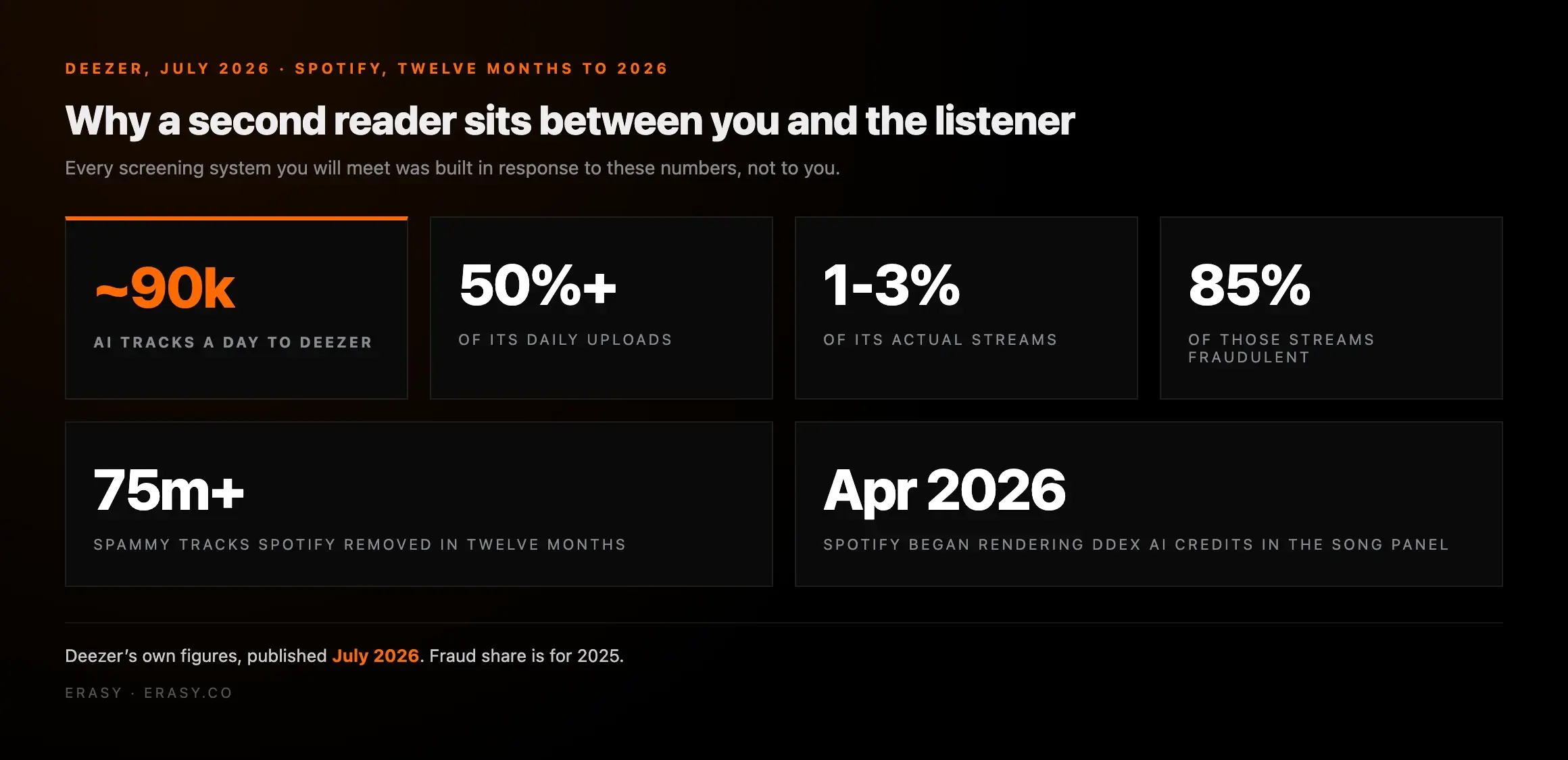
The volume context explains the machinery. Deezer, which publishes more detail than anyone, said in July 2026 that fully AI-generated music had passed 50% of its daily uploads at roughly 90,000 tracks a day, while accounting for between 1 and 3% of actual streams. Deezer's newsroom post is the clearest public statement of the problem every platform is solving: an enormous inbound pile, very little of it listened to, and a meaningful slice of it fraud.
Your job is to not look like that pile. In practice that means one artist name rather than five, releases spaced like a person makes them, titles and credits written by a human, and no thirty-second filler tracks padding an album. We go through the upload-side specifics in our guide to distributing AI music without getting flagged.
Impersonation: the one true prohibition
If there is a hard rule in the Spotify AI music policy, this is it. Vocal impersonation is only allowed in music on Spotify when the impersonated artist has authorised the usage. That is the published wording, from the 25 September 2025 announcement, and it applies whether the impersonation came from a voice model or a gifted human mimic.
The same policy covers fraudulent uploads to an artist's official profile — the trick where someone delivers a track under an existing artist's name so it lands on their page. Spotify said it is testing prevention upstream with distributors, which is why some distributors now hold releases that name-match an established act.
The practical consequence for AI creators is narrow but absolute: an AI cover in a recognisable singer's voice has no compliant path onto Spotify without documented authorisation from the rights holder, and no amount of audio cleanup changes that, because the violation is the voice rather than the file. We cover what remains possible in our guide to AI cover songs. Everything else in this article is about tracks that are yours to release.
AI credits, DDEX, and whether honesty costs you
The question we get more than any other is whether ticking the AI box at upload is an own goal. The evidence says no, and it is unusually explicit for a platform policy.
Spotify helped develop the industry disclosure standard through DDEX, the body that defines how music metadata moves between distributors and services. The standard lets a delivery state where and how AI played a role — AI-generated vocals, instrumentation, or post-production — as separate fields rather than one blunt flag. Spotify's AI credits beta went live on 16 April 2026, surfacing those credits in the Song Credits panel on mobile.
On the consequence, Spotify's own announcement says the work is "not about punishing artists who use AI responsibly or down-ranking tracks for disclosing information about how they were made", and that "all music is treated equally, regardless of the tools used to make it". You are entitled to be sceptical of a platform describing its own fairness. What you cannot claim is that the policy is secret or ambiguous.
The asymmetry that should decide it for you
Not declaring does not make a track undetectable. It moves the decision from you to a classifier — Spotify's, Deezer's, or your distributor's — which reaches its own conclusion without your input and without telling you.
A declared AI track carries a credit. An undeclared one later identified as AI carries a credibility problem, and on Spotify it now risks a badge applied by review rather than by choice.
Spotify against the platforms it is compared to
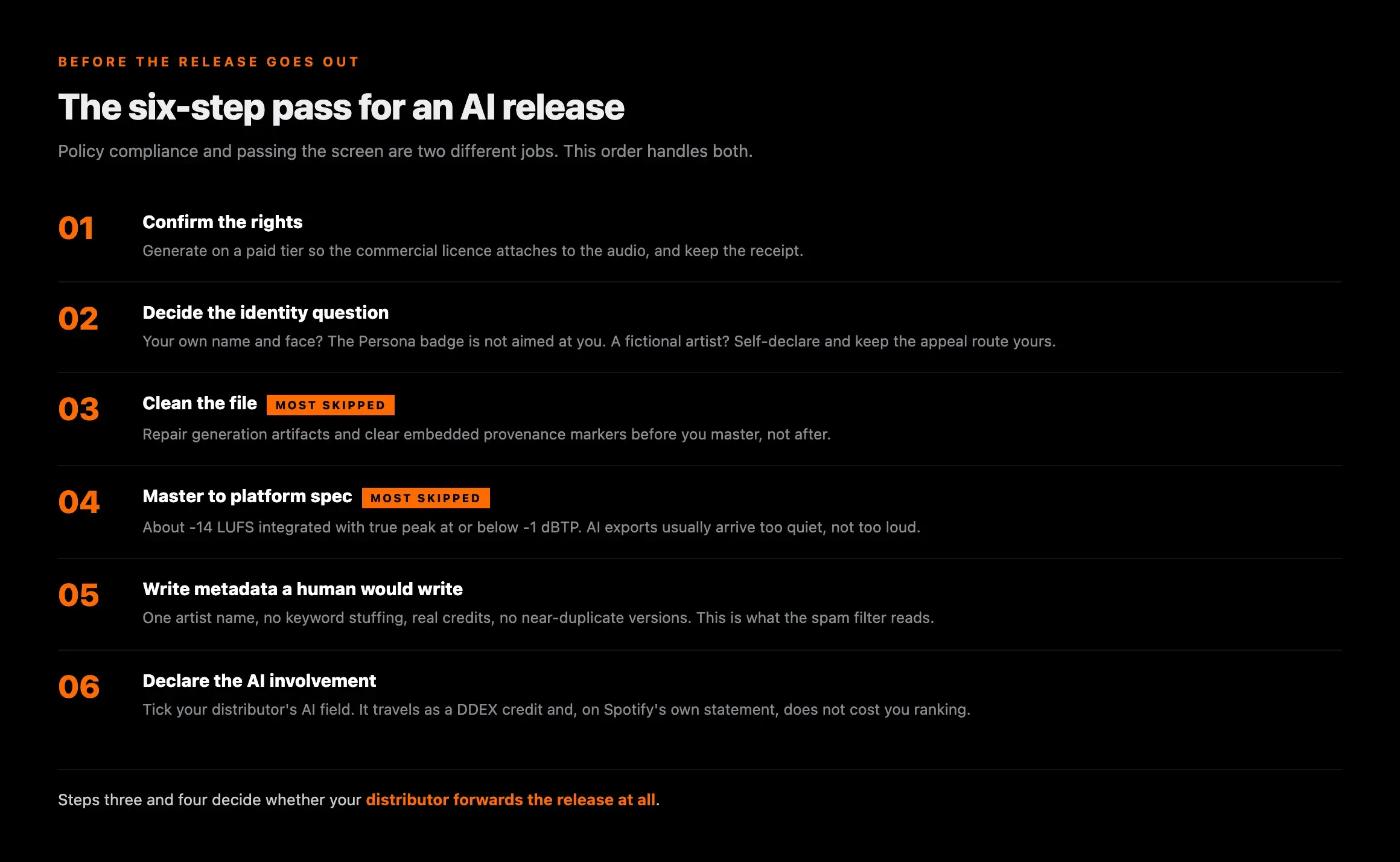
Spotify is not the strictest service on AI music, which surprises people who only read the headlines about it. Deezer moved earlier and enforces against the audio itself rather than the identity behind it.
| Platform | Position on AI music | What it labels | Recommendation impact |
|---|---|---|---|
| Spotify | Allowed; enforcement aimed at spam, impersonation and AI identities | AI Persona badge on the artist, from mid-Sept 2026; AI credits per track since Apr 2026 | Badged personas excluded from editorial and algorithmic recommendation by default |
| Deezer | Allowed; own AI detection running since January 2025 | Albums containing fully AI-generated tracks tagged for listeners since June 2026 | Detected fully-AI tracks excluded from algorithmic and editorial recommendation |
| Apple Music | Allowed; AI Transparency Tags announced to providers 4 March 2026 | Self-declared tags across Artwork, Track, Composition and Music Video — optional now, required on future deliveries | No published AI-specific recommendation exclusion |
| YouTube | Allowed with disclosure of synthetic or altered realistic content | Disclosure label on the watch page where required | Monetisation governed by Partner Program and originality rules, not an AI flag |
| Distributors (DistroKid, TuneCore, CD Baby) | Accept AI music if you hold the rights and declare it | AI declaration field passed on in the DDEX delivery | Screening happens before the platforms ever see the file |
Apple is the interesting third case, because it went the opposite way to Deezer. Its AI Transparency Tags, announced to content providers on 4 March 2026, split disclosure into four fields — artwork, track, composition and music video — and Apple says it defers to content providers to determine what qualifies as AI-generated content. The tags are optional now and required on future deliveries, with no independent verification behind them. That is disclosure without detection, which is the mirror image of Deezer's approach and a different risk profile again from Spotify's review team.
Two things follow from that table. First, the gate you meet earliest is your distributor's, not Spotify's — a file that fails an automated screen at submission never becomes a Spotify policy question at all. Second, Deezer's model is the one to watch, because exclusion triggered by detection can reach you whatever you declared, while Spotify's badge at least comes with a notification and an appeal.
If you want the detail on how those detection systems reach a verdict and why two of them routinely disagree about the same file, we pulled that apart in our piece on what AI music detectors actually see.
The pass we run before an AI release goes to Spotify
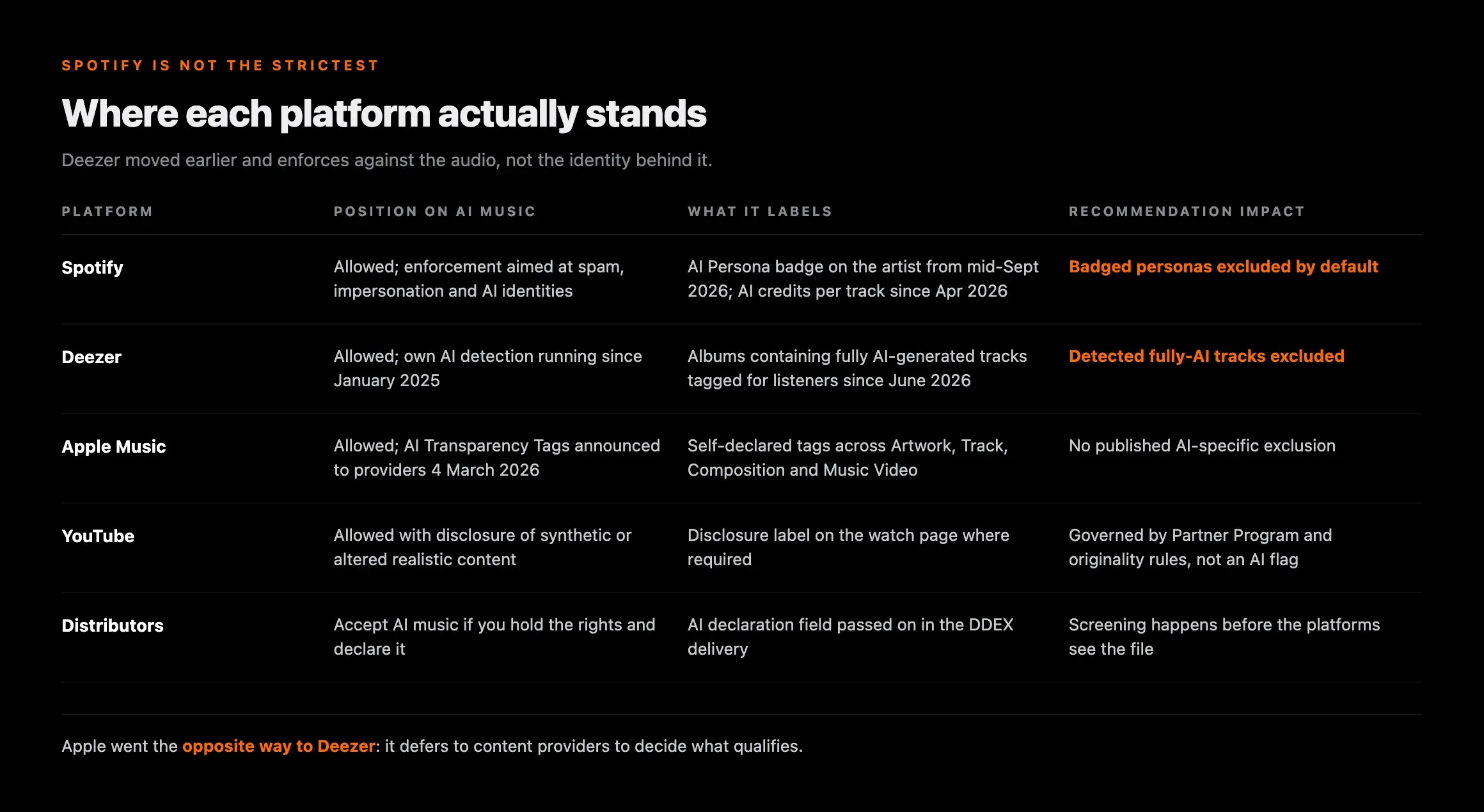
Policy compliance and passing the screen are two different jobs, and this order handles both. Nothing here takes specialist software except step three.
Generate on a paid tier so the commercial licence attaches to the audio, and keep the receipt. Distributors ask for proof, and it is the one rejection category with an easy answer.
Releasing under your own name and face? The Persona badge is not aimed at you. Building a fictional artist? Self-declare it and keep the framing and the appeal route yours.
Repair generation artifacts, clear embedded provenance metadata and generation markers, and do it before you master rather than after so you are not re-colouring balanced audio.
About -14 LUFS integrated with true peak at or below -1 dBTP. Spotify turns loud masters down rather than rewarding them, and AI exports usually arrive too quiet rather than too loud.
One artist name, no keyword stuffing in titles, real credits, no near-duplicate versions of the same track. This is what the spam filter reads.
Tick your distributor's AI field and select which elements applied. It travels as a DDEX credit and, on Spotify's own statement, does not cost you ranking.
Steps three and four are the ones people skip, and they are the ones that decide whether your distributor forwards the release at all. The full version, timed step by step, is in our twelve-step cleaning checklist, and the loudness numbers per platform are in our LUFS targets guide.
Before the distributor screen, not after
Clear the file once. Let the policy be the only question.
Undetectr handles the audio half of this list — generation artifacts, embedded watermarks, C2PA provenance metadata and noise-floor patterns — in a single pass, on a one-time Lifetime plan rather than a subscription.
Four things people get wrong about this policy
"Spotify banned AI music in 2025." It did not. It removed 75 million spammy tracks and published an impersonation policy in the same week, and the two got compressed into one headline. The announcement that produced those numbers says in writing that all music is treated equally regardless of the tools used to make it.
"The AI badge will be slapped on my song." The badge marks an artist identity, not a track. Declaring AI involvement in a song's credits is a separate system that has existed since April 2026 and carries no recommendation penalty.
"If I do not declare, nobody knows." Spotify said explicitly that it will not rely on self-disclosure alone and reviews profiles itself. Deezer has been detecting from the audio since January 2025. Non-declaration is not invisibility, it is forfeiting your say.
"Stripping the watermark solves the policy problem." It solves a different problem — the automated screen between you and the platform. No amount of audio work makes an unauthorised voice clone compliant, or a forty-track duplicate upload look like a human release. Fix the audio because the distributor gate is real; fix the behaviour because that is what the policy reads.
And a note on where this is heading. Spotify says listeners will eventually be able to report suspected AI Personas, which turns enforcement from a review queue into a crowd signal. If you are building a project you intend to run for years, the version of it that survives that shift is the one that was honest from the start.
Keep reading
- Cleaning AI music for release: the 12-step 2026 checklist
- How to distribute AI music without getting flagged
- Can you sell Suno AI music on Spotify and DistroKid?
- AI music detectors: what they actually see, and why they disagree
- LUFS for Spotify and every streaming platform: 2026 targets
- Can you copyright AI music?
Frequently asked questions

Cara Whelan — Policy Editor, Erasy
Cara covers platform policy for Erasy — pricing changes, terms updates and the rules that decide what you can actually do with the music you generate. They work from primary announcements and FAQs rather than the coverage of them, and date every figure so you know when it was last checked.
Does Spotify allow AI-generated music in 2026?+
What is Spotify's AI Persona badge and when does it appear?+
Does the AI Persona badge stop you earning on Spotify?+
Will disclosing AI in my credits get my track down-ranked?+
What actually gets AI music removed from Spotify?+
How is Spotify different from Deezer on AI music?+
Do I need to change my tracks to comply with Spotify's policy?+
Should I hide that my artist project is AI?+
Disclosure: Erasy is an independent guide to AI music cleanup, and Undetectr is the tool we use and link to. The AI Persona badge details, rollout timing and recommendation treatment are from Spotify's newsroom announcement of 11 August 2026; the spam-filter, impersonation and DDEX AI-credits details and the 75 million figure are from Spotify's announcement of 25 September 2025. Deezer upload and stream figures are Deezer's own, published July 2026. Apple's Transparency Tags detail is from its 4 March 2026 provider announcement, as reported by Music Business Worldwide. Platform and distributor policies reflect published rules as of 6 September 2026 and change without notice — check the current terms before you submit.