AI Music
AI Music Earnings 2026: Inside a Reported $15,000 Month
Somebody in every AI music thread has read that two French creators cleared $15,000 in a month from tracks they generated with Suno, and somebody else has replied that AI music pays nothing at all. Both are quoting real reporting. The reason AI music earnings arguments never resolve is that almost nobody does the arithmetic that connects the two numbers.
So we did it. We took the reported $15,000 month, the only published study that puts revenue figures on the biggest AI acts, Spotify's own payout disclosures, Deezer's fraud findings and Luminate's census of what the other 253 million tracks earn, and reduced all of it to one question: how many plays does a given income actually require, and where do those plays have to happen? The answer is unglamorous, and it is the same answer whether your track took four minutes to make or four months.
Key takeaways
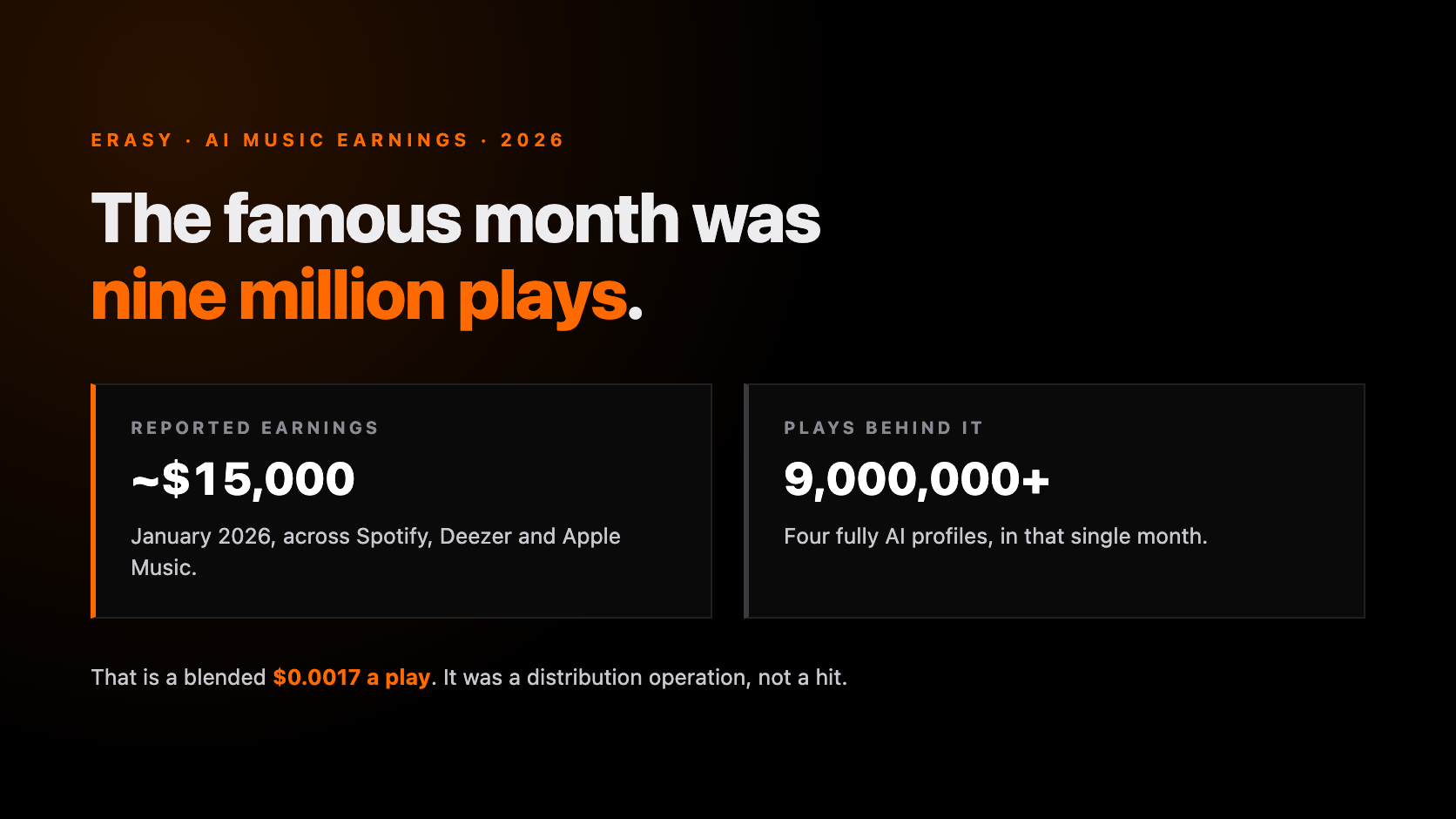
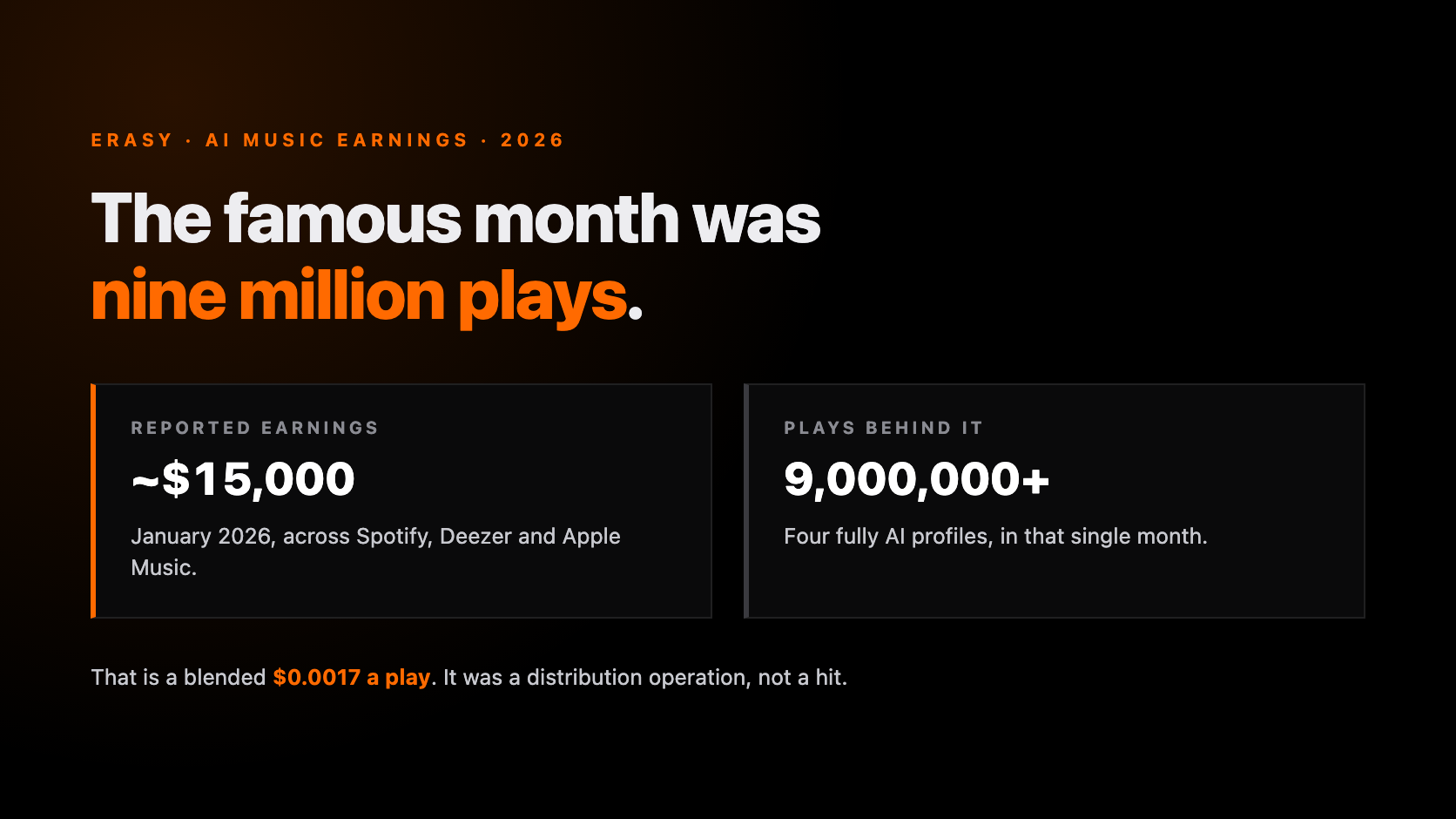
The famous $15,000 month was nine million plays. Le Monde's reporting on Chayen and Erwin describes four fully AI artist profiles taking more than nine million streams in January 2026 across Spotify, Deezer and Apple Music. That works out at roughly $0.0017 a play.
YouTube pays the category more than Spotify does. In the one study that puts numbers on the top ten AI acts, YouTube accounted for an estimated $3.7 million against Spotify's $2.38 million — 61% of the total, from a platform most AI creators treat as an afterthought.
The headline earnings figures are models, not accounts. That study calculates Spotify revenue at a flat $0.004 per stream and YouTube at a $2.12 RPM midpoint. Every roundup that repeats the $6.1 million total as a measurement is repeating a calculator output.
A large share of AI streams is already worth nothing. Deezer found up to 85% of the streams on fully AI-generated tracks to be fraudulent and demonetised them, and Spotify pays no recording royalty at all on a track under 1,000 streams in the previous 12 months.
The January playbook has been partly closed since. Invented artist identities now attract Spotify's AI Persona badge and lose editorial and algorithmic recommendation by default, and Suno capped downloads at 7, 20 or 60 a month from 3 September 2026.
The $15,000 month, decoded
The case is worth taking seriously because it is properly reported rather than a screenshot on TikTok. Le Monde spent months investigating AI-generated music and followed two creators, Chayen and Erwin, who found Suno, spun up several wholly AI artists in minutes and put them on Spotify, Deezer and Apple Music. January 2026 was the month that made the headline.
The detail that gets dropped every time the figure is repeated is the traffic behind it. Four profiles, more than nine million plays in a single month. Divide one by the other and the blended rate is about a sixth of a cent — well under the $0.004 everyone quotes, because the mix included free-tier listening, multiple territories and three platforms with different economics.
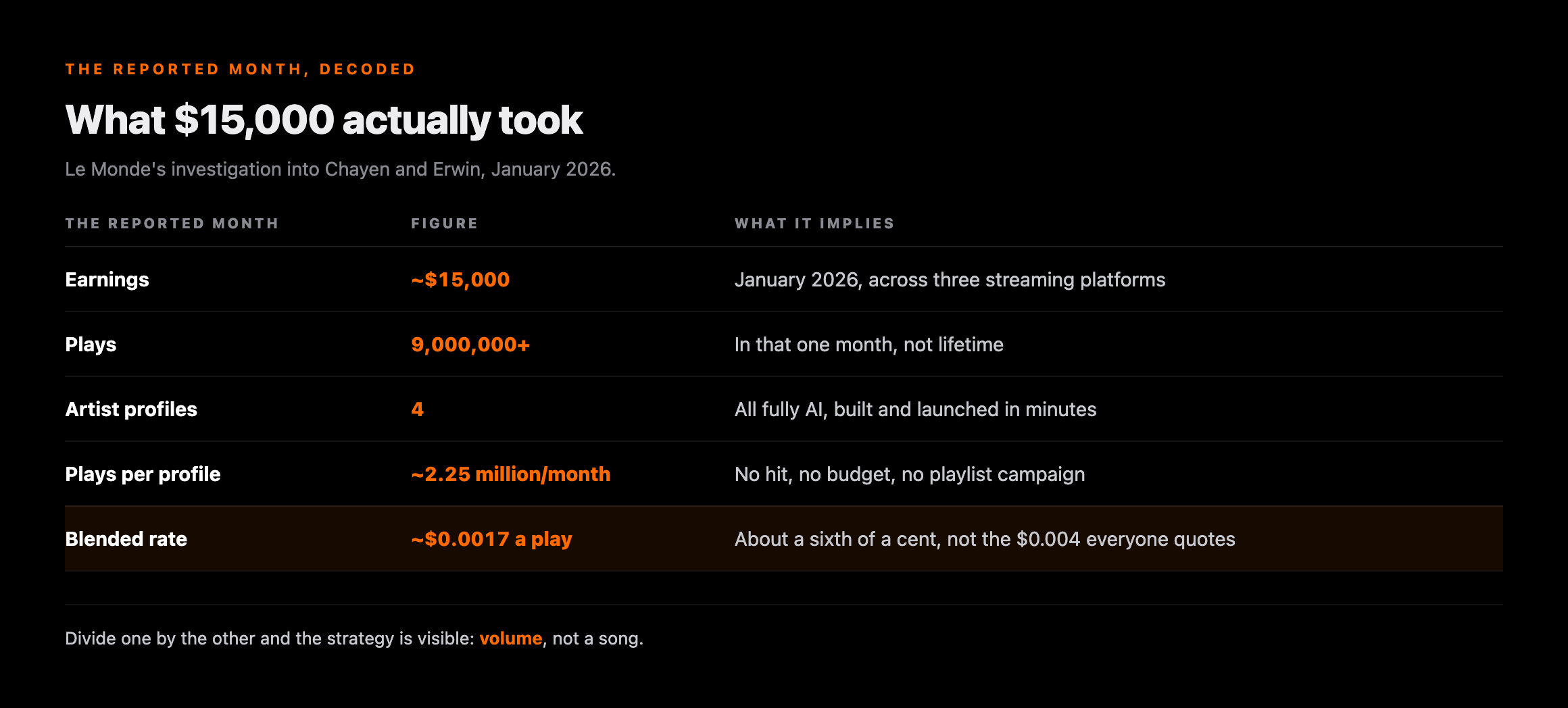
| The reported month | Figure | What it implies |
|---|---|---|
| Earnings | ~$15,000 | January 2026, across three streaming platforms |
| Plays | 9,000,000+ | In that one month, not lifetime |
| Artist profiles | 4 | All fully AI, built and launched in minutes |
| Plays per profile | ~2.25 million/month | Each profile performing like a small real artist |
| Implied blended rate | ~$0.0017 per play | About 42% of the $0.004 figure studies model with |
| Generation tool | Suno | Text-to-music; commercial rights attach to paid plans |
Note what is not in that table: a hit, a marketing budget, a playlist campaign or a single named song anyone can hum. This was a distribution operation. The French press review of the investigation is blunt about it — the artists are described as faux artistes 100% IA, fake artists, and the success was in how many of them there were and how fast they shipped. Whether the $15,000 was each or between them is not stated identically everywhere the investigation is relayed, which is its own small lesson in how these figures travel.
What AI music earnings look like at the top
There is exactly one public attempt to size the whole category, and it is worth reading carefully rather than quoting. In July 2026 Kapwing pulled Songstats data for the acts listed in the AiMCharts database and published estimated earnings for the ten biggest. The combined figure — $6.1 million from more than 2.3 billion plays — has been reported everywhere since as though it came off a royalty statement.
It did not. The study states its own method: Spotify revenue calculated at a flat $0.004 per stream, YouTube at SocialBlade's default RPM midpoint of $2.12 per thousand views. Those are reasonable assumptions and they are still assumptions, applied uniformly to ten catalogues with ten different territory mixes. Treat the shape as real and the decimals as decoration.
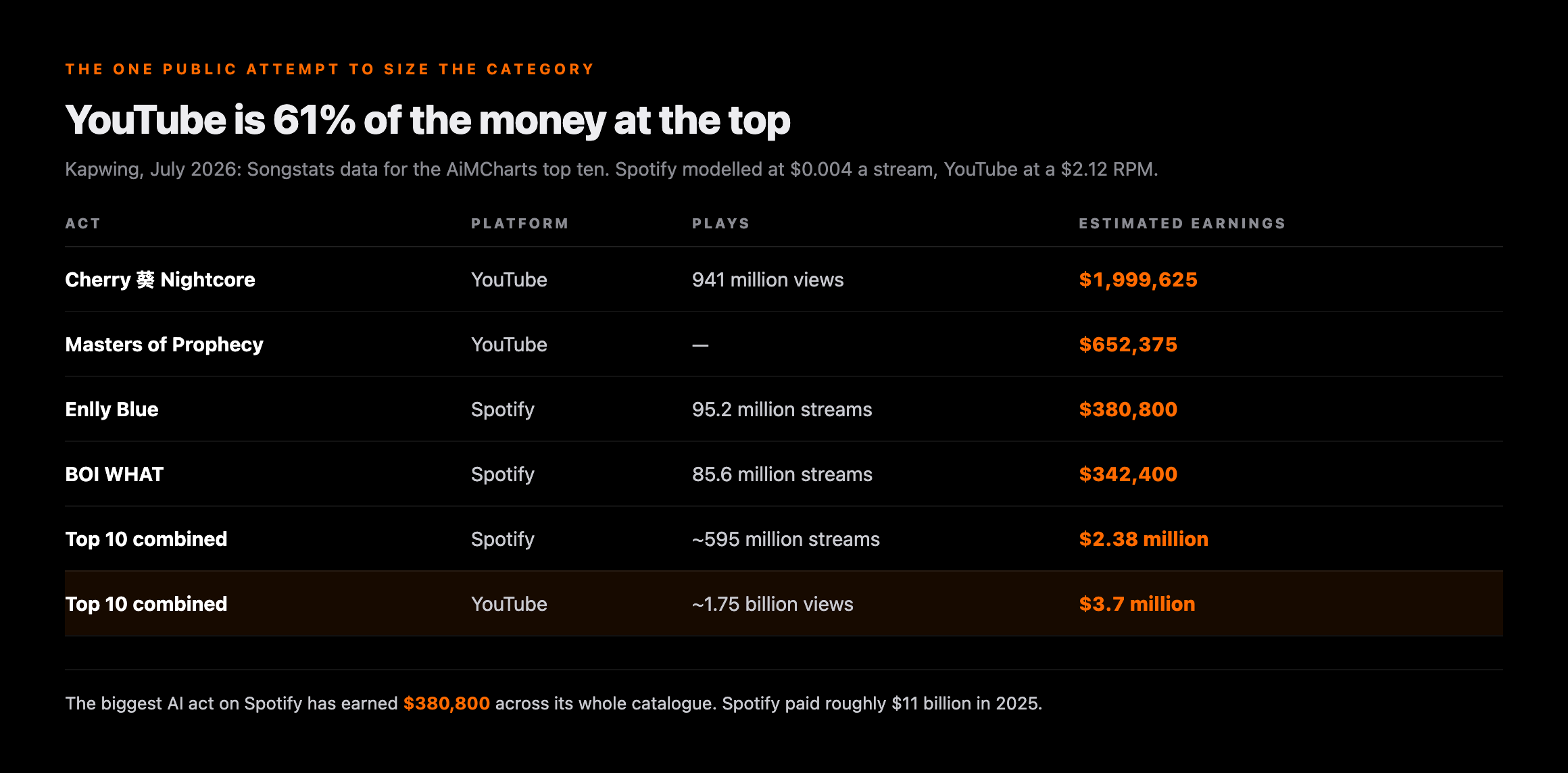
| Act | Platform | Plays | Estimated earnings |
|---|---|---|---|
| Cherry 葵 Nightcore | YouTube | 941 million views | $1,999,625 |
| Masters of Prophecy | YouTube | — | $652,375 |
| Enlly Blue | Spotify | 95.2 million streams | $380,800 |
| BOI WHAT | Spotify | 85.6 million streams | $342,400 |
| Top 10 combined | Spotify | ~595 million streams | $2.38 million |
| Top 10 combined | YouTube | ~1.75 billion views | $3.70 million |
The finding buried in that table is the platform split. YouTube produced 61% of the money in the category's top tier, from three times the volume at roughly half the per-play rate. Every list of biggest AI artists reports the Spotify ranking first because Spotify is what people mean by streaming, and the Spotify ranking is the smaller half of the business.
Scale it against the rest of the market and the ceiling comes into focus. Spotify's 2026 Loud & Clear report says it paid roughly $11 billion in 2025, that more than 13,800 artists generated at least $100,000, and that more than 1,500 generated over $1 million. The biggest AI act on the platform, on this study's own method, has earned $380,800 across its entire catalogue. That places the category leader somewhere in the four-figure ranks of the Spotify economy, not at the top of it.
AI music earnings are a plays problem
Here is the table the whole search results page is missing. Pick a monthly income, apply the rates the published work actually uses, and read off how many plays it takes. Nothing about the music changes these numbers.
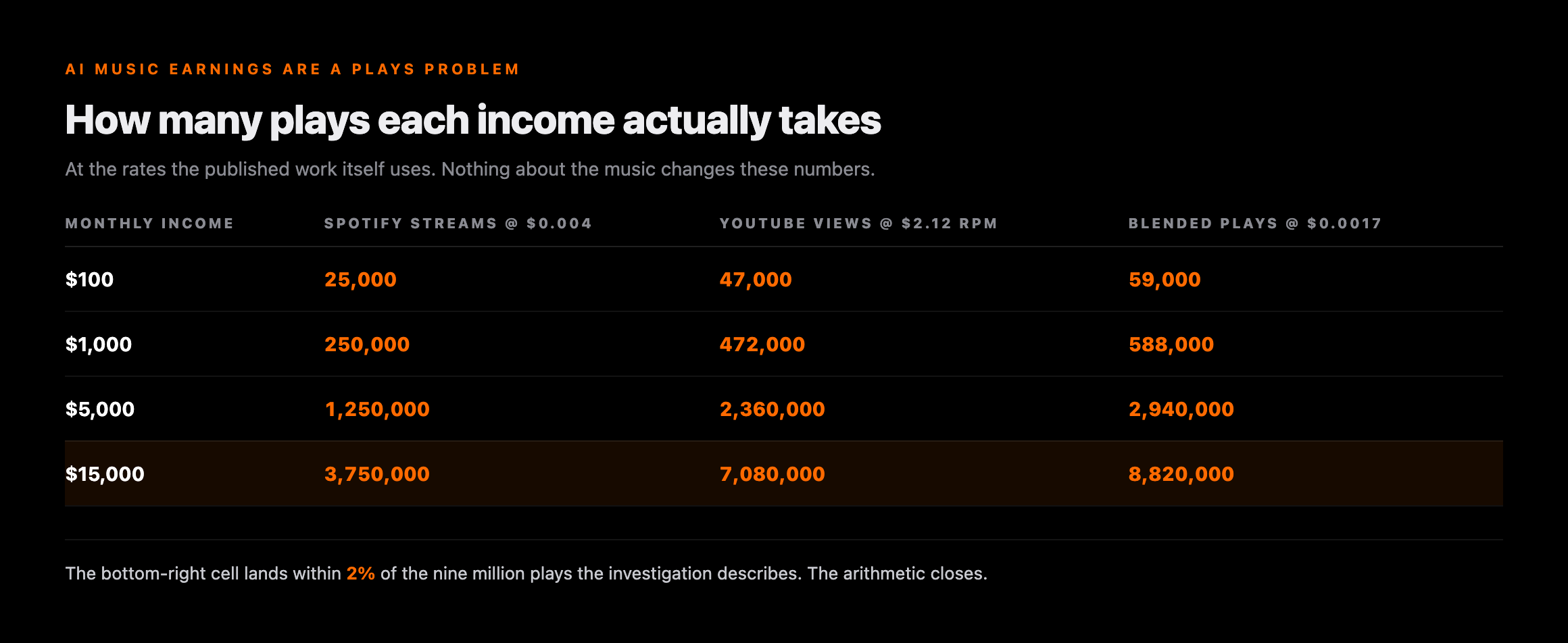
| Monthly income | Spotify streams @ $0.004 | YouTube views @ $2.12 RPM | Blended plays @ $0.0017 |
|---|---|---|---|
| $100 | 25,000 | 47,000 | 59,000 |
| $1,000 | 250,000 | 472,000 | 588,000 |
| $5,000 | 1,250,000 | 2,360,000 | 2,940,000 |
| $15,000 | 3,750,000 | 7,080,000 | 8,820,000 |
The bottom-right cell is the reported month, and it lands within 2% of the nine million plays the investigation describes. That is the strongest evidence available that the $15,000 figure is neither invented nor repeatable on a whim: the arithmetic closes, and it closes at a traffic level most independent releases never approach.
For the other end of the distribution, Luminate's 2025 year-end report is the reality check. Of the 253 million tracks that took the year's 5.1 trillion on-demand audio streams, 88% were streamed fewer than 1,000 times in the whole year — 120.5 million of them fewer than ten times. Roughly 106,000 new tracks reach the stores every day. A catalogue is not a business model on its own; it is a lottery ticket you can buy in bulk.
Most of those plays are worth nothing
Every income projection you have read multiplies plays by a rate. Real payouts run a play through several gates first, and on AI catalogues specifically, most plays do not clear them. This is the single biggest reason reported earnings come in below the calculator.
| Gate | The rule | What it does to the play |
|---|---|---|
| Spotify royalty floor | A track earns no recording royalties unless it reaches 1,000 streams in the previous 12 months | Plays on a track under the line pay zero; Spotify says 99.5% of listening happens above it |
| Fraud demonetisation | Deezer reported in January 2026 that up to 85% of streams on fully AI-generated tracks were detected as fraudulent | Those streams are stripped of payment entirely |
| Recommendation default | From mid-September 2026 Spotify's AI Persona profiles are excluded from editorial and algorithmic recommendation by default | Removes the mechanism that delivers new listeners, without removing the track |
| Promo screening | SubmitHub blocks submissions scoring 85%+ on its AI detector; about 11% of last month's uploads hit that bar | Closes the paid curator route; flagged tracks that do get through are approved at 16% against 31% |
| Distributor intake | Automated AI screening at the distribution step | A rejected release never goes live, so it never accrues a play at all |
Two of those gates are worth reading in the original, because the secondary coverage rounds both of them off. Deezer's own upload figures put AI music at 1–3% of total streams while it arrives at 90,000 tracks a day, and state that "all fraudulent streams are removed from the royalty pool" — the 85% share of AI streams caught that way is from its January 2026 announcement, and it describes streams on fully AI-generated tracks rather than the tracks themselves. Meanwhile Spotify's badge announcement states plainly that the badge "is about the artist's public identity, not about how the music was made".
Read those together and a pattern shows up that nobody selling an AI music course will mention: the volume strategy and the fraud problem share a detection surface. Deezer's 85% figure is dominated by industrial stream-farming rather than by hobbyists, but the systems that catch farms do not have a category for "prolific and honest". A catalogue that looks like a farm gets treated like one.
Four things the people earning actually do
Strip out the cases that turn out to be fraud and the ones that turn out to be marketing for somebody's course, and the creators with real income in this niche have four habits in common. None of them is a prompt trick.
Sienna Rose, the AI R&B act that passed three million Spotify monthly listeners by January 2026, put out at least 45 songs and 10 albums between September and December 2025. The reported $15,000 month came from four profiles, not one. Volume is the strategy; the individual track is a unit of inventory.
YouTube produced 61% of the top tier's estimated revenue. It has no 1,000-stream floor, it pays on views rather than on listener share, and it carries a second income line in Content ID that streaming has no equivalent to.
A stream pays a recording royalty and a mechanical royalty, and the second one only arrives if the work is registered. Most AI creators have registered nothing, so the publishing side of their own catalogue sits unclaimed.
Xania Monet signed a reported $3 million deal with Hallwood Media in September 2025 and reached No. 30 on Billboard's Adult R&B Airplay chart. Telisha "Nikki" Jones writes the lyrics and says so. The disclosed human author is the part that could be signed.
The fourth habit is the one that has aged best, and it is worth being precise about why. An invented identity was an asset in January and is a liability in September, because Spotify now labels it. A real name attached to real writing is not affected by that badge at all.
What changed between January and September 2026
This is the part that makes most of the earnings content on this topic quietly out of date. The reported $15,000 month happened in a policy window that has since narrowed on three sides. Nothing here bans AI music — six distributors still accept it openly, and rejections come from automated screening rather than from a rule against the category — but the specific levers that produced that month have moved.

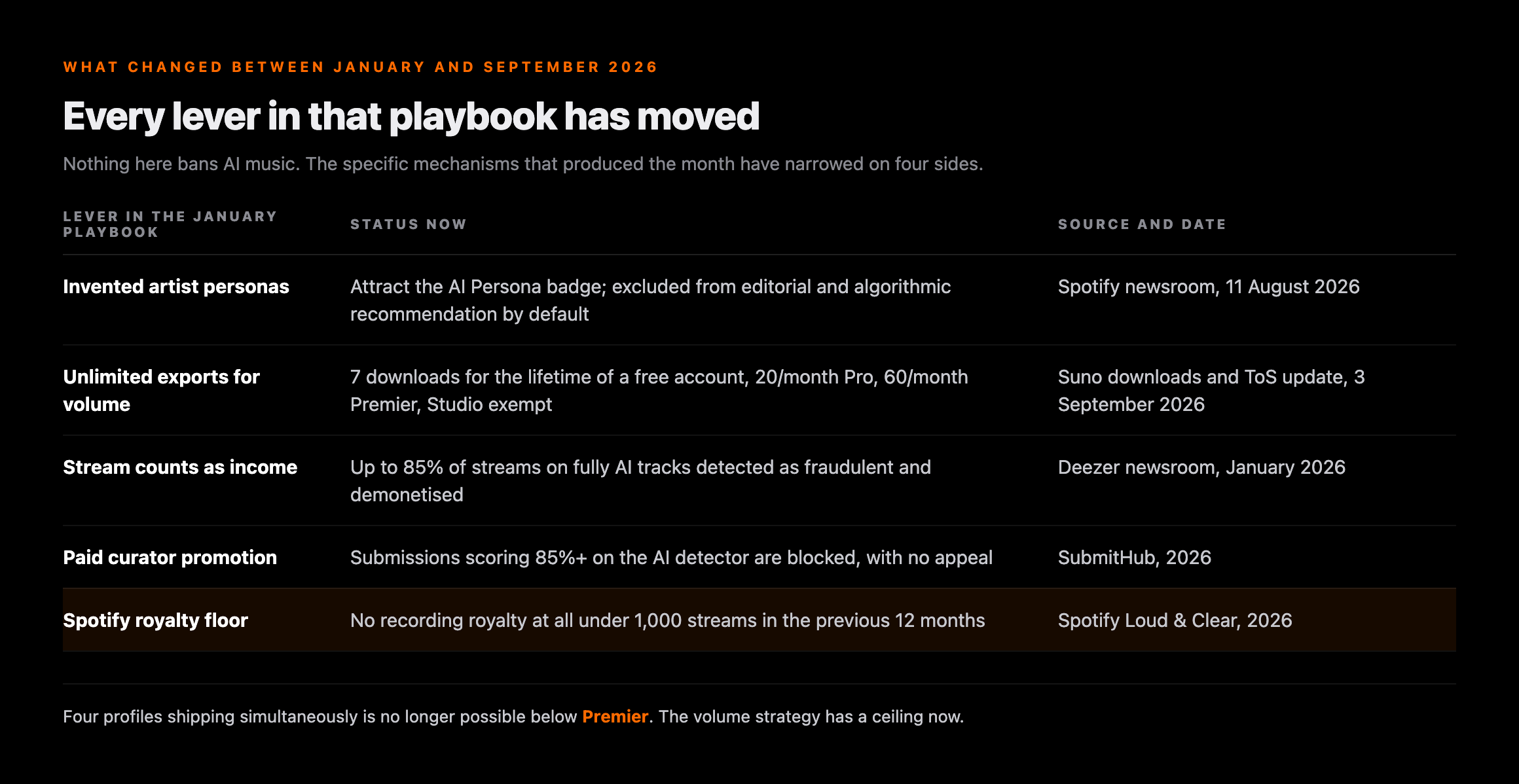
| Lever in the January playbook | Status now | Source and date |
|---|---|---|
| Invented artist personas | Attract the AI Persona badge; excluded from editorial and algorithmic recommendation by default unless a listener follows the artist | Spotify newsroom, 11 August 2026; badges from mid-September |
| Unlimited exports for volume | 7 downloads for the lifetime of a free account, 20/month Pro, 60/month Premier, Studio exempt — retroactive to your existing library, no rollover | Suno downloads and ToS update, effective 3 September 2026 |
| Stream counts as income | Up to 85% of streams on fully AI tracks detected as fraudulent and demonetised | Deezer newsroom, January 2026 |
| Paid curator promotion | Submissions scoring 85%+ on the AI detector are blocked, with no appeal and no exemption for writing your own lyrics | SubmitHub AI policy page, read 19 September 2026 |
| Getting distributed at all | Unchanged — DistroKid, RouteNote, UnitedMasters, LANDR, Amuse and Symphonic accept AI music; the friction is automated screening at intake | Distributor policies, current |
The download caps deserve a second look, because they are the first hard brake anyone has put on the volume strategy. Sienna Rose's output of roughly eleven tracks a month is still legal under a Pro subscription. Four profiles shipping simultaneously is not, unless you are on Premier or Studio. We have the full mechanics — including the detail that stems count once rather than per file — in our breakdown of Suno's download limits.
The revenue lines nobody in the search results counts
Every competing page on this query models streaming and stops. That is the actual gap, because streaming is the worst-paying line available to a small catalogue and the only one that depends entirely on a recommendation system deciding to serve you.
Sync placements
One placement pays in a lump and does not care how many monthly listeners you have. Published rate guides put low-budget and independent placements in the hundreds to low thousands and national advertising far higher; there is no standard rate card, and anyone quoting one precisely is guessing. The arithmetic that matters is the comparison: a placement worth $2,000 is the same money as half a million Spotify streams at $0.004, and it arrives in one transaction to one buyer who chose your track deliberately. That is why pitching for paid sync is the first line we would build for a catalogue that has no audience yet — and selling direct to the listeners you do have is the second, because neither one asks an algorithm for permission.
Publishing and mechanical royalties
A stream generates two royalties. The recording side reaches you through your distributor automatically; the composition side waits for a registration most AI creators have never made. It is the cheapest money on the table and the least collected, and we walk through the registration itself — and the awkward authorship question underneath it — in our guide to MLC royalties for AI music.
YouTube, on purpose rather than by accident
The platform split in the earnings study is not a curiosity; it is a recommendation. YouTube has no minimum-stream floor, it pays on views, and Content ID gives a catalogue a claim on other people's uploads of the same audio. Our YouTube monetisation rules for AI music covers what the platform requires in disclosure and what it does about synthetic content.
The gate before any of this pays
All of the above assumes the release went live. A track rejected at a distributor's automated intake screening never reaches a store, never accrues a play and never generates a royalty of any kind, which makes screening the cheapest failure in the whole chain to fix and the one most people discover last. It is a technical problem — watermark signals and generation artifacts in the audio — and it is entirely separate from every policy question above.
Clear the screening step first
An unreleased track earns nothing, whatever the rate card says.
Undetectr targets the watermark signals and generation artifacts distributors screen for at intake. It does not change how a platform labels your release and it cannot stop an AI Persona badge — nothing can. €39 one-time, no subscription.
If you are starting now, here is the honest plan
We would not chase the January playbook. It required nine million plays a month, it ran on invented identities that now carry a recommendation penalty, and the export caps that arrived on 3 September put a ceiling on the volume it depended on. What survives from it is the unglamorous half: consistency, multiple releases, and treating distribution as plumbing rather than as an event.
Build the lines that pay per transaction before the one that pays per fraction of a cent. Register the publishing side of everything you release. Put your own name on the work, because the badge attaches to invented identities rather than to production methods, and because a disclosed human author is what got the one AI act in this story an actual record deal. Then release often enough that the catalogue has a chance to find the listener, and read where AI music can legally be sold and what each channel pays before you assume streaming is the destination.
And treat every income screenshot you see with the arithmetic in this article. Nine million plays or it did not happen.
Keep reading
- How to sell Suno music: generation to sold in about 15 minutes
- MLC royalties for AI music: how to register in 2026
- Spotify AI music policy: the badge, the credits and the rules
- AI music backlash 2026: what the critics get right
- How to distribute AI music without getting flagged
- Cleaning AI music for release: the practical checklist
Frequently asked questions

Eddie Mathews — AI Music Editor, Erasy
Eddie covers the craft side of AI music for Erasy — prompting, arrangement, vocal direction and the workflow between a generation you like and a file you can release. They test on their own material and say plainly where a technique stops working.
How much do AI artists actually make from streaming?+
Is the $15,000 a month from AI music real?+
How many streams do you need to earn $1,000 a month?+
Does Spotify pay for AI-generated music?+
Why is my per-stream rate lower than $0.004?+
Is AI music demonetised for fraud?+
What is the most reliable way to earn from AI music in 2026?+
Disclosure: Erasy is an independent guide to AI music cleanup, and Undetectr is the tool we recommend and link to. Figures here were checked at source on 19 September 2026. The $15,000 month comes from Le Monde's investigation into AI-generated music as relayed in the French trade press, which does not state identically everywhere whether the sum was each or combined; the earnings estimates for the top ten acts are Kapwing's July 2026 study using Songstats and AiMCharts data, and are modelled at $0.004 per Spotify stream and a $2.12 YouTube RPM rather than measured; the payout totals are Spotify's own Loud & Clear reporting; the upload, stream-share and fraud figures are Deezer's own, though its January 2026 demonetisation post returns 403 to automated readers, so the 85% figure is cited rather than linked and the July post carrying the upload and stream shares is linked instead; the catalogue distribution is Luminate's 2025 year-end report; and the sync ranges are third-party rate guides, which is why they are given as ranges and not as a rate card.