AI Music
MLC Royalties for AI Music: How to Register in 2026
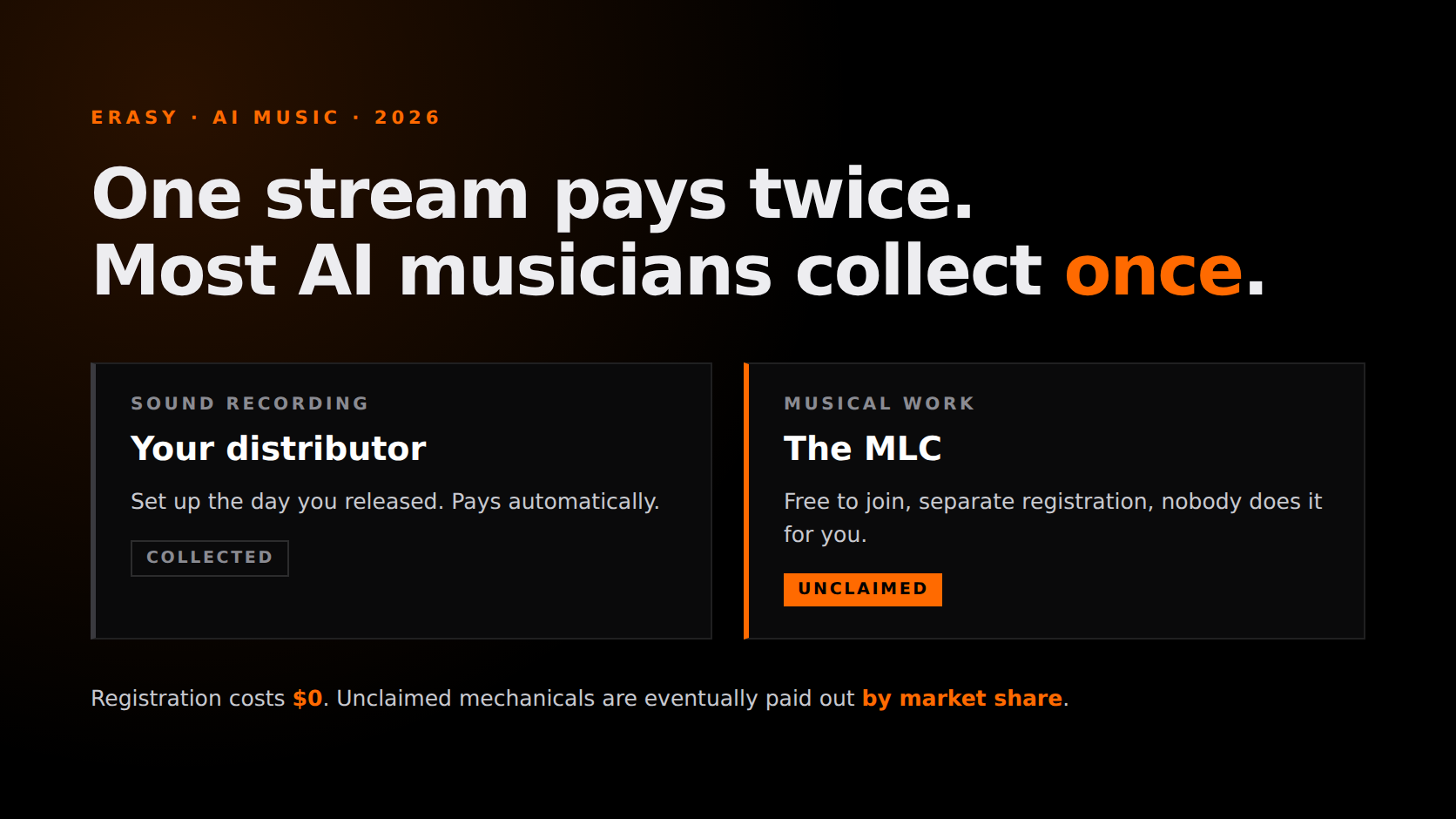
There is a royalty on every US stream of your music that your distributor does not collect, does not mention, and cannot pay you. MLC royalties for AI music are the same mechanical royalties every songwriter in America is owed, the Mechanical Licensing Collective has distributed more than $4 billion of them since 2021, and almost nobody generating tracks with Suno or Udio has registered a single work. Registration is free and takes a few minutes per song.
The catch is not the paperwork. It is that filing a work registration means asserting you own a share of a composition, and the US Copyright Office decided in January 2025 that typing a prompt does not make you its author. We read the Copyright Office report, the Music Modernization Act rules on unclaimed money, Suno's September 2026 terms and three administrators' live price pages, and this is the honest version: who should file, who should not, and what it is realistically worth.
Key takeaways
Membership and registration cost $0. The MLC is funded by the digital services, not by rights holders, and you do not need a publishing company — self-administered songwriters list themselves as the publisher.
Your distributor collects the other royalty. It pays the sound recording. The mechanical royalty belongs to the composition, and DistroKid's pricing page listed no publishing administration add-on at all when we checked on 9 September 2026.
Prompting alone is not authorship. The Copyright Office's January 2025 report is explicit, so the strength of your claim tracks what you actually wrote — lyrics, melody, or the selection and arrangement of generated parts.
Unclaimed money goes to the majors, not back to you. After a statutory holding period the MLC distributes unmatched royalties by relative market share, which means the largest publishers.
Doing it yourself saves 15% to 20% forever. Songtrust charges $100 per writer plus 20% of mechanicals; TuneCore Publishing charges $75 plus 20%. The MLC charges nothing, and covers the US only.
Two royalties, one stream
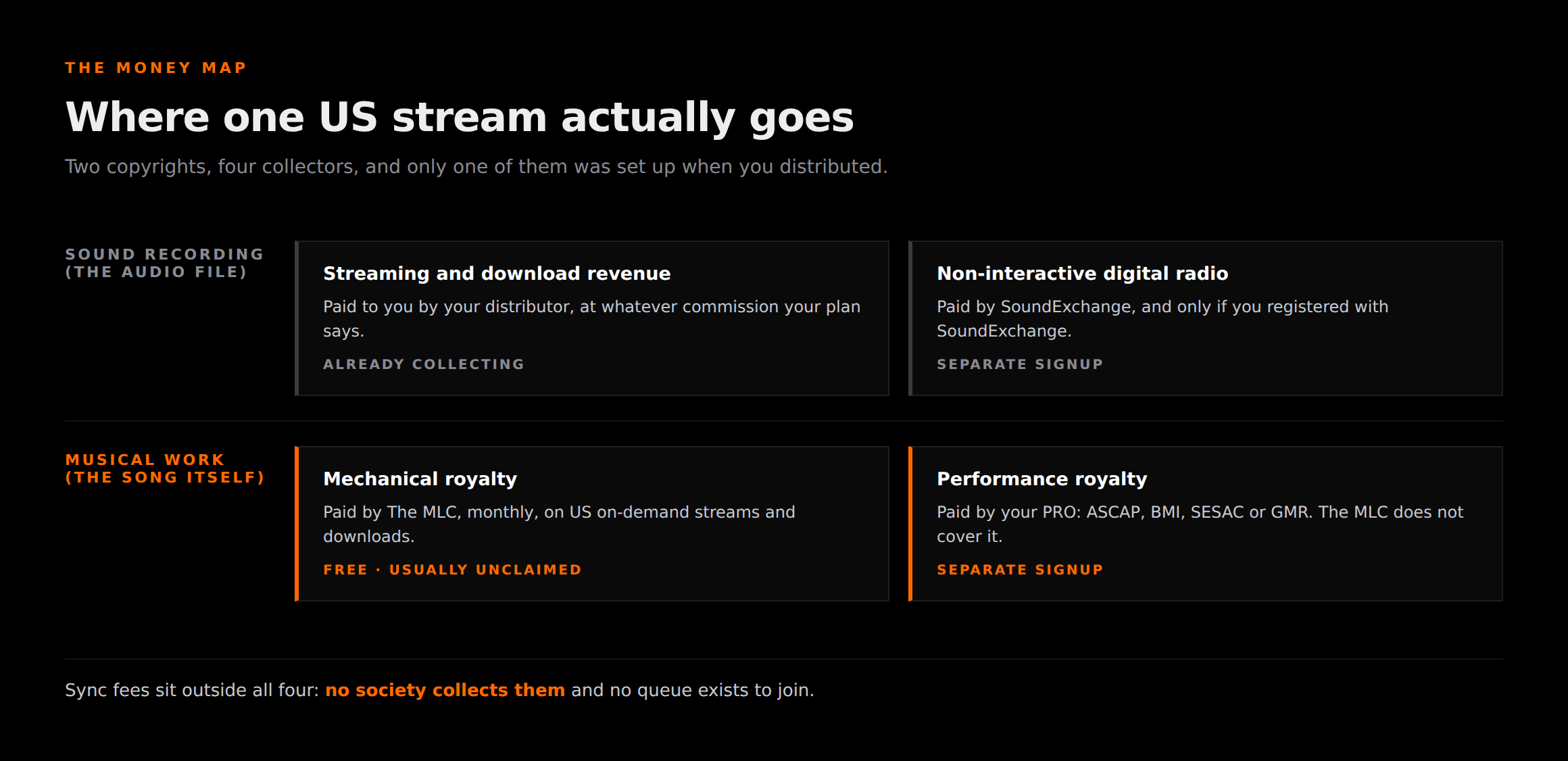
Every on-demand stream in the United States generates money on two separate legal objects. The sound recording is the audio file you uploaded. The musical work is the song underneath it — the composition and the lyrics. They are distinct copyrights, they are paid through completely different plumbing, and one of them has been quietly accumulating in your name while you did nothing about it.
Your distributor handles the recording. That is what the 0% commission marketing is about, and it is genuinely 0%. It has nothing to do with the composition, because a distributor is not a publisher and does not pretend to be one. The composition side splits again, into a mechanical royalty and a performance royalty, and each has its own collector.
| The money | Which copyright | Who collects it in the US | Do you sign up separately? |
|---|---|---|---|
| Recording royalty on streams and downloads | Sound recording | Your distributor | No — already done |
| Mechanical royalty on streams and downloads | Musical work | The MLC | Yes, and it is free |
| Performance royalty | Musical work | ASCAP, BMI, SESAC or GMR | Yes, via a PRO |
| Non-interactive digital radio | Sound recording | SoundExchange | Yes, separately |
| Sync fee for TV, film, games, ads | Both | Nobody — it is negotiated | There is no queue to join |
Read that table as a checklist of accounts you either have or do not. Most independent AI musicians have exactly one of the five. That is the whole story of this article.
Can an AI-generated song be registered at all?
Mechanically, yes. There is no AI question on the MLC's work registration, the organisation has published no policy excluding AI-assisted works, and nothing in the form asks which software touched the file. Anyone entitled to collect US digital audio mechanical royalties can become a member, and the MLC says plainly that connecting with it is free.
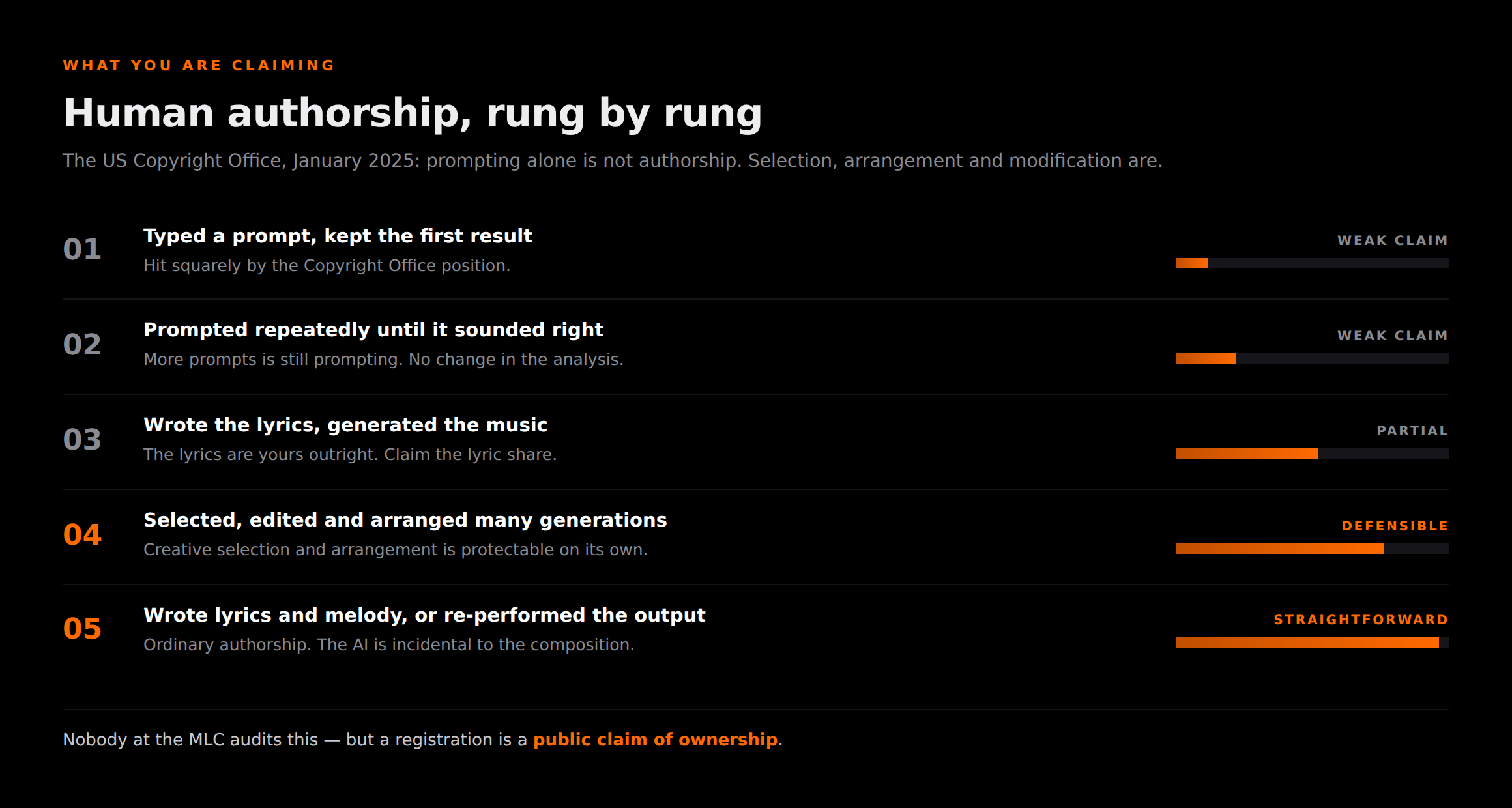
Legally it is a different question, and this is where every other guide on this topic stops. A work registration is a claim of ownership in a musical work. In January 2025 the US Copyright Office published Part 2 of its report on copyright and artificial intelligence and concluded that prompting alone does not supply the human authorship copyright requires, because a prompt does not give a person control over how the idea is expressed. The same report is clear about what does count: creative selection, coordination and arrangement of AI-generated material, and creative human modification of it, are protectable.
So the question is not "is my music AI". It is what did you actually write. Find yourself honestly in this table before you file anything.
| What you actually did | Human authorship in the composition | Registering it is |
|---|---|---|
| Typed a prompt, kept the first generation | Weak — the Copyright Office position hits this squarely | A claim you would struggle to defend |
| Wrote the lyrics yourself, generated the music | The lyrics are yours outright | Reasonable on your lyric share |
| Wrote lyrics and melody, generated arrangement and production | Substantial | Straightforward |
| Generated many parts, then selected, edited and arranged them | Protectable as selection and arrangement | Reasonable on the arrangement |
| Re-sang, replayed or rewrote the generated output | Ordinary authorship, AI incidental | No different from any other song |
Nobody at the MLC audits this. The consequence of a thin claim is not a rejection letter, it is that you have made a public assertion you cannot support if someone contests it — and in a niche where thousands of people prompt the same models with similar words, contests are not hypothetical. Our longer treatment of the ownership question is in can you copyright AI music, and it is worth reading before you register a catalogue rather than a song.
What Suno's September 2026 terms actually grant you
People assume a paid generator subscription settles this. It does not, and the September 2026 rewrite made that more explicit rather than less. Suno's terms, effective 3 September 2026, moved the language from ownership to granted commercial rights, tied commercial exploitation to a permitted download inside your tier's allocation, and set those allocations at seven lifetime trial downloads on the free tier, twenty a month on Pro and sixty a month on Premier.
The sentence that matters
A paid Suno plan grants you the commercial rights to exploit output you downloaded while subscribed. It does not warrant that an enforceable copyright exists in that output for you to own. Those are different promises, and only the first one is being made.
That distinction is the whole reason the authorship table above matters. A commercial licence from a generator lets you release and sell the track. It cannot manufacture the copyright that a mechanical royalty is paid on, because that is not the generator's to give. Our sister site keeps a tier-by-tier audit of what each Suno tier actually grants if you need the clause-level version.
Registering with the MLC, step by step
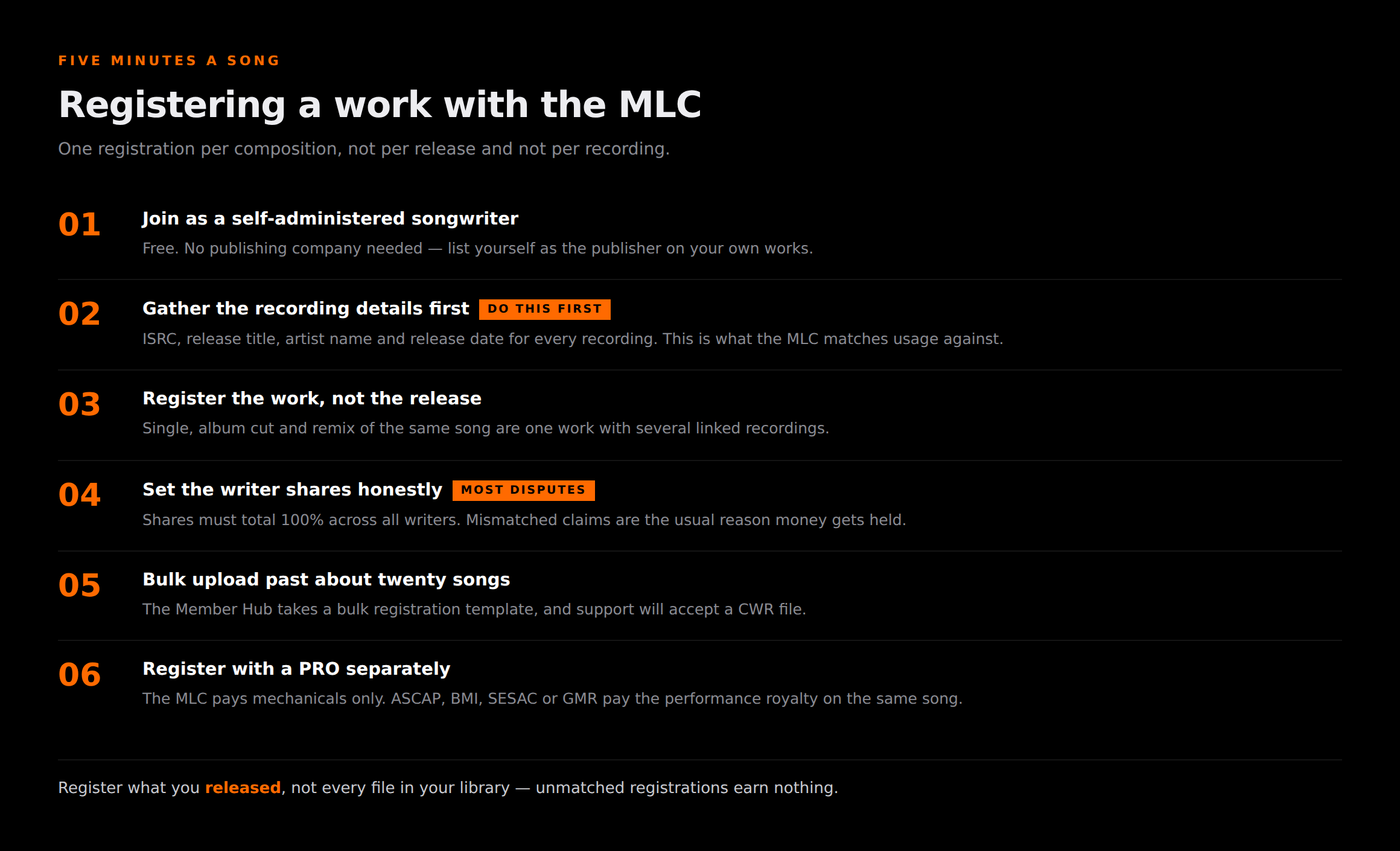
If you cleared the authorship question, the rest is admin. Set aside an evening for a catalogue and about five minutes for a single song. You are creating a member account, then filing one work registration per composition — not per release, and not per recording.
Membership is free. If you have no publishing entity, you list yourself as the publisher on your own works — no company formation, no lawyer, no fee.
Have the ISRC, release title, artist name and release date for every recording of the song. These are what the MLC uses to match usage reports to your registration.
One registration per composition. If a song exists as a single, an album cut and a remix, that is one work with several linked recordings.
Shares must total 100% across all writers. If a collaborator wrote the lyrics, their share goes in here, and mismatched claims are the most common reason money gets held.
The Member Hub takes a bulk work registration template, and support will take a CWR file. Entering three hundred AI tracks one at a time is not a plan.
The MLC handles mechanicals only. ASCAP, BMI, SESAC or GMR handle the performance royalty on the same composition, and neither one covers the other.
One practical warning specific to generated catalogues: register the songs you actually released and are promoting, not every file in your library. A registration you cannot tie to an ISRC on a live release earns nothing and adds noise to the matching process the MLC has spent five years improving.
Free yourself, or 20% to an administrator
The alternative to filing is paying a publishing administrator to file for you, worldwide, and take a permanent cut of what they collect. That is a real service and for some catalogues it is the right call, but the pricing deserves to be seen next to the free option rather than instead of it. Every figure below came off the company's own page on 9 September 2026.
| Route | Up front | Cut of what they collect | Territory | Registers with the MLC for you? |
|---|---|---|---|---|
| Register yourself with the MLC | $0 | 0% | United States only | You are the MLC member |
| Songtrust | $100 one time per songwriter | 15% performance, 20% mechanical | Worldwide | Yes |
| TuneCore Publishing | $75 one time per songwriter | 20%, and 50% on sync | Worldwide | Yes |
| Distributor alone, e.g. DistroKid | $24.99–$89.99 a year | 0% of the recording | Worldwide recordings | No — no publishing add-on listed |
The honest decision rule is geography. If your listeners are overwhelmingly American — which, for most AI catalogues seeded on US platforms, they are — the MLC covers the money that exists and an administrator is charging 20% forever to collect foreign royalties you do not currently earn. If you are genuinely global, or you have more songs than patience, the cut buys real coverage. What is never defensible is paying nobody and registering nowhere.
What the MLC will never pay you for
The MLC administers the US blanket mechanical licence created by the Music Modernization Act. That is a precise scope, and most explainers blur it into "the MLC pays songwriters", which sends people looking for money in the wrong place.
| Income | Paid by the MLC? | Who pays it instead |
|---|---|---|
| US on-demand streams, composition side | Yes | The MLC, monthly |
| US downloads and limited downloads, composition side | Yes | The MLC |
| Streams outside the United States | No | That territory's collecting society |
| Performance royalties anywhere | No | Your PRO |
| Anything attached to the sound recording | No | Your distributor |
| YouTube Content ID revenue | No | Content ID, via your distributor |
| Sync placements in TV, film, games and ads | No | Nobody collects it — it is negotiated |
That last row is the one worth sitting with. Sync is the only line in the table where the number is not fractions of a cent, and it is also the only one with no collecting society, no queue and no automatic payment — someone has to pitch the track and negotiate a fee. If you want that route open, you need a place to sell and pitch from: played.fm handles paid sync placements and direct sales to listeners, which is a different kind of income from anything the MLC administers. Registering your compositions and pitching for sync are not alternatives; they cover opposite ends of the same catalogue.
For the platform-side rules that decide how many of those US streams you get in the first place, our Spotify AI music policy breakdown covers the AI Persona badge and what being labelled costs in reach.
The unmatched pool, and why late registration costs you
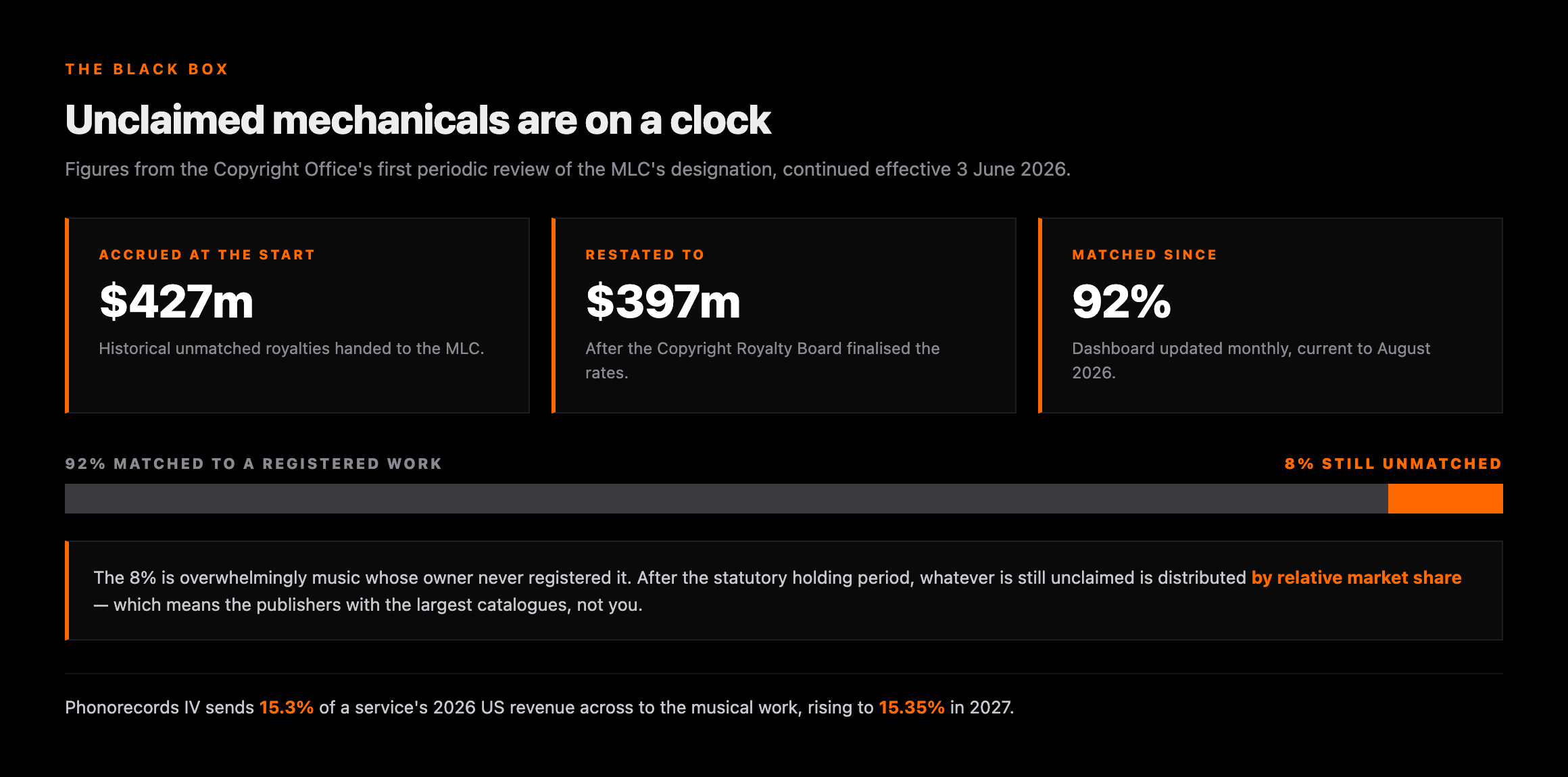
When a stream is reported and no registered work matches it, the money does not disappear and it does not go back to Spotify. It goes into the unmatched pool, the black box, and it waits. The MLC received roughly $427 million in accrued historical unmatched royalties at the start, restated to about $397 million after the Copyright Royalty Board finalised the rates, and it publishes a dashboard of what has been matched since, updated monthly and current to August 2026.
The part that should move you is what happens at the end. Under the Music Modernization Act, royalties still unmatched and unclaimed after a statutory holding period are distributed to copyright owners based on relative market share. Market share means the publishers with the largest catalogues. Your unregistered mechanicals are not being held for you indefinitely; they are on a clock, and at the end of it they are paid to somebody else entirely lawfully.
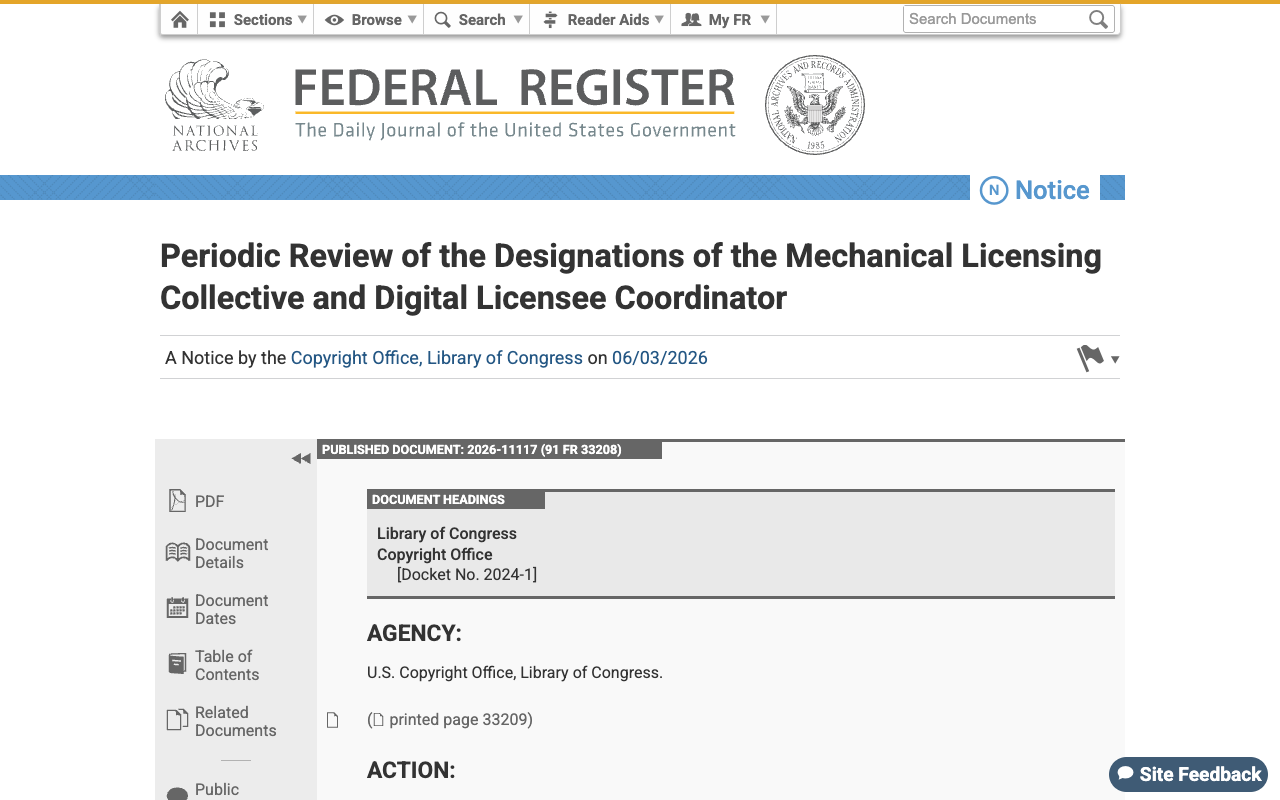
Those figures come from the Copyright Office's first periodic review of the MLC's designation, which continued it effective 3 June 2026. Read them as reassurance about the plumbing and as a warning about the queue: 92% matched is very good, and the 8% that is not matched is overwhelmingly music whose owner never registered it.
Is it worth it for an AI catalogue?
Straight answer: on a hundred streams, no, the mechanical royalty is a rounding error. Under the Phonorecords IV schedule the headline rate crossing to the musical work in the US is 15.3% of an interactive service's revenue in 2026, rising to 15.35% in 2027, and the mechanical share is what remains after the service pays the performing rights organisations. Split across a catalogue with modest play counts it is small money per song per month.
It is worth it for a different reason: it accumulates, it costs nothing, and it is the one income line in this niche that does not require anyone to discover you again. A song registered once keeps earning on every subsequent stream for as long as the release stays up. That last condition is doing more work than people expect. Mechanical royalties are paid on streams that happened, so the release has to clear the distributor's automated AI screening to go out, and it has to stay live afterwards — which is why clearing generation artifacts and screening flags before submission belongs upstream of any of this. A registration against a release that was rejected pays exactly zero.
And be realistic about the ceiling. Nothing here fixes the actual problem in AI music, which is that almost nobody is listening; it fixes the problem of not being paid for the listening that does happen. Those are worth separating in your head. If you want the workflow that gets a generated track through screening in the first place, that is our 12-step release checklist, and the revenue routes that do not depend on streaming are in how to sell Suno music.
Before the registration can earn
A registered song only pays if the release stays live
Undetectr repairs generation artifacts and clears the markers that trip a distributor's automated screening, so the release you registered actually ships and keeps streaming.
Keep reading
Frequently asked questions

Cara Whelan — Policy Editor, Erasy
Cara covers platform policy for Erasy — pricing changes, terms updates and the rules that decide what you can actually do with the music you generate. They work from primary announcements and FAQs rather than the coverage of them, and date every figure so you know when it was last checked.
Can you register AI-generated music with the MLC?+
How much does it cost to join the MLC?+
Doesn't my distributor already collect mechanical royalties for me?+
What happens to mechanical royalties nobody claims?+
Does the MLC pay for streams outside the United States?+
Do I still need ASCAP or BMI if I register with the MLC?+
How much is a mechanical royalty actually worth per stream?+
Will registering with the MLC expose my catalogue as AI-generated?+
Disclosure: Erasy is an independent guide to AI music cleanup, and Undetectr is the tool we use and link to. Membership, registration and scope details are from The MLC's own member pages and its historical royalties dashboard, current to August 2026. The human authorship position is from Copyright and Artificial Intelligence, Part 2, published January 2025. The continued designation of the MLC and the 53 million works, 80,000 members and 92% match figures are from the Copyright Office periodic review published 3 June 2026. Administrator prices were read from Songtrust, TuneCore and DistroKid on 9 September 2026. Nothing here is legal advice, rates and terms change without notice, and a rights question about a specific catalogue is worth an hour of a music lawyer's time.