AI Music
The Majors Sued Suno and Bought Into Stability AI: What Changes

The most-upvoted AI-music thread of the fortnight says “Sony & UMG launch their own music ai”, and 158 people agreed with it. It is wrong, and the correction matters more than the headline did: the major labels' Stability AI investment was an equity stake, not a product launch — a $76m Series B announced on 25 August 2026 in which Universal, Sony and Warner all bought in alongside Electronic Arts.
Nobody launched anything you can sign up for. But something did happen that reaches your release, and no article covering the round has joined it up: the company the majors bought into sells its models on a fully licensed training data claim, and three distributors have quietly stopped asking whether your track is AI and started asking what your model was trained on. We read the funding announcement, all three distributor policies and both Suno complaints at source on 29 September 2026. Where a figure is our arithmetic rather than someone's published number, the line says so.
The short version
- No major launched a music AI. UMG, Sony Music Group and Warner Music Group took equity in Stability AI's $76m Series B on 25 August 2026, with Electronic Arts in the same round.
- It is the first time all three majors have backed one AI company in a single round — and the money follows alliances that already existed: UMG signed with Stability in October 2025, Warner in November 2025.
- Three distributors now gate on the model, not the track. TuneCore, Symphonic and Downtown (CD Baby) all test whether your generator's training data was licensed. DistroKid, RouteNote and UnitedMasters publish no such test.
- Suno is licensed and litigated at once. Warner settled and signed; BMG and Believe signed; UMG and Sony filed again on 18 September 2026 over the v6 models.
What actually happened, in four facts
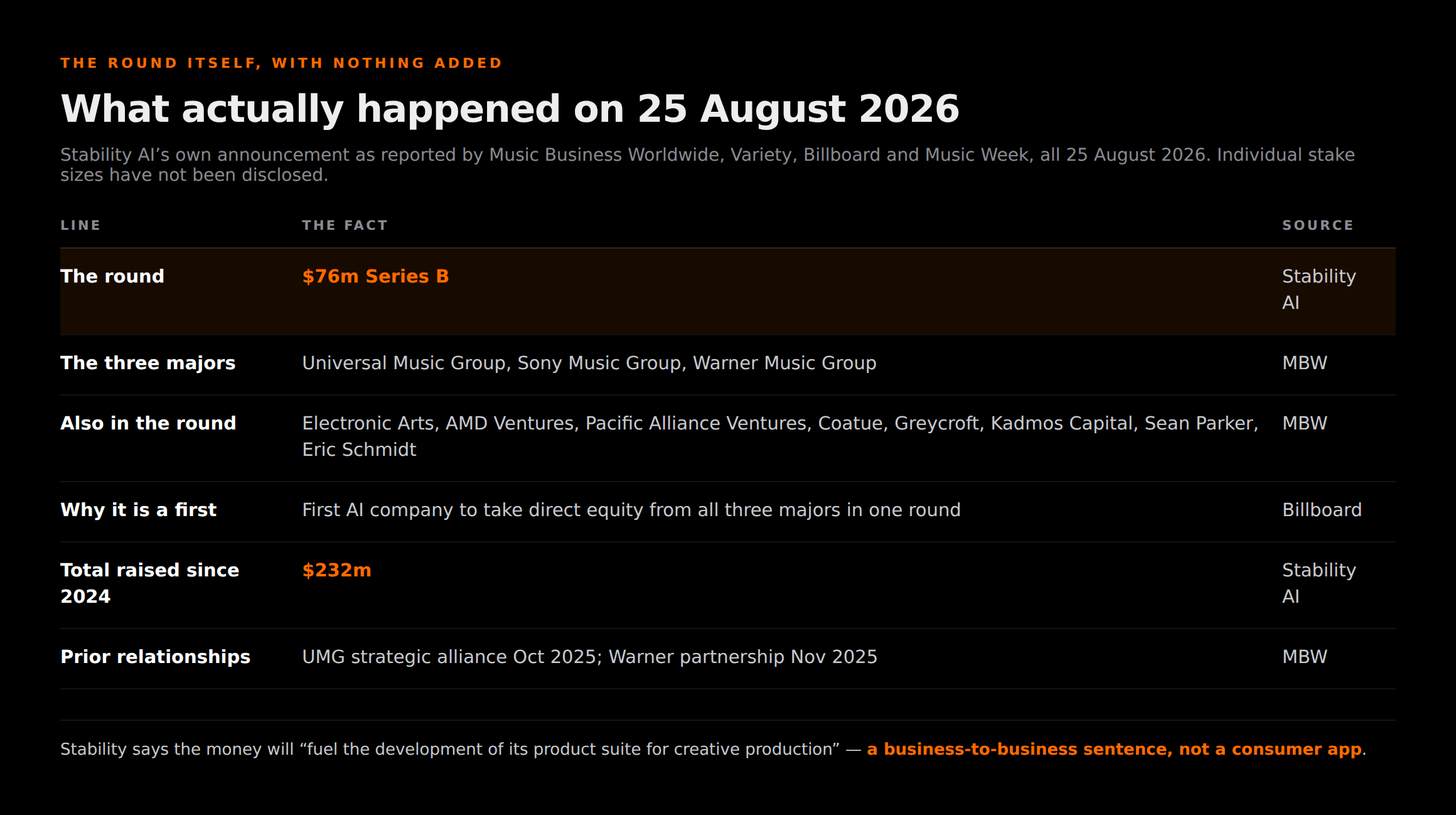
Every version of this story that reached Reddit lost the distinction between buying part of a company and building a product. Here is the round as Stability, Music Business Worldwide, Billboard and Variety all reported it, with nothing added.
| What | The fact | Source |
|---|---|---|
| The round | $76m Series B, announced 25 August 2026 | Stability AI; MBW; Variety |
| Who joined | Universal Music Group, Sony Music Group, Warner Music Group and Electronic Arts — plus AMD Ventures, Pacific Alliance Ventures, Coatue, Greycroft, Kadmos Capital, Sean Parker and Eric Schmidt | MBW, 25 Aug 2026 |
| What is new about it | The first time all three major music companies have taken direct equity in one AI company in a single funding round | Billboard, 25 Aug 2026 |
| Total raised to date | $232m since Prem Akkaraju became CEO in 2024 | Stability AI |
| What the money is for | To “fuel the development of its product suite for creative production, deepen its applied research discipline, and expand its professional services arm” | Stability AI, quoted by MBW |
Read the last row twice, because it is the one that kills the rumour. Production tooling, research and professional services is a business- to-business sentence. It is not the description of a consumer app that competes with the thing you already pay for.
Why three companies suing AI firms invested in one
This is the part the threads are groping toward, and they are not wrong to find it strange. Two of these three companies are in active litigation against an AI music generator. All three just wired money to a different one.
The record explains more than it first appears. The equity did not arrive out of nowhere: UMG entered a strategic alliance with Stability in October 2025 to co-develop responsibly-trained AI music tools, and Warner announced its own partnership in November 2025. The August round follows two relationships that were already a year old. Electronic Arts, likewise, is a games company with an obvious appetite for licensed audio generation.
So the honest reading is shaping-and-licensing rather than product-launch: the majors are buying influence over a company that builds on licensed data, at the same time as they litigate against one they say did not. The popular thesis on Reddit goes further — that the lawsuits exist to clear the field for the labels' own horse. That is a reading, not a fact. Nobody outside those boardrooms knows the motive, and we are not going to pretend the public record settles it.
Stable Audio 3.0 and the licensed training data claim
Here is the fact that actually reaches your release. Stable Audio 3.0, released on 21 May 2026, is a family of four models that generate tracks over six minutes long; three of the four are open-weight, and an 18 August 2026 plugin puts them inside Ableton, Logic, Cubase and Reaper. Stability's ownpage markets them as “Commercially safe models, trained on fully licensed datasets”, with legal indemnification under the enterprise licence. The published corpus is 1,278,902 recordings — 806,284 licensed from the production library AudioSparx and 472,618 from Freesound under CC-0, CC-BY and CC-Sampling+.
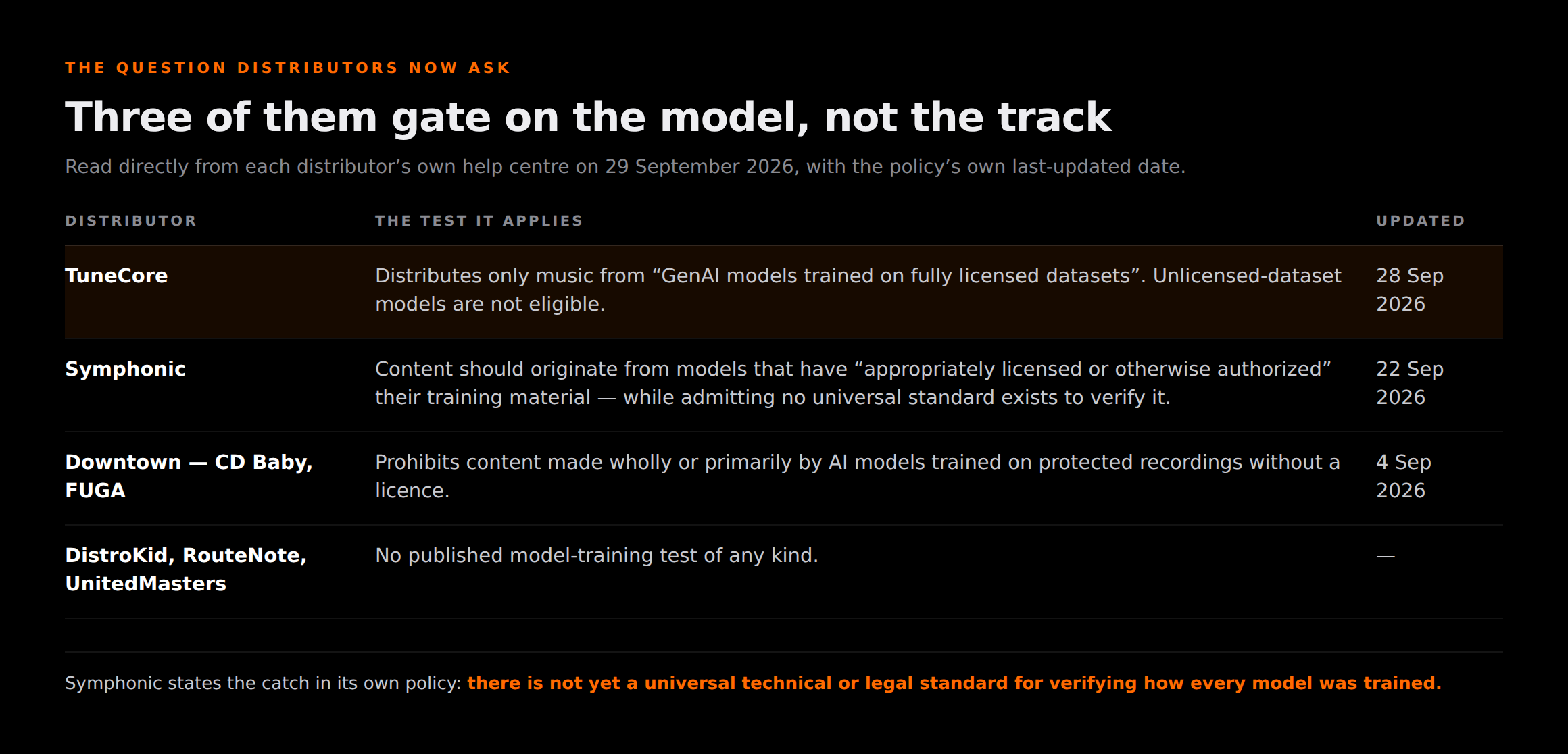
That claim used to be marketing. In 2026 it is a distribution test. Three distributors have moved from asking whether a track is AI to asking what the model was trained on, and we read all three policies at source rather than in a roundup:
| Distributor | The test it applies | Policy updated |
|---|---|---|
| TuneCore | “TuneCore only distributes music created using GenAI models trained on fully licensed datasets. Music created using models that rely on unlicensed datasets is not eligible for distribution.” It has partnered with Google Flow Music as a route it treats as distribution-ready. | 28 Sep 2026 |
| Symphonic | Works to ensure fully AI-generated content “originates from models and services that have appropriately licensed or otherwise authorized the materials used to train and operate their systems” — while stating plainly that “there is not yet a universal technical or legal standard for verifying how every model was trained”. | 22 Sep 2026 |
| Downtown (CD Baby, FUGA) | “Content created wholly or primarily by AI models trained on copyright protected sound recordings without a license from the applicable copyright owners is prohibited.” AI content mimicking popular artists is separately banned. | 4 Sep 2026 |
| DistroKid, RouteNote, UnitedMasters | No published model-training test. They publish AI policies, but none of them turns on where the generator's training data came from. | — |
Note what Symphonic admits in the same breath as its rule: it cannot reliably verify the answer. That is the honest state of this gate in 2026 — a real test, unevenly enforced, with the burden sitting on a disclosure you make at upload. A model with a public licensing claim is the one that survives the question when it is asked.
Suno and Stability, side by side
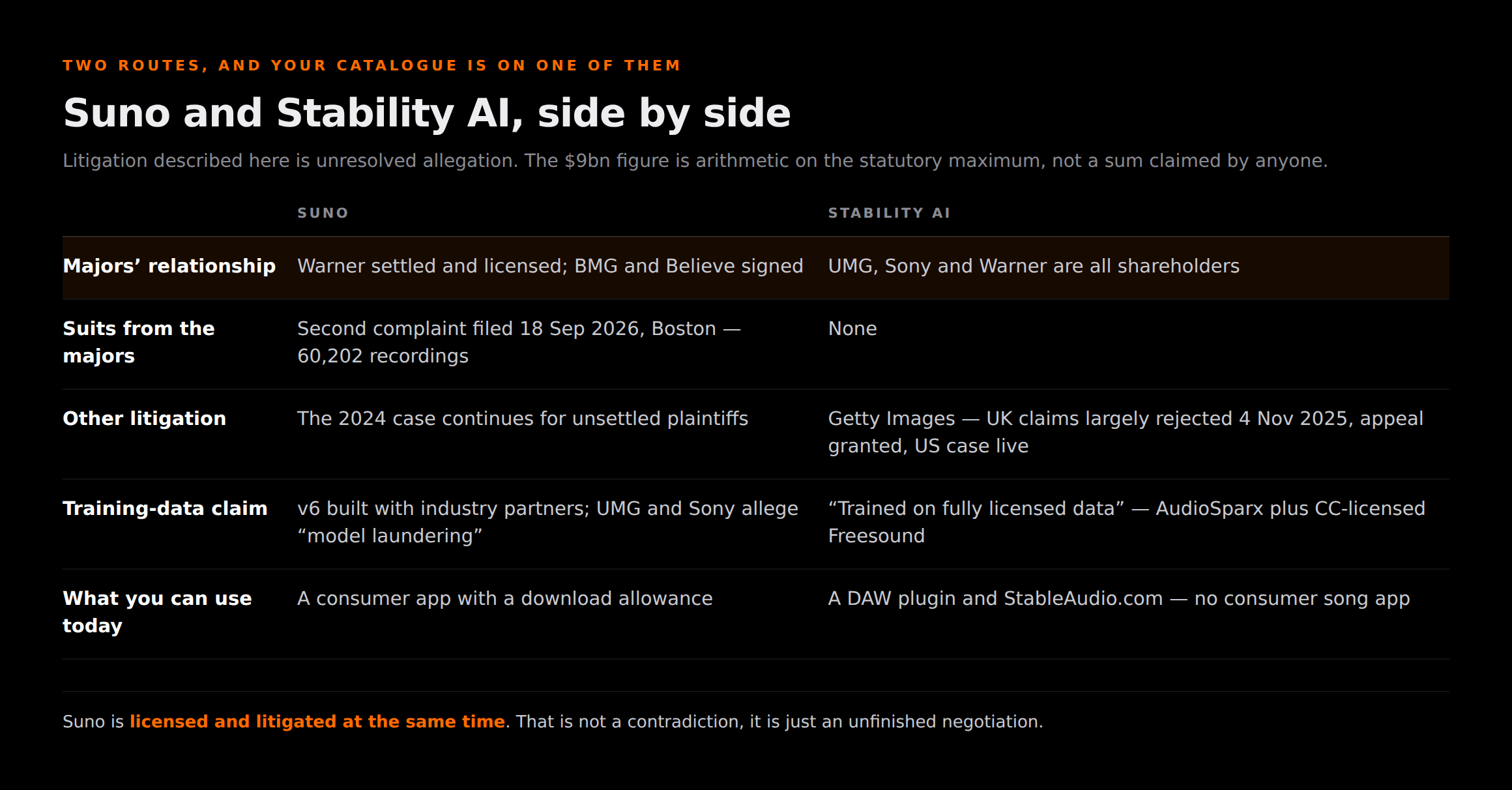
Two companies, two routes to the same destination, and most readers of this site have a catalogue sitting on one of them.
| Suno | Stability AI | |
|---|---|---|
| Major-label relationship | Warner settled and signed a licence; BMG and Believe signed deals. UMG and Sony have not settled. | UMG, Sony Music Group and Warner Music Group are all shareholders as of 25 Aug 2026. |
| Litigation from the majors | Second suit filed 18 Sep 2026 in Boston federal court, covering 60,202 recordings. | None. All three majors are investors. |
| Other litigation | The 2024 case continues for the unsettled plaintiffs. | Getty Images. UK High Court largely rejected the copyright claims on 4 Nov 2025; Getty granted leave to appeal 16 Dec 2025; a US case is active in N.D. Cal. |
| The training-data claim | v6 described as developed with industry partners. UMG and Sony allege it was trained on interactions with earlier, unlicensed models — what they call “model laundering”. Suno calls the claims fundamentally flawed. | “Trained on fully licensed data”: AudioSparx plus CC-licensed Freesound, counts published. |
| What you can actually use | A consumer app at suno.com with a subscription and a download allowance. | A DAW plugin and StableAudio.com. No consumer song-generation app. |
One number needs defusing before it spreads any further. The $9bn figure attached to the second Suno suit is not a sum anyone has demanded. It is 60,202 recordings multiplied by the $150,000 statutory maximum for wilful infringement — arithmetic on a ceiling, done by reporters, not a claim in the complaint. We have written up what the Suno lawsuits mean for songs you have already released on our sister site, and UMG's separate complaint against DistroKid is covered on Artifactr. Everything in both is allegation until a court says otherwise.
What the major labels' Stability AI investment changes for a track you have already released
This is the section every news piece skips, so here it is as a situation table. Nothing in this round removes a live track from anywhere. The exposure is at your next upload.
| Your catalogue | What the gate asks | Outlook | What to do now |
|---|---|---|---|
| Pre-v6 Suno back catalogue | Was the model trained on licensed data? | Fails TuneCore's test as written. Fine on distributors with no model test. | Do not migrate it to TuneCore expecting it to pass. Keep it where it already ships. |
| New Suno v6 output | Same question, contested answer. | Suno says industry partners; UMG and Sony allege otherwise. Unresolved. | Disclose accurately at upload. Do not claim a licence status nobody has confirmed. |
| Made on a licensed model | Answerable, with a public source. | The one catalogue that clears the training-data gate cleanly. | Keep the model's licensing page; it is the evidence if you are ever asked. |
| Open-source model, unknown data | Unanswerable. | The weakest position — “I don't know” reads the same as no licence. | Find out before your next release, or move new work to a model that publishes its corpus. |
And note the failure mode that has nothing to do with any of this. Training-data licensing decides whether a distributor accepts your catalogue in principle. It does not get an individual file through the automated screening at intake, which is a separate machine looking at the audio itself — watermark signals and generation artifacts — and it is the one that produces the rejection emails people actually post about.
The other gate, the one that reads the audio
A licensed model answers the policy question. It does not clean the file.
Undetectr targets the watermark signals and generation artifacts that distributors screen for at intake. It has nothing to do with training-data policy, and it does not change how any platform labels or credits your release — no tool can do that. €19 for 10 tracks, or €39 one-time for unlimited.
What it does not change
Now the deflation, because this page would be dishonest without it. None of this makes a single person listen to your music. An equity round does not create an audience. The most consistent thing anyone says in these forums is not that distribution is hard — distribution has been solved for years and costs about $25 a year — it is that nobody can find listeners once the track is up.
Which is why the useful response to a funding announcement is not to change models. It is to stop depending on algorithmic discovery for income. The money in music for a catalogue this size is in paid sync placements — TV, film, games and ads, where a single brief pays more than a year of streaming and nothing has to trend first — and after that in selling direct to the people who already like your work, keeping the whole price rather than a share of a pool. Worth knowing before you plan around a storefront: Bandcamp, the platform most “just sell direct” advice points at, banned music generated wholly or in substantial part by AI on 13 January 2026.
We ran the arithmetic on both routes in 1,000 streams versus one sale, and the fair summary of what the AI-music backlash gets right is that the audience problem is real and no licensing news touches it.
Who owns a piece of which AI music company
The reference table, strictly limited to announced and sourced arrangements. Where the record is silent we have left it silent rather than guessing at stake sizes, none of which have been disclosed.
| AI company | Music-industry backers | Form | Announced |
|---|---|---|---|
| Stability AI | Universal Music Group, Sony Music Group, Warner Music Group (plus Electronic Arts) | Equity, $76m Series B. Preceded by a UMG strategic alliance and a Warner partnership. | 25 Aug 2026 (alliances Oct and Nov 2025) |
| Suno | Warner Music Group, BMG, Believe | Licensing deals; Warner's settled its litigation. UMG and Sony are suing. | 2026 |
| Symphonic (distributor) | Sureel, Musical AI | Opt-in dataset licensing: artists elect to make their catalogue eligible for AI training deals, default split 80% artist / 20% Symphonic on net revenue. | Addendum updated 24 Sep 2026 |
The Symphonic row is the one nobody expects, and it is the clearest illustration of where this is heading: the same industry arguing over who may train on what is quietly building the machinery to sell that permission by the account.
The one-line version
The majors did not build a competitor; they bought a seat at a company whose selling point is licensed training data, at the exact moment licensed training data became something distributors check. Whether your next release ships is now partly a question about a model you did not build — so know the answer before you are asked it.
Related articles
- Spotify AI music policy 2026: what is allowed and what is not
- AI music backlash 2026: what the critics get right
- Suno refund 2026: can they cap downloads you already paid for?
- 1,000 streams vs one sale: what AI music actually pays
- Can you sell AI-generated music? Where, and what it pays
- Cleaning AI-generated music for release: the checklist
Frequently asked questions

Eddie Mathews — Editor, Erasy
Eddie reads the filing and the help-centre article rather than the roundup, and marks the difference between what a company has said and what a forum has concluded. Where the public record does not settle a question, this site says so.
Did the major labels launch their own AI music generator?+
What is Stable Audio 3.0?+
Is Stability AI being sued?+
Does using a licensed AI model get my music past distributors?+
Is Suno licensed now?+
Did UMG settle with Suno?+
Does any of this affect music I have already released?+
Disclosure: Erasy is an independent guide to AI music cleanup, and Undetectr is the tool we recommend and link to. Sources checked at source on 29 September 2026: the $76m Series B, investor list, $232m total and use-of-proceeds quote from Stability AI's announcement as reported by Music Business Worldwide, Variety and Billboard (25 August 2026), which is also the source for the UMG October 2025 and Warner November 2025 alliances; Stable Audio 3.0's release date, model family, licensing claim and training corpus from Stability AI's own product pages and Digital Music News; distributor policies read directly from TuneCore's GenAI Music Content Framework (updated 28 September 2026), Symphonic's Stance on Generative AI and DSP reference guide (22 September 2026), Symphonic's AI & Dataset Licensing addendum (24 September 2026) and Downtown Music's Content Policy Rules as published in CD Baby's help centre (4 September 2026); the second Suno complaint, its 60,202-recording count and Suno's response from Variety, The Hollywood Reporter and Digital Music News (18–22 September 2026); Getty Images v Stability from the English High Court judgment of 4 November 2025 and subsequent appeal reporting; Bandcamp's policy from its own 13 January 2026 post. The $9bn exposure figure is arithmetic on the statutory maximum, not a sum claimed, and is labelled as such above. Stake sizes in the Series B have not been disclosed. Litigation described here is unresolved allegation, and nothing on this page is legal advice.