AI Music
AI Music Backlash 2026: What the Critics Get Right, and What They Get Wrong
Every AI music thread arrives at the same place. Somebody posts a track they are proud of, somebody else calls it slop, and a hundred comments later nobody has cited a single number. Meanwhile the AI music backlash has stopped being a comment-section argument and started being court rulings, chart bans and recommendation policy — decisions that change what your release can actually do.
So we went through the charges one at a time against the primary sources: a 9,000-person blind listening study, a peer-reviewed paper on what people say versus what they do, Deezer's own upload and stream figures, the Munich judgment against Suno, CISAC's economic modelling and SubmitHub's scan of over a million releases. Three of the loudest claims do not survive it. Three quieter ones survive completely, and those are the ones that will cost you something.
Key takeaways
"Anyone can hear it" is the weakest claim in the whole argument. 97% of 9,000 people across eight countries failed a blind test, and a 2026 peer-reviewed study found the stated preference for human-made music collapses within about 60 seconds of pressing play.
The aversion is social rather than sonic. The same study found listeners stay 15–25% less willing to share or endorse a track once they know it is AI — they like it, they just do not want to be seen liking it.
The flood is real in uploads and absent from listening. Around 90,000 fully AI tracks a day reached Deezer at the June 2026 peak — over half of new deliveries — for 1–3% of streams, about 85% of which were detected as fraudulent.
The consent complaint is now a judgment, not an opinion. On 31 July 2026 the Munich Regional Court found against Suno on training, memorisation and outputs, granting injunctive relief, disclosure and damages. It is not final.
Almost nothing framed as a ban is one. Spotify labels identities, Deezer withholds recommendation surfaces, Australia's charts exclude wholly AI records — and six major distributors accept AI music openly.
What the backlash is actually made of
The word "backlash" is doing too much work. Several unrelated complaints travel under it with wildly different amounts of evidence behind them, and bundling them is why every discussion turns into a shouting match. Separate them and something useful happens: some are yours to act on, one is being decided in a courtroom you are not in, and one is a matter of taste dressed up as a fact.
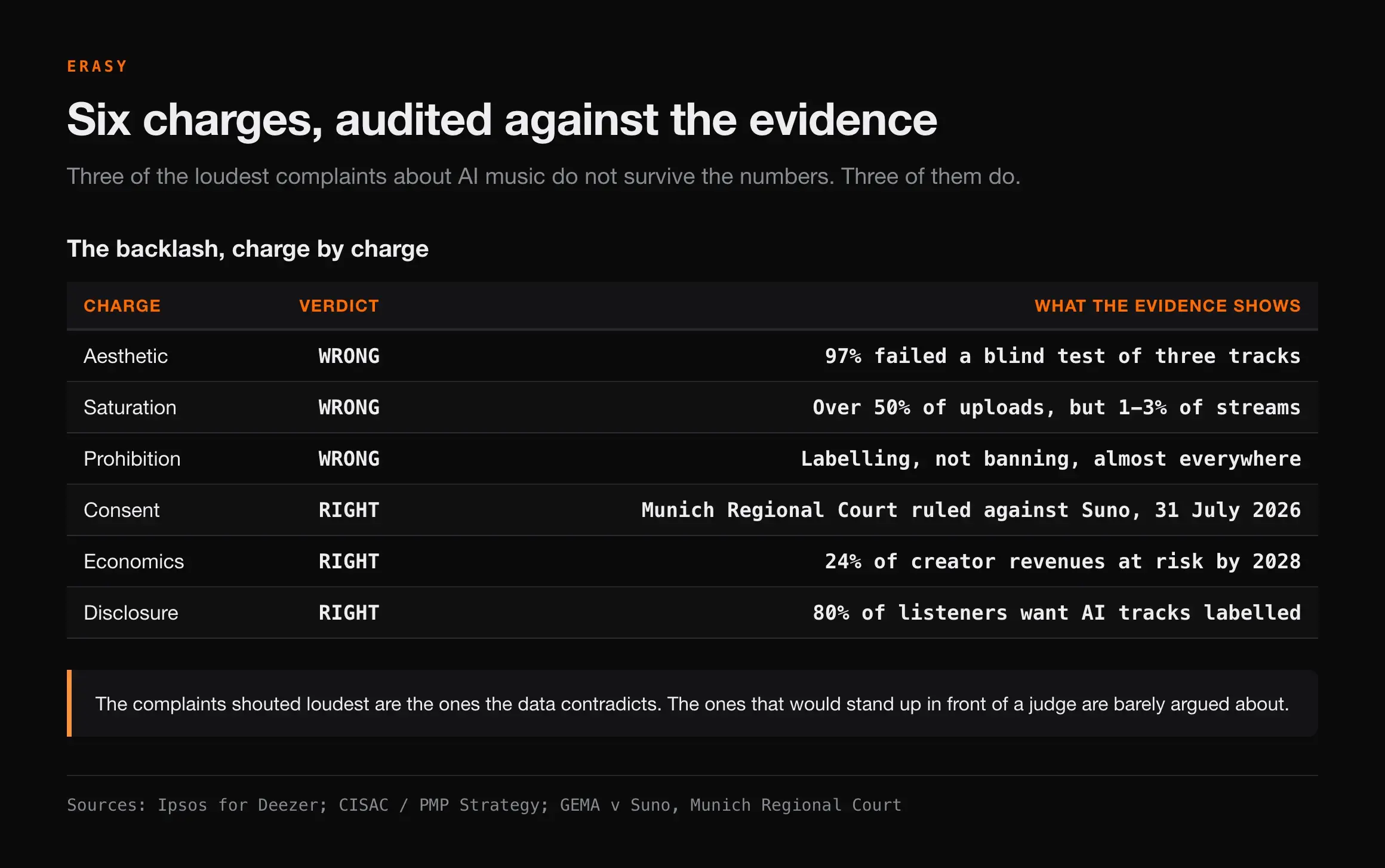
| The charge | What is claimed | What the evidence shows |
|---|---|---|
| Aesthetic | Listeners can hear that it is AI, and it is worse | 97% failed a blind test of three tracks (Ipsos/Deezer, 9,000 people); ratings converge after ~60 seconds of listening |
| Saturation | AI uploads are drowning out human artists | True of uploads — >50% of Deezer's daily deliveries at the June 2026 peak — but 1–3% of streams, ~85% of those fraudulent |
| Prohibition | Platforms and distributors are banning AI music | Mostly labelling and recommendation withholding; Bandcamp and Australia's charts are the real exclusions |
| Consent | The models were trained on copyrighted work without permission | Upheld in Germany: Munich Regional Court ruled against Suno on 31 July 2026; appeal expected |
| Economics | It takes money out of human creators' pockets | CISAC/PMP Strategy projects 24% of creators' revenues at risk by 2028, €10bn cumulative over five years |
| Disclosure | Listeners are not being told what they are hearing | 80% of surveyed listeners want fully AI tracks labelled; 38.5% of July 2026 releases involved AI by SubmitHub's scan |
Read down that right-hand column and the shape of the thing changes. The complaints that get shouted loudest are the ones the data contradicts, and the ones that would actually stand up in front of a judge are barely argued about at all. Take them in that order.
Wrong: "anyone can hear it is AI"
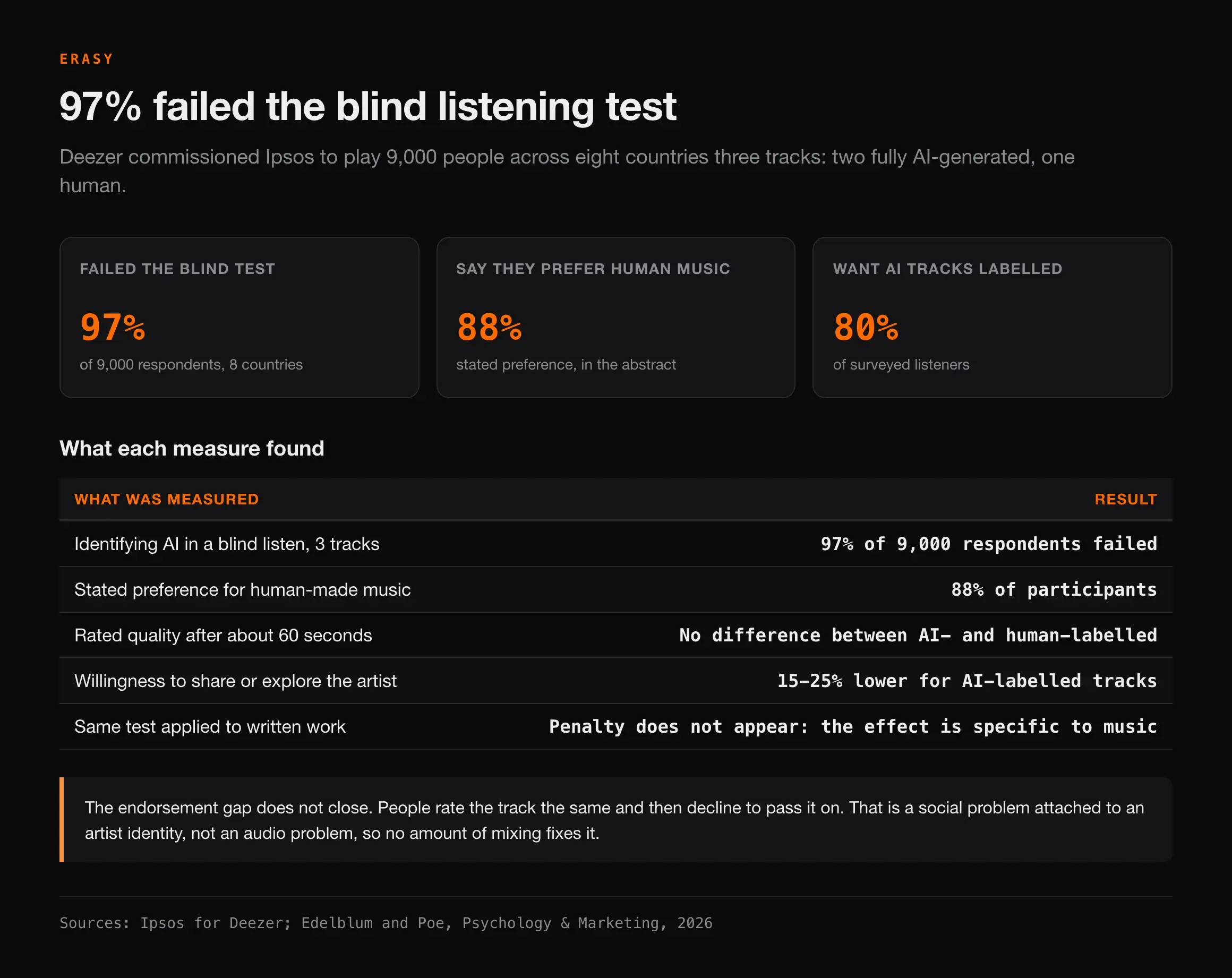
This is the most confidently repeated claim in the backlash and the one with the most evidence stacked against it. Deezer commissioned Ipsos to run what it billed as the first survey of attitudes to AI-generated music: 9,000 people across the United States, Canada, Brazil, the UK, France, the Netherlands, Germany and Japan, each played three tracks — two fully AI-generated, one human — and asked to identify which was which. 97% got it wrong. Of those, 71% said they were surprised by their own result and 52% said it made them uncomfortable.
That is one survey, and surveys can be built to flatter whoever paid for them. So the more interesting corroboration comes from a peer-reviewed paper published in Psychology & Marketing in 2026 — "Liking Without Endorsing", by Andrew Edelblum and Joshua Poe at the University of Dayton. Asked in the abstract, 88% of participants said they preferred human-made music. Once they actually pressed play, that preference vanished inside about a minute: the same song scored the same whether it was labelled AI or human.
| What was measured | Result | Source |
|---|---|---|
| Identifying AI in a blind listen (3 tracks) | 97% of 9,000 respondents failed | Ipsos for Deezer, 8 countries |
| Stated preference for human-made music | 88% of participants | Edelblum & Poe, Psychology & Marketing 2026 |
| Rated quality after ~60 seconds of listening | No difference between AI-labelled and human-labelled | Same study |
| Willingness to share or explore the artist | 15–25% lower for AI-labelled tracks | Same study |
| Same test applied to written work | Penalty persists — the effect is specific to music | Same study |
| Listeners who want fully AI tracks labelled | 80% | Ipsos for Deezer |
The last two rows are where this stops being a win for your side of the argument. The endorsement gap does not close. People rate the track the same and then decline to pass it on, and Poe's summary of the finding is the most quotable sentence in the entire literature: "They like it, they just don't want to be seen liking it." That is not an audio problem, so no amount of mixing fixes it. It is a social problem attached to your artist identity, and it is the honest reason a good AI track can get pleasant listens and no shares.
Wrong: "AI is drowning out human music"
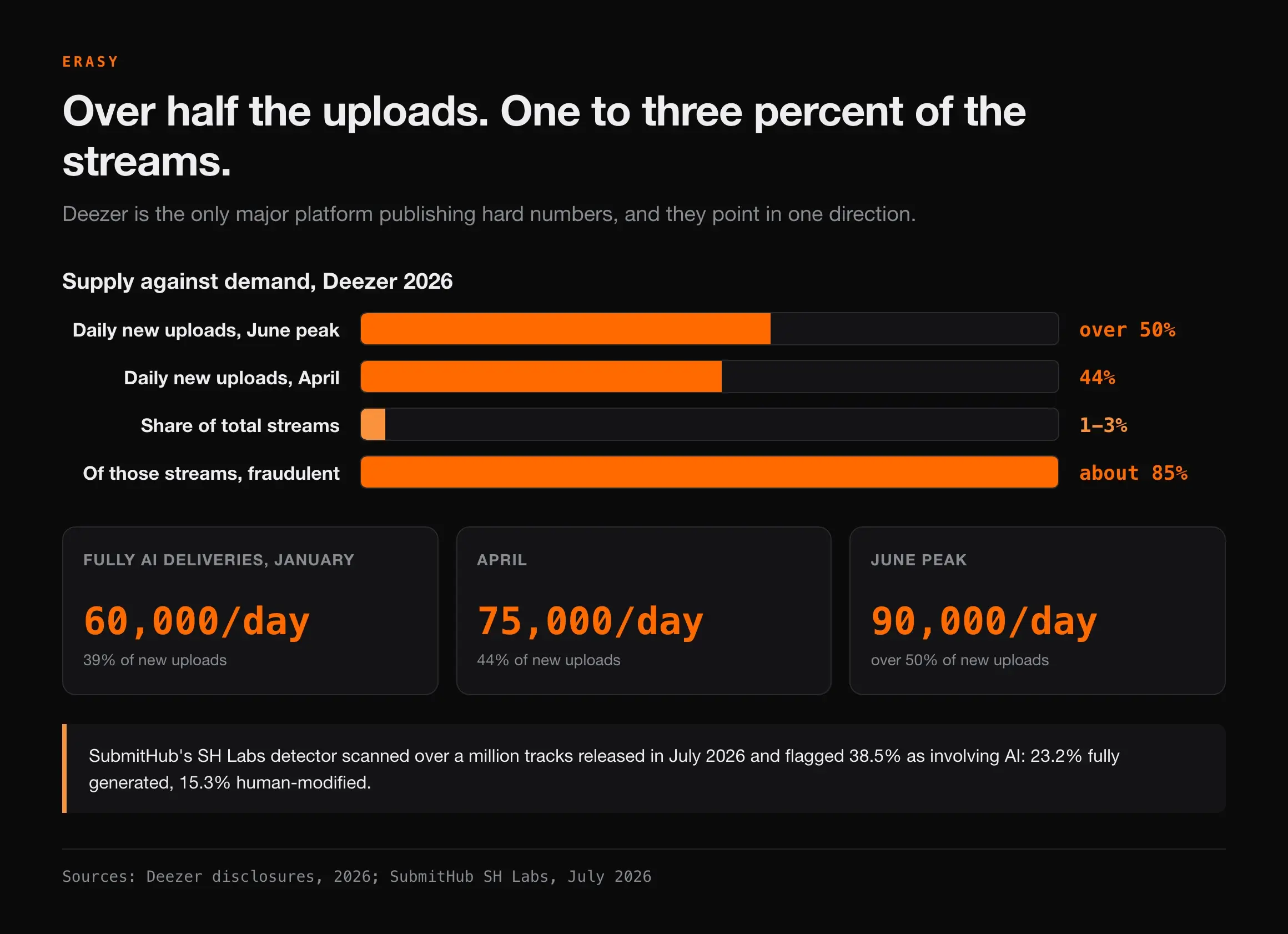
Deezer is the only major platform publishing hard numbers on this, and its numbers are genuinely startling — in one direction. Fully AI-generated deliveries went from about 60,000 a day in January 2026 (39% of new uploads) to roughly 75,000 in April (44%) to a June peak of around 90,000 a day, which took AI past half of all new music delivered to the platform for the first time.
Then the other half of the same disclosure, which travels far less widely: that torrent accounts for 1–3% of total streams, and Deezer detects roughly 85% of those streams as fraudulent and demonetises them. Strip the bot traffic out and the genuine listening share of the largest AI music supply on record rounds to somewhere under half a percent.
Deezer: AI-generated music, supply vs demand (2026)
Two things follow, and the second is not comfortable. The substitution story — listeners abandoning human artists for machine-made tracks — has no support in the only public data we have. But the flood still costs everyone something, because a catalogue growing at that rate makes every release harder to surface, yours included. The people complaining about the noise are not wrong about the noise. They are wrong about who is listening to it.
Pair it with the largest independent sample published so far: SubmitHub's SH Labs detector scanned over a million tracks released globally in July 2026 and flagged 38.5% as involving AI — 23.2% fully generated, 15.3% human-modified.
Wrong: "AI music is banned everywhere"
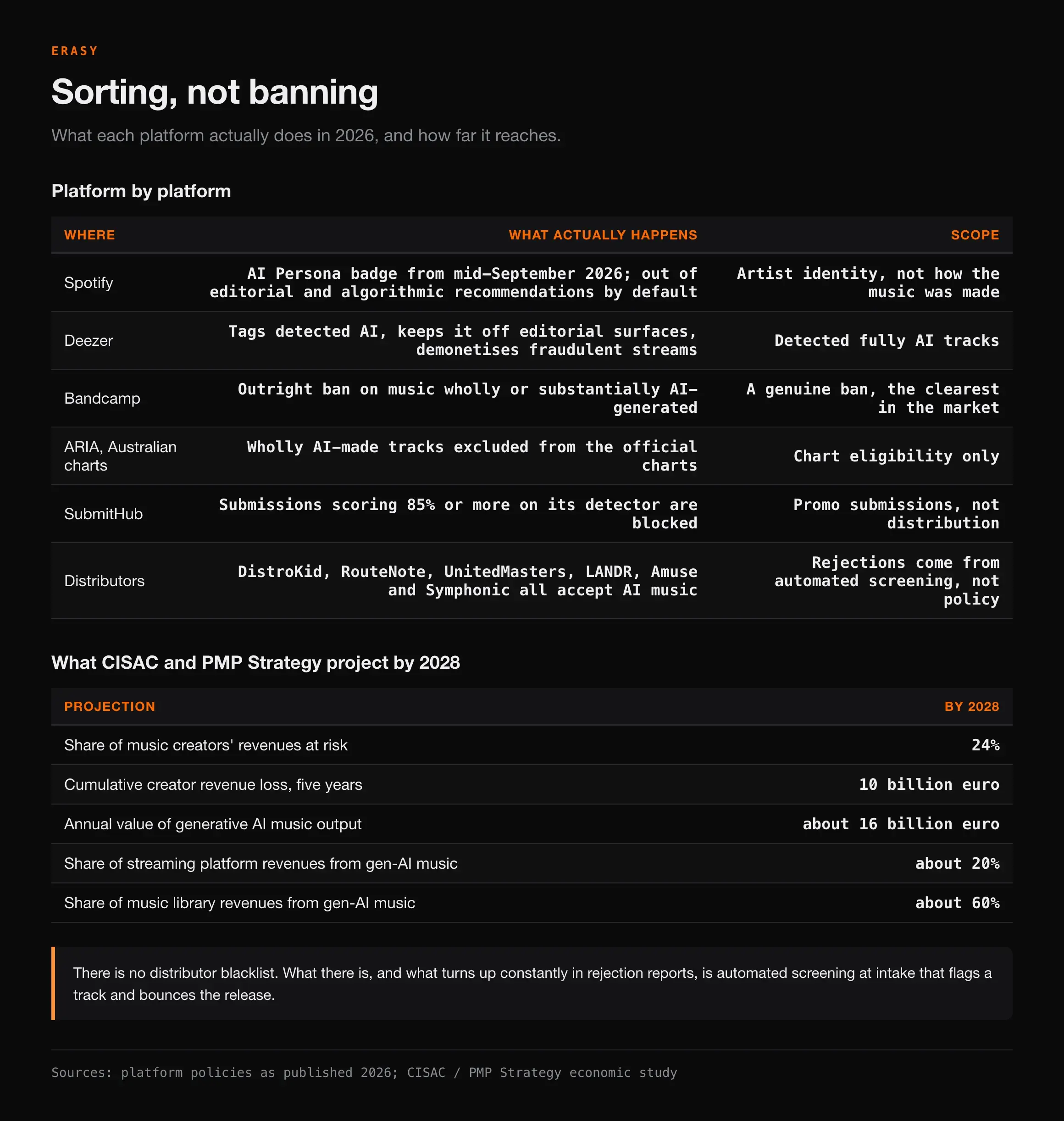
This gets repeated by people on both sides and it is close to backwards. What has actually happened in 2026 is a sorting exercise: fully human music unrestricted, AI-assisted music accepted with growing disclosure obligations, and wholly AI-generated work labelled, kept out of recommendations, or excluded from a few specific places. Bans in the plain sense are rare.
| Where | What actually happens | Scope |
|---|---|---|
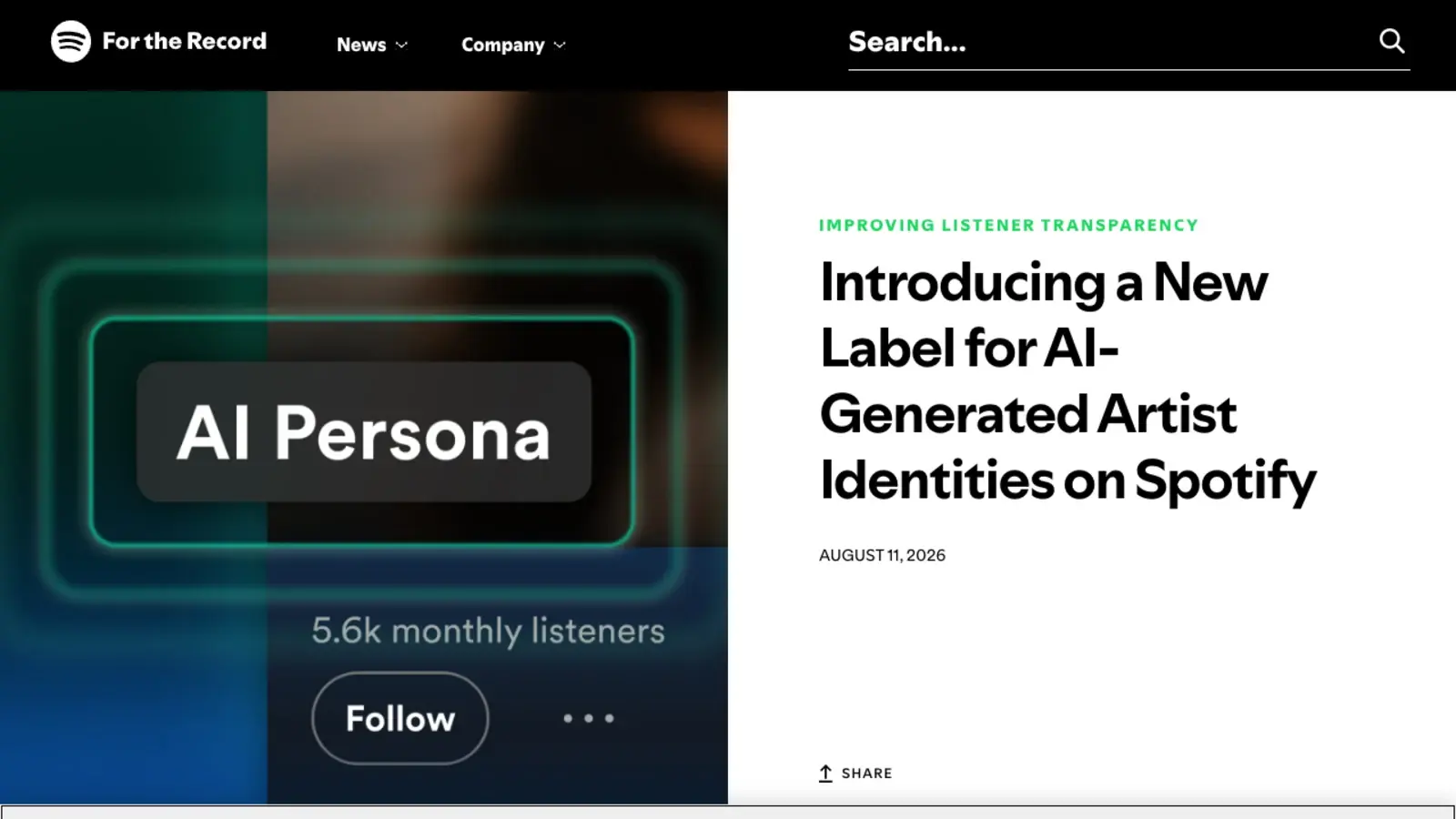
| Spotify | AI Persona badge from mid-September 2026; excluded from editorial and algorithmic recommendations by default unless a listener follows | Artist identity, not how the music was made |
| Deezer | Tags detected AI and keeps it out of editorial and algorithmic surfaces; demonetises fraudulent streams | Detected fully AI tracks |
| Bandcamp | Outright ban on music wholly or in substantial part AI-generated | A genuine ban — the clearest one in the market |
| Australian charts (ARIA) | Wholly AI-made tracks excluded from the official charts after the AI Madonna cover row, August 2026 | Chart eligibility; AI in a supporting role still counts |
| SubmitHub | Submissions scoring 85%+ on its detector are blocked, with no appeal | Promo submissions only, not distribution |
| Distributors | DistroKid, RouteNote, UnitedMasters, LANDR, Amuse and Symphonic all accept AI music openly | Rejections come from automated screening, not a policy ban |
That last row is the one people get wrong in both directions. There is no distributor blacklist for AI music. What there is — and what turns up constantly in real rejection reports — is automated screening at intake that flags a track and bounces the release, which feels identical to a ban from where you are standing and is a completely different problem to solve. We keep the platform detail current in our Spotify AI music policy guide.
Right: consent stopped being an opinion
Here the backlash is simply correct, and as of this summer it has a judgment behind it. On 31 July 2026 the 42nd Civil Chamber of the Munich Regional Court ruled for the German collecting society GEMA against Suno, largely as pleaded, over six musical compositions.
The court prohibited four distinct acts: reproduction for training purposes in the United States, reproduction through memorisation inside the model in Germany, communication to the public through offering the model, and reproduction and communication to the public through the outputs. It granted injunctive relief, disclosure and damages. The significant part for everyone downstream is the first item — the first major European decision holding that training on protected works can infringe even where the training happened outside the EU. The judgment is not final and an appeal is expected.
At the same time the licensing side has moved, which is why the flat claim that all AI music is built on theft is getting less accurate by the month — and still is not wrong enough to wave away. Suno's v6 generation, released on 9 September 2026, is built on licensed catalogues from Warner Music Group, BMG and Believe. Only Warner is a major. Universal settled with Udio but its suit against Suno is still live, and Sony has settled with neither. So the honest position is that one major has licensed, one is still suing, one has done nothing, and a German court has already ruled on the underlying question.
None of that is in your control. What is in your control is not repeating the claim that the whole industry has signed off, because it has not, and the people you are arguing with can check. There is more on where this leaves ownership of your own output in our copyright explainer.
Right: the economic complaint has numbers behind it
The most-cited modelling here is the study CISAC commissioned from PMP Strategy, the first global attempt to size generative AI's economic effect on music and audiovisual work. Its central projection is that 24% of music creators' revenues are at risk by 2028, a cumulative €10 billion over five years, on an unchanged regulatory framework.
| What CISAC/PMP Strategy projects | By 2028 |
|---|---|
| Share of music creators' revenues at risk | 24% |
| Cumulative creator revenue loss, five years | €10 billion |
| Annual value of generative AI music output | ~€16 billion |
| Cumulative gen-AI music output value, five years | ~€40 billion |
| Share of streaming platform revenues from gen-AI music | ~20% |
| Share of music library revenues from gen-AI music | ~60% |
It is modelling, not measurement, and it was commissioned by a body representing the people it says will lose out. Both caveats are fair. But the mechanism is not exotic: a fixed royalty pool divided among a rapidly growing number of tracks pays every track less, whether that track came from a person or a prompt. Which is the part worth internalising, because it applies to you too.
Which is the real argument against building your own plan around streaming income. The pool is the thing being diluted, and you are adding to the numerator. The money conversation that has not moved is licensing for use — paid placements in TV, film, games and advertising, where a single sync fee is worth more than a number of streams most independent releases will never reach. If you want that route, pitching for sync placements is where to start, and selling direct to the listeners you already have beats waiting on per-stream arithmetic. We ran the numbers on both in can you sell AI-generated music.
Right: disclosure is the fight that is actually happening
Strip out the noise and every institution in this story has converged on the same demand, and it is not a ban. Ipsos found 80% of listeners think fully AI-generated music should be clearly labelled, 73% want to know when a streaming service is recommending it to them, and 52% think it should be kept out of the main charts — which is precisely what Australia's charts then did.
SubmitHub's founder Jason Grishkoff put the industry version of it plainly alongside his own scan of a million releases: "I think the path forward for AI music is disclosure. People should be able to decide for themselves whether they want to engage with AI-generated music." You can dislike that framing. You are not going to out-argue 80% of listeners and a detector that four platforms already license.
The good news, which almost nobody in the argument mentions, is that disclosure is cheaper than the fear of it. Spotify's recommendation penalty attaches to the AI Persona badge, which labels an invented artist identity, not the AI credits that describe how a recording was made. Those are two different systems and conflating them is what convinces people that admitting anything buries a release. Our sister site has the practical version of this in AI music disclosure that works.
So make it anyway — here is what that actually asks of you
The case for carrying on is not that the critics are stupid. It is that the surviving objections are about training data, royalty dilution and honesty, and exactly one of those three is something you personally control. The person enjoying the process of making music is not the problem anybody with evidence is describing.
Answer the distributor's AI question factually and use the per-role credits where your distributor supports them. A generated bed under your own lyrics is not the same declaration as a fully generated track.
The recommendation penalty attaches to a synthetic artist identity, not to your production method. A real name and a real face keep you out of the badge entirely.
Most of what listeners call the AI sound is tonal balance and loudness. It is ordinary corrective work, and it is the cheapest quality gain available to you.
Automated intake screening at distributors is what bounces releases, and it is separate from every policy question above. Solve it as a technical problem, not a moral one.
1–3% of streams across the largest AI catalogue on record tells you what the ceiling looks like. Direct sales and sync placements do not depend on algorithmic reach.
The channels growing fastest in this niche disclose in every caption. Being the one who said it beats being the one it was applied to.
Screening is a technical gate, not a verdict
Clear the automated screening step before you argue with anyone.
Undetectr targets the watermark signals and generation artifacts distributors screen for at intake. It does not change how a platform labels your release — nothing does, and anyone claiming otherwise is selling you something. €39 one-time, no subscription.
The part nobody in the argument will help you with
Win every point above and you are still left with the endorsement gap, which is the one finding in this whole article that has no workaround: people will listen and not pass it on. That makes algorithmic discovery a bad bet for an AI release regardless of quality, and it is the honest argument for owning the relationship instead — selling direct to the people who already like what you do, rather than waiting for strangers to recommend you to each other.
Keep reading
- Spotify AI music policy: the badge, the credits and the rules
- The AI sound signature: what you hear vs what machines measure
- Can you copyright AI music? What actually protects your release
- Cleaning AI music for release: the 12-step checklist
- MLC royalties for AI music: how to register in 2026
- How to distribute AI music without getting flagged
Frequently asked questions

Eddie Mathews — AI Music Editor, Erasy
Eddie covers the craft side of AI music for Erasy — prompting, arrangement, vocal direction and the workflow between a generation you like and a file you can release. They test on their own material and say plainly where a technique stops working.
Why is there a backlash against AI music?+
Can people actually tell if a song is AI-generated?+
Is AI music banned on Spotify?+
Is it illegal to make and sell AI music?+
Do I have to disclose that my music is AI-generated?+
Is AI music really flooding streaming services?+
Is it wrong to make AI music?+
Disclosure: Erasy is an independent guide to AI music cleanup, and Undetectr is the tool we recommend and link to. Figures in this article are quoted from their primary sources and checked on 16 September 2026: the listening study is Ipsos for Deezer (9,000 respondents, eight countries); the endorsement findings are Edelblum and Poe, "Liking Without Endorsing", Psychology & Marketing (2026), DOI 10.1002/mar.70170, whose publisher page blocks automated access, so it is cited here through the University of Dayton summary; the upload and stream shares are Deezer's own; the release scan is SubmitHub's SH Labs detector and carries that detector's accuracy caveats; the revenue projections are CISAC/PMP Strategy modelling commissioned by a rightsholder body, not measurement; and the Munich judgment of 31 July 2026 is not final and is expected to be appealed.