Music Creation
AI Vocals or a Session Singer? Costs, Credits and What You Can Release
The question that collected 82 upvotes and 158 replies in nine days is one sentence long: a dance producer who used to pay a singer $200 to $300 a song cannot any more, has moved to AI vocals, and wants to know whether that is wrong.
The 158 replies are the ethics argument. The four highest-scoring ones are all about the argument; every reply that named an actual priced alternative scored two points or less, which is why this question gets asked again every few weeks and never answered. So this page does the other half. We read 153 of the 158 comments, pulled every price off the vendor’s own page today, and followed the question past the comparison into the release.
The number that decides the cost is not the one on the pricing page. It is the export allowance — how many finished files a plan actually lets you take away in a month, and in what format. Every figure below was read at source on 15 November 2026 and is dated.
The short version
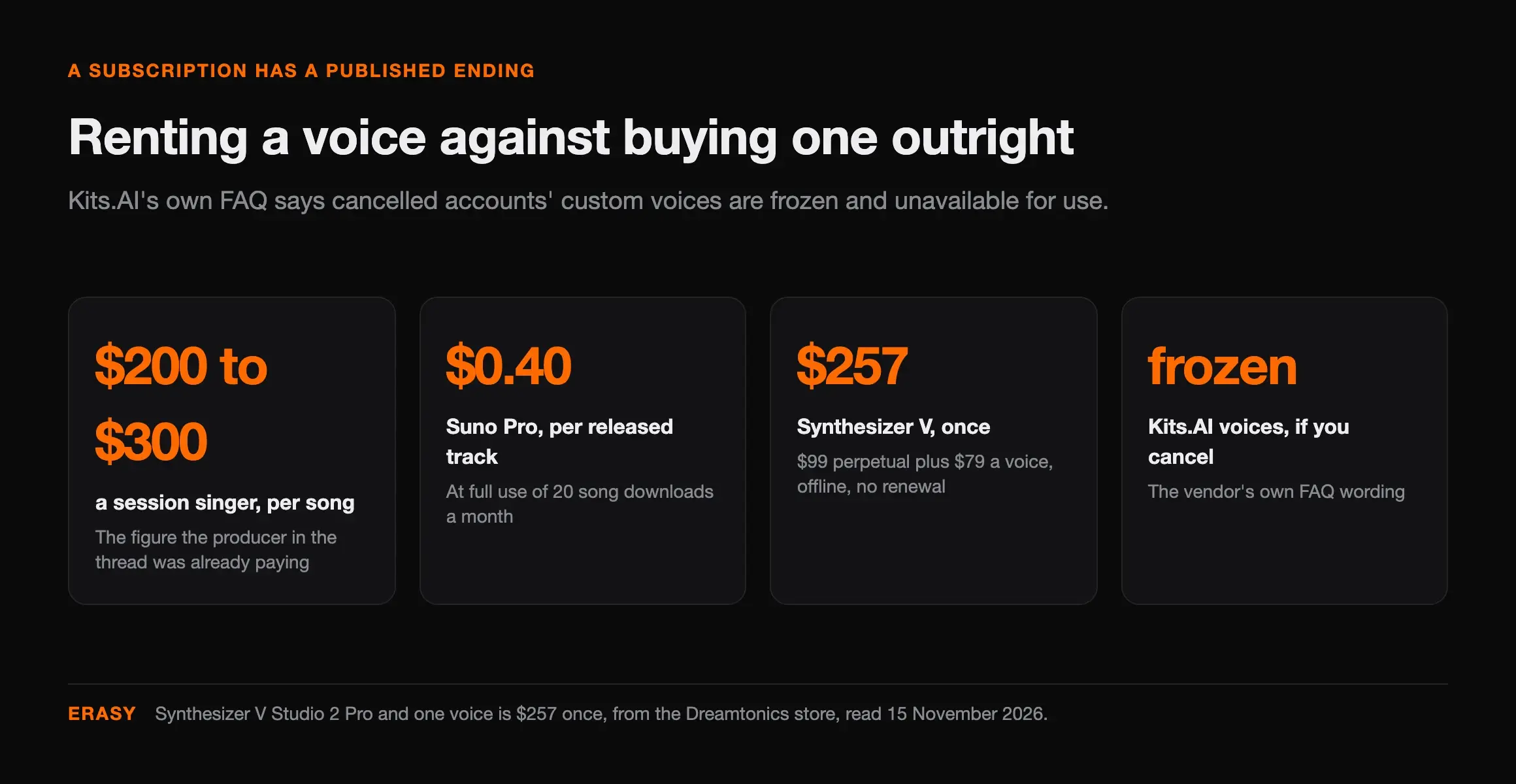
The short version: one session singer at the thread’s own $200 to $300 costs more than two years of the generator plan that replaces them. Suno Pro is $8 a month billed $96 a year and includes 20 song downloads a month, which is $0.40 a released track.
Price the export, not the subscription. Suno’s free plan lists “No monthly song downloads”, Kits.AI’s gives zero download minutes, and Lalals’ caps voice output at 10 seconds. None of the three free tiers produces a file you can release.
The route nobody in 158 replies seconded costs $257 once. Synthesizer V Studio 2 Pro is $99 with a perpetual licence and voices are $79 each. Cancel a subscription instead and Kits.AI says your custom voices “will be frozen and unavailable for use”.
On the release side there are two published requirements and one open question: a songwriter credit is mandatory and wants a real name, Apple needs “at least one performer credit, and a producer credit”, and nobody publishes who the performer is when a model sang it.
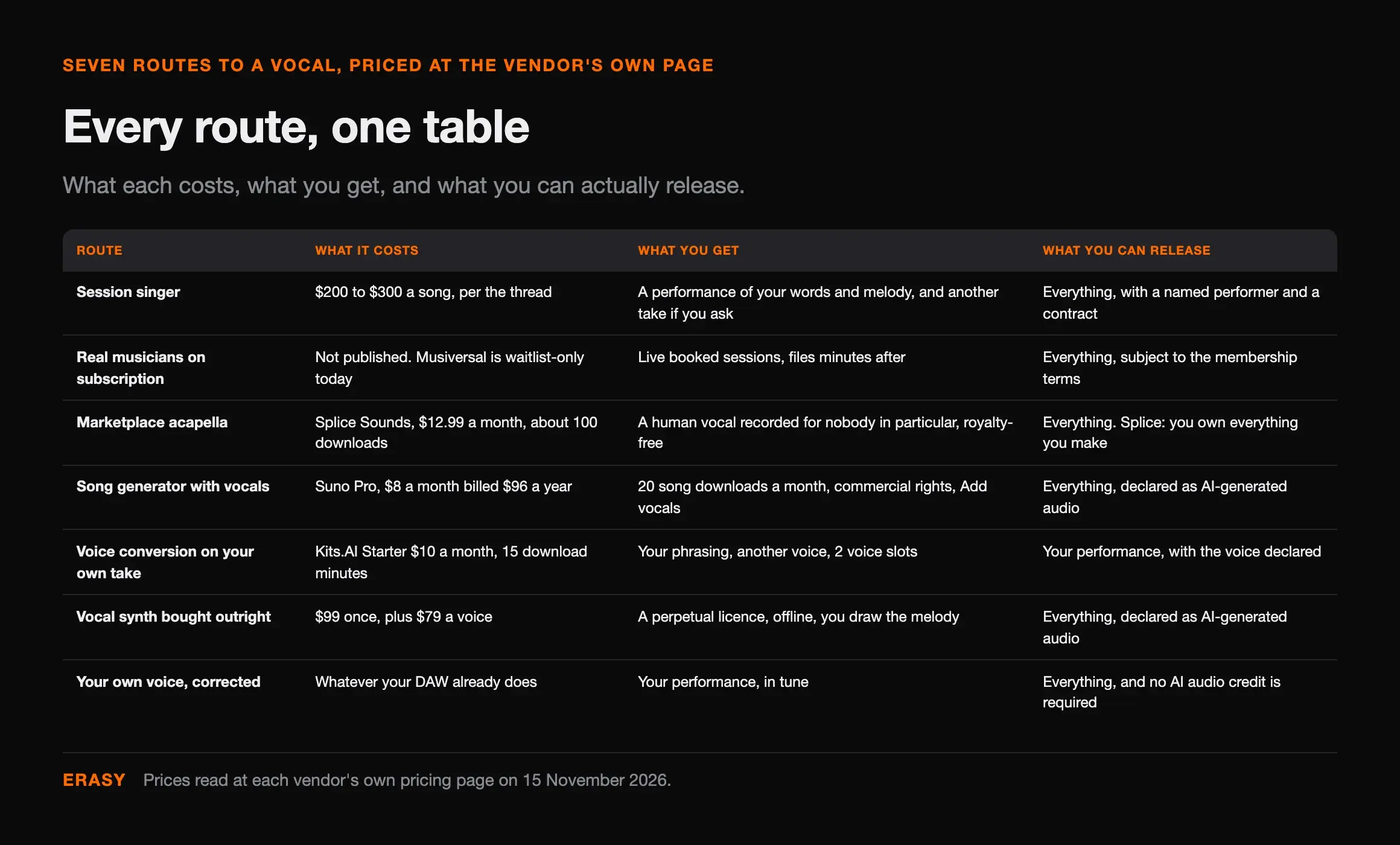
Every route, one table
Seven ways to get a vocal onto an instrumental you made, with what each one asks for and what you are left holding. Prices are what the seller published on 15 November 2026; a price is an asking price, not a promise of what you will pay.
| Route | What it costs | What you get | What you can release |
|---|---|---|---|
| Session singer | $200-$300 a song, per the thread | A performance of your words and melody, and another take if you ask | Everything, with a named performer and a contract |
| Real musicians on subscription | Not published. Musiversal is waitlist-only today | Live booked sessions, files minutes after | Everything, subject to the membership terms |
| Marketplace acapella | Splice Sounds, $12.99 a month, about 100 downloads | A human vocal recorded for nobody in particular, royalty-free | Everything. Splice: "You own everything you make" |
| Song generator with vocals | Suno Pro, $8 a month billed $96 a year | 20 song downloads a month, commercial rights, Add vocals | Everything, declared as AI-generated audio |
| Voice conversion on your own take | Kits.AI Starter $10 a month, 15 download minutes | Your phrasing, another voice, 2 voice slots | Your performance, with the voice declared |
| Vocal synth bought outright | $99 once, plus $79 a voice | A perpetual licence, offline, you draw the melody | Everything, declared as AI-generated audio |
| Your own voice, corrected | Whatever your DAW already does | Your performance, in tune | Everything, and no AI audio credit is required for pitch correction |
Two rows are not what they look like. A marketplace acapella is a human performance of somebody else’s words — Splice sells about 100 downloads a month for $12.99 and says “you own everything you make” — so it is only a route if your song can be built around a vocal written for nobody. And the subscription row is the one the thread recommended twice, which is the next section’s problem.
What a session singer costs
The $200 to $300 in this thread is one producer’s figure for a lead vocal, posted on 6 November 2026, and it is the most useful number in the discussion because it comes with a budget attached. Around it, the same thread puts the whole-track cost higher: an indie rapper of two decades, at nine points, reckons “it costs like $1000 bare minimum to produce a track” once everyone is paid.
Two replies point at Fiverr for cheaper singers and one, at a single point, makes the argument nobody upvoted: approach independent singers with home studios directly, because “I have never had to spend a penny on singers and I have worked with a lot of professional voices” who joined for the music. That is a real route, it is free, and it costs you the thing this producer said he is short of.
The reply that would have answered the question best names Musiversal — a membership that books live sessions with real musicians, vocals among them, and returns files minutes after the session. We could not price it. Its pricing page returns Access Denied and its home page now reads “Join the Waitlist”, so the “$150 a month” a commenter quotes is a commenter’s figure, not a published one. We are not printing a union rate either: the only scale figure circulating on this subject is quoted second-hand, and SAG-AFTRA’s own contract page refuses this connection outright, so there is nothing here we read ourselves.
What the fee buys is worth naming, because no generator sells it: a person who hears your track, takes a note and sings it again, plus a contract, a credit and a name. One reply makes the case against from the other side — singers “sing in tune, they can try it 100 times and never give you an issue” is the pitch for the machine.
What AI vocals cost per release
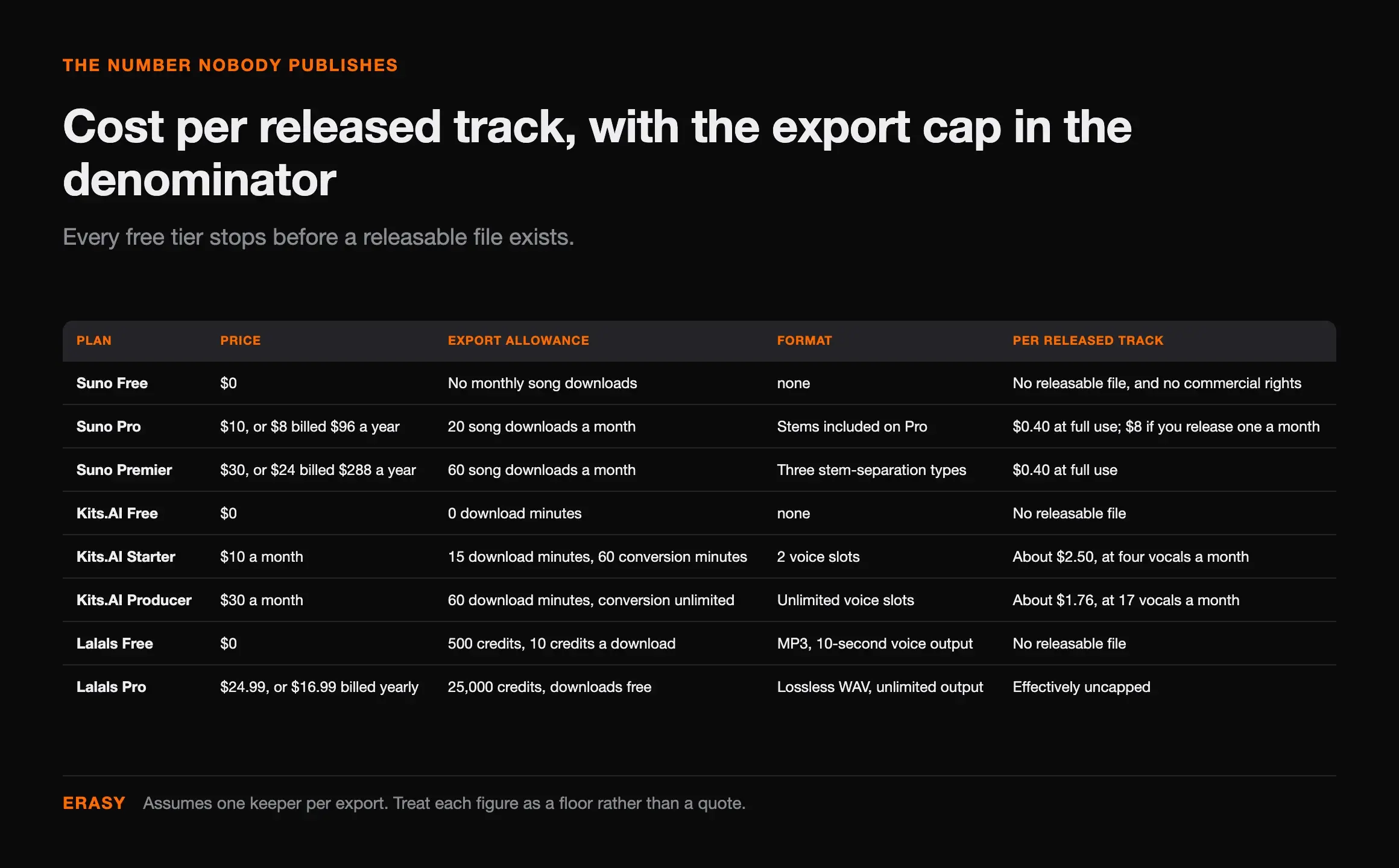
Every page on this subject prices the subscription. None of them prices the file. The two numbers that decide what a released track actually costs are the export allowance and the export format, and all three vendors below publish both.
The per-track column assumes a three-and-a-half-minute lead vocal and one keeper per export. Takes you throw away still spend the allowance, so treat it as the floor.
| Plan | Price | Export allowance | Format | Per released track |
|---|---|---|---|---|
| Suno Free | $0 | "No monthly song downloads" | — | No releasable file, and "No commercial rights" |
| Suno Pro | $10, or $8 billed $96 a year | 20 song downloads a month | Stems included on Pro | $0.40 at full use; $8 if you release one a month |
| Suno Premier | $30, or $24 billed $288 a year | 60 song downloads a month | Three stem-separation types | $0.40 at full use |
| Kits.AI Free | $0 | 0 download minutes | — | No releasable file |
| Kits.AI Starter | $10 a month | 15 download minutes, 60 conversion minutes | 2 voice slots | About $2.50, at four vocals a month |
| Kits.AI Producer | $30 a month | 60 download minutes, conversion unlimited | Unlimited voice slots | About $1.76, at 17 vocals a month |
| Lalals Free | $0 | 500 credits, 10 credits a download | MP3, 10-second voice output | No releasable file |
| Lalals Pro | $24.99, or $16.99 billed yearly | 25,000 credits, downloads free | Lossless WAV, unlimited output | Effectively uncapped |
Read the Lalals rows together and the pattern on this market is clear: the cheap tier is a demo tier. A 10-second output cap and an MP3 export are not a near-miss on a release, they are a different product, and the lossless WAV a distributor wants sits two tiers up at $24.99 a month. Suno’s free plan does the same thing with one line, “No monthly song downloads”, and its credits “do not carry over from day to day or month to month”. If you are already on Pro and running out of exports rather than credits, the download limits and what counts against them is the page to read before you upgrade.
Buying the voice once
One reply in 158 asks the only question that reframes the sum: “How much do you pay for Suno per year? What about 5 years? Synthesizer V with a couple of voice banks is going to be cheaper in the long run and it’s not a subscription.” It scored one point. Checked at source, it is right on the arithmetic.
Synthesizer V Studio 2 Pro is $99, sold as a perpetual licence that runs offline, and voices in the Dreamtonics store are $79 each. Two voices and the host is $257, once — roughly one session singer at this thread’s own rate, or about two and a half years of Suno Pro billed annually, after which it keeps working. The voices are built, in Dreamtonics’ words, from “licensed recordings of real professional singers who are compensated”, which answers a chunk of the ethics argument the thread spent 158 replies on.
The catch is that it is a different instrument. A vocal synth sings the melody you draw, note by note, so it gives you control a prompt cannot and it will not invent a topline for you. The comparison is not Synthesizer V against Suno; it is Synthesizer V against a singer you would have had to direct anyway.
And subscriptions have a published ending that outright purchase does not. Kits.AI’s own FAQ says that if you cancel, custom voices “will not be deleted … but they will be frozen and unavailable for use”. Design a voice, build two albums around it, stop paying, and the voice stops. That is the real cost of the cheap monthly figure, and it is the one thing a $79 voice bank cannot do to you.
Your voice over an AI bed
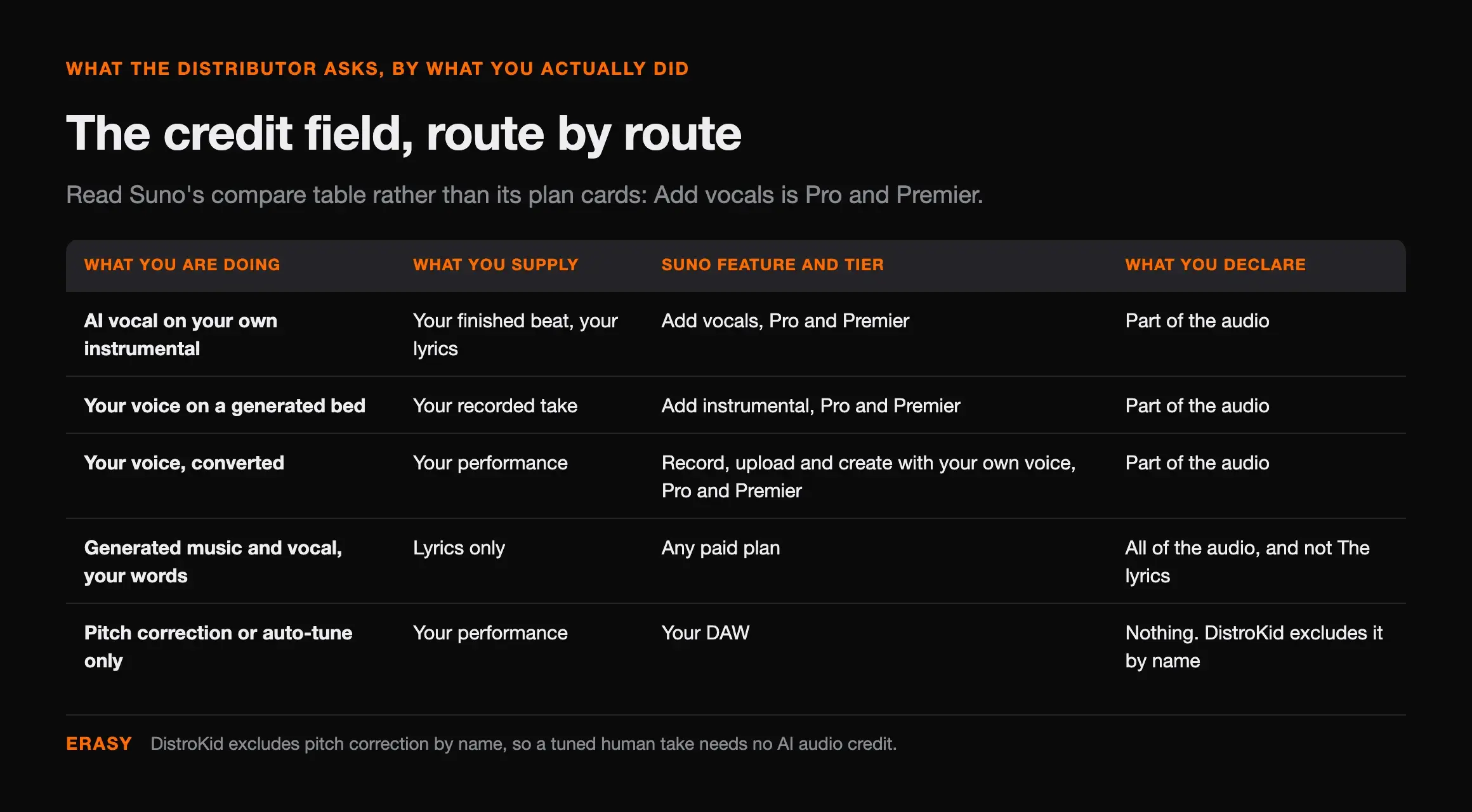
A sibling thread in the same fortnight shows where producers go next: “I then thought to only use Suno for beats and lay my own vocals over them thinking that would solve the problem.” It is the right instinct and the wrong direction for a producer who already has the instrumental. Suno’s compare table lists both halves, and both start on Pro.
| What you are doing | What you supply | Suno feature and tier | What you declare |
|---|---|---|---|
| AI vocal on your own instrumental | Your finished beat, your lyrics | "Add vocals — add a vocal track to an existing instrumental", Pro and Premier | "Part of the audio" |
| Your voice on a generated bed | Your recorded take | "Add instrumental — add an instrumental track to an existing acappella", Pro and Premier | "Part of the audio" |
| Your voice, converted | Your performance | "Record, upload, and create with your own voice", Pro and Premier | "Part of the audio" |
| Generated music and vocal, your words | Lyrics only | Any paid plan | "All of the audio", and not "The lyrics" |
| Pitch correction or auto-tune only | Your performance | Your DAW | Nothing. DistroKid excludes it by name |
The upload ceiling is where this bites: Suno takes up to 8 minutes of audio on Free and 30 on both paid tiers, so a full instrumental fits either way, and stem extraction — which you will want in order to mix the returned vocal properly — is Pro and above. Whether a half-AI track reads differently to a machine than a fully generated one has actually been tested, and our sister site has five hybrid workflows and what happens to each, including which stem gives you away. We will not restate it here.
What the distributor asks
This is the half the comparison pages never reach, and it is two published requirements plus one question nobody answers.
The first requirement is the songwriter. DistroKid’s credits article says “you must first credit a songwriter, as this is mandatory for all songs”, and a second article, edited 29 October 2026, says it wants a real name: “Songwriters are typically credited by their real names, rather than stage or band names.” For a producer who writes his own music and words, that field is the easy one — it is him.
The second is Apple’s. DistroKid’s upload-form article, edited 1 November 2026, states that the Apple Music section needs “at least one performer credit, and a producer credit”. The producer is you. The performer is not. Apple’s own specification rules out the generic word and recommends roles including Programming and Synthesizer instead, and neither company publishes guidance for a vocal no person sang. Our sister site works through every field on that form, and what 51 creators actually entered.
Declaring AI is a separate system from crediting people. AI Credits, edited 2 November 2026, covers “AI-generated audio (vocals, instrumental tracks, etc.)” — vocals named first — and explicitly does not cover “Pitch correction, auto-tune, etc.”, “AI-assisted mixing or mastering” or “AI-assisted workflows”. Spotify, Apple Music and YouTube are the three platforms DistroKid says display it. None of this is legal advice; the rights questions in the last section are worth taking to someone qualified.
Is a part-AI vocal screened differently?
One reply in the thread states the fear plainly: “the powers at be will render your entire project AI generated with the AI fingerprinting in the audio.” It is worth correcting, because the published mechanism is narrower and much less alarming than that.
DistroKid’s AI tag article, edited 13 November 2026, names the detector — an “independent service called ACRCloud” — and then takes most of the weight out of it: “The tag is informational. It doesn’t affect distribution through DistroKid”, “Your track still goes out to all streaming platforms”, and, on using AI at all, “Nope, and there’s nothing you need to do.” It concedes that “third-party detection tools aren’t perfect” and publishes a correction form answered “typically within 24-48 hours” — for a track flagged incorrectly, which is not the same as a track you want untagged.
So the honest answer is that a flag is not a rejection, and no major distributor publishes a rule that refuses a release for scoring as AI-generated. What does get releases rejected by automated screening is the audio: generation artifacts, a smeared top end, the three layers of the AI sound signature. If the vocal is the only generated element in an otherwise well-produced track, that is the layer to clean, and our release cleanup order is the sequence we use.
Our recommended tool
The vocal is a file before it is a release.
Undetectr works on the finished export: the generation artifacts and the AI-detection markers in the audio, which is the layer that meets a distributor's automated screening. It changes nothing about how a platform labels your release as AI — that is self-declared on delivery and no audio tool touches it.
The thing that costs you listeners
The most useful criticism in the thread is not ethical at all. At five points: “AI vocalists all sound the same. I use Suno and another Chinese AI music platform, and to my surprise, even their voices sound alike. So you end up hearing the same voice singing everyone’s songs.” Two more replies name the consequence — at four points, “they’re a dead give-away … and then everyone will think your whole song is AI-written”, and at three, “people hear the AI vocals and immediately assume the entire song was written by AI.”
That is a release problem, not a taste problem: a default voice tells a listener the whole record was typed, including the parts you spent a decade learning to do. The same commenter names her own fix — “I started using my own AI voice” — which on Suno is Voices, listed on Pro and Premier, and on Kits.AI is a voice slot, two on Starter. Going further and training a custom model on your own catalogue shades the model rather than the voice, and the six things listeners actually react to covers the rest.
One reply claims “Spotify will block you from Discovery Mode”. Spotify’s published song eligibility criteria name four conditions — a participating licensor, 30 days since release, 20 streams in Discovery Mode contexts in 28 days, and last month’s monetisation eligibility — and not one of them mentions AI. What Spotify does publish is on the AI Persona badge page: music from AI Personas “isn’t included in editorial or personalized recommendations unless a listener intentionally engages with the artist”. The badge is about identity, not tools, and the page says so — it “doesn’t apply if you: use AI tools to make your music, but your artist profile represents a real person”. What triggers it is AI-generated photorealistic artist imagery, so the cheapest insurance on this whole page is a real photograph of yourself. Our sister site covers how that designation is set.
Is there anything wrong with it?
No — and the thread’s own scoring is the argument. The top reply, at 64 points, is “These anti AI people don’t care. They will just tell you to pay a real person”, and the poster answers it himself at 14: “But they won’t pay for you to hire a real person.” At 22 points a songwriter of 25 years lists what he cannot afford — a guitarist, a drummer, a studio, an engineer — and notes that “nobody bats an eye at using MIDI, a drum machine, autotune, or effects pedals”.
The comparison that actually applies to this producer is not AI vocals against a session singer. It is AI vocals against not releasing, and a sum that compares a $96 subscription with a $300 fee has already skipped the only option he said was off the table. The deeper version of the identity question is worth reading once and then dropping: what the credits say about calling yourself an artist.
On rights, Suno’s own article is better than most commentary: on Pro or Premier “you own the songs”, “music made 100% with AI would not qualify for copyright protection”, but “if you wrote the lyrics for your song(s), you own those lyrics” and some registrars may treat you as the writer with Suno as an instrument. A producer who writes the music and the words and generates the vocal is not the 100% case — which matters, because Suno also warns that “some distributors exclude songs that are not eligible for copyright protection”. Our own copyright explainer goes further, and none of it is legal advice.
Once the track exists
The last thing worth saying is the thing the thread does not: nobody asked how the finished song finds listeners, and that is the wall these releases actually hit. Distribution is solved and costs almost nothing. What a producer who cannot fund a singer needs is income that does not depend on being recommended — paid sync placements, where a supervisor with a brief makes the decision and the fee is agreed up front, and selling direct to the people who already like your records. Neither one needs an algorithm to pick you, which is why they beat waiting for a thousand streams when the budget is the problem.
Related reading
Frequently asked questions
Eddie Mathews — AI Music Editor, Erasy
Eddie covers the craft side of AI music for Erasy — prompting, arrangement, vocal direction and the workflow between a generation you like and a file you can release. They price every tool at the vendor’s own page and date the figure.
Is it cheaper to use AI vocals or to hire a session singer?+
Can I release a song with AI vocals on Spotify?+
What do I put in the performer credit if the vocal is AI?+
Do AI vocals get my track flagged or rejected?+
Are AI vocals free?+
Does using AI vocals give me the Spotify AI Persona badge?+
Can I copyright a song if I wrote everything except the vocal?+
Disclosure: Erasy is an independent guide to AI music cleanup, and Undetectr is the tool we recommend and link to. Every price on this page was read at the vendor’s own page on 15 November 2026 — suno.com/pricing, kits.ai/pricing, lalals.com/pricing, splice.com/plans and the Dreamtonics store — and distributor and platform rules are dated to the edit date each publisher shows: DistroKid’s AI tag article (13 November 2026), AI Credits (2 November), the upload form (1 November), songwriters’ real names (29 October) and the credits dashboard article, read through DistroKid’s public help-centre API because its article pages refuse this connection; Spotify’s Discovery Mode eligibility and AI Persona badge pages and Suno’s rights article, read directly. Musiversal could not be priced: its pricing page returns Access Denied and its site is waitlist-only. SAG-AFTRA’s contract page also refuses this connection, so no union scale figure is quoted. Quotations and scores come from 153 of the 158 comments on one r/SunoAI thread (6 November 2026, 82 points at the time of writing), read through the public arctic-shift mirror because reddit.com serves this container a bot-check page; the thread link goes to Reddit for readers. We booked no session and ran no listening test, and nothing here is legal advice.