Music Creation
Why AI Music Sounds Soulless, and the Six Fixes That Work
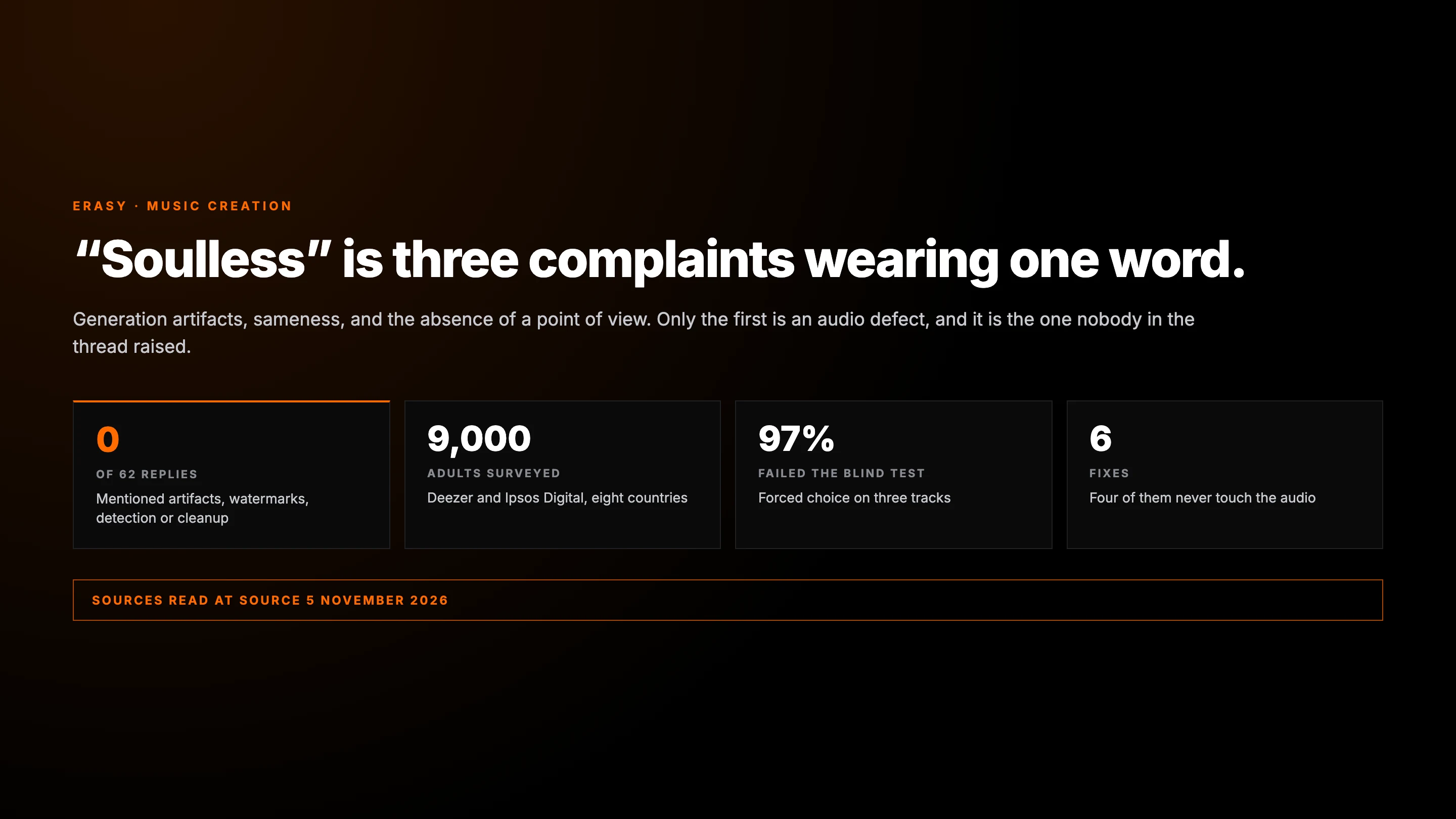
On 27 October 2026 an amateur songwriter asked r/SunoAI why AI music sounds soulless even when the vocals and arrangement are nearly perfect — a question nobody on the open web has a straight answer to. Someone had left a kind comment on one of his songs saying it was good, but needed “more grit? More originality? More something…” His tracks are clean, the arrangements hold up, nothing is obviously wrong — and still, he wrote, it “feels a bit like a perfect photo with no one behind the camera.”
That is the problem worth solving, because the stakes are not detection. In the only large survey on the subject, 97% of 9,000 listeners could not tell AI music from human music — while 45% of streaming users said they would filter it out and 40% that they would skip it unheard. So the question is not about being caught. It is about whether anyone stays.
This page separates the three things that word is doing, says which one a tool can actually fix, and gives six fixes in order of effort. The evidence is two primary sources we read at source: Deezer and Ipsos’ survey release in full rather than the half that gets quoted, and all 81 retrievable comments on that thread, read and counted one by one.
The short version
The short version: “soulless” is three complaints in one word — generation artifacts, sameness, and the absence of a point of view. Only the first is an audio defect, and it is the one almost nobody is complaining about.
97% of 9,000 adults failed a blind test (Deezer/Ipsos, fieldwork 6–10 October 2025). But 80% want AI music labelled, 45% of streaming users would filter it out and 40% would skip it without listening. Both halves are true and come from one source.
So this is a retention problem, not a detection problem. People are not identifying your track as AI. They are not staying.
Of 62 replies from 46 creators, the two commonest fixes were directing the performance and giving the song a point of view — nine each. Not one of the 62 mentioned artifacts, watermarks or cleanup.
Three problems wearing one word
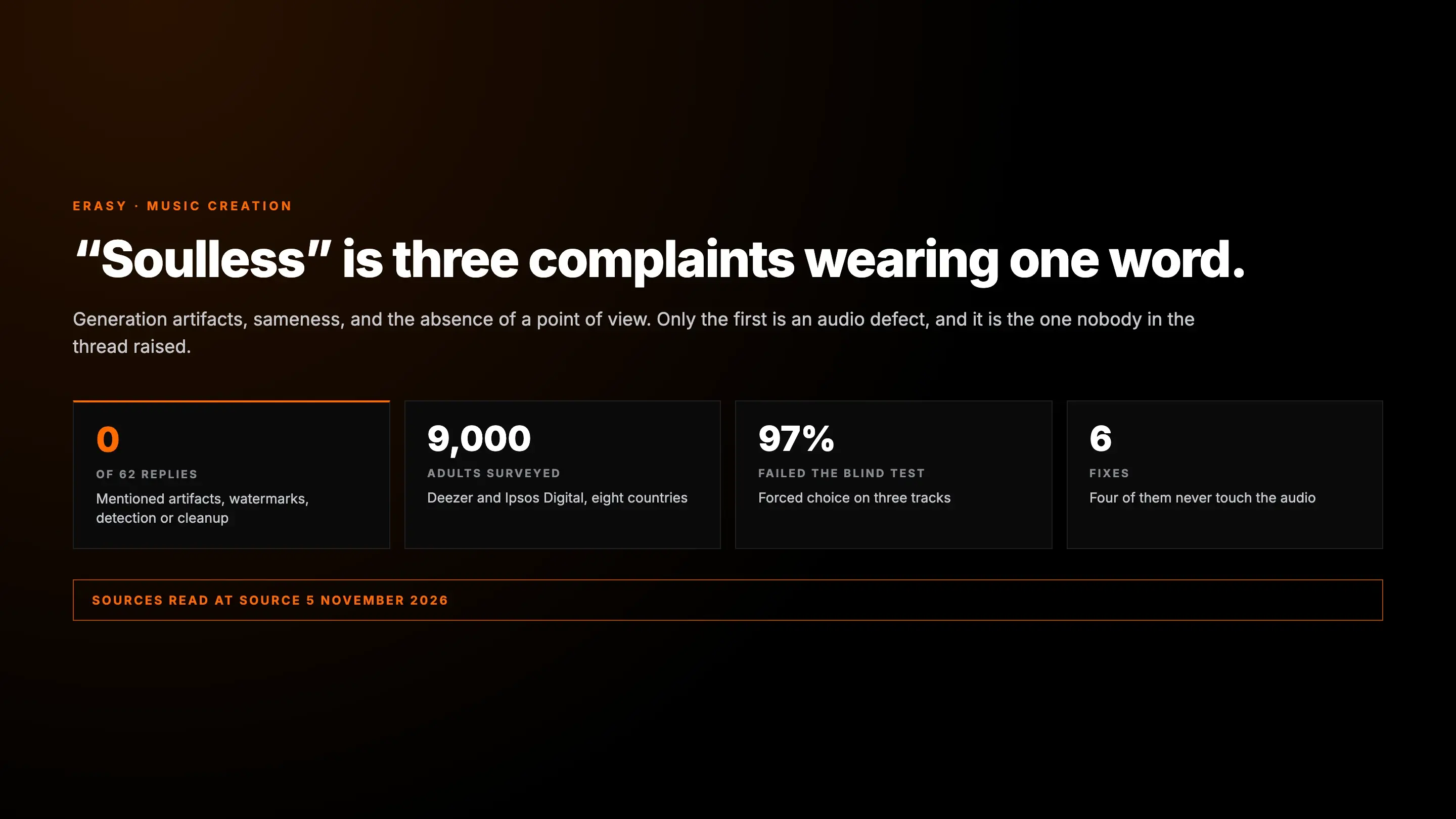
The reason this argument never resolves is that two people using the word “soulless” are usually describing different things. One means the file sounds cheap. One means it sounds like everything else. One means there is nobody in it. Those have different causes, different difficulty, and — this is the part that gets sold dishonestly — different answers to the question “can I buy something that fixes this?”
| Layer | What it actually is | Who notices | What moves it |
|---|---|---|---|
| 1. Generation artifacts | A measurable audio defect: smeared consonants, washed reverb tails, the decode stage's own spectral signature | Some listeners on good monitors; every detector | Cleanup and a mastering pass |
| 2. Sameness | Not a defect. A narrow prompt space and a default arrangement shape, repeated | Anyone who hears a lot of it, including you after a month | Writing and prompting |
| 3. No point of view | Not an audio property at all. Nothing in the waveform is wrong | Everyone, eventually — and it is what the comment on his song meant | Only you |
We have taken the mechanism of layer one apart elsewhere, so this page does not repeat it: see the three layers of the AI sound for what the audible artifact is, what the machine-detectable one is, and why they are not the same thing. What matters here is the ranking. The layer you can pay to fix is the layer fewest people are complaining about, and the layer everybody is complaining about is free and hard.
What 46 creators said when one of them asked
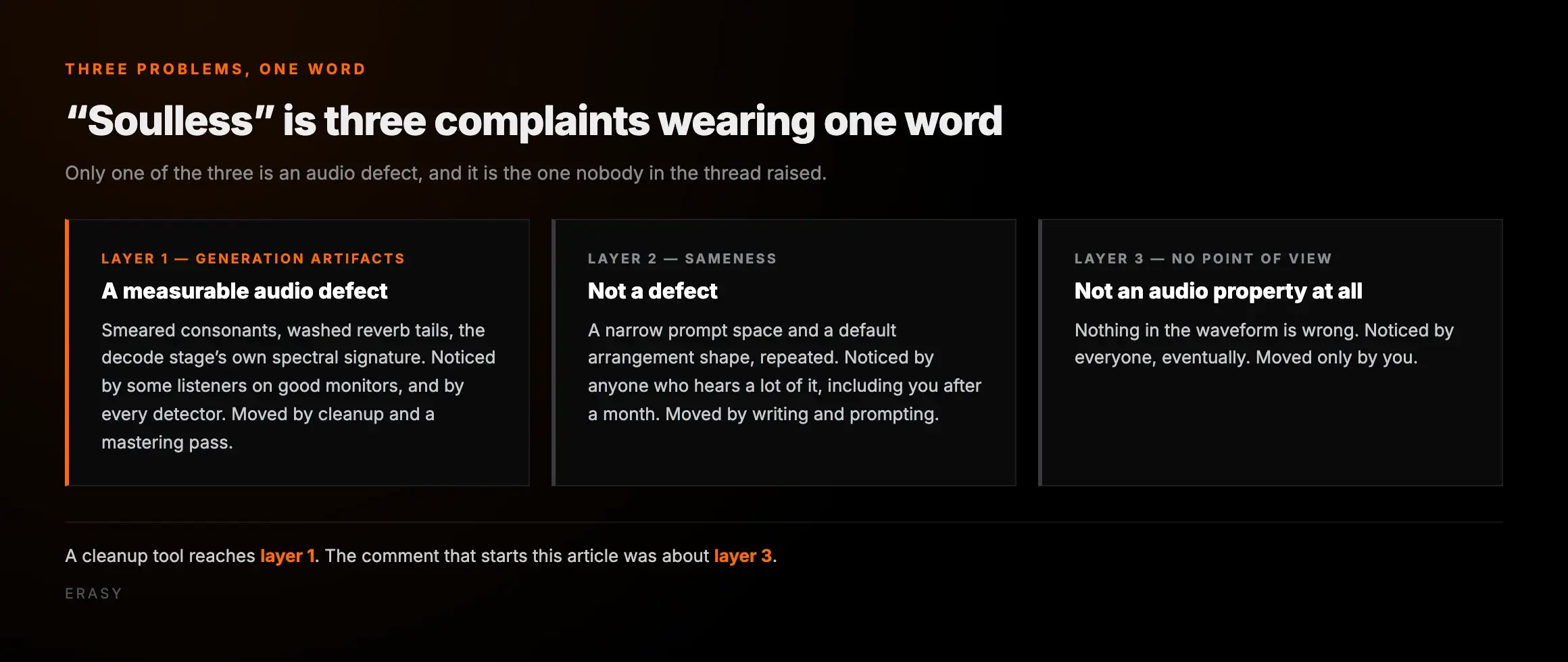
The thread drew 85 comments. Eighty-one are still retrievable, 19 of them the author answering people, which leaves 62 replies from 46 other creators to a man asking what he should actually do. We read all 62 and sorted each into the one thing it was mainly saying. The classification is ours and a reply can touch more than one bucket; the counts below are the primary reading.
| What the reply was mainly saying | Replies | Representative line |
|---|---|---|
| Direct the performance: prompts, lyric brackets, section cues | 9 | “Bracket the vocals and you can have your soul” |
| Give the song a point of view only you have | 9 | “it writes about some abstract person experiencing some abstract feelings” |
| It is not in the file — it is in knowing, or the word is meaningless | 15 | “You know in your heart no one real is behind the music” |
| Choose the imperfections instead of accepting them | 7 | “nothing ever feels like a decision” |
| Put your own performance in: voice, hum, beatbox, raw instrumental | 6 | “Learn to record your own music” |
| The mix has flattened it | 2 | “run through a compressor to zero dynamics and no instrument seperation” |
| Blame the model version | 2 | “that's exactly what v4.5+ had, and that was lost in later versions” |
| It all sounds the same | 1 | “spat out of the same sausage machine” |
| Conversation, links and track swaps | 11 | — |
| Artifacts, watermarks, detection or file cleanup | 0 | — nobody raised it |
Two things in that table are worth sitting with. The first is the 15: a quarter of the replies say the problem is in the listener rather than the recording, and they are not all being dismissive — one of them simply asked whether “soulless is a term from music theory.” The second is the 0. In 62 replies about why AI music feels empty, nobody mentioned an artifact, a watermark or a cleanup tool. That is the honest size of layer one in this conversation, and any page that sells you a cleaner as the answer to “soulless” is answering a question nobody in that thread asked.
The most upvoted technical answer named the target better than any production guide we have read: human records carry “tiny timing pushes, breaths in odd places, a note that lands a little sharp and stays because the emotion was right,” while generated takes “smooth all of that into the safest average, so the dynamics stay even and nothing ever feels like a decision.” Everything in the fix list below is a way of putting decisions back in.
Both halves of the only survey anyone quotes
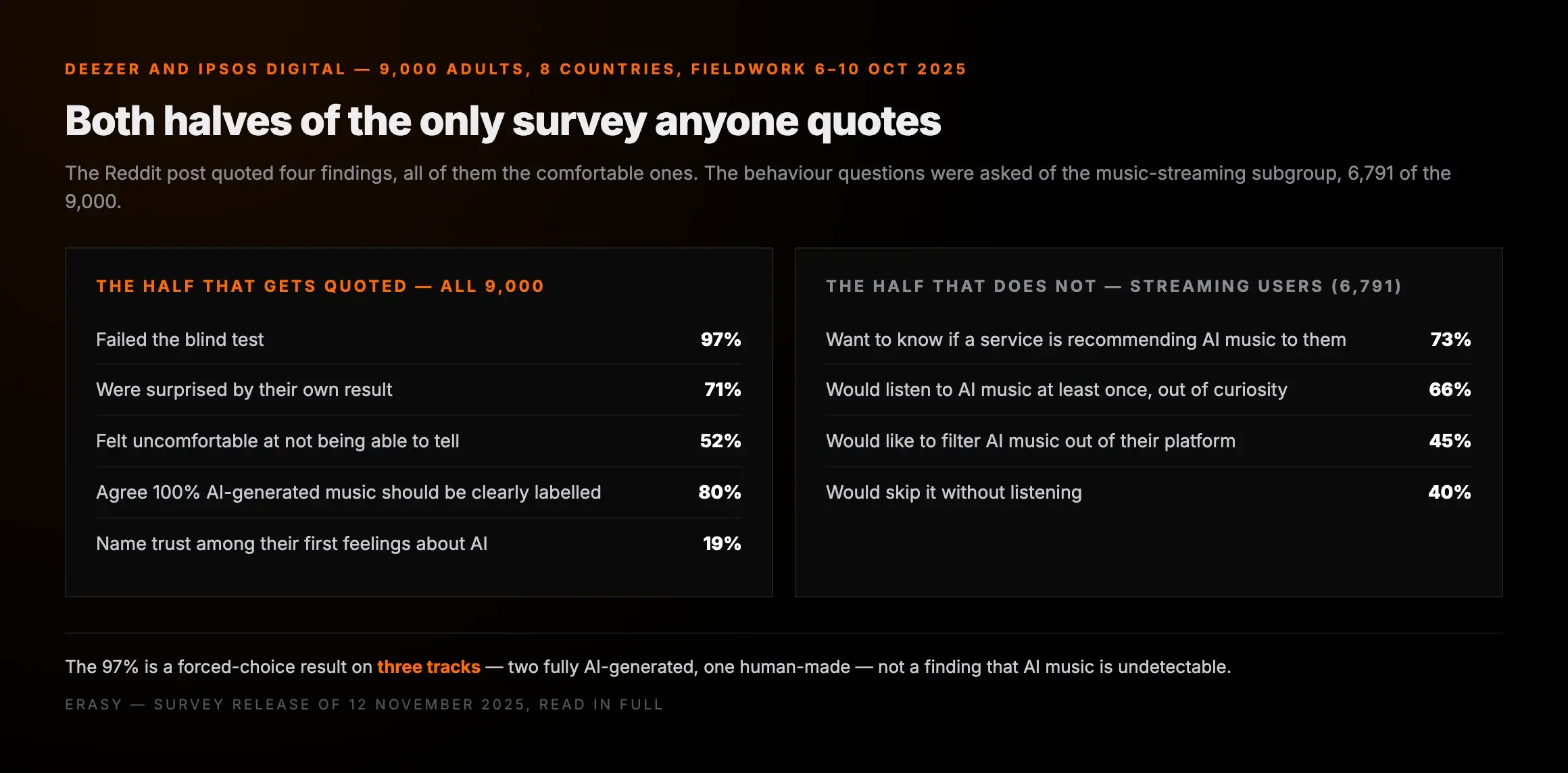
An hour before that question, the same subreddit was passing around the Deezer and Ipsos survey as proof that the soulless charge is nonsense. It is better evidence than the posts using it realise, and it cuts both ways. The method matters: Deezer commissioned Ipsos Digital to survey 9,000 adults aged 18–65 across eight countries, fieldwork 6–10 October 2025, published 12 November 2025. Respondents heard three tracks — two fully AI-generated, one human-made — and were asked to classify them. The 97% is a forced-choice result on three songs, not a finding that AI music is undetectable.
The Reddit post quoted four findings, all of them the comfortable ones. Here is the release in full. Note the base column: the behaviour questions were asked of the music-streaming subgroup, 6,791 of the 9,000, and pages that quote them as whole-sample figures are overstating them slightly.
| What the survey found | Figure | Asked of |
|---|---|---|
| Failed the blind test | 97% | all 9,000 |
| Were surprised by their own result | 71% | all 9,000 |
| Felt uncomfortable at not being able to tell | 52% | all 9,000 |
| Agree 100% AI-generated music should be clearly labelled | 80% | all 9,000 |
| Want to know if a service is recommending AI music to them | 73% | streaming users (6,791) |
| Would listen to AI music at least once, out of curiosity | 66% | streaming users |
| Would like to filter AI music out of their platform | 45% | streaming users |
| Would skip it without listening | 40% | streaming users |
| Name trust among their first feelings about AI | 19% | all 9,000 |
Both halves are true, from one source, and we have not found another page on this subject that carries both. “Listeners cannot tell” and “listeners want it labelled, and four in ten would skip it” are not in tension. They describe people who do not know what they are hearing and would rather not hear it anyway.
The survey is a year old, and Deezer’s own numbers have moved
It is worth being blunt that this is not news. The fieldwork is from October 2025 and the release is from November 2025, so anyone presenting the 97% as a current finding is quoting a year-old listening test. Deezer has published on the same subject since, and the platform-side figures in the two releases are far apart — same company, same measurement, eight months.
| Deezer's own figure | Survey release, 12 Nov 2025 | Newsroom, 21 Jul 2026 |
|---|---|---|
| Fully AI-generated tracks uploaded daily | over 50,000 | nearly 90,000 |
| Share of total daily deliveries | 34% | more than 50% on peak days |
| Share of streams | about 0.5% | between 1% and 3% |
| AI-track streams found to be fraudulent | up to 70% | up to 85% (during 2025) |
Two readings follow. The supply of AI music nearly doubled in eight months while its share of actual listening stayed in the low single digits, which is the sameness problem expressed as a market. And the fraud figure is a reminder that a large share of AI streaming numbers are not people — so a thin listener count is closer to the real baseline than the headline totals suggest.
So it is not detection, it is retention
Put the two datasets together and the usual framing of this topic falls over. If 97% of listeners cannot pick AI music out of three tracks, then almost nobody is hearing your song, identifying it as machine-made and rejecting it on that basis. The rejection is happening earlier and more quietly than that.
The survey says so in its own numbers. 40% of streaming users would skip AI music without listening and 45% would filter it out — but 58% believe their platform has never recommended any to them, and a further 25% are unsure. People are declaring an intention to avoid something they largely cannot identify and mostly do not know they have been served. The same release has 52% saying fully AI tracks should be kept out of the charts while only 11% want them treated equally, which is an opinion about category, not about your mix.
What that changes is the job. The aim is not to pass as human — the data says you already do, and the argument about whether you should is a separate fight. The aim is to give somebody a reason to reach the second chorus. That is a retention problem, and it is the same problem every independent release has had for twenty years, which is oddly good news: the techniques are known and none of them are about hiding anything.
The one layer that really is a measurable defect
Layer one is real, and it deserves the honest version rather than the sales version. A generated export can carry consonants that smear, reverb tails that wash out instead of decaying, cymbals that turn to grit, and a spectral fingerprint from the decode stage that detectors read easily. On a phone speaker much of that is inaudible. On monitors, in a car, or next to a commercially mastered reference, some of it is exactly the “cheap” quality people reach for the word “soulless” to describe — even though it is a different complaint from the one in the thread.
Two of the 62 replies landed on the mix rather than the song, and they are worth taking literally: one described the sound as “restrained, just like it’s run through a compressor to zero dynamics,” and another, writing in French, named the problem as pop lissage — smoothing — and warned that feeding an already over-polished upload back in smooths it further. Both are describing level and dynamics, which is a mastering an AI track decision, not a soul decision. Separately, artifact removal is the step for the defects themselves, and our sister site’s guide to what detectors actually hear covers the machine-readable half, which no listener is judging you on.
Our recommended tool
Clean the defect, not the question
Undetectr targets the generation artifacts and AI-detection markers that distributor screening looks for, which is the one layer of 'soulless' that is a measurable audio defect. It will not give a song a point of view, and no audio tool changes how a platform labels a release as AI — nothing can. Use it on a track you already believe in.
Why so much of it sounds the same
Layer two is the complaint that travels furthest, and it is not an audio fault. One reply put it as everything being “spat out of the same sausage machine,” and at nearly 90,000 fully AI tracks a day into one platform alone, the aggregate really is homogeneous. But the cause is prompt space, not the model’s soul: a few thousand genre words get typed over and over, each resolving to the safest central example of itself.
That is fixable from the keyboard, and the thread is specific about how. Describe the record you want in the terms a producer would use rather than a genre label — one creator’s method was to work out what he liked about his favourite artists’ sound and then describe that. Vary the lyric’s shape: one creator deliberately mixes clean rhymes with unrhymed lines, short chanted couplets against ten-syllable ones, and occasional spoken interjections. Use exclusions as well as inclusions. If you are worried that generation makes your track interchangeable in a stronger sense, we have looked at whether Suno songs repeat as a question about the actual audio.
Two replies, and the thread author himself, said v6 is flatter on this than v4.5 or v5 were. That is a handful of listener reports rather than a measurement, and nobody has published a model-by-model comparison, so test the same lyric across versions on your own material before you believe either side — which is also what we found looking at the v6 muffled complaints.
The six fixes, in order of effort
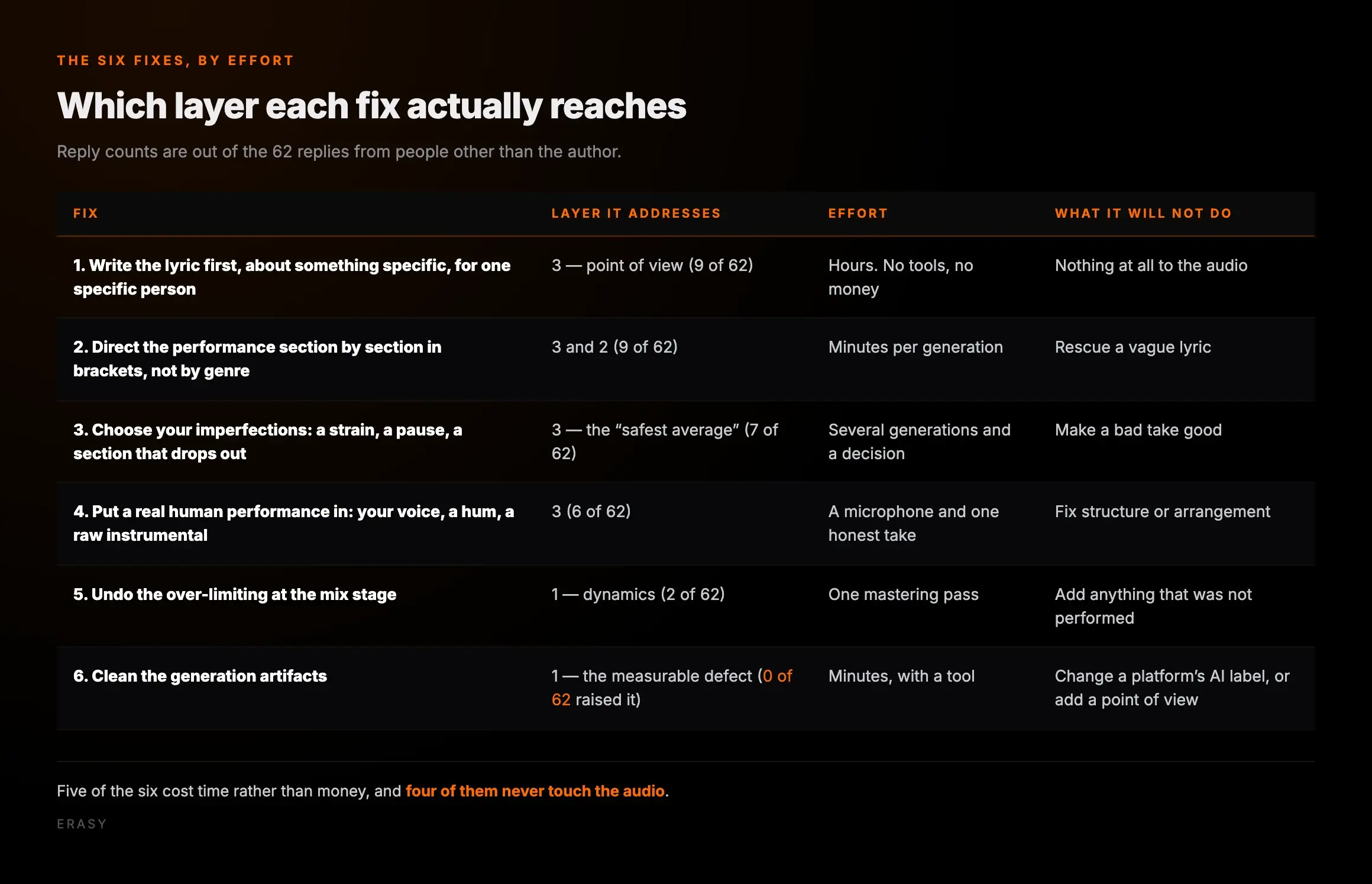
These are the things creators in that thread said worked, ordered by what they cost you rather than by how much we like them. The last column is the one most lists leave out, and it is the reason this page is arranged around layers: every fix has a boundary, and knowing it is how you stop buying the wrong one.
| Fix | Layer it addresses | Effort | What it will not do |
|---|---|---|---|
| 1. Write the lyric first, about something specific, for one specific person | 3 — point of view (9 of 62 replies) | Hours. No tools, no money | Nothing at all to the audio |
| 2. Direct the performance section by section in brackets, not by genre | 3 and 2 (9 of 62) | Minutes per generation | Rescue a vague lyric |
| 3. Choose your imperfections: a strain, a pause, a section that drops out | 3 — the “safest average” (7 of 62) | Several generations and a decision | Make a bad take good |
| 4. Put a real human performance in: your voice, a hum, a raw instrumental | 3 (6 of 62) | A microphone and one honest take | Fix structure or arrangement |
| 5. Undo the over-limiting at the mix stage | 1 — dynamics (2 of 62) | One mastering pass | Add anything that was not performed |
| 6. Clean the generation artifacts | 1 — the measurable defect (0 of 62 raised it) | Minutes, with a tool | Change a platform's AI label, or add a point of view |
The order is deliberate and it is the opposite of how this topic is usually sold. The free fixes sit at the top because they address the layer listeners are actually reacting to, and the paid one sits at the bottom because it fixes the layer nobody in a 62-reply thread about soullessness thought to mention. Both ends matter — a track with a point of view and audible decode grit is still worse than it needs to be — but if you only do one thing this week, do number one.
If you want people to stay, the wall is not the mix
It would be dishonest to end a page about retention by implying a better mix gets you heard. It does not. Distribution is the solved part of this — getting a track onto streaming services is a weekend’s work and the hard part is that almost nobody is looking for it. Fixing all three layers gives you a record worth somebody’s attention; it does not produce the attention.
Which is the argument for routes that do not depend on being discovered. Pitching for paid sync placements in film, television, games and advertising pays because somebody needed that specific piece of music — no recommendation algorithm sits between you and the fee, and a track with a clear point of view is precisely what a brief is looking for. Alongside that, selling direct to the people who do find you keeps the full price and the relationship instead of converting a stranger into a fraction of a cent. That is what the fixes above are for: not passing a test, but being worth coming back to.
Related reading on Erasy
Frequently asked questions

Eddie Mathews — AI Music Editor, Erasy
Eddie covers the craft side of AI music for Erasy — prompting, arrangement, vocal direction and the workflow between a generation you like and a file you can release. They test on their own material and say plainly where a technique stops working.
Why does AI music sound soulless even when nothing is wrong with it?+
Can listeners actually tell that music is AI-generated?+
If almost nobody can tell, why does it matter?+
Does cleaning up artifacts make AI music sound less soulless?+
What did creators themselves say actually worked?+
Is Suno v6 worse at this than earlier models?+
How do I make an AI song feel more alive without recording anything?+
Disclosure: Erasy is an independent guide to AI music cleanup, and Undetectr is the tool we recommend and link to. Survey figures are quoted from Deezer's own newsroom release of 12 November 2025 (Ipsos Digital, fieldwork 6–10 October 2025, 9,000 adults in eight countries, streaming-user subgroup n=6,791) and its newsroom post of 21 July 2026, both read at source on 5 November 2026. The reply counts come from all 81 retrievable comments on the r/SunoAI thread of 27 October 2026, read through the public arctic-shift mirror because reddit.com serves this container a bot-check page; the thread links go to Reddit for readers. The classification into answer types is ours, and a reply can belong to more than one. We ran no listening test: the descriptions of audible artifacts are established mechanisms and listener reports, not our measurements. Figures current as of 5 November 2026.