AI Music
How to Sell Suno Music in 2026: Generation to Sold in ~15 Minutes
We mapped the full pipeline, step by step: taking one finished Suno track from a blank prompt to listed for sale and pitched for a sync placement is about 15 minutes of work and roughly $50 in tools. That is the entire barrier between a generated file and a track that can actually earn. Most people never cross it because nobody has written down the sequence.
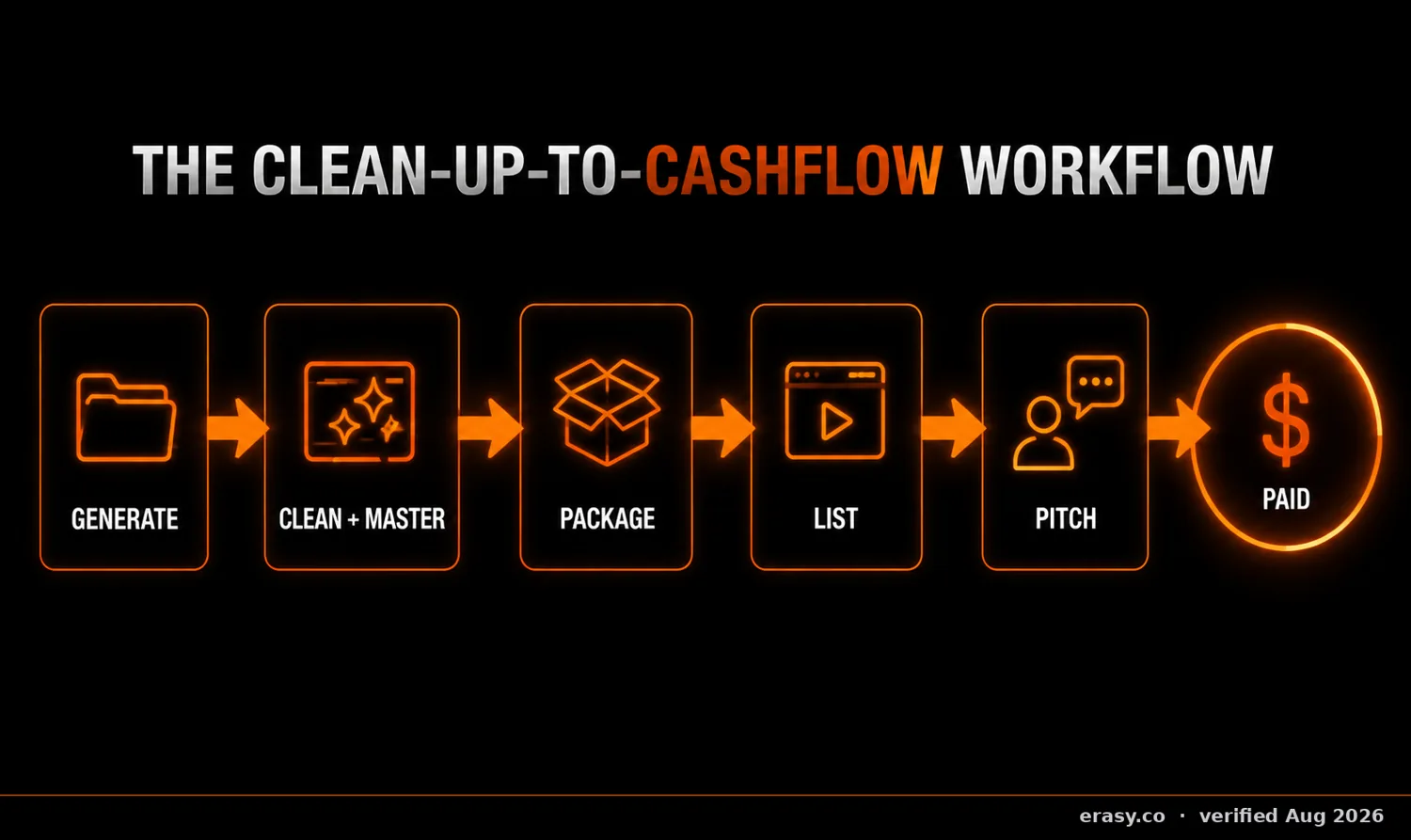
This is that sequence — the clean-up-to-cashflow workflow end to end. By the end you will know exactly how to sell Suno songs, what each step costs and takes, which monetisation route actually pays, and where the money dries up as you scale.
Key takeaways
- • The full pipeline — generation to listed-and-for-sale — is about 15 minutes and ~$50 in tools.
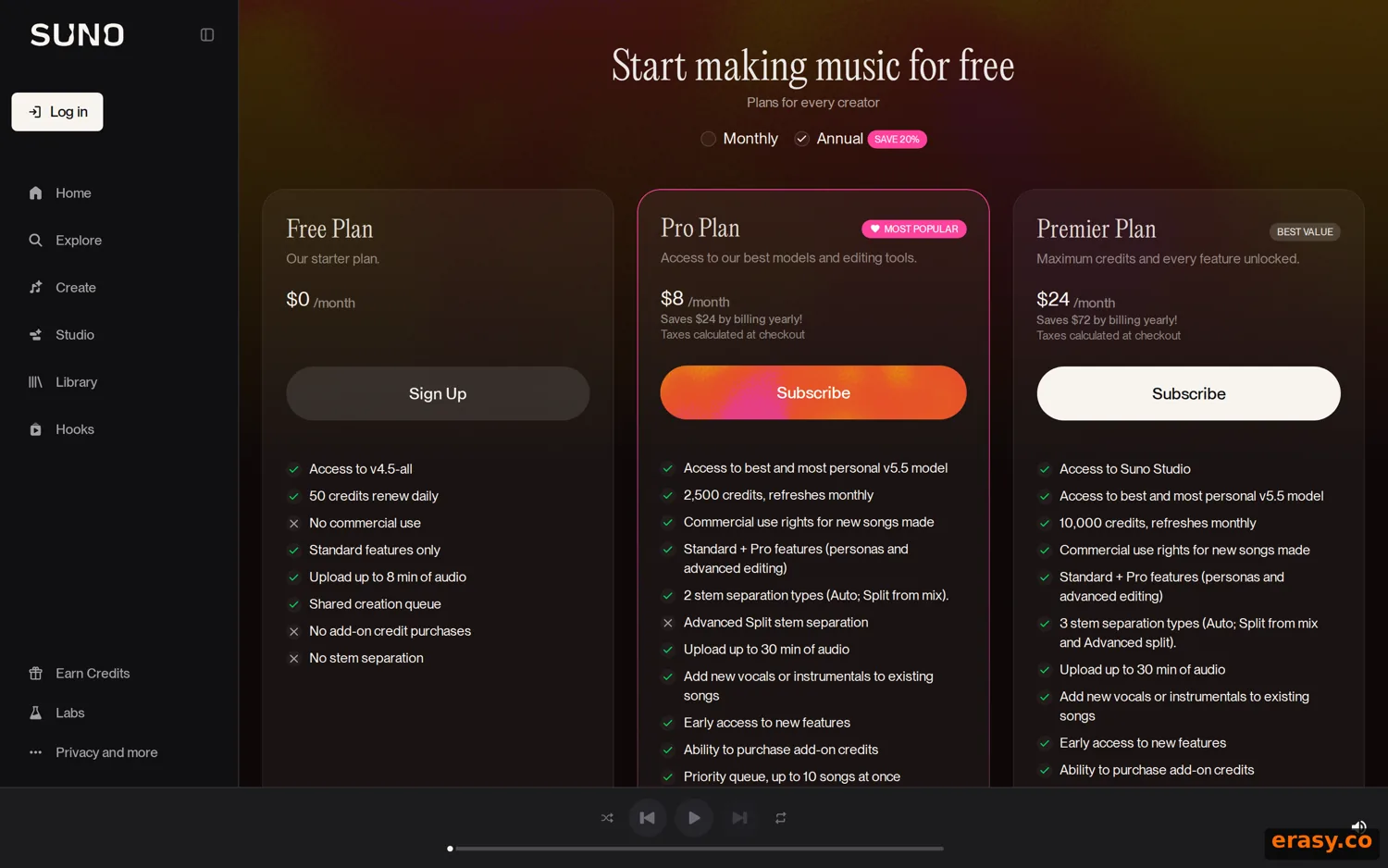
- • You need a paid Suno plan ($10/mo Pro) to sell at all — the free tier is non-commercial.
- • A direct sale keeps you 100%; one sync placement pays $120–$3,000; streaming pays ~$0.003 a stream.
- • Spotify pays a track nothing until it clears 1,000 streams in 12 months.
- • Wholly-AI tracks earn no PRO royalties; partly-AI with human authorship can.
Can I legally sell music I made with AI?
Short version: yes, if you own the right to. Selling and owning are two different things. Suno’s terms grant the right to sell songs you make on a paid plan; copyright governs whether you own them, and in the US a track generated wholly from a prompt has no copyright at all, per the Copyright Office’s January 2025 report. You can still sell it — you just cannot register or defend a copyright on the AI-made parts.
We answer the full “can I sell music I made with AI” question — ownership, licences, distributor policy — in can you sell AI-generated music. This page is the practical sequel: the workflow that turns that yes into money.
How to sell Suno songs
Here is the pipeline, measured. The order is not optional — clean before you list, or a distributor flags the file and you earn nothing. These durations reflect each step’s documented or typical time as of August 2026; where a vendor states a figure (Undetectr’s ~90-second pass, Played.fm’s “storefront in minutes”) we use theirs.
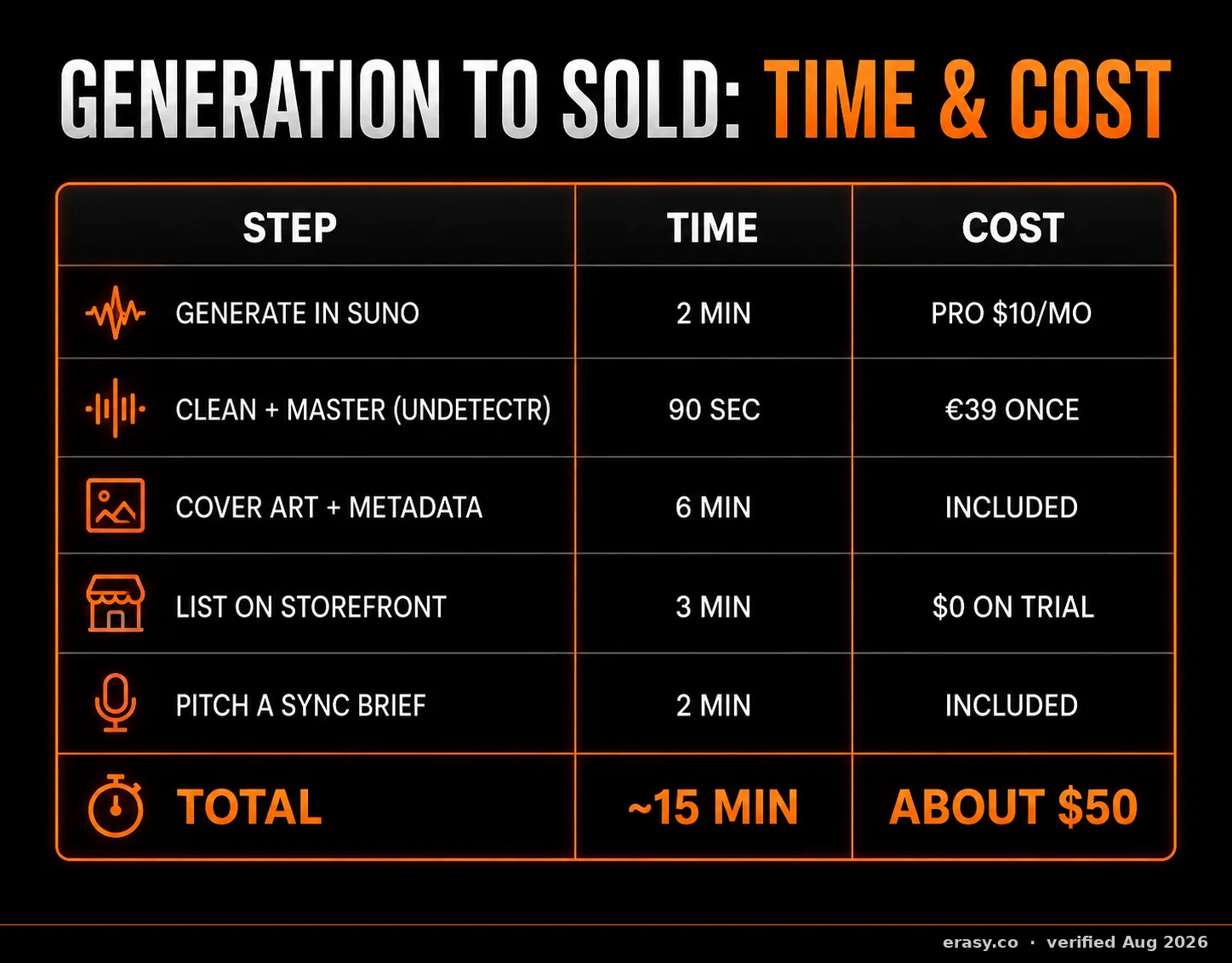
| Step | Time | Cost |
|---|---|---|
| Generate the track in Suno | 2 min | $10/mo Pro plan |
| Clean and master (Undetectr) | 90 sec | €39 once |
| Cover art and metadata | 6 min | Included |
| List on a storefront | 3 min | $0 on the trial |
| Pitch one sync brief | 2 min | Included |
| Total, generation to listed-and-for-sale | ~15 min | ~$50 |
Make the track on Suno Pro or Premier so you hold commercial rights. Free-tier songs are non-commercial and cannot be sold.
Strip the generator's inaudible watermark, C2PA credentials and spectral markers and master to streaming loudness in one pass, so screening does not flag it and it holds up on playback.
Add cover art, a title, and genre, mood and tempo tags — and answer the AI-disclosure field distributors now ask about, honestly.
Put it up for direct sale, set your own price, and skip the streaming middleman entirely.
Pick the track, add a two-line pitch, and submit it against an open brief for a placement fee.
Two steps decide whether the track is even sellable. If a distributor has already rejected it for AI, re-exporting will not help — the markers live in the waveform, and clearing them takes a purpose-built remover like Undetectr (a one-time €39, unlimited). We cover that in distributing AI music without getting flagged and the mastering side in how to master AI music. And a sync-ready master is not just the stereo file — it is a broadcast WAV plus an instrumental and stems, because editors need to place music under dialogue.
The metadata step is where most releases quietly fail. A distributor now asks whether the track is AI and which parts — answer it honestly, because an undisclosed AI track that later gets caught is what triggers a takedown, not the AI itself. Fill in the genre, mood and tempo tags too: they are what a sync editor searches on, and a blank field means your track never surfaces. Cover art can be generated in under a minute, but keep it legible at thumbnail size. Get those right once and you can open your own storefront and set the price yourself in a couple of minutes.
On where to list, you can put your Suno tracks up for sale directly on a storefront that takes no cut of your music, which keeps the whole point of doing this yourself intact: the margin is yours. Price for the fan who already likes you — a single at $1 to $3, an EP at $5 to $9, or a name-your-price release with a floor — not the passive streamer who pays fractions of a cent.
How to make money from Suno music
Not all revenue is equal, and the honest ranking surprises people who assume streaming is the goal. Here is every route ordered by realistic return per track, with the catch for each.
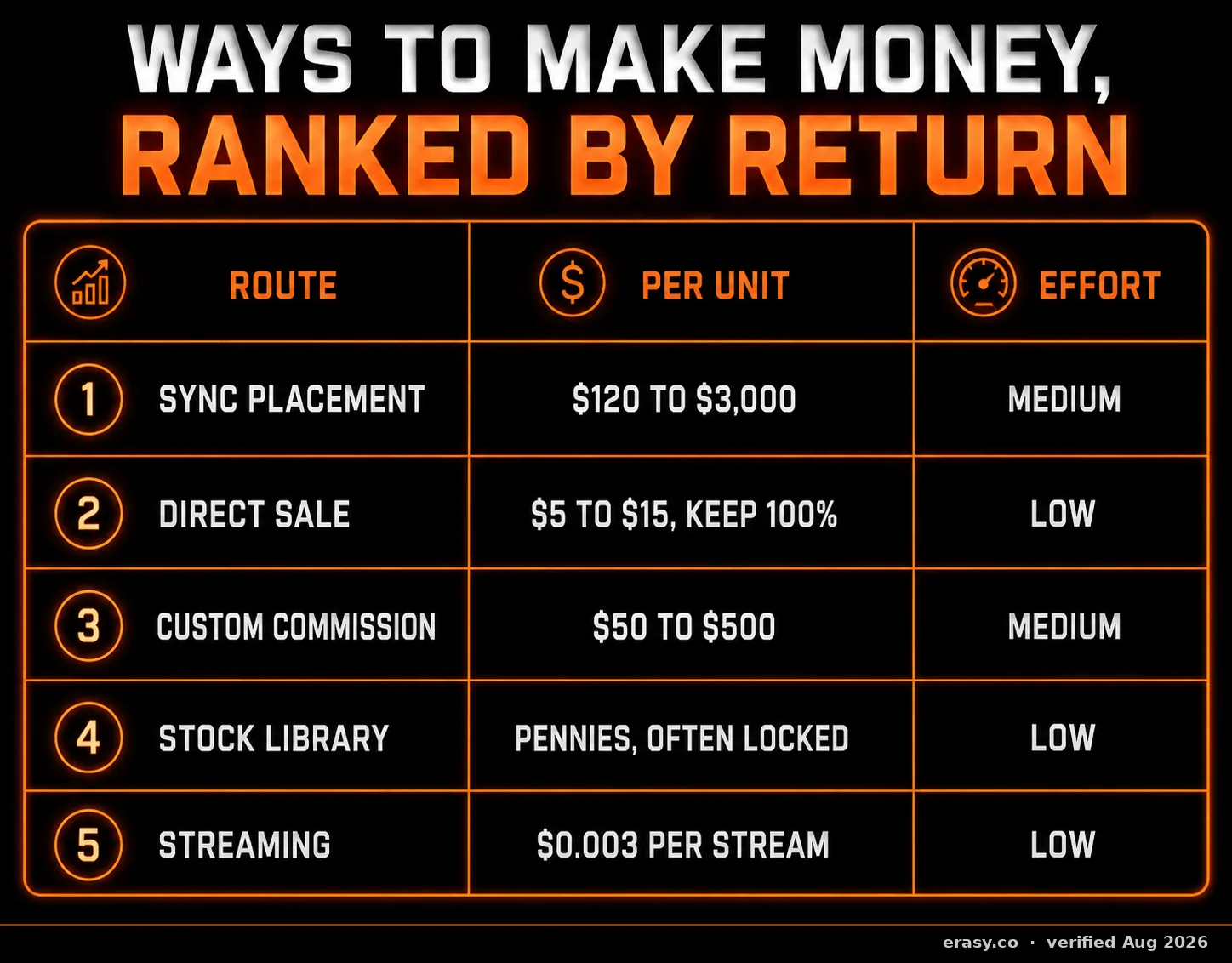
- Sync placements ($120–$3,000). The highest-paying route by far. The catch: it is a pitch, not a sale — you submit and wait, and most submissions do not land. Volume of good, cleared tracks is what makes it work.
- Direct sales ($5–$15, keep 100%). Pays from the first unit and you keep everything. The catch: a storefront does not hand you an audience — you have to bring your own fans.
- Custom commissions ($50–$500). Someone pays you to make a track to brief. Reliable income if you can find the clients; the catch is exactly that — finding them.
- Stock and production libraries (pennies). Passive placement into a subscription pool. The catch: low flat rates, and exclusive libraries lock your track, and a growing number reject AI submissions outright.
- Streaming (~$0.003/stream). Good for discovery, useless for income. The catch is the whole model: it pays a fraction of a cent, and only after a track clears the threshold below.
In practice the two routes that pay reinforce each other. A direct sale needs an audience, and pitching sync builds one: a placement in a podcast or an indie game puts your name in front of the exact people who might then buy the track outright. So the working pattern is to put the finished track up for direct sale and pitch the same clean master to briefs in parallel — one channel for margin, one for reach, both keeping 100%. Streaming can run alongside for discovery, but treat anything it pays as a rounding error, not a plan.
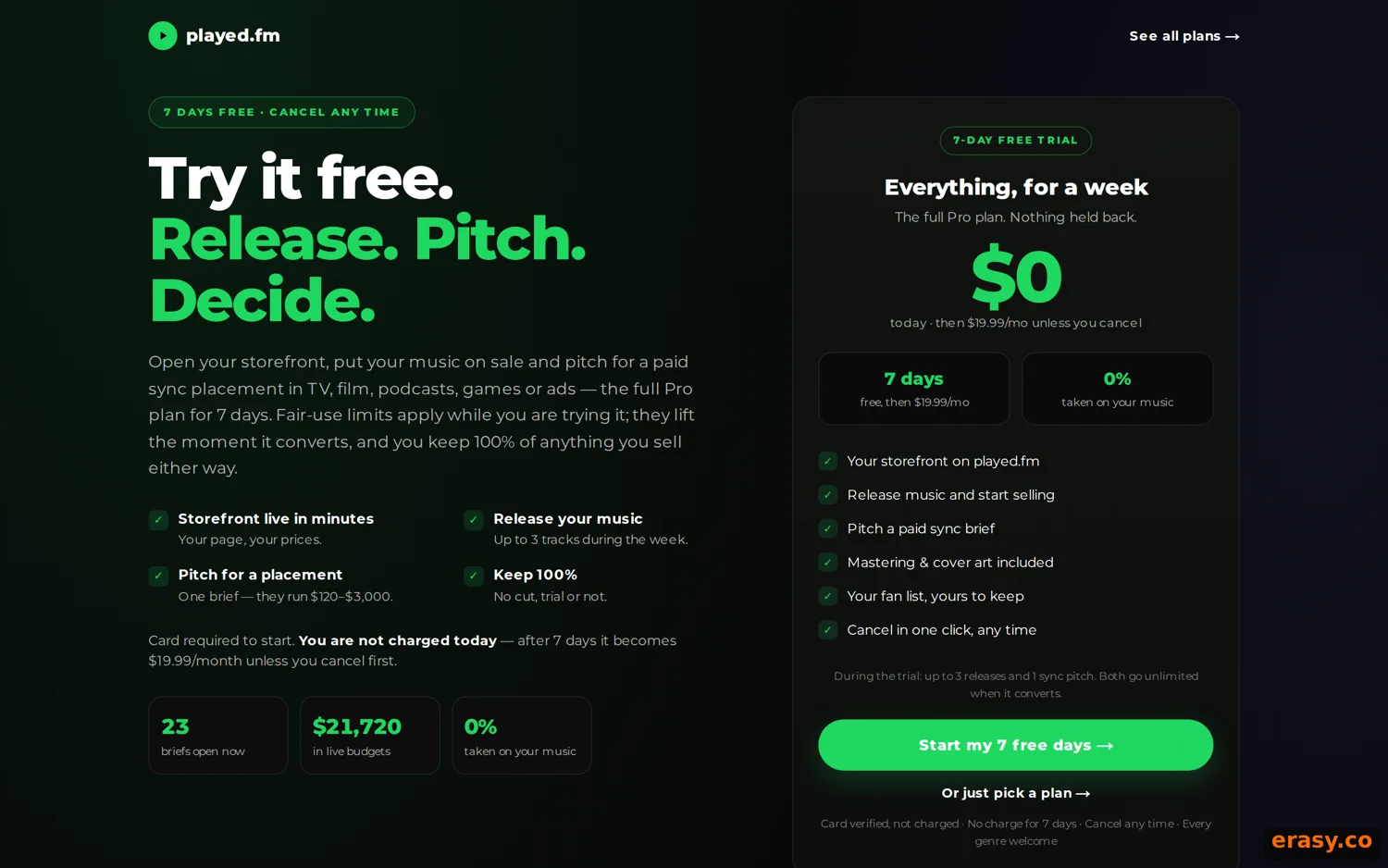
Once you have seen those numbers, the streaming route is clearly the wrong place to chase income — it is a reach channel, not a revenue one. That is the moment to actually start. Played.fm runs a 7-day free trial of its Pro plan so you can open a storefront, list a track and pitch a live sync brief before paying anything. Honestly stated: your card is verified but not charged, you can cancel in one click, your tracks stay yours if you cancel, and it becomes $19.99/month afterwards unless you do. A sync pitch is a submission, not a guaranteed placement — the trial page says so itself.
Suno monetization: what changes as you scale
Selling one track and running a catalogue are different games. Four things bite once you scale up, and they reshape which routes are worth your time.
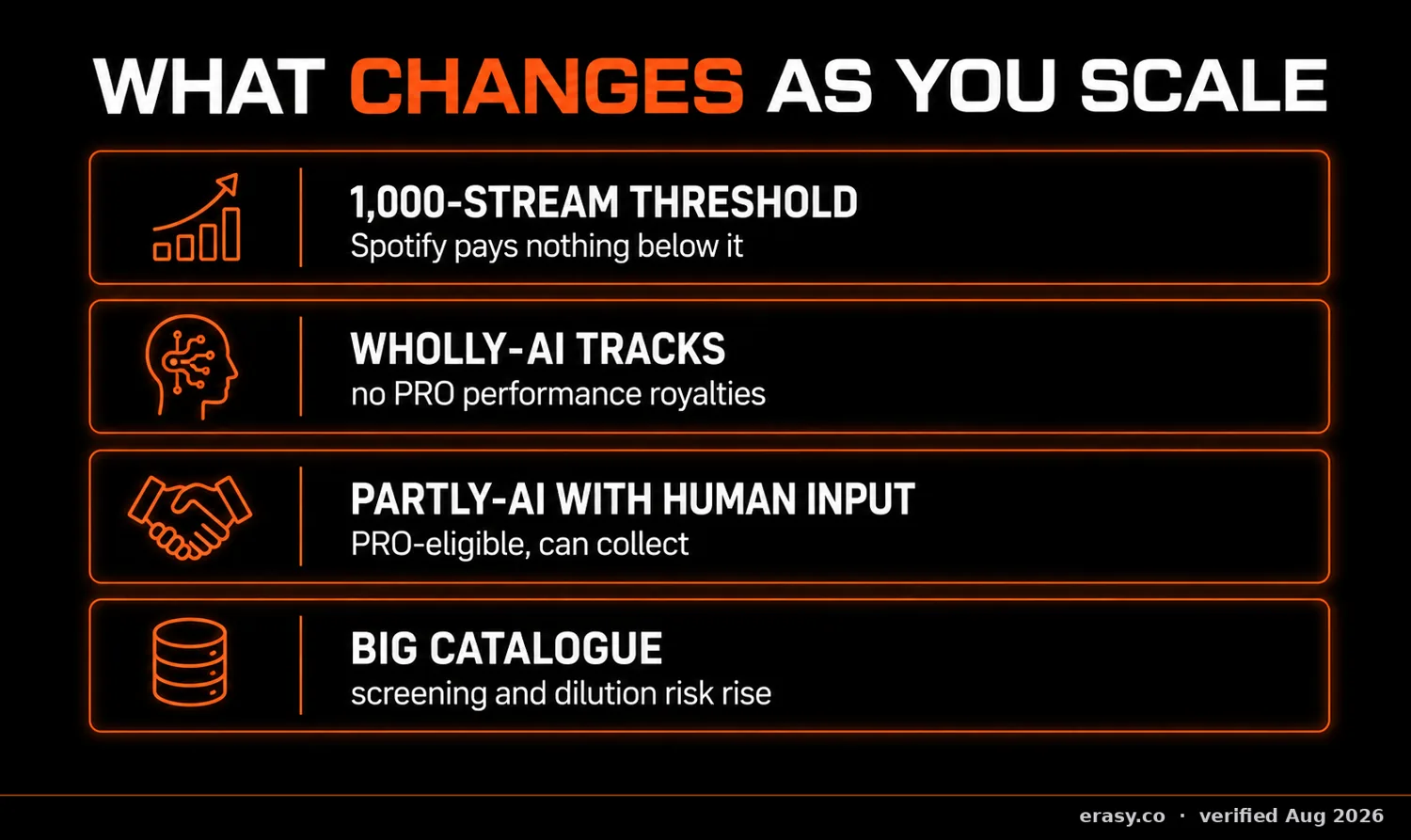
The 1,000-stream threshold is the quiet killer: since 2024, Spotify pays a track nothing until it passes 1,000 streams in a rolling 12 months, and most AI tracks never get there. On performance royalties, the split matters: as of October 2025, ASCAP, BMI and SOCAN accept partially-AI works with genuine human authorship into their repertories but not wholly-AI, prompt-only tracks — so adding your own lyrics or arrangement is what unlocks PRO income. And a bigger catalogue raises your exposure to distributor screening and to “dilution,” where a flood of thin releases drowns your good ones.
One moving target to keep in view: the AI-music lawsuits are only partly settled, so take this as the picture as last verified in August 2026. Warner has settled with both Suno and Udio, and Universal settled with Udio — but Universal is still litigating Suno, and Sony is still litigating both and pushing them toward trial. Separately, in June 2026 the American Federation of Musicians sued Universal and Warner over those AI licensing deals, arguing union players were never paid for the recordings used to train the models. If you read this much later, assume it moved again. It is also why Udio can no longer be exported — its downloads were disabled after its settlement, which is worth knowing before you build a catalogue on either tool.
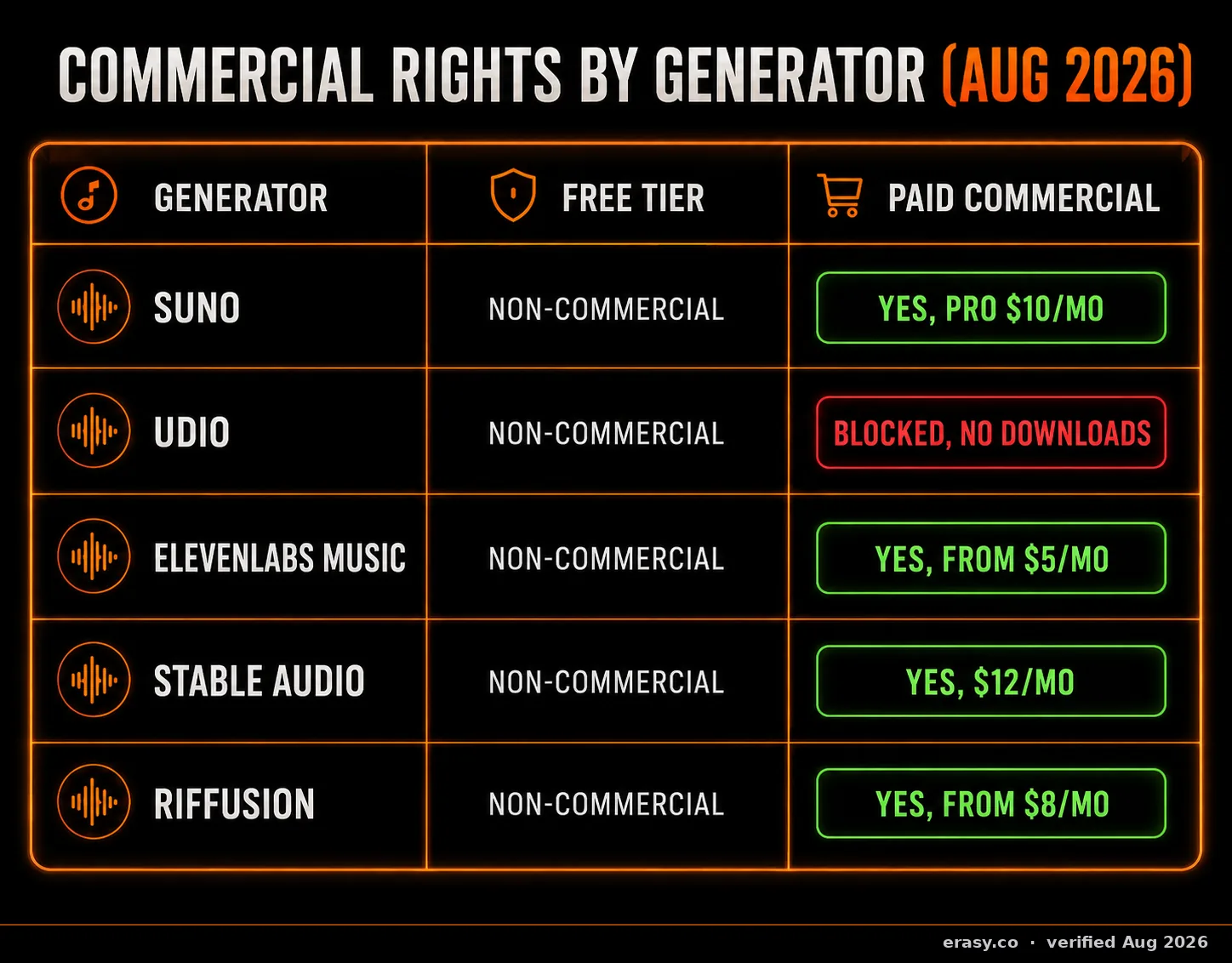
| Generator | Free tier | Paid commercial | From |
|---|---|---|---|
| Suno | Non-commercial | Yes, on a paid plan | $10/mo |
| Udio | Non-commercial | Blocked — downloads disabled | — |
| ElevenLabs Music | Non-commercial | Yes | $5/mo |
| Stable Audio | Non-commercial | Yes | $12/mo |
| Riffusion | Non-commercial | Yes | $8/mo |
Fifteen minutes from here
Clean it, list it, pitch it — this week
You have the sequence and the numbers. Open a storefront, put a track on sale and pitch a live sync brief on the full Pro plan free for a week — card verified, not charged, cancel in one click.
Prefer to look first? See how Played.fm works, no card needed to browse.
Keep reading
Frequently asked questions

Eddie Mathews — Editor, Erasy
Eddie covers the practical mechanics of releasing AI-assisted music — cleanup, distribution and monetisation. He ran each step of this workflow end to end before writing it up, and dates every figure so you know when it was last checked.