AI Music
Suno Refund 2026: Can They Cap Downloads You Already Paid For?
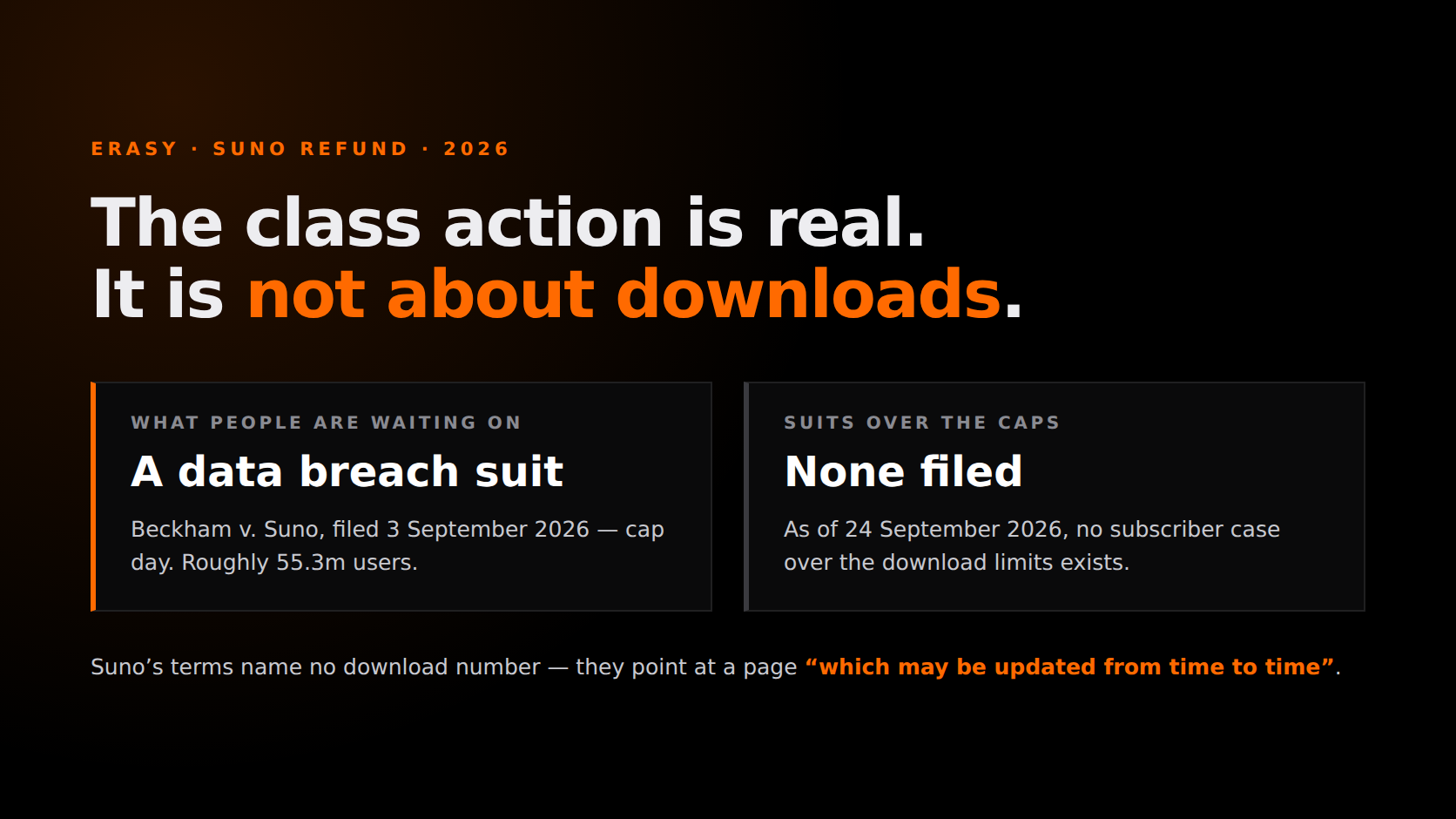
You bought a year of Suno Pro on the understanding that downloads were unlimited, and on 3 September 2026 a meter appeared at 20 a month — applied backwards, to songs you generated long before anyone mentioned a cap. Five threads in a fortnight carried 635 comments between them, and almost all of that traffic circles the same two questions: can I get a Suno refund, and is the class action people keep mentioning going to do anything about it?
Both have answers, and neither is the answer being repeated. We read Suno's Terms of Service, its refund article, its announcement of the policy and its live pricing page on 24 September 2026, and went looking for the lawsuit by docket number rather than by rumour. The class action is real, is not about downloads, and was filed the same day the caps landed — which is almost certainly how the two became one story.
The short version
- No subscriber class action over the caps exists. The case being cited is Beckham v. Suno, Inc., 1:26-cv-14065 in the District of Massachusetts, filed 3 September 2026 — a proposed class action over a data breach affecting roughly 55.3 million users.
- A Suno refund is discretionary, not a right — but the help centre publishes four situations where the company does refund, and the terms leave the door open.
- The caps are contractually covered. The Terms of Service name no download number; they point at an account page “which may be updated from time to time”.
- The real harm is rights, not convenience. Commercial use attaches to the download, so an un-exported track is not cleared to release, sell or license.
- Prices, settled: Pro is $10 a month or $8 billed yearly; Premier $30 or $24. Suno's own savings lines prove which is which.
What actually changed on 3 September 2026
Until this month, a paid Suno plan came with unmetered exports: you generated, you downloaded, and the only limit was credits. On 10 August Suno announced that from 3 September downloads themselves would be counted — and not from a clean slate, but across everything already in your library.
The stated reason is stream farming. Suno's announcement says limiting downloads “will make it harder for bad actors to mass-export music”. That is a real problem — Deezer has reported that a large majority of streams on fully AI-generated tracks are detected as fraudulent — but it is caused by operations running thousands of tracks, and the cap lands on everyone.
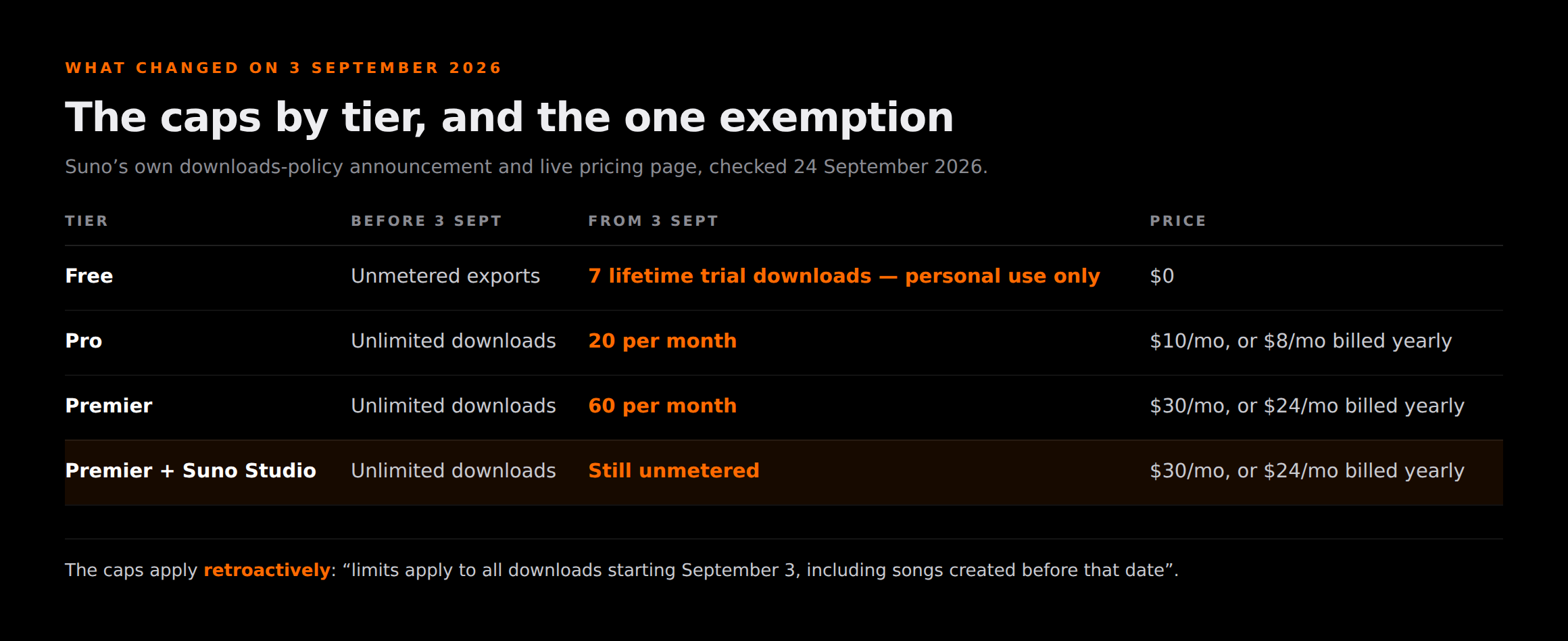
| Tier | Before 3 Sept | From 3 Sept | Price |
|---|---|---|---|
| Free | Unmetered exports | 7 lifetime trial downloads, personal use only | $0 |
| Pro | Unlimited downloads | 20 downloads per month | $10/mo, or $8/mo billed yearly |
| Premier | Unlimited downloads | 60 downloads per month | $30/mo, or $24/mo billed yearly |
| Premier + Suno Studio | Unlimited downloads | Still unmetered — the one documented exemption | $30/mo, or $24/mo billed yearly |
Those prices are worth pausing on, because most coverage got them wrong and it changes every calculation below. Suno's pricing page displays “$8/month” for Pro and “$24/month” for Premier, which reads like the monthly rate. It is the annual rate per month, and the page proves it: billing yearly “saves $24” only reconciles against $10 a month ($120 versus $96), and “saves $72” only against $30 ($360 versus $288).
The mechanics of the caps themselves we have covered separately, in our review of the download limits. This page is about the money and the entitlement, which is a different question and a worse-answered one.
The part that is not about convenience: commercial rights are metered now
Read the threads and the complaint sounds like an inconvenience complaint — I have to ration my exports. It is not, and the reason sits in one sentence of Suno's announcement: “For any song that you download from the platform as a paying subscriber, you have the commercial rights to the music.”
Commercial rights attach to the download, not to the song and not to the subscription. Music Business Worldwide read the policy the same way: songs cannot be released, sold or licensed until a download has been spent on them. So the cap is not a limit on convenience. It is a limit on how many tracks a year you may release at all — 240 on Pro, 720 on Premier, seven ever on the free tier.
For most people 240 releasable tracks a year will never bite. For anyone with a back catalogue it bites immediately and retroactively: 600 songs generated under unmetered terms now clear at 20 a month, which is two and a half years of rationing to reach a position you already believed you held. Suno's line that “every song stays playable and shareable on Suno” is true, and it answers a different question.
Anything you downloaded before 3 September is already cleared, so work out what you hold before you start drafting complaints. The argument is only ever about the rest.
The class action everyone is citing is real. It is about something else.
The most-upvoted thread in this episode is titled “Pending Class Action Lawsuit against Suno for Existing Subscribers!!” and carries 213 upvotes and 219 comments. Its substance is one user relaying that they were “just told” such a case exists. Hundreds are now waiting on it.
There is no filed subscriber class action about the download caps. We looked for one by docket and by coverage and found nothing, as of 24 September 2026. What does exist is a proposed class action filed by a Suno user, in a Massachusetts federal court, on 3 September 2026 — the exact day the caps took effect. That case is Beckham v. Suno, Inc., 1:26-cv-14065, and it is about a data breach. It alleges that a November 2025 security incident exposed roughly 55.3 million unique email addresses, sign-up phone numbers and tens of thousands of Stripe purchase records. The claims are negligence, breach of implied contract and unjust enrichment; the relief sought is damages, individual notice and at least five years of identity-theft protection.
A user-filed class action against Suno, landing on cap day, is precisely the shape of thing that turns into “there is a class action for existing subscribers” by the third retelling. It is also no help whatsoever if your grievance is downloads: joining it cannot restore an allowance, and it is not asking anyone to.
What else is actually filed against Suno
It is a crowded docket, which is part of why the rumour travelled. None of these is a subscriber suit about exports either.
| Case | Who is suing | About | Helps a capped subscriber? |
|---|---|---|---|
| Beckham v. Suno (1:26-cv-14065, D. Mass., 3 Sept 2026) | A Suno user, proposed class | November 2025 data breach, ~55.3m users | No |
| UMG & Sony v. Suno (1:26-cv-14275, D. Mass., 18 Sept 2026) | Two major labels | Alleges v6 was trained on the earlier models' outputs; 60,202 recordings | No |
| Isbell, Lowery, Forsyth, Calle v. Suno (D. Mass., Sept 2026) | Four recording artists | Alleged identity-rights violations | No |
| Indie artist proposed class action | Musicians | AI output and stream-ripping claims — now in discovery | No |
| A subscriber suit over the download caps | — | — | Does not exist as of 24 Sept 2026 |
What would have to happen for a real one? Somebody would need a theory that survives the variation clause in the next section but one — most plausibly consumer-protection or misrepresentation, built on how the annual plan was advertised at the point of sale rather than on terms drafted to allow exactly this. That is a harder case than the threads assume, and nobody has brought it.
What Suno's terms actually say about a refund
The clause everybody quotes is the right one to quote. Suno's Terms of Service say: “Payments made by you hereunder are final and non-refundable, unless otherwise determined by Suno.” Two things in it are usually missed. The trailing clause makes every refund a discretionary act. And the terms note that this does not limit statutory refund rights under applicable law — which matters enormously depending on where you live.
More useful than the clause is Suno's own “Can I get a refund?” help article, which publishes the situations where the discretion actually gets exercised. There are four, they are specific, and the download caps are not among them.
| Suno's published refund situations | What it covers | Does a capped annual subscriber fit? |
|---|---|---|
| Accidental yearly purchase | You meant to buy monthly and bought a year; Suno reverts the plan with a partial refund | Closest fit, and a stretch — it is aimed at a misclick, not a policy change |
| Accidental or unused sign-up | Zero songs in the account and one or more payments taken | No, if you have been generating music |
| Product malfunction | Significant downtime or a feature not working; Suno offers credits that roll over | No — a policy change is not a malfunction, and the remedy is credits |
| Service discontinuation | Pro rata refund of pre-paid fees based on months remaining | No — the service continues; only the allowance changed |
Suno's answer to prepaid annual subscribers who believed they were buying unmetered downloads has been, in substance, that they can cancel. Cancellation stops the next charge; it returns nothing and restores nothing. That is the gap the 635 comments are shouting into, and it is a real one — not a refund policy failing to apply, but a refund policy never written to cover this.
Which is not a reason to skip the ask. “Unless otherwise determined by Suno” means a dated email to billing@suno.com — what you bought, when, what you understood it to include, what changed — is a free option with a non-zero hit rate. Do it before anything adversarial: every route below works better with a written refusal attached.
Can a company cap something you prepaid for?
This is the question under all 635 comments, and it deserves a straight answer rather than an encouraging one. Nothing here is legal advice, none of this has been tested in court against Suno, and the answer genuinely differs by country. What follows is the shape of the problem.
Start with what the contract says, because it is drafted for exactly this moment. Suno's Terms of Service do not state a download number anywhere. They say the number you get “depends on your service tier, as set out at https://suno.com/account, which may be updated from time to time”. That is a variation clause pointing at a page the company controls: the contract never promised twenty or infinity, it promised whatever the account page says today. Alongside it sits the broader reservation — Suno “reserves the right to modify, suspend or discontinue, temporarily or permanently, the Service (or any part thereof) with or without notice” — and the right to change the terms themselves at its sole discretion.
Read as contract, then, the cap is permitted. A pure breach-of-contract argument runs into that clause immediately, and that is why the promising arguments are not contract arguments.
The arguments with more in them go outside the contract, and there jurisdiction decides everything. In the UK and the EU, unfair-terms law limits how far a trader can rely on a clause letting it vary a contract to the consumer's detriment. In the US the live theory is about the sale rather than the clause: what a buyer was told an annual plan included at the moment they bought it, which is consumer-protection and misrepresentation territory. Suno's terms expressly do not limit statutory refund rights under applicable law, and that is the hook those arguments hang on.
Our honest read: the contract almost certainly permits the cap, a consumer-protection challenge is arguable but unlitigated, and the remedies in the next section will settle your situation far sooner than any of it. Do not wait for a case nobody has filed.
The five routes actually open to you
Nowhere in the threads is this set out in one place, so here it is, in the order we would use them. The ordering matters: each is strengthened by having done the previous one, and the strongest burns the account.
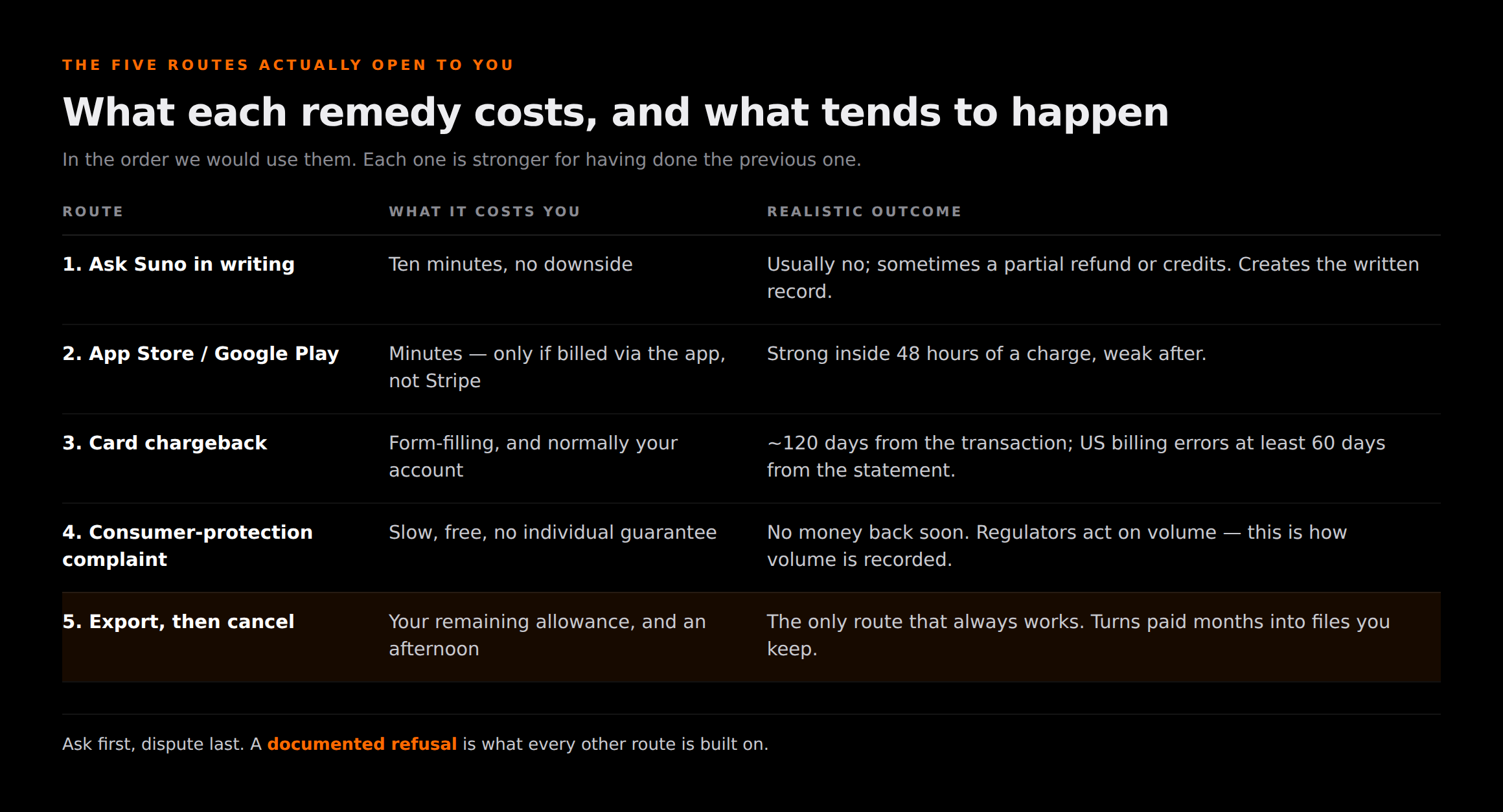
| Route | What it costs you | Realistic outcome |
|---|---|---|
| 1. Ask Suno in writing (billing@suno.com) | Ten minutes. No downside. | Usually no, sometimes a partial refund or credits. Creates the written record every other route needs. |
| 2. App Store / Google Play refund | Minutes — but only if you were billed through the app, not Stripe on the web | Strong inside 48 hours of a charge, weak after. Apple's Report a Problem is case-by-case. |
| 3. Card chargeback / dispute | Form-filling, and normally your account | Roughly 120 days from the transaction on not-as-described grounds; in the US at least 60 days from the statement. Expect the account to close. |
| 4. Consumer-protection complaint | Slow, free, no individual guarantee | No money back for you in the short term. Regulators act on volume, and this is how volume gets recorded. |
| 5. Export the catalogue, then cancel | Your remaining allowance, and an afternoon | The only route that always works. Converts the months you have paid for into files you keep. |
One note on route 2, because it catches people out: which route you even have depends on who took the money. Suno bills on the web through Stripe and separately through the App Store and Google Play, and its help centre is explicit that mobile subscriptions “should be canceled directly through those third party services”. If Apple or Google took the payment, Suno cannot refund it. Google publishes a 48-hour window for subscription refunds and then points you back at the developer; Apple's Report a Problem flow has no published window and is decided case-by-case.
On route 3, the dates are the thing. The billing-error rules under Regulation Z give US cardholders a window measured from the statement, not from when you got annoyed, and the network rules for service-quality disputes are measured from the transaction. An annual plan bought in, say, March is already outside a 120-day window in September. Check your own dates before you build a plan around a dispute.
What a released track costs now
Because commercial rights ride on the download, the cap turns Suno's subscription into something closer to a per-release price — and that is the number to decide with. Suno confirms that subscribers who hit the limit can buy additional downloads, without naming a price. Third-party reporting from early September puts extras at $2.99 for one, $8.95 for three, $14.95 for five and $29.90 for ten — no meaningful bulk discount. That screen sits behind Suno's login, so treat the figures as reported rather than confirmed.
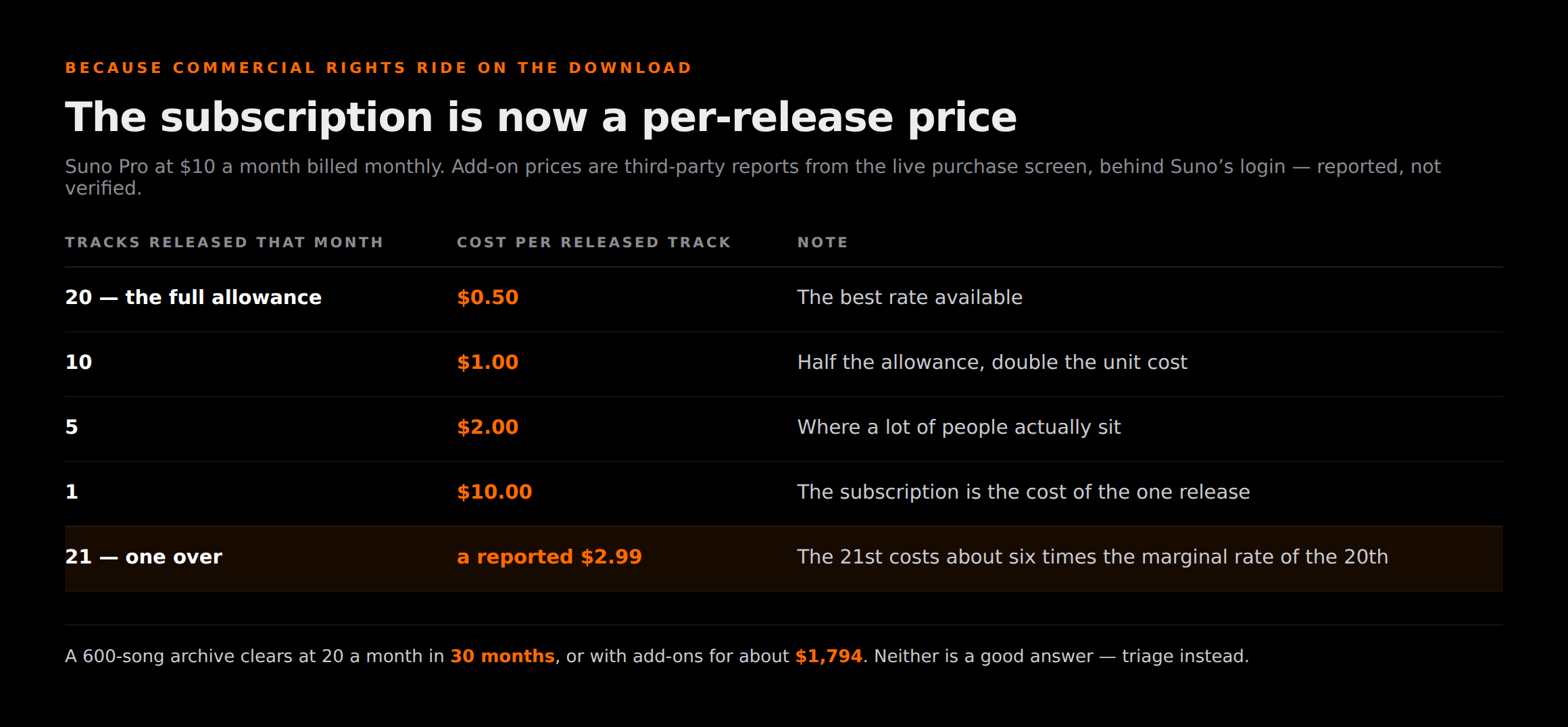
| How many tracks you release in a month (Pro, $10) | Cost per released track | Note |
|---|---|---|
| 20 — the full allowance | $0.50 | The best rate available |
| 10 | $1.00 | Half the allowance, double the unit cost |
| 5 | $2.00 | Where a lot of people actually sit |
| 1 | $10.00 | The subscription is the cost of the one release |
| 21 — one over | $0.50 for the first 20, then a reported $2.99 | The 21st costs about six times the marginal rate of the 20th |
The uncomfortable implication is for the back catalogue, not the new work. Clearing 600 archived songs at 20 a month takes 30 months; with add-ons at a reported $2.99 each it is about $1,794. Neither is a good answer, which is why the move for a large library is to triage it and stop treating the archive as inventory. Most of it was never going to be released, and the arithmetic on what AI tracks actually earn makes that case better than we can here.
If you are staying, get the catalogue out cleanly
Most people reading this will not cancel, because there is no equivalent product and the cap does not bite at their volume. If that is you, the job changes from grievance to housekeeping: spend the allowance on the tracks you will actually release. We wrote the export routes up separately — there is still no native bulk download, and the routes differ mainly in whether they want your Suno login.
One thing worth saying plainly, because it is where the money leaks: a download you have spent is not the same as a release that goes live. Distributors screen uploads automatically, and a rejected or quietly pulled track has consumed an allowance for nothing. That is now a metered failure rather than a free one — the strongest practical argument for checking a file before you submit it.
A spent download is a wasted download if it gets rejected
Screening is the cheapest failure in the chain to fix — and now it costs you an allowance.
Undetectr targets the watermark signals and generation artifacts distributors screen for at intake. It does not change how a platform labels or credits your release, and nothing can. €39 one-time, or €19 for 10 tracks.
What the caps are really for
The stream-farming explanation is true and incomplete. The caps arrived in the middle of the most consequential fortnight in this company's history, and the shape of them makes more sense read against that. Warner Music Group settled and licensed; BMG partnered in August; Believe and TuneCore followed on 8 September. Six days after that, UMG and Sony sued Suno a second time, over the v6 models, asserting 60,202 recordings.
A company negotiating licences needs to show it is not a firehose pointed at streaming platforms. Metering exports is the most legible way to show it, which is why we would not expect complaint volume to reverse the caps: they are not a pricing experiment, they are a term of the company's route to legitimacy. The v6 launch that accompanied them has its own problems — we reviewed the model and the revolt when it landed.
Which leaves the question the caps make unavoidable: if you can clear only twenty tracks a month, where should those twenty go? Not into volume plays on streaming. The honest problem here was never distribution — it is that nobody can find the music, and a cap on releases makes an undiscovered release more expensive, not less. The routes that pay per use rather than per fraction of a cent are worth more per download spent: paid sync placements in TV, film, games and ads pay once and properly for a single track, and selling direct to people who already follow you keeps the whole price and does not depend on a recommendation system deciding to serve you. Twenty tracks a month is a poor fit for a stream-farming strategy and a perfectly adequate fit for either of those.
And if your plan was to release at volume on streaming, read what Spotify's 2026 policy does to AI profiles before you spend a download on it. The cap is not the only ceiling that arrived this year.
Keep reading
Frequently asked questions

Cara Whelan — Policy Editor, Erasy
Cara tracks the platform and distributor rules that decide whether an AI release goes live, and reads the terms of service so readers do not have to. They cite the primary document wherever one exists.
Can I get a refund on my annual Suno plan because of the download limits?+
Is there a class action lawsuit against Suno over the download limits?+
Can Suno paywall songs I already made?+
Do I still own the tracks I made before the caps?+
Does cancelling my Suno subscription delete my songs?+
How much does Suno actually cost per month in 2026?+
Is a chargeback a good idea for a Suno subscription?+
Disclosure: Erasy is an independent guide to AI music cleanup, and Undetectr is the tool we recommend and link to. Nothing on this page is legal advice. Figures were checked at source on 24 September 2026: the caps, the retroactivity and the commercial-rights wording from Suno's downloads-policy announcement; the refund situations from its “Can I get a refund?” help article; the non-refundable, variation and modification clauses from its Terms of Service; the prices from suno.com/pricing, where the monthly-versus-annual split is derived from the page's own stated savings. The Beckham docket number and breach figures are as reported by Music Business Worldwide and Digital Music News — the court record returns 403 to automated readers, and the case is a set of allegations Suno has not answered in public. Add-on download prices are third-party reports from a screen behind Suno's login. Dispute windows vary by network, issuer and country.