AI Music
Playlist Push vs Meta Ads: What Promotion Costs an AI Release
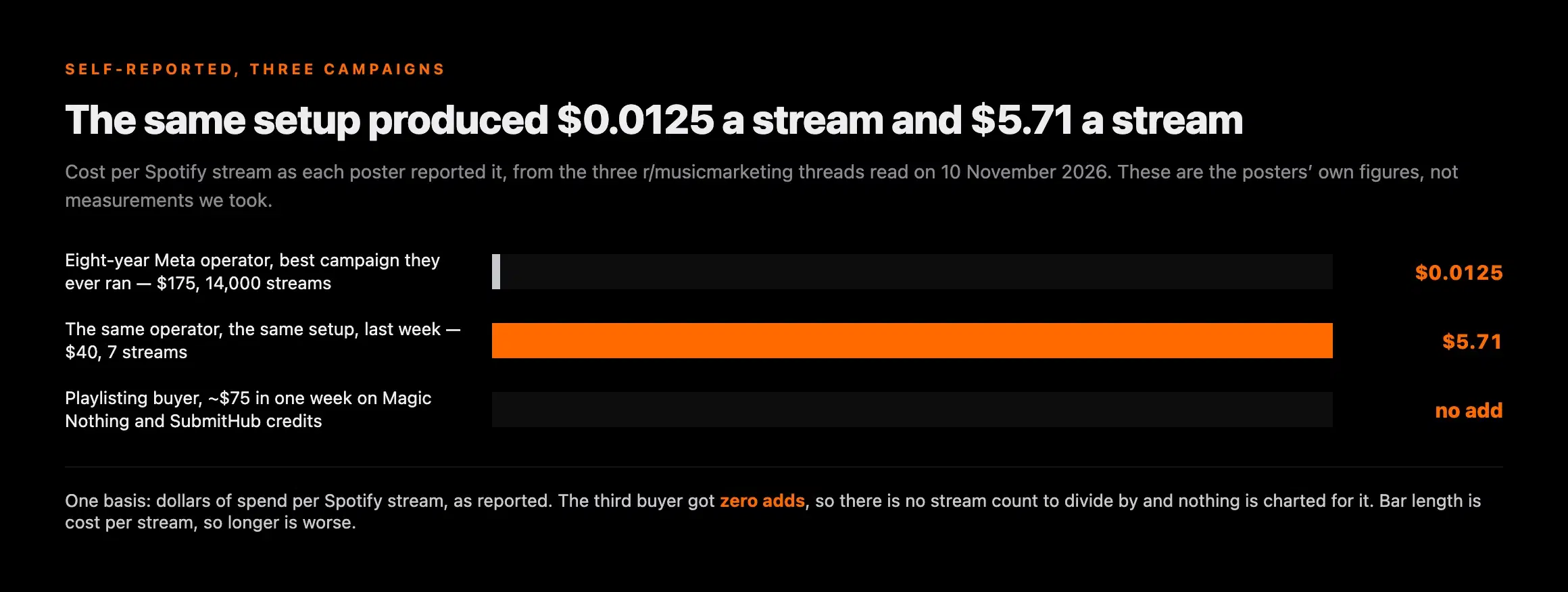
In eight days at the start of November, three artists posted what they had spent on promotion. One runs about $3,000 a month through Meta ads and Playlist Push. One has been running Meta ads for eight years and watched the same setup go from 14,000 streams for $175 to seven streams for $40. The third spent $75 in a week on playlisting credits and got nothing at all.
What none of the three posts does, and what no page ranking for this question does either, is finish the sum. A promotion price is only half of a decision; the other half is what the thing you bought pays back. So we read all 179 replies across the three threads, pulled the published prices and marketplace figures off five promotion services, and converted every number into two quantities nobody prints: cost per playlist add, and cost per stream against what a stream earns.
Two notes on what this page is and is not. It prices paid playlist promotion; it does not recommend it, and the section on Spotify’s artificial-streaming rule explains why that distinction matters more than the vendors’ marketing does. And every price below was read at the vendor’s own page on 10 November 2026, because the best-ranking review of Playlist Push anywhere was last updated in April 2019 and still quotes curator pay the company no longer offers.
The short version
The short version: at every published price, a single playlist add has to return thousands of streams before it pays for itself — about $22.50 an add at Magic Nothing’s own placement rate, $9.92 to $24.80 at PlaylistsForYou’s. And Spotify’s help centre says plainly that it “does not pay artist royalties according to a per-play or per-stream rate”, so every figure here is an estimate, read as an order of magnitude.
Curators are paid to listen, not to add you. Playlist Push pays $1.25 to $15 a review and states “you are paid for reviewing songs, not for adding them to your playlists”; Magic Nothing says accepting, passing and placing elsewhere “all pay the same”. That is the mechanism behind one curator calling your drums too quiet and the next calling them too loud.
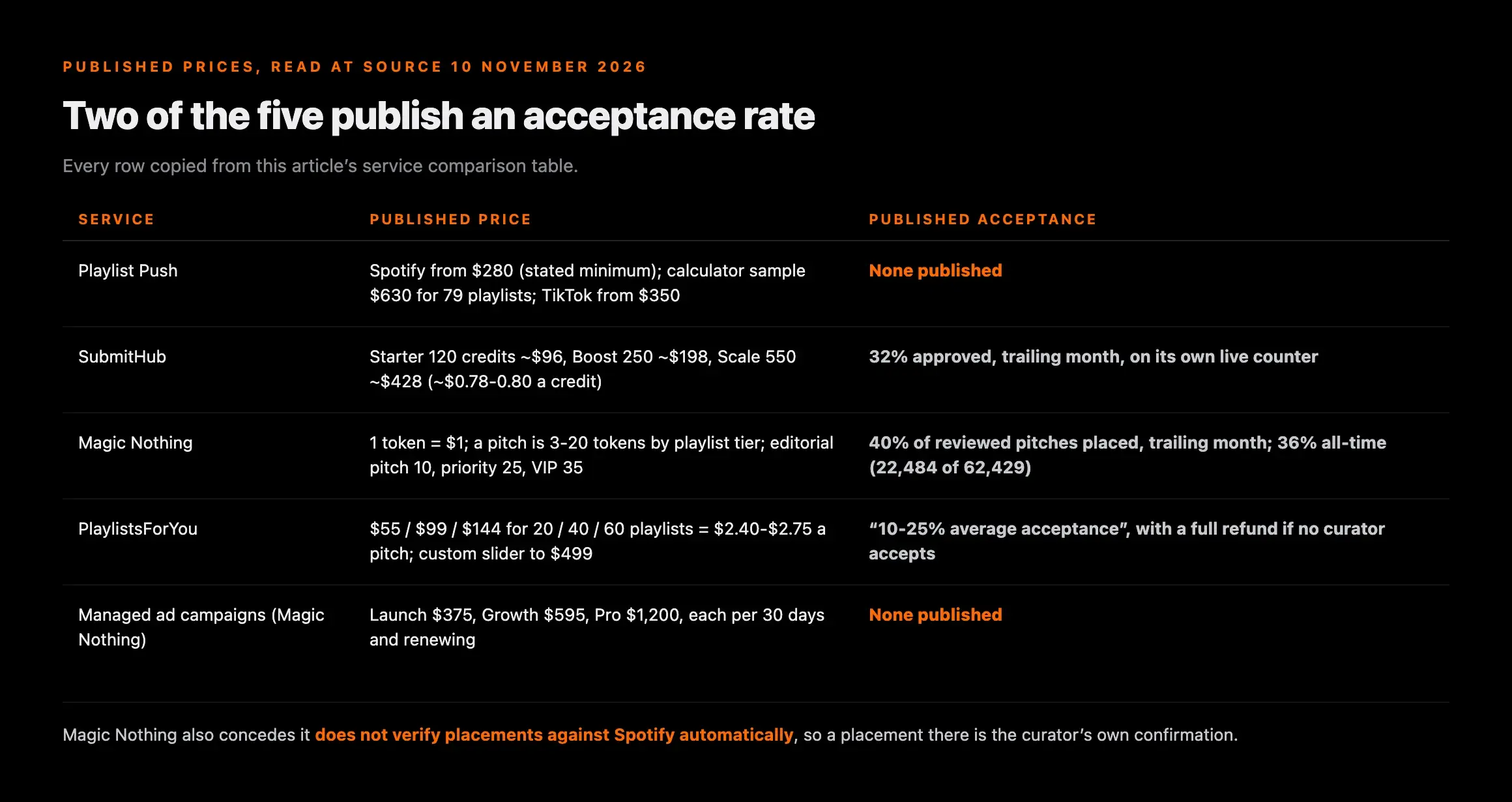
The three published acceptance rates disagree with each other: SubmitHub 32% over the trailing month, Magic Nothing 40% of reviewed pitches, PlaylistsForYou “10-25%”. Playlist Push, the largest, publishes none.
Across all 179 replies, not one reports a measured positive return from paid playlisting. The highest-scoring reply in the thread about $75 of credits is from a playlist curator telling the poster not to bother.
What three artists actually paid
These are self-reported figures from forum posts, not measurements we took, and the table says which thread each one came from. That matters more than usual here, because the loudest of the three posts was corrected by its own author in the replies.
| Who, and where | Spend | Channel | Reported result | Unit cost |
|---|---|---|---|---|
| Agency running campaigns for several artists, 3 Nov (43 points / 94 comments) | ~$2,000 a month on Meta, ~$1,000 a month on pitching | Meta ads pointed at a playlist, then Playlist Push and PlaylistsForYou | "3/6 adds per 80$ spend"; cost per result corrected in-thread to 3-6 cents | $13.33-$26.67 per playlist add |
| Eight-year Meta operator, best campaign they ever ran, 31 Oct (46 / 70) | $175 (seven days at $25) | Meta ads | 14,000 Spotify streams, 700+ YouTube followers | $0.0125 per stream |
| The same operator, the same setup, last week | $40 over 36 hours | Meta ads | 7 Spotify streams, 16 video views | $5.71 per stream |
| Playlisting buyer, 5 Nov (12 / 38) | ~$75 in one week | Magic Nothing and SubmitHub credits | Zero adds, and contradictory rejection notes on one song | No add to divide by |
| Reply in the 31 Oct thread (9 points) | $50 | Meta ads optimised for Instagram follows, not for plays | 300+ Instagram followers, 20 Spotify monthly listeners | $2.50 per monthly listener |
| Reply in the 31 Oct thread (11 points) | $100 in one week | Meta ads, on a setup that had worked for two years | Budget reallocated to Facebook placements, no streams; campaign killed | Not measurable |
The corrections are the part you would miss by reading the post alone, and there were three of them. A commenter read 45 cents a result off the attached dashboard; the author replied that the figure was cost per thousand impressions and his actual cost per result is three to six cents. The $3,000 is not one artist’s campaign but several. And the streaming graph everyone was reacting to came from about $500 of spend, and counts listeners rather than streams. The single most-quoted promotion-cost post of the month is materially different once you read its replies.
The voting is evidence too. That thread’s five highest-scoring replies — 38, 34, 26, 25 and 19 points — are all the same objection, that the spend is not returning. The top one is a single line: “Everybody in the music business making money except the people making the music.”
Is Playlist Push legit, and what does it cost in 2026?
Legitimate in the plain sense: it publishes its prices, names its network size, pays its curators a published rate and promises nothing about results. Its Spotify product starts at a stated $280 minimum, and it says outright that “Playlist Push does not offer any guarantees for the results you will receive after your song is sent out”.
| Service | Published price (10 Nov 2026) | What the money buys | What it does not buy | Published acceptance |
|---|---|---|---|---|
| Playlist Push | Spotify from $280 (stated minimum); calculator sample $630 for 79 playlists; TikTok from $350 | Pitches into a network it describes as 4,000+ verified playlists, each reviewed by a paid curator | Any guarantee of results, stated in those words | None published |
| SubmitHub | Starter 120 credits ~$96, Boost 250 ~$198, Scale 550 ~$428 (~$0.78-0.80 a credit) | 10-15, 30-40 or 40-60 playlist pitches plus Instagram and Facebook ad credits; a reply inside 72 hours | Placement. Credits spent on a pass are spent | 32% approved, trailing month, on its own live counter |
| Magic Nothing | 1 token = $1; a pitch is 3-20 tokens by playlist tier; editorial pitch 10, priority 25, VIP 35 | A guaranteed human review inside 72 hours, with tokens auto-returned if nobody reviews in time | A placement — "nobody here can sell you one". A pass is not refunded | 40% of reviewed pitches placed, trailing month; 36% all-time (22,484 of 62,429) |
| PlaylistsForYou | $55 / $99 / $144 for 20 / 40 / 60 playlists = $2.40-$2.75 a pitch; custom slider to $499 | Genre-matched pitching, placements lasting one month, results inside five days | Scale — it names a network of 60+ curators | "10-25% average acceptance", and a full refund if no curator accepts |
| Managed ad campaigns (Magic Nothing) | Launch $375, Growth $595, Pro $1,200, each per 30 days and renewing | The vendor's team running real ad campaigns for a track or a playlist | Any published performance figure | None published |
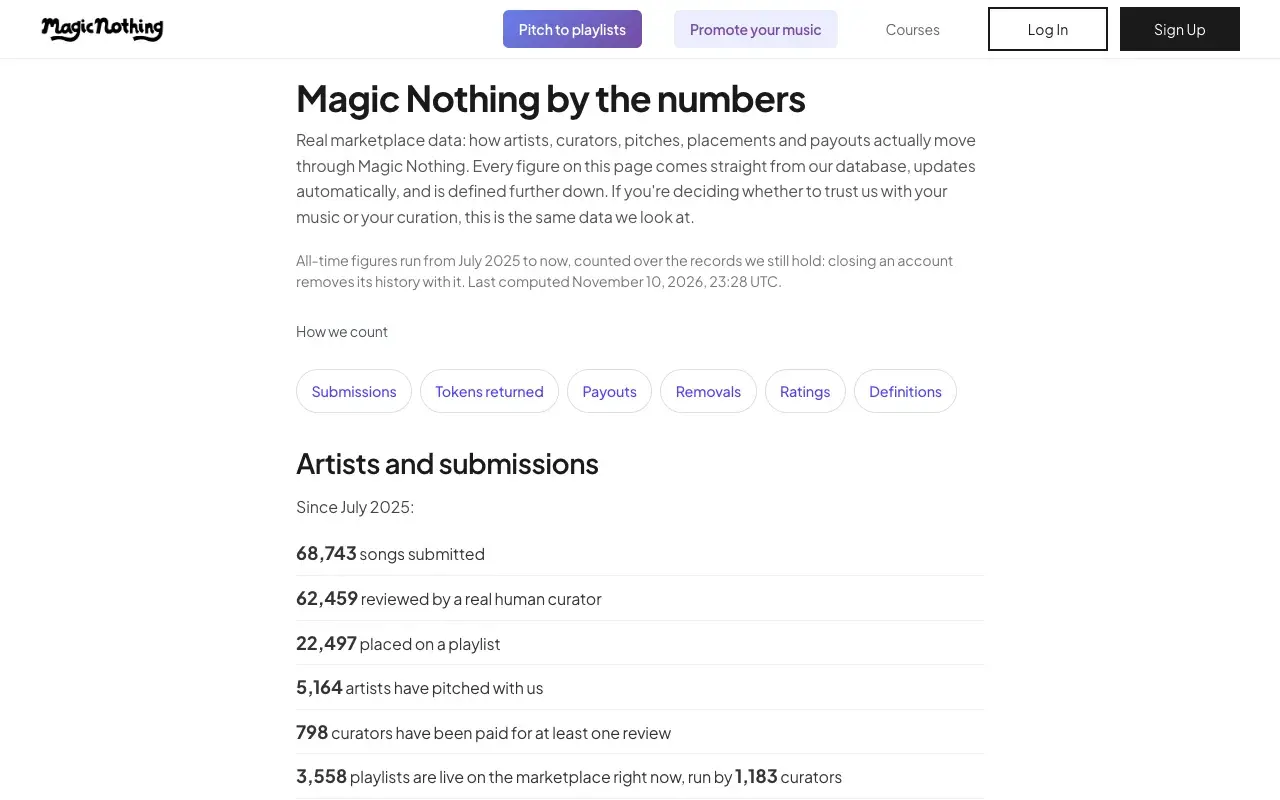
The service publishing the most numbers is also the one publishing the awkward ones. Magic Nothing’s figures page, recomputed from its database hourly, gives 68,686 songs submitted since July 2025, 62,429 reviewed by a human and 22,484 placed — and then concedes “we don’t currently verify placements against Spotify automatically”, so a placement is the curator’s own confirmation. No competitor page on this query mentions that, and it is the single most important caveat on any acceptance rate you will be quoted.
Meta ads for music: what changed
The 31 October thread drew 68 replies from 27 people, and the explanations do not agree. Ranked by score: the platform’s conversion rates have collapsed generally (16 points); budget is being reallocated to Facebook placements that do not produce streams (11); iOS tracking loss has blinded the pixel (7); ad inventory has been expensive and erratic for a year (7); the Advantage+ and audience-network defaults override manual setup (4 and 3). One operator reported 1,000 of 1,500 impressions arriving from Facebook Reels after bidding that placement down by 90%.
The dissent is real and it scores lower. Two operators say their campaigns still convert under 20 cents and that the thread is describing a settings problem, not a platform problem; nobody resolved it, and the original poster had already ruled out the two settings they named. The most interesting result in the thread is a third approach: a $50 campaign optimised for Instagram follows rather than plays, which produced 300+ followers and 20 Spotify monthly listeners — more, its author says, than any song-targeted campaign they had run. The reply to it is the warning: followers acquired that way skip your posts, and the skip rate costs you organic reach.
One tactic appears in both threads with opposite verdicts, and neither can be checked from outside. The 3 November account advertises in cheap territories on the reasoning that “when you run ads in developing regions they still translate to algorithmic streams in USA/EU”. An operator in the other thread says the opposite: “Tier 1 is still fine. Tier 2 and 3 are just junk at this point.” Keep that disagreement in mind for the artificial-streaming section, because cheap non-target geography is the exact shape of the thing Spotify says it removes.
The number that decides it: cost per stream against what a stream pays
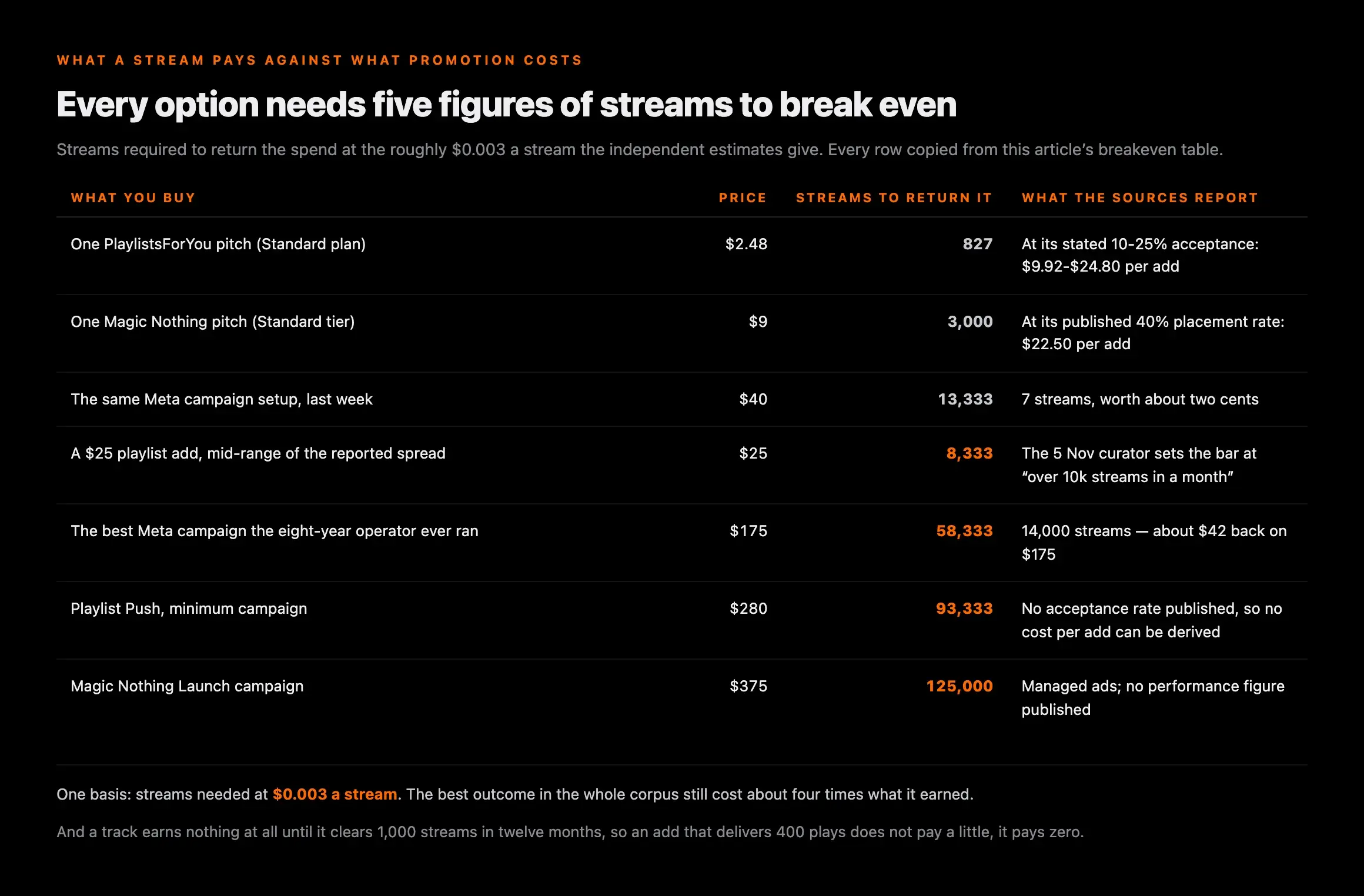
Before any arithmetic, the caveat that belongs on all of it. Spotify states in its own help centre that it “does not pay artist royalties according to a per-play or per-stream rate” — payouts are a share of net revenue, so there is no official figure to divide by. We use the independent estimate our 1,000 streams against one direct sale piece already works from, roughly $0.003 a stream, and every row below is an order of magnitude rather than a quote.
| What you buy | Price | Streams needed to return it | What the sources report |
|---|---|---|---|
| One PlaylistsForYou pitch (Standard plan) | $2.48 | 827 | At its stated 10-25% acceptance: $9.92-$24.80 per add |
| One Magic Nothing pitch (Standard tier) | $9 | 3,000 | At its published 40% placement rate: $22.50 per add |
| A $25 playlist add, mid-range of the reported spread | $25 | 8,333 | The curator in the 5 Nov thread sets the bar at "over 10k streams in a month" — about $30 of royalty |
| Playlist Push, minimum campaign | $280 | 93,333 | No acceptance rate published, so no expected cost per add can be derived |
| Magic Nothing Launch campaign | $375 per 30 days | 125,000 | Managed ads; no performance figure published |
| The best Meta campaign the eight-year operator ever ran | $175 | 58,333 | It produced 14,000 streams — about $42 back on $175 |
| The same campaign setup last week | $40 | 13,333 | 7 streams, worth about two cents |
Two things fall out of that table. The first is that the best outcome in the corpus — a campaign its own operator calls the best they ever had — still cost about four times what it earned. The second is worse and it is structural: a track earns nothing at all on Spotify until it clears 1,000 streams in twelve months, so a playlist add that delivers 400 plays does not pay a little, it pays zero. Our breakdown of what AI music actually earns has the thresholds in full.
Why the rejection notes contradict each other
The 5 November poster’s complaint was not really the money. It was that one curator said the drums were too quiet and another said they were too loud, on the same song. The marketplaces explain that themselves, in writing, on their own pages.
Playlist Push pays its curators $1.25 to $15 per song review and states the rule twice: “you are paid for reviewing songs, not for adding them to your playlists”, and, under the question of whether a curator must add every song, “No. You are paid to listen and give thoughtful feedback, not to add songs.” Magic Nothing is blunter still: “Accepting, passing and placing a song on another playlist all pay the same, because the work is the same: listening properly and writing back,” and “a pass is a normal outcome and it isn’t refunded, because the listen is the thing you bought.”
So the note you get is a condition of the reviewer’s payment, not an assessment you commissioned from someone qualified to give one. A reply in the thread worked that out independently and scored four points: to get paid they have to write something when they reject you, “hence the random critiques”. The highest-scoring reply of all, at 13 points, is from a playlist curator who runs the kind of five-credit SubmitHub playlists the poster was pitching, and whose advice is to ignore curator feedback entirely because “more than half of them don’t make music”. The same curator says their own tracks sitting permanently in their own playlists do “almost nothing”.
That incentive is not a scandal, and it is worth saying why: a curator who were paid for adds would be selling placement, which is the thing the next section is about. The cost of designing it correctly is that you are buying a listen, and two listens can disagree.
The artificial-streaming line, and which side of it you are on
Spotify’s definition is narrow and worth quoting exactly: “An artificial stream is a stream that doesn’t reflect genuine user listening intent.” On paid services it is blunt — “paid 3rd-party services that guarantee streams aren’t legitimate” — and it extends that to “any service that claims to offer guaranteed placement on playlists on Spotify in exchange for money”.
Read those two sentences and the vendors’ wording stops looking like legal boilerplate. The bar is on guarantees: of streams, or of placement. Playlist Push offers no guarantee of results. Magic Nothing says a pitch “doesn’t buy a placement, and nobody here can sell you one”. Both pay a curator identically whether they add you or pass. That is the whole architecture of a compliant marketplace, and it is also why none of them can tell you what your money will do.
What is left is outcome risk, and it lands on you rather than on the promoter. Spotify says it conducts “daily cleaning to ensure artificial streams are removed from public numbers”, that a song “may also be removed from Spotify playlists” depending on severity, that confirmed cases can mean “the withholding of associated royalties”, and that it charges labels and distributors per track where flagrant artificial streaming is detected. Your distributor is where that arrives. Note which way the geography argument cuts here: a cheap audience in a territory your listeners are not in is precisely a pattern that does not reflect genuine listening intent, and a creator in the third thread was already asking what a sudden spike of streams from one country means. We are not telling you to buy playlist placement. This page prices it.
Does an AI release get treated differently?
Honestly: nothing in these three threads is about AI music at all. The artist who got nothing for $75 is not an AI artist, so those rejections are ordinary curation and it would be a misreading to present them as evidence that playlists screen generated tracks. None of the five services above publishes an AI rule on its pricing page either.
Two things are true and sourced. SubmitHub runs its own AI detector, now at v4.3, covering Suno, Udio, Riffusion, ElevenLabs, MiniMax, Mureka, Treblo, Google Lyria and FlowMusic, claiming better than 99% accuracy while stating that “a result is a probability, not proof” and that edited stems and remastering make it less certain. And which promo platforms publish an AI policy at all is a separate audit, which our sister site ran across six of them in its platform-by-platform comparison.
What does carry over is simpler. A paid pitch buys a human being listening to your audio, and what they judge is the mix. That is the one variable on this entire page you control for free: a noise floor the model left behind or an unfinished master is a reason to pass that has nothing to do with the song, and getting the file release-ready costs less than one campaign.
Our recommended tool
Fix the file before you pay for ears
Undetectr targets the generation artifacts and AI-detection markers in an exported track — the release-readiness layer, before a curator or a distributor's screening hears it. It does not change how any platform labels your music as AI, and no tool does. It will not make a curator say yes either; it removes one reason to say no.
What the same money buys elsewhere
The alternative that survives this arithmetic is the one where a single decision is worth money. A paid sync placement is one music supervisor saying yes once, and it pays like a licence rather than like a play — our own figures put a placement at $120 to $3,000, which at $0.003 a stream is the equivalent of 40,000 to a million streams. Pitching for paid sync placements in TV, film, games and ads does not need an algorithm’s cooperation, and selling direct to the people who already like your music keeps all of it.
| Route | What it costs | What one unit pays | What you own afterwards |
|---|---|---|---|
| Paid playlist pitching | $2.40-$20 a pitch; $55-$630+ a campaign | A placement for roughly a month, at a one-in-three to one-in-ten chance per pitch | A stream count |
| Paid social ads | $25-$2,000+ a month in the reported accounts | Clicks. One reported case: $2.50 per Spotify monthly listener | An audience on a platform you rent |
| Selling direct | Listing time; no cost per sale | $5-$15, and you keep 100% | The customer, and the money |
| Sync pitching | Time, and whatever a library or pitching route charges | $120-$3,000 per placement | A licence fee and a credit |
This is not a claim that sync is easy or fast — it is slower than buying a campaign and most pitches go nowhere. It is a claim about where the money is: the $280 that needs 93,000 streams to come back is also 31 direct sales at $9, and those 31 people are reachable again next release.
What none of this fixes
The cost numbers do not touch the actual problem, and the same weekly sweep that found these three threads shows what it is. In the window to 8 November, across five music subreddits, the top post of the entire fortnight was a creator asking “I mean… what else is left?” at 494 points and 313 comments, beside “So how are people promoting?” (15 / 110), “New AI song promotion” (44 / 254) and “PROMO TIME” (23 / 169). Getting distributed is solved. Being heard is not.
What the three cost threads add is a price for that wall, and it is the first time this argument has had one. At a third of pitches accepted and several thousand streams needed per add, paid promotion is not a discovery mechanism an independent release can afford at these payout rates — it is a way to buy a number. If you want the version of this with platform mechanics rather than invoices, our piece on monetising on YouTube counts what actually worked for people who answered that question, and how listeners are reacting covers the audience side of the same problem.
Related reading
Frequently asked questions
Eddie Mathews — AI Music Editor, Erasy
Eddie covers the craft and the commerce side of AI music for Erasy — what a release costs, what it earns, and the workflow between a generation you like and a file you can sell. They read the vendor’s own page before quoting a price.
Is Playlist Push worth it?+
How much does Spotify playlist promotion cost in 2026?+
Do Meta ads still work for music in 2026?+
Is paying for playlists against Spotify's rules?+
Why did my song get rejected by every curator?+
Should I trust the feedback a curator gives me?+
Can you promote AI-generated music with paid ads and playlist pitching?+
Disclosure: Erasy is an independent guide to AI music, and Undetectr is the tool we recommend and link to. We have no relationship with any promotion service named on this page and no affiliate arrangement with any of them. Spend figures, quotations and reply counts come from all 179 retrievable comments across three r/musicmarketing threads (3 November 2026, 43 points / 94 comments; 31 October 2026, 46 / 70; 5 November 2026, 12 / 38), read through the public arctic-shift mirror because reddit.com serves this container a bot-check page; thread links go to Reddit for readers. Those are self-reported figures from forum posts, not measurements of ours, and the classification of replies by argument is ours. We ran no promotion campaign. Prices, network sizes and acceptance rates were read at playlistpush.com, submithub.com, magicnothing.xyz and playlistsforyou.com on 10 November 2026; the Magic Nothing marketplace figures carry their own timestamp of that date. Policy quotations are from Spotify’s artificial-streaming article and its royalties article. The per-stream estimate is the independent figure our own earnings pages use; Spotify publishes no per-stream rate. The 2018 review referred to in the introduction is Ari’s Take, published 2 October 2018 and last updated 18 April 2019.