AI Music
Release Stuck in Review? The 2026 Timeline and What the Wait Costs
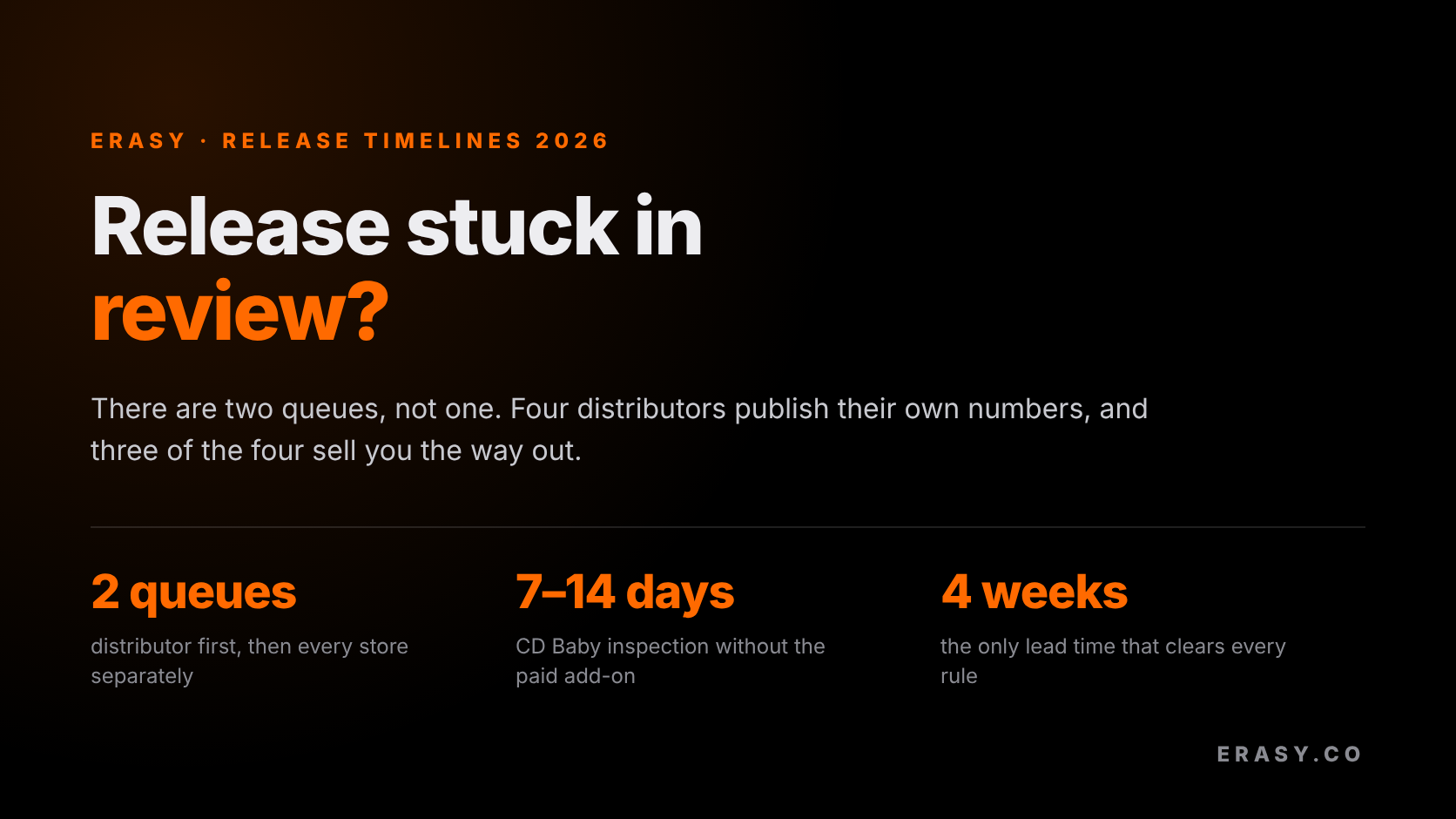
Your release date is Friday, the upload went in on Tuesday, and the dashboard has said the same thing for four days. A release stuck in review is the most common way an independent release goes wrong, and it is the one failure mode nobody plans for — because almost every page explaining it has the shape of the process wrong.
The cost is countable. Miss the Spotify pitch window and you lose editorial consideration and your followers' Release Radar for that song permanently. We read the DistroKid, TuneCore, CD Baby and LANDR help centres and Spotify's own artist support at source on 9 October 2026 and set every published number against the others. Three of the four distributors sell you the defence against their own queue, and the published lead-time rules do not agree.
The short version
- There are two queues, not one. Your distributor's own review runs first — about 2 business days at TuneCore, 7-14 at CD Baby without its paid add-on — and only then do the stores start.
- Faster review is a paid feature at two of four. CD Baby's Fast Forward cuts inspection from 7-14 business days to 1-2; LANDR sells a 2-5 day window against 2-10 standard.
- Four weeks is the number, not seven days. Spotify needs 7 days to pitch, TuneCore wants two weeks in stores for playlist consideration, DistroKid says pick a date four weeks out. Only four weeks clears all three.
- A hold is an email you have to answer. TuneCore: “You must reply to the email from our Content Review Team after you make the requested changes.” It does not advance on its own.
- Being AI-generated does not put you in a slower queue. No distributor publishes one. DistroKid “accepts music created with AI tools”. What AI adds is one more field to fill in correctly.
Two queues, not one
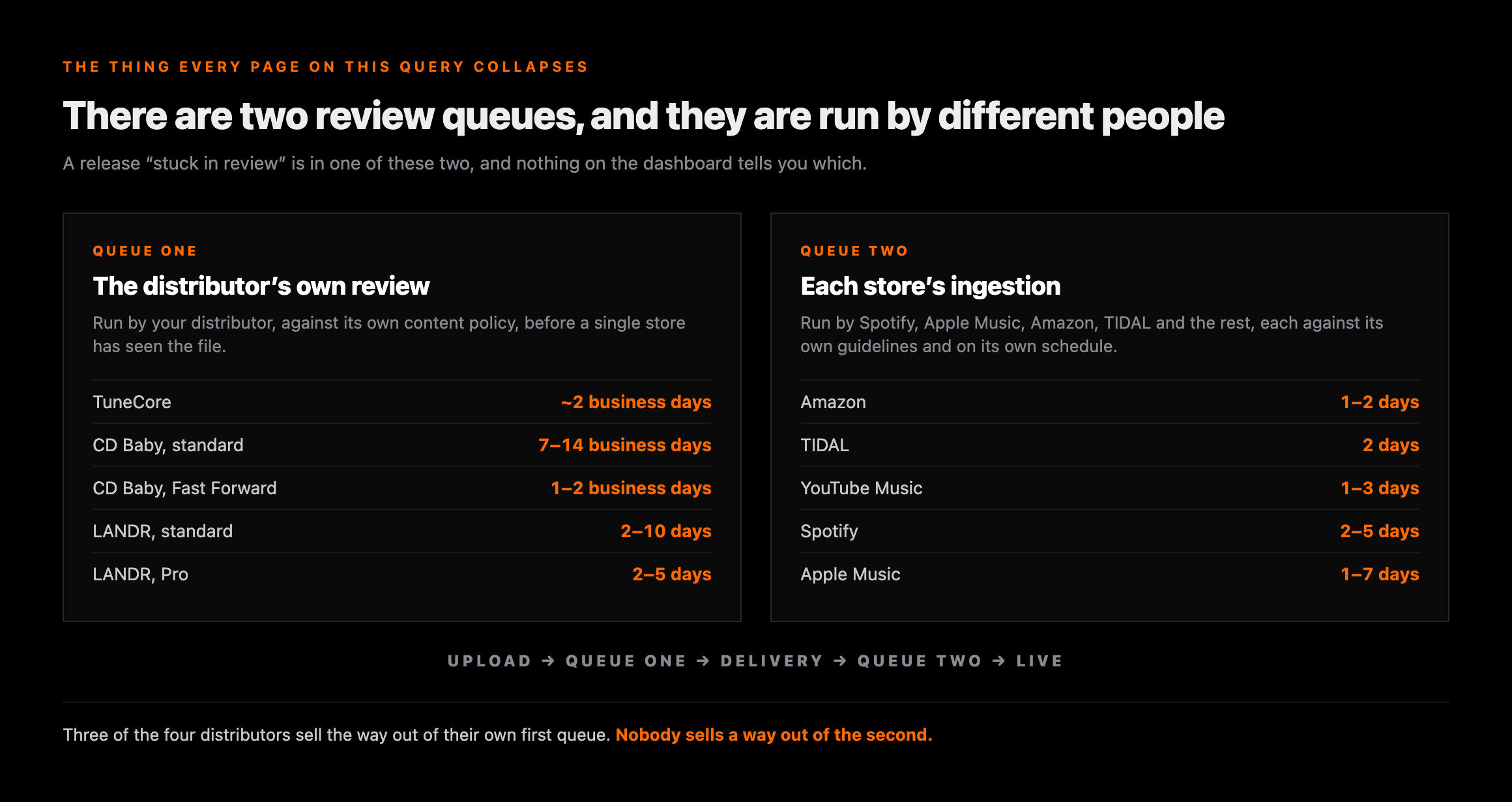
Here is what makes a release stuck in review so maddening: the word “review” is doing two completely different jobs, and your dashboard usually will not tell you which one you are in.
The first queue belongs to your distributor. Before anything leaves for the stores, a human or a rules engine at DistroKid, TuneCore, CD Baby or LANDR looks at your artwork, your metadata, your rights declarations and your audio. TuneCore calls it Content Review; CD Baby calls it inspection. Nothing has been delivered anywhere yet. If something is wrong, this is where it stops, and the clock stops with it.
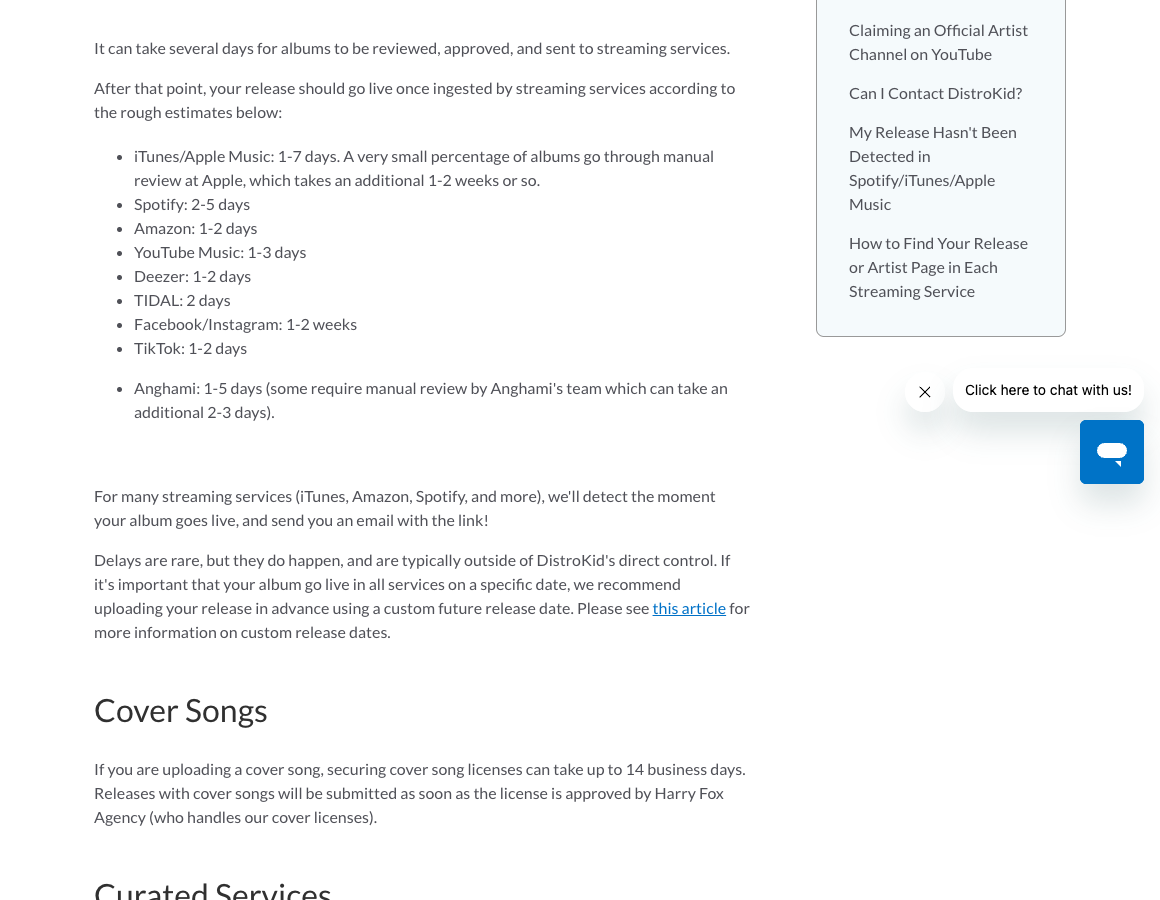
The second queue belongs to each store and starts only after your distributor approves and sends. Spotify, Apple Music, Amazon and the rest each ingest on their own schedule, and some releases get pulled aside for extra checks on top: DistroKid notes that “a very small percentage of albums go through manual review at Apple, which takes an additional 1-2 weeks or so”.
| Queue one — your distributor | Queue two — each store | |
|---|---|---|
| Who is looking | DistroKid / TuneCore / CD Baby / LANDR | Spotify, Apple Music, Amazon, TIDAL, each separately |
| What they check | Artwork specs, metadata, rights and AI declarations, audio format | Their own content guidelines and ingestion rules |
| Has anything been delivered? | No — nothing has left the distributor | Yes — it is in the store's pipeline |
| Can you fix it yourself? | Yes, and you usually have to reply to an email to restart it | Not directly — corrections go back through the distributor |
| Typical length | 1-2 business days to 7-14, depending on who and what you pay | 1-2 days to 2 weeks per store, longer if pulled for manual review |
Every competing guide we read collapses those two into one number, which is why their totals disagree with each other and with the help centres. Keep them separate and the rest of this is a calendar you can count on.
How long your distributor's review takes
All four numbers below are published by the distributors themselves, and the spread between them is far wider than anyone warns you about. The outlier is the one worth planning around.
| Distributor | Its own review step | Faster, if you pay | Page updated |
|---|---|---|---|
| TuneCore | “About 2 business days to review your release”, then sent to stores immediately | Not offered as an add-on | 9 Oct 2026 |
| CD Baby | Inspection: 7-14 business days standard | Fast Forward: 1-2 business days | 28 Sep 2026 |
| LANDR | Live “within 2-10 days”, team reviews then distributes | Distribution Pro / Studio Pro: “2-5 day review window” | 30 Sep 2026 |
| DistroKid | “Several days for albums to be reviewed, approved, and sent” | No faster review sold; a future release date needs Musician Plus or Ultimate | 21 Jul 2026 |
Read the middle column twice. CD Baby's unpaid inspection is 7-14 business days — up to three calendar weeks before a single store has seen your track — and Fast Forward collapses it to 1-2. LANDR's 2-5 day window is a subscription feature. DistroKid sells no faster review, but the one tool that protects a launch date, a future release date, is not on its entry plan.
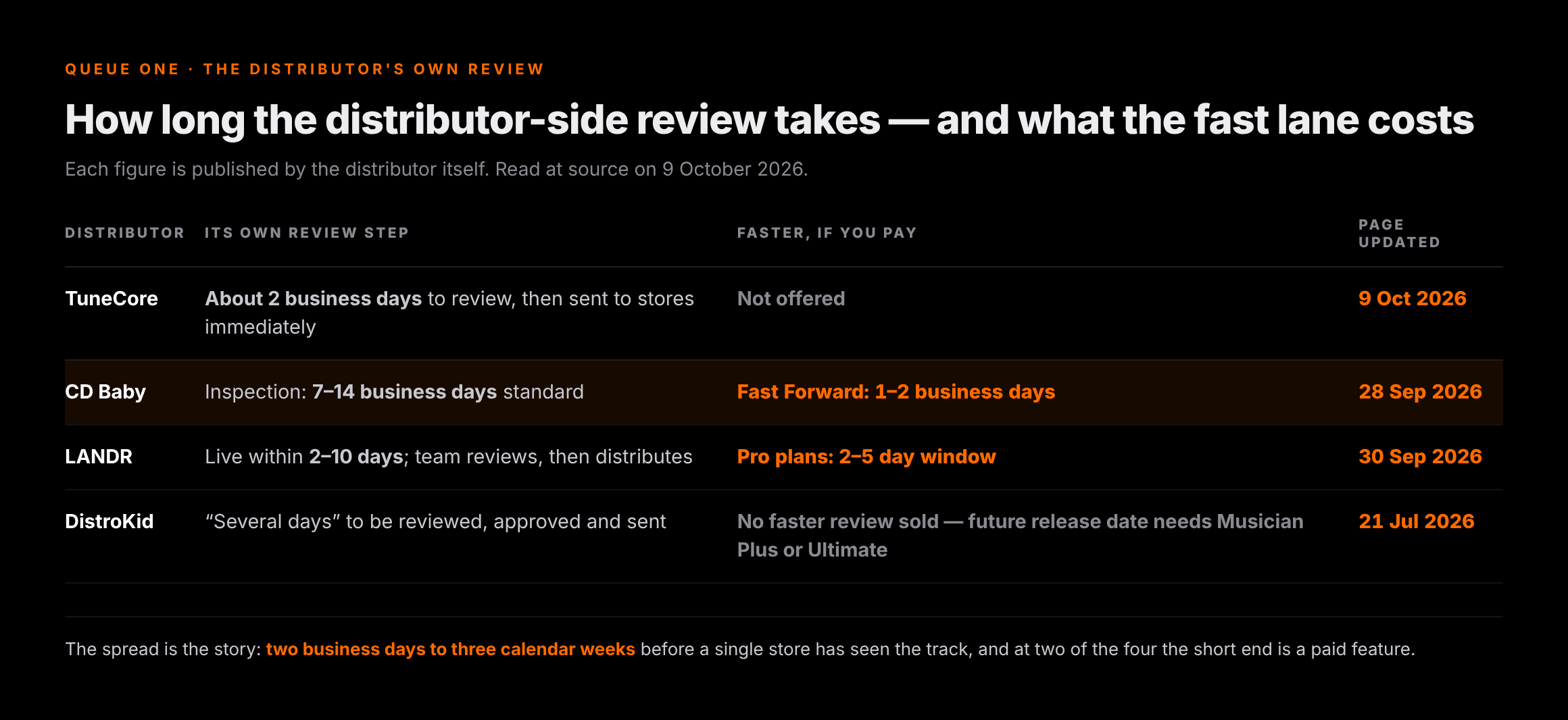
So the first queue costs between two business days and three weeks, and which end you land on is partly a function of your subscription. That is not a scandal — inspection is labour — but it does mean an entry-plan release needs a longer runway than any generic guide tells you.
Then the stores take their own time
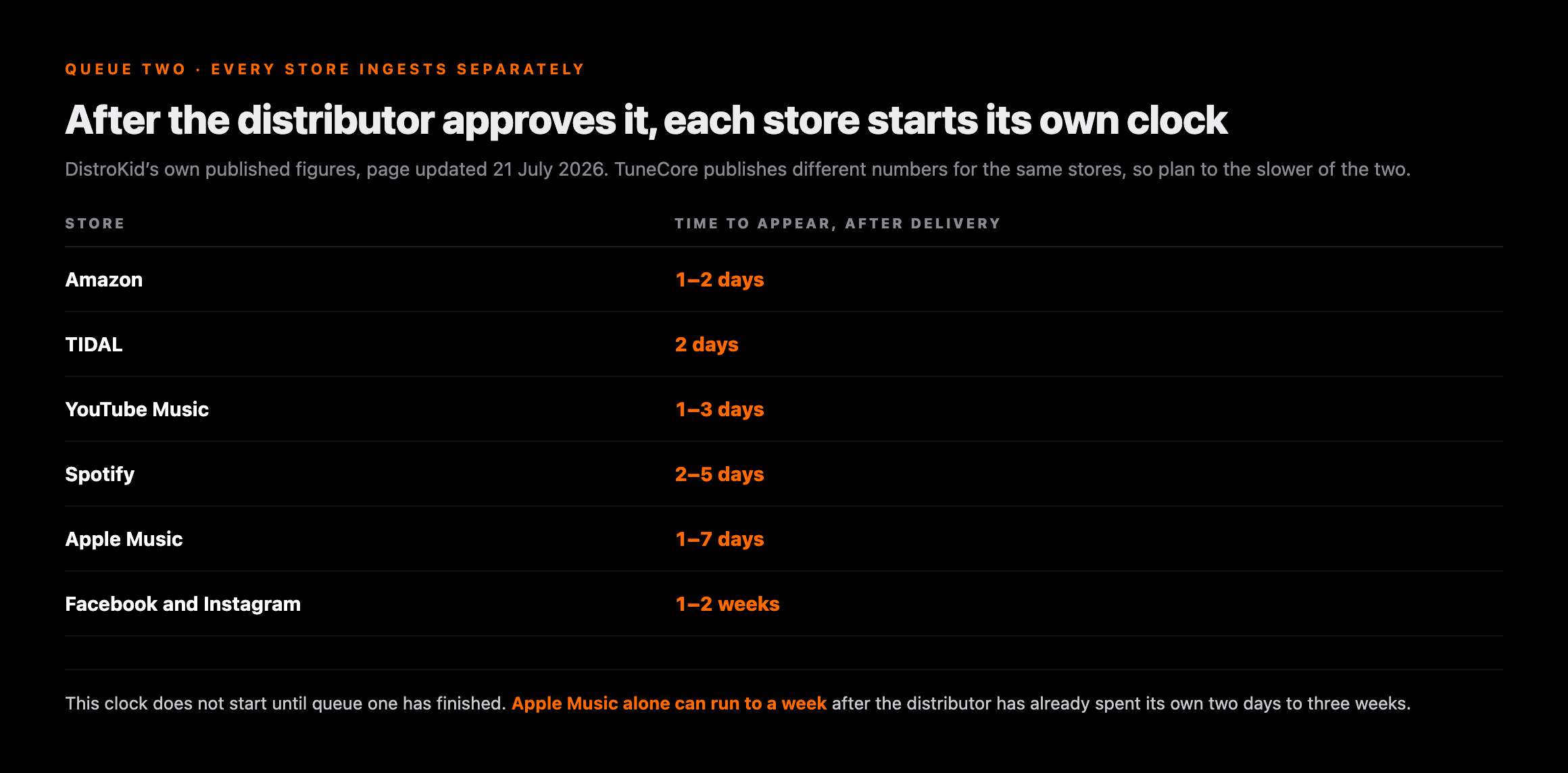
Once your distributor has sent the release, each store works at its own pace. Both DistroKid and TuneCore publish per-store estimates, and putting them side by side is instructive: they do not agree, including on Apple Music, where one says days and the other says up to a week.
| Store | DistroKid estimate | TuneCore estimate |
|---|---|---|
| Spotify | 2-5 days | 2-5 business days |
| Apple Music / iTunes | 1-7 days | 1-2 business days |
| Amazon Music | 1-2 days | 1-3 business days |
| YouTube Music | 1-3 days | 1-2 weeks |
| Deezer | 1-2 days | 3-4 business days |
| TIDAL | 2 days | 1-3 business days |
| TikTok | 1-2 days | 5 business days |
| Facebook / Instagram | 1-2 weeks | — |
| Anghami | 1-5 days, plus 2-3 if manually reviewed | 1-2 weeks |
Two of those gaps matter. YouTube Music is 1-3 days at DistroKid and 1-2 weeks at TuneCore, the difference between a coordinated launch and a release that trickles out over a fortnight. And TuneCore quotes business days while DistroKid does not, so a Thursday approval is not the same bet at both.
Neither set is wrong. Both are estimates of other companies' pipelines, and they drift. Plan to the slowest store you care about and add the manual-review tail on top.
The three lead-time rules nobody joins
No page on this subject puts the next part together, and it is why well-organised releases still miss their date. Three companies publish three different minimum lead times, for three different purposes, and they stack rather than replace each other.
| Rule | Who sets it | What it is for | Their words |
|---|---|---|---|
| 7 days | Spotify | Editorial pitch and Release Radar | “Deliver your music at least 7 days before release so our editors have time to listen.” |
| 2 weeks in stores | TuneCore | Playlist consideration | “Your release will need to be approved by TuneCore and processed in the stores at least two weeks prior to your release date.” |
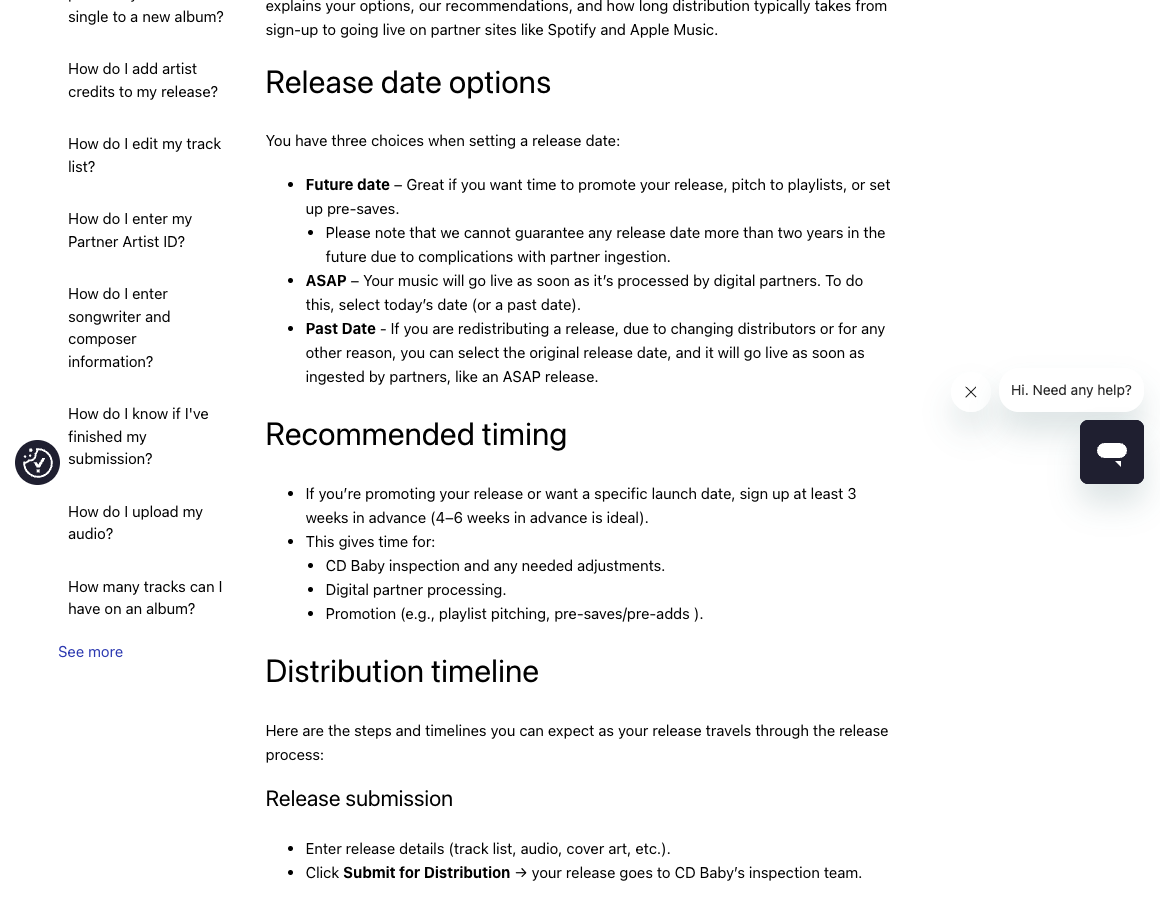
| 3 weeks (4-6 ideal) | CD Baby | Inspection, partner processing, promotion | “Sign up at least 3 weeks in advance (4-6 weeks in advance is ideal).” |
| 4 weeks | DistroKid | Holding a date across every platform | “If you choose a release date less than four weeks in advance, there's a chance your album could still be stuck in a service's review queue.” |
Notice what Spotify's 7 days actually is. It is not “upload seven days early and you are fine”. It is a deadline for the song to be delivered, approved and sitting in Spotify unreleased with a pitch attached. Everything in the two queues above has to have finished before that clock starts. TuneCore says as much in its own wording — approved and processed in the stores two weeks ahead — which is a stricter rule than Spotify's floor, from the company that has to get you there.
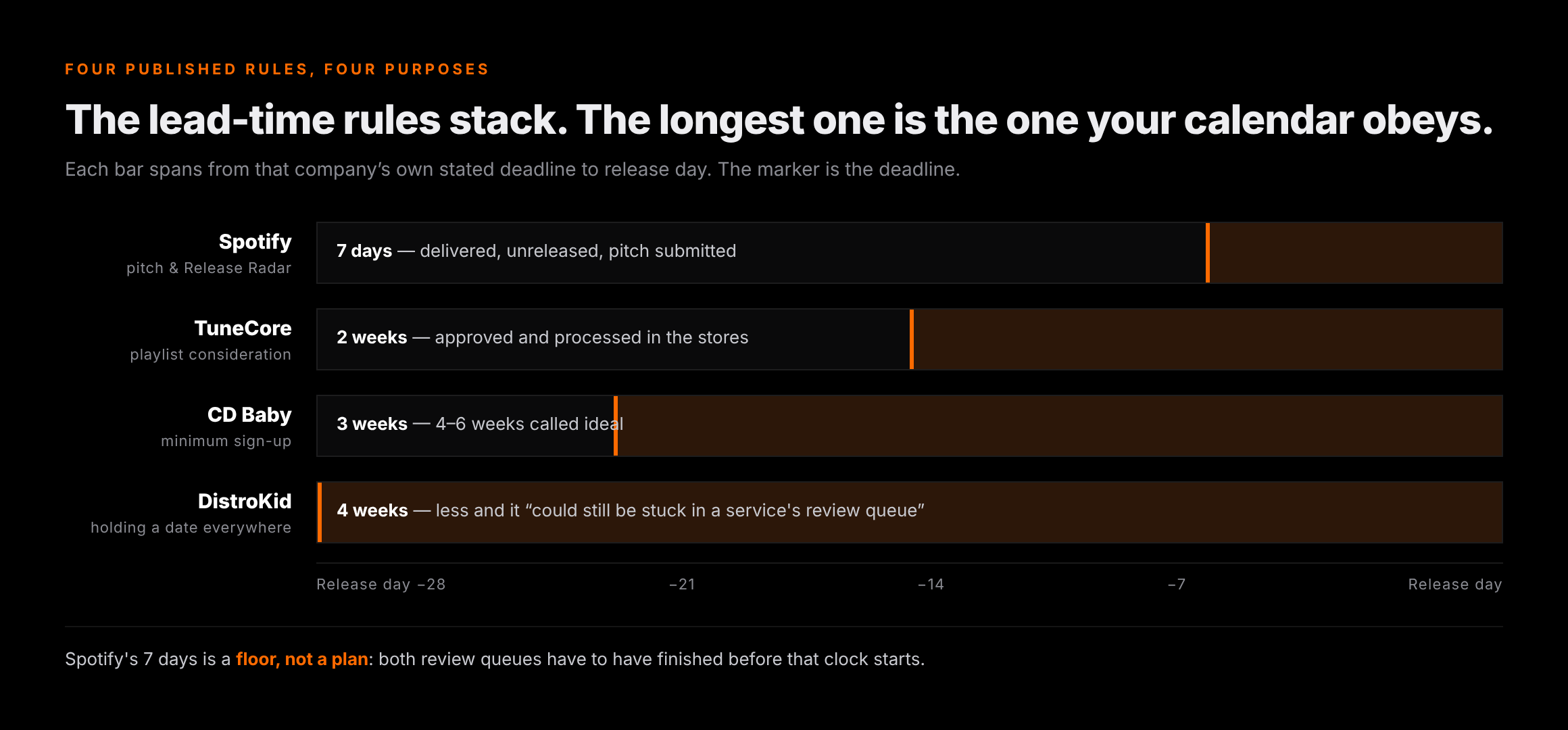
Stack them and the answer is four weeks — not because four weeks is magic, but because it is the only number satisfying the strictest rule anyone in the chain publishes, and it leaves room for the thing none of them price in: a flag, and the days you spend clearing it.
What the wait actually costs
Most of what a delay costs is recoverable. You move the date, redo the social posts, feel stupid for a week. One cost is not recoverable, and it is the one worth protecting.
The part you cannot get back
Spotify's artist support states it twice over. First the mechanism: “If you pitch an unreleased song at least 7 days before release, we'll add it to your followers' Release Radar playlists.” Then the cut-off: “Once a song has gone live, it's no longer eligible for pitching.” There is no retroactive pitch and no appeal. A release that slips past its pitch window goes out with no editorial consideration and no Release Radar push to the people who already followed you.
That matters more than it sounds for an AI release, for a reason that appears only when you line up two Spotify policies. Spotify has said it will not include AI Personas in editorial or algorithmic recommendations by default — we cover that in our Spotify AI music policy breakdown. Release Radar is built for people who already follow you, which makes it one of the few algorithmic placements that does not depend on being discovered first. Losing it to a queue is a bad trade.
The other costs are smaller: pre-saves pointing at a date that moved, a coordinated launch that becomes a staggered one, and the Friday you spent refreshing a dashboard.
What an AI track adds to the queue — and what it doesn't
Let us be exact here, because the internet is not. There is no published separate review timeline for AI-generated music at any of the four distributors above. None of them advertises a slower lane, and none of them says AI releases get extra scrutiny as a class. DistroKid's help centre answers the question directly: “Yes—DistroKid accepts music created with AI tools, but there are some rules.” The rules are ownership, no impersonation, no mass-generated spam and no infringement, and it adds the honest caveat that “streaming services may reject or remove releases that don't meet their guidelines”.
What it does add is one more front-end field you can get wrong, and a blank or contradictory one is exactly what the first queue stops. DistroKid's AI credits question, per a help page updated 6 October 2026, asks you to pick at least one option if any of the track was AI-generated.
| What you declare | What it means | When it applies |
|---|---|---|
| The lyrics | AI wrote the words | Prompted or generated lyrics |
| The music | AI composed the melody | Generated composition or arrangement |
| All of the audio | Everything the listener hears is AI-generated | A straight Suno or Udio export |
| Part of the audio | Some of it is AI, some is human | AI instrumental under your own vocal, or the reverse |
| Nothing to declare | AI used only as a tool | Pitch correction, auto-tune, AI-assisted mixing or mastering |
Pick “all of the audio” and DistroKid also asks whether your artist name is a human or an AI persona — the field feeding the labelling that Spotify, Apple Music and YouTube show listeners. The last row is the one people get wrong the other way: an AI mastering tool is not a reason to file AI credits. Declaring accurately costs nothing in the queue; a mismatch can cost days.
The file-level step, before you upload
Clear the generation artifacts before intake screening meets them
Undetectr processes an AI-generated master for the artifacts and model signatures that distributors' automated intake screening reacts to. Be clear about the limits: it does not make a review go faster, it does not get you out of a content-review flag, and no tool changes how a platform labels or credits your release. It is a file job, done before you upload.
Disclosure: Erasy is an independent guide and Undetectr is the tool we recommend and link to; we may earn a commission if you subscribe.
A hold is a conversation, not a queue
This is the most useful thing in any help centre we read, and the thing people waiting patiently do not know. A release flagged in the first queue is not in a line that will eventually reach the front. It is waiting on you.
TuneCore spells out the mechanism. A flagged release shows as “Not Sent” or “Unreleased”, or you see a red banner when you sign in. An email goes to you from contentreview@tunecore.com explaining why it did not pass. And then:
“You must reply to the email from our Content Review Team after you make the requested changes so that we can review, approve and deliver the release to stores.”
“Not Sent” or “Unreleased” at TuneCore, “In Review” at LANDR, a red banner at sign-in. A status is information; a silent dashboard is not.
Check spam. TuneCore's comes from contentreview@tunecore.com with the reason and the fix. CD Baby and LANDR both say their teams contact you when edits are needed.
Replying is what restarts the review. TuneCore quotes 24 business hours for Content Review to come back to you once you do.
If the fix cannot land four weeks out, change the release date while you still can rather than letting it go live unpitched.
Five days of silence is almost never the queue being slow. It is usually an email in a spam folder.
What actually holds a release
The causes are mundane and mostly preventable, and each has a different price in days. The cover-song line surprises people, because the delay is not your distributor's at all.
| What holds it | Where it bites | What it costs you |
|---|---|---|
| Artwork that misses spec | Distributor review | A reply-and-recheck cycle — days, not hours |
| Metadata errors (artist name, formatting, missing ISRC) | Distributor review, or a store rejecting after delivery | Days in queue one; a redelivery if it gets through |
| A cover song without a licence | Before submission | DistroKid: securing cover licences “can take up to 14 business days” |
| Unsigned service agreements or unpaid items | Before submission at CD Baby — it blocks submission entirely | Indefinite, and invisible unless you check the Title Overview flags |
| A duplicate or conflicting release | Store side | A takedown and a redelivery, which runs both queues again |
| AI credits left blank or contradicting the audio | Distributor review | A reply-and-recheck cycle, and the labelling may be wrong if it slips through |
| Pulled for manual review at a store | Store side, nothing you can do | DistroKid: at Apple, “an additional 1-2 weeks or so” |
Our pre-release checklist for AI tracks walks the file-level half of this in order, and the guide to distributing without getting flagged covers the declarations. Between them, most of the rows above never happen.
Build the calendar backwards
The fix is boring and it works: pick the release date first and count backwards through both queues, rather than forwards from whenever the mix is finished.
Upload. This is DistroKid's own threshold for a date holding across every platform, and it is inside CD Baby's 4-6 week ideal.
Queue one. Two business days if you are at TuneCore, up to 14 if you are on CD Baby without Fast Forward. Watch for the flag email.
Approved and processed in the stores — TuneCore's own bar for playlist consideration. If you are not here yet, move the date.
Spotify's floor: delivered, unreleased, pitch submitted. This is also what puts the track into your followers' Release Radar.
Two notes on the arithmetic. Business days are not days: a 7-14 business-day inspection is up to nineteen calendar days once two weekends are in it, most of your four weeks on its own. And on an entry plan, check you can even set a future release date before building a calendar that depends on one.
If the date slips anyway
Sometimes it slips. What is recoverable: the date, the social plan and the pre-saves, all of which you can move while the release is unreleased. What is gone once the song is live is the pitch and the Release Radar placement for that track, and no support ticket reopens them.
Keep the size of this in proportion, though. A missed Release Radar on a track with two hundred plays costs roughly nothing, because two hundred plays was already roughly nothing — and the loudest complaint in the AI-music community is not distribution at all. Getting distributed is largely solved. Being heard is not, and no calendar hygiene fixes it. Our numbers on a thousand streams versus one direct sale are the arithmetic behind that sentence.
Which argues for having one route to money that sits in nobody's ingestion queue. A paid sync placement — a track licensed into a show, a game, an ad — is a brief answered and a fee agreed, on a timeline set by the buyer. Selling direct sits beside it, and the money arrives when someone pays rather than when a pipeline clears. Neither waits on a review queue, and neither depends on an algorithm noticing you.
The one-line version
A release stuck in review is almost always in the first of two queues, waiting on an email you have not answered; four weeks is the only lead time that satisfies every published rule; and the one thing a slip takes permanently is the Spotify pitch and the Release Radar that comes with it.
Related reading on Erasy
- How to distribute AI music without getting flagged
- Cleaning AI-generated music for release: the checklist, in order
- Spotify's AI music policy: what is allowed and what is not
- Can you sell Suno music on Spotify and DistroKid?
- Are Suno songs unique, and what happens if two people get one
- What AI music detectors actually see, and why they disagree
Frequently asked questions

Eddie Mathews — Editor, Erasy
Eddie reads the terms of service and the help-centre article rather than the roundup, and marks the difference between what a company has said and what a tutorial has assumed. Where the public record does not settle a question, this site says so.
Why is my release stuck in review?+
How long does it take for music to go live after a distributor approves it?+
Is a release held up because it was made with AI?+
How far before my release date should I upload?+
What happens to my Spotify playlist pitch if the release is late?+
Can I pay to make the review faster?+
My release says Not Sent or Unreleased. What do I do?+
Should I just re-upload the release somewhere else instead of waiting?+
Sources read at source on 9 October 2026: the per-store go-live estimates, the Apple manual-review note, the cover-licence timeframe, the four-weeks-ahead rule, the plan requirement for a future release date, the AI-tools policy and the AI-credits options from DistroKid's help centre (pages updated 29 June, 21 July, 19 and 25 August, 30 September and 6 October 2026); the 2-business-day review, the 3-4 week upload recommendation, the two-weeks-in-stores rule for playlist consideration, the per-store estimates and the Content Review flag mechanics including the reply requirement and the 24-business-hour turnaround from TuneCore's help centre (updated 7 and 9 October 2026); the 3-week minimum and 4-6 week ideal, the Fast Forward and standard inspection windows, the partner processing ranges and the blocked-submission flags from CD Baby's help centre (updated 28 September and 3 October 2026); the 2-10 day standard and the 2-5 day subscription review window from LANDR's (updated 30 September 2026); and the 7-day delivery and pitch rule, the Release Radar consequence and the “no longer eligible for pitching” cut-off from Spotify's artist support. All four distributor help centres return 403 to automated requests behind their bot walls; every page cited is an official URL on the company's own domain, read through those help centres' public article endpoints. Where two distributors publish different estimates for one store, both are shown rather than averaged. No distributor publishes a review timeline specific to AI-generated music and this page does not infer one. Nothing here is legal advice.