AI Music
Are Suno Songs Unique? What Happens If Two People Get the Same Track
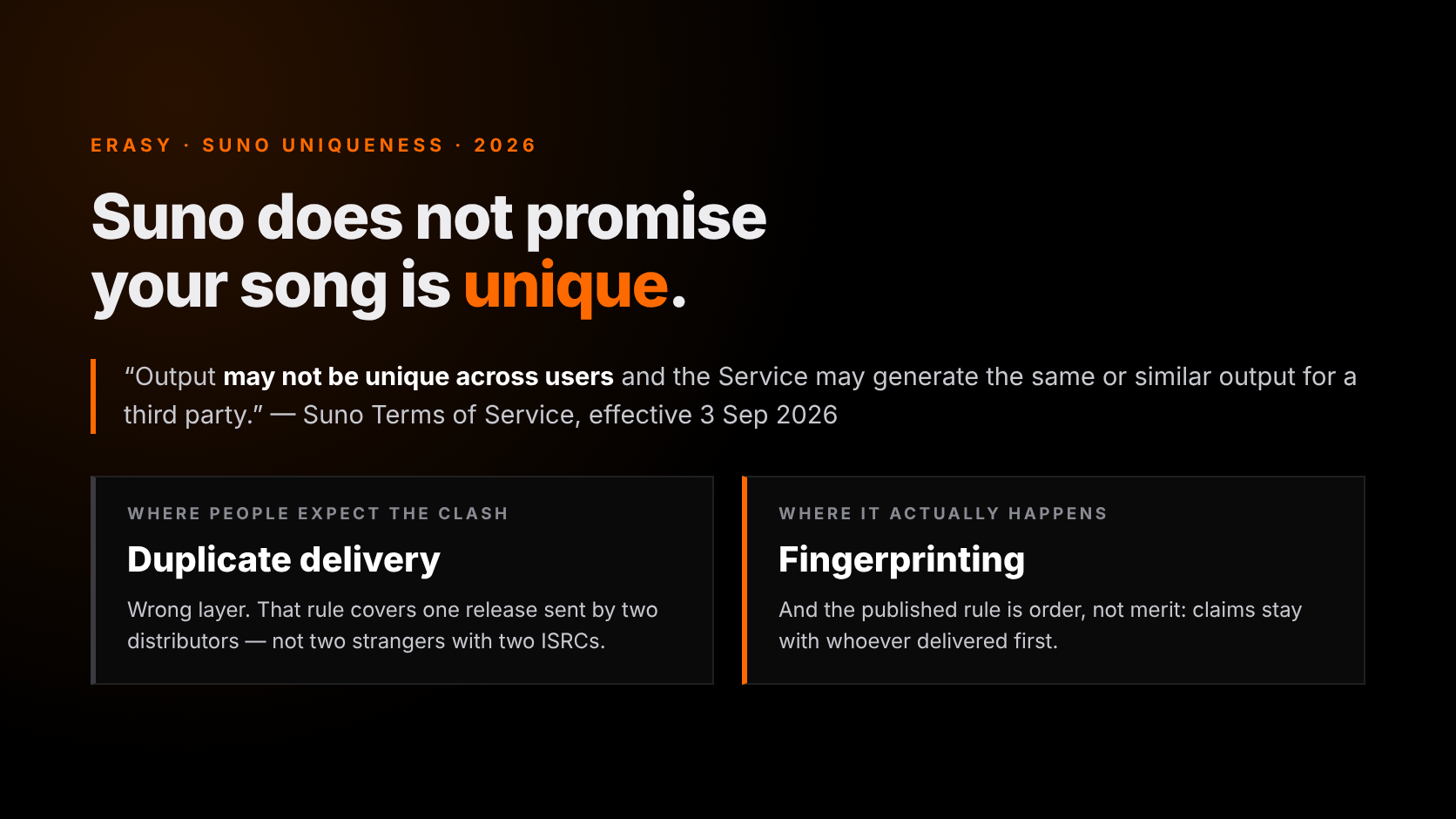
You typed a prompt, Suno handed back a song, and somewhere behind it is the question nobody on the first page of search results answers: are Suno songs unique, or could a stranger be sitting on the same track? Suno answers it in its own Terms of Service, and the answer is no.
That matters in money terms, not philosophical ones. A release passes through four systems before it earns anything, and identical audio behaves differently at each one. Most pages on this subject warn you about the duplicate-content rule, which is the one layer where a collision does not happen. We read Suno's terms, YouTube's Content ID documentation, the DistroKid and CD Baby help centres, Spotify's artist support and the US Copyright Office's January 2025 report at source on 6 October 2026. Every quote below is verbatim; where a conclusion is ours, the line says so.
The short version
- Suno does not promise your song is unique. Its terms say output “may not be unique across users and the Service may generate the same or similar output for a third party”.
- Nobody publishes how often this happens. Suno gives no figure, and no independent measurement exists. A page that quotes you a percentage invented it.
- The duplicate-delivery rule does not cover this case. It governs one release sent by two distributors — not two strangers filing two releases with two ISRCs.
- Fingerprinting is where it collides, and order decides. YouTube: claims on an overlapping segment “will remain with the partner who delivered the content first”.
- Neither of you necessarily owns the recording. The Copyright Office holds that “prompts alone do not provide sufficient human control” to make you the author.
Are Suno songs unique? What the terms actually say
Start with the document that settles it, because the whole internet argues about this while the answer sits in clause form on Suno's own site. The Terms of Service — last revised 10 August 2026, effective 3 September 2026 — say this:
“Due to the nature of machine learning, Output may not be unique across users and the Service may generate the same or similar output for a third party.”
And, in the same breath, “Other users may provide similar submissions and receive the same output.” Read those two sentences as what they are: a disclaimer. Suno is not saying collisions are common. It is declining to promise they never happen, which is more useful than any guide's reassurance.
The rest of the uniqueness question is a chain of clauses in the same terms, pulling in different directions. On a paid plan Suno assigns you its interest in the output. It declines to warrant that your use will not infringe anyone. The free tier is limited to “lawful, personal and non-commercial purposes”, and commercial use is gated on a download. Four separate promises, and none of them is exclusivity.
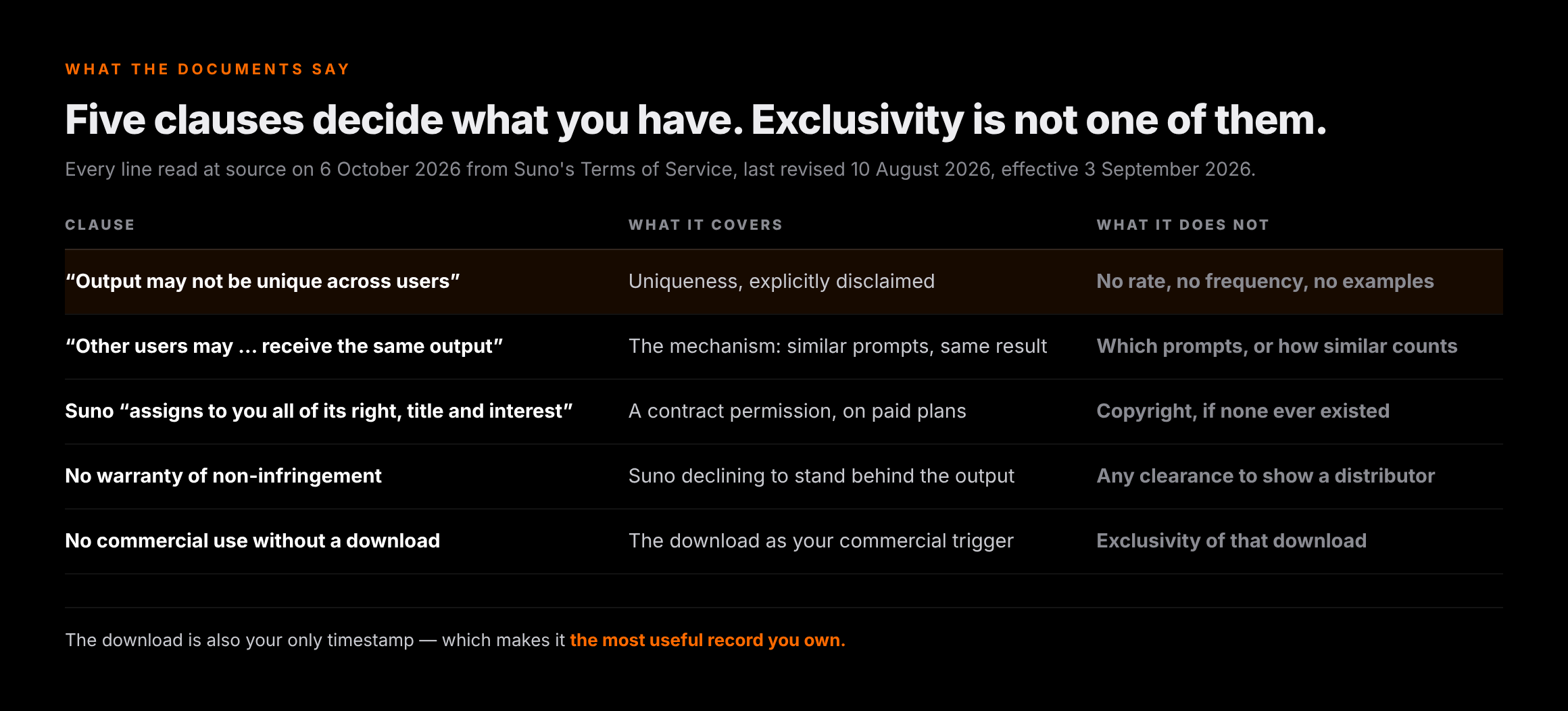
| Suno's own words | What it covers | What it does not |
|---|---|---|
| “Output may not be unique across users” | Uniqueness, explicitly disclaimed | No rate, no frequency, no examples |
| “Other users may provide similar submissions and receive the same output” | The mechanism — similar prompts, same result | Which prompts, or how similar is similar |
| Suno “assigns to you all of its right, title and interest” in output (paid plans) | A contract permission from Suno to you | Copyright, which Suno cannot assign if it never existed |
| No warranty that your use “will not infringe the rights of any Third Party” | Suno declining to stand behind the output | Any clearance you could show a distributor |
| “May not commercially exploit Output that has not been downloaded” | The download as the commercial trigger | Anything about exclusivity of the download |
That last row is why the download allowance matters twice over: it is your commercial trigger and your only timestamped artefact. Hold that thought.
How often are Suno songs not unique? Nobody publishes it
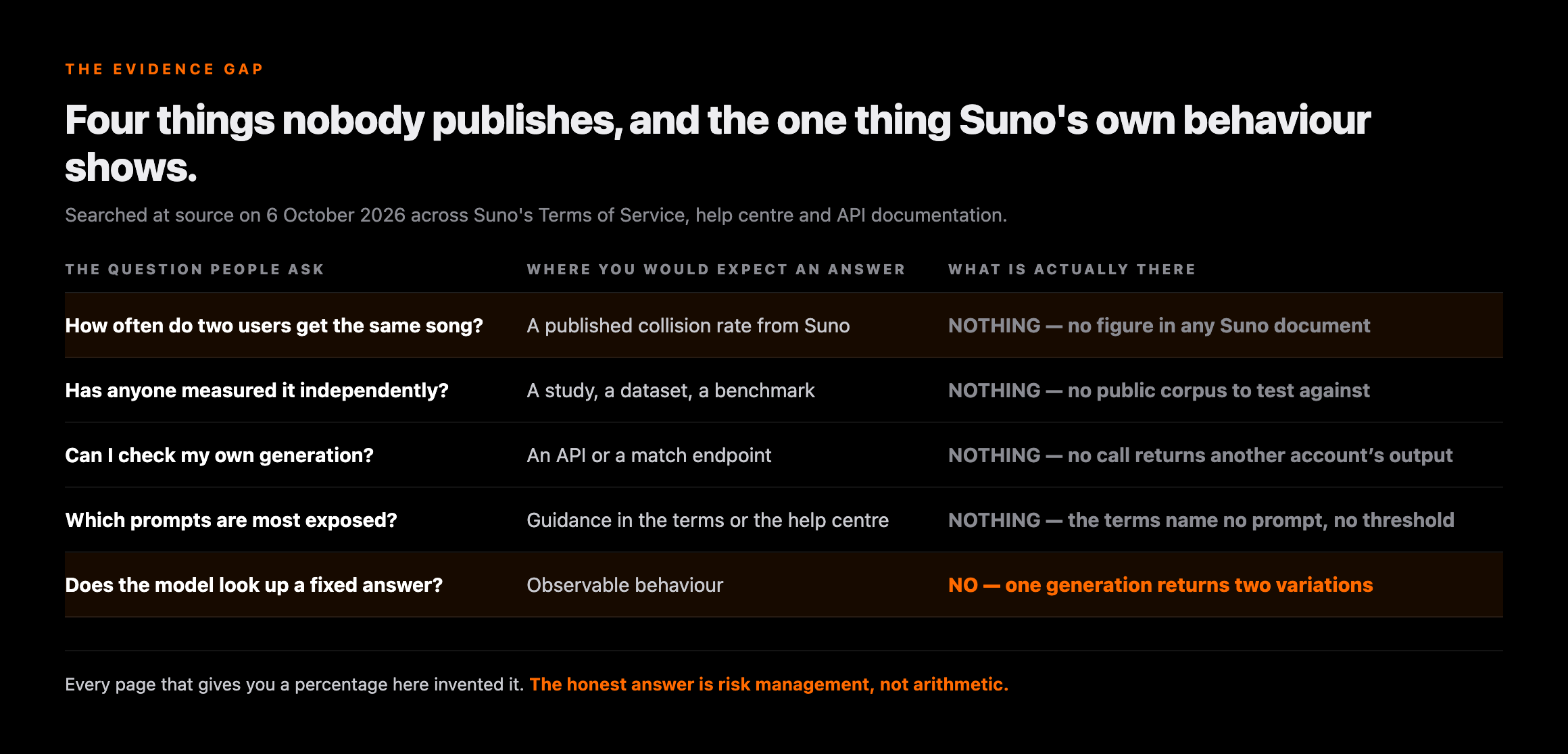
Here is where most pages switch from quoting to guessing. The truthful position is short: Suno publishes no collision rate, and no independent measurement exists. No API tells you whether your generation matches another account's, there is no public corpus to test against, and no figure appears in any Suno document we could find. We are not going to fill that hole with a number. What published behaviour does show is narrower: a generation returns two variations rather than one, so the system samples rather than looking up a fixed answer — which is why running the same prompt twice yourself gives two different songs.
Our inference, labelled as such
Nothing published tells you which generations are most exposed, so this is reasoning rather than reporting: the thinner your input, the less there is to make your output different from someone else's. A four-word style prompt with auto-generated lyrics gives the model almost nothing of yours to work from. Your own written lyrics, your own uploaded audio, a specific structure and an edit afterwards all pull the result away from whatever the average request for that genre produces. We cannot quantify that, and we are not claiming Suno confirms it.
Treat the question as risk management rather than arithmetic. What happens if it does land on you is documented in detail — just not where people look.
Where identical audio actually collides
A release is not one system. It is four, stacked, and each identifies your track by a different thing — which is why the common advice is aimed at the wrong layer. Your distributor identifies the track by its ISRC. DistroKid describes the code as “a unique identifying code for individual sound recordings … it helps identify it amongst all the songs available in the world, even if those songs have the same title”, and it generates one “for every song you upload”. Two people uploading the same audio get two ISRCs, under two artist names, inside two releases. Nothing in that layer is looking at the waveform at all.
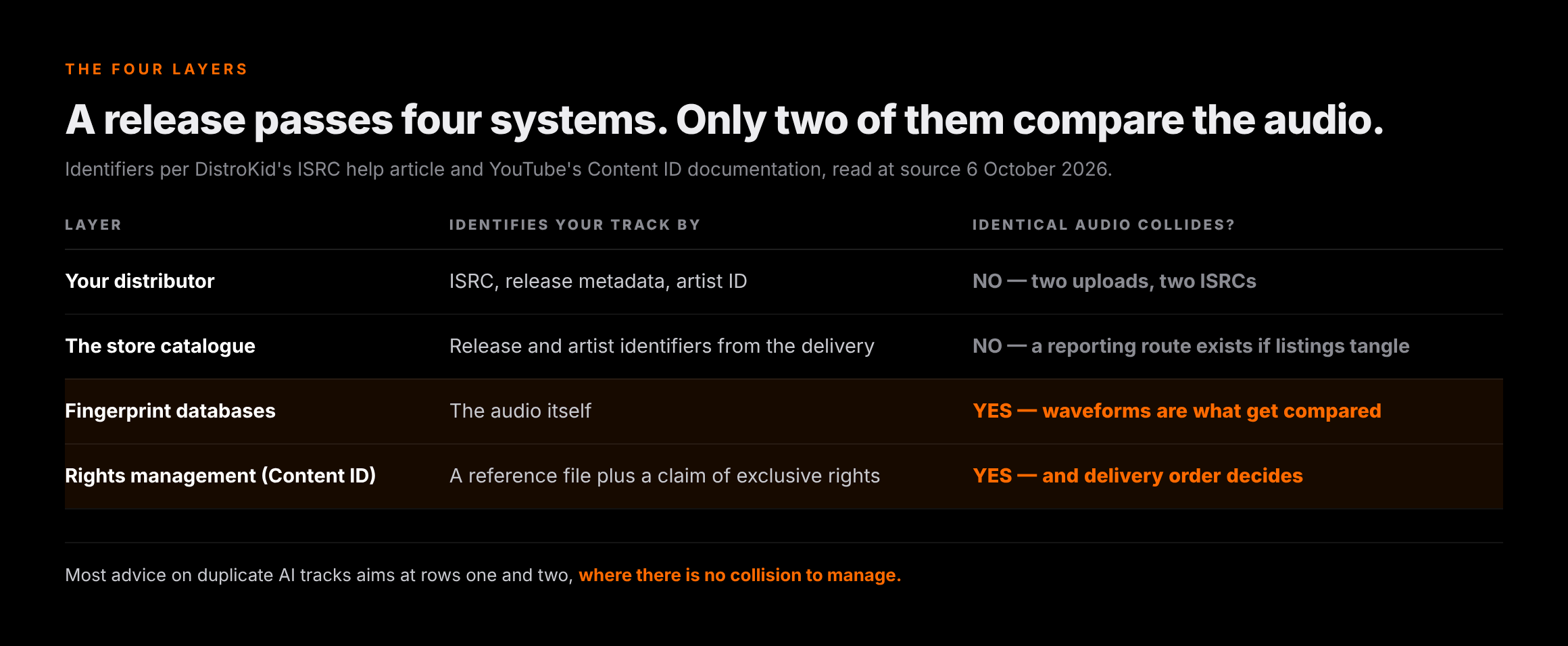
| Layer | Identifies your track by | Does identical audio collide? |
|---|---|---|
| Your distributor | ISRC, release metadata, artist ID | No — two uploads, two ISRCs, two releases |
| The store catalogue | Release and artist identifiers from the delivery | No automatically; Spotify has a reporting route if listings get mixed up |
| Fingerprint databases | The audio itself | Yes — this is the layer that compares waveforms |
| Rights management (Content ID and equivalents) | A reference file plus a claim of exclusive rights | Yes — and delivery order decides who keeps the claims |
Read down the third column and the shape of the problem changes. The advice you have been given is about rows one and two, where there is no collision to manage. What can cost you money is rows three and four.
Why the duplicate-delivery rule everyone quotes does not apply
Search for duplicate releases and you will land on a help-centre article like CD Baby's, which is clear and often misquoted:
“Digital music platforms like Spotify, Apple Music, and Amazon only allow one distributor to deliver a specific release to their store. If the same album is sent to a platform by two different distributors, the platform won't know which one to pay. To avoid confusion, they often remove the album entirely until the issue is resolved.”
Every word of that is about one release arriving twice — the same identifiers pushed down two pipes, so the store cannot tell who to pay. CD Baby's instruction follows: “if your album is removed due to duplicate delivery, you'll need to choose one distributor to continue servicing that release.” You cannot choose on behalf of a stranger, because you and the stranger were never servicing one release.
The rule is real and it will catch you — just on a different day. It bites when you move distributors. DistroKid tells switchers to upload first, then “the next day, go to your old distributor and remove those releases”, noting that “there's a chance that your albums will appear twice in streaming services before your old distributor takes them down. This brief overlap is okay.” Deliberate, brief, and yours to resolve. None of it describes two unrelated accounts with the same generated audio.
What the stores do have is a correction route for listings that get tangled. Spotify's own page on music mixed up with another artist points you at the content mismatch form in Spotify for Artists and says “we'll email you when we've fixed the issue — usually within a few days”. That is a metadata fix, not an ownership ruling, and it is worth knowing exists before you need it. Our breakdown of Spotify's AI music policy covers the disclosure and spam side of the same rulebook.
Content ID: whoever delivered first keeps the claims
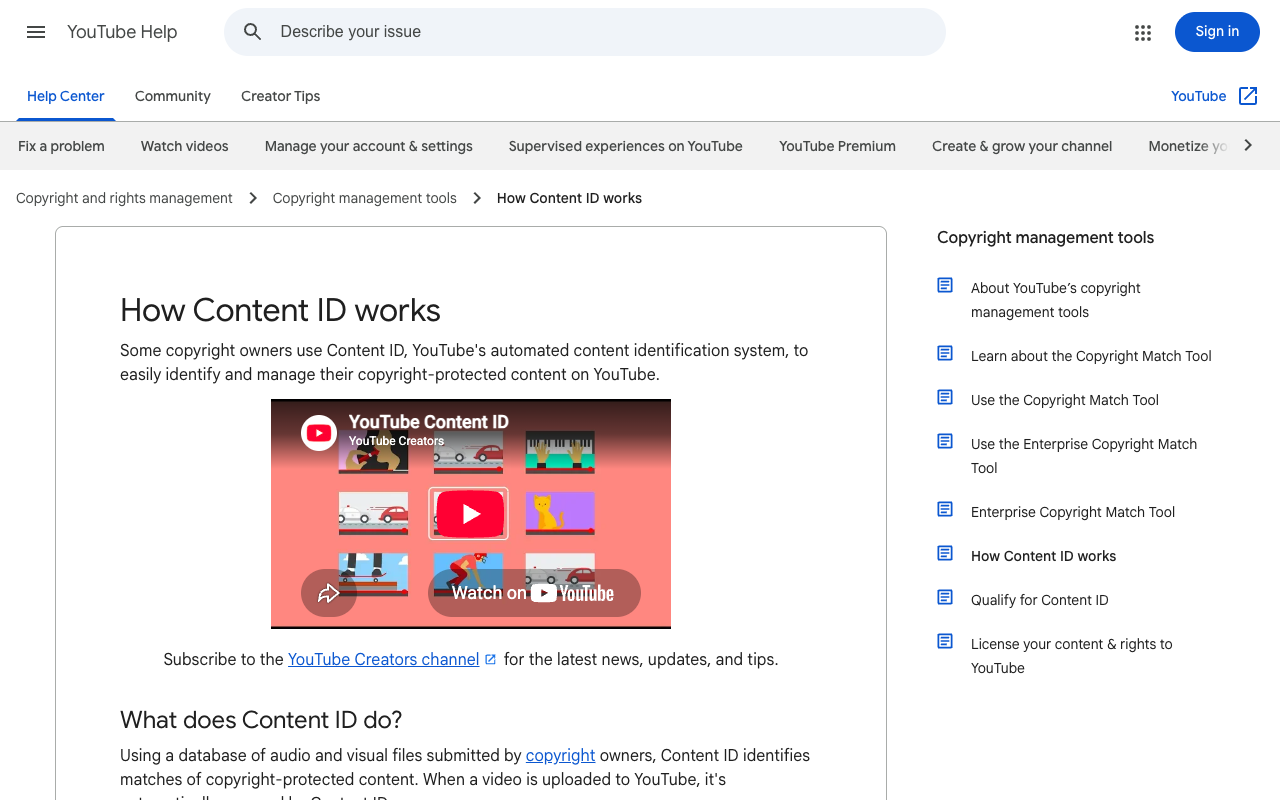
This is the layer that matters, and the rule is published. Content ID works from “a database of audio and visual files submitted by copyright owners” and “identifies matches of copyright-protected content”. It compares the audio. Two identical files are, to that system, the same recording regardless of what the metadata around them says.
When two references cover the same audio, YouTube calls it a reference overlap, and its page on fixing them states the interim rule in one sentence:
“Until the reference overlap is resolved, any claims based on the overlapping segment will remain with the partner who delivered the content first.”
Not whoever has the better rights. Not whoever generated it earlier. Whoever delivered first. YouTube's page on resolving Content ID issues describes the stricter case — “Asset Ownership Conflicts arise when multiple content owners provide 100% asset ownership in a specific territory” — and tells you to review the asset, “request ownership, or contact the other owners to resolve the conflict”. The fix is a negotiation, not an adjudication.
| Reference overlap | Asset ownership conflict | |
|---|---|---|
| What triggers it | Two references cover the same audio segment | Two owners each assert 100% ownership in one territory |
| YouTube's published interim rule | Claims stay with whoever delivered first | Review, request ownership, or contact the other owner |
| Who resolves it | The two partners — exclude the segment or assert exclusive rights | The two owners, between themselves |
| What it needs from you | Evidence of what you actually control | Evidence of what you actually control |
Distributors describe a revenue hold while a conflict is open — TuneCore's guide is one of several that say so. We attribute that to the distributors, not to YouTube: neither YouTube page we read states it.
There is a prior question, and it is the one to sit with. The same YouTube page says Content ID is for owners who “must own exclusive rights to a substantial body of original material”. Exclusive is the operative word, and Suno has just told you in writing that your output may not be unique. Nothing in YouTube's documentation bans AI music from Content ID — a claim several ranking pages make without citing a source — but the exclusivity requirement is a real obstacle, and it is about what you can honestly assert rather than about AI policy. Our coverage of monetising AI music on YouTube goes further into the monetisation routes that do not require it.
If two people have the same Suno song, who owns it?
Two things get called ownership here and they are not the same. One is your contract with Suno; the other is copyright. You can have the first without the second, and on a prompt-only track that is the likely position.
The contract is straightforward. On a paid plan Suno “assigns to you all of its right, title and interest in and to any Output owned by Suno” generated from your submissions. Read it closely: Suno can only assign what it holds. If no copyright ever came into existence in the recording, the assignment moves nothing, and the clause is still doing useful work — it is your permission to release — just not the work people think.
Copyright is where the January 2025 report from the US Copyright Office is the document that matters:
“The Office concludes that, given current generally available technology, prompts alone do not provide sufficient human control to make users of an AI system the authors of the output.”
The same report draws the line on the other side too: “Human authors are entitled to copyright in their works of authorship that are perceptible in AI-generated outputs, as well as the creative selection, coordination, or arrangement of material in the outputs, or creative modifications of the outputs.” That is not a loophole. It is the whole instruction manual, and the next section is what it means in practice.
Put the two together and the collision stops being frightening and starts being odd. You and a stranger each have Suno's permission, and neither of you necessarily has a copyright in the audio to enforce against the other — which makes the instinctive move, a takedown, the one move the record does not support, because a notice is a sworn claim. Our sister site walks through what a DMCA notice on an AI song actually requires, including the statement a counter-notice has to make under penalty of perjury. Our own guide to copyrighting AI music covers the registration side.
What actually makes the recording yours
The Copyright Office gives you the test, and it is about contribution rather than disclosure. Tools that let you “control the selection and placement of individual creative elements” are treated differently from prompts, with copyrightability decided “on a case-by-case determination”. So the question is not whether you used AI. It is what of yours is perceptible in the result.
Lyrics you wrote are your authorship, perceptible in the output, whoever rendered the vocal. This is the cheapest and strongest contribution available to you, and it is the one most likely to make your generation unlike anyone else's.
A hummed melody, a played riff, a recorded vocal you upload as an input gives the model something nobody else has. It also gives you a dated source file that exists outside Suno.
Choosing sections, cutting, re-ordering, deciding where the track ends — the report's language for this is creative selection, coordination or arrangement. Do it in a project file you keep.
Generation dates, the prompt or lyric text, the input files, the exported master, the project. Not because a rule demands it, but because every question in this article is answered by evidence of what you contributed and when.
Notice what is missing: nothing about processing the file. A cleaner master is a better release and not a contribution to authorship, and keeping those two apart is most of the clear thinking available here. If you are rebuilding an older track, our note on what Suno's Remaster really does matters here too: a remaster is a fresh generation, so it is a new recording with the same uniqueness question attached, not a cleaned-up version of the one you already had.
The pre-release check, in order
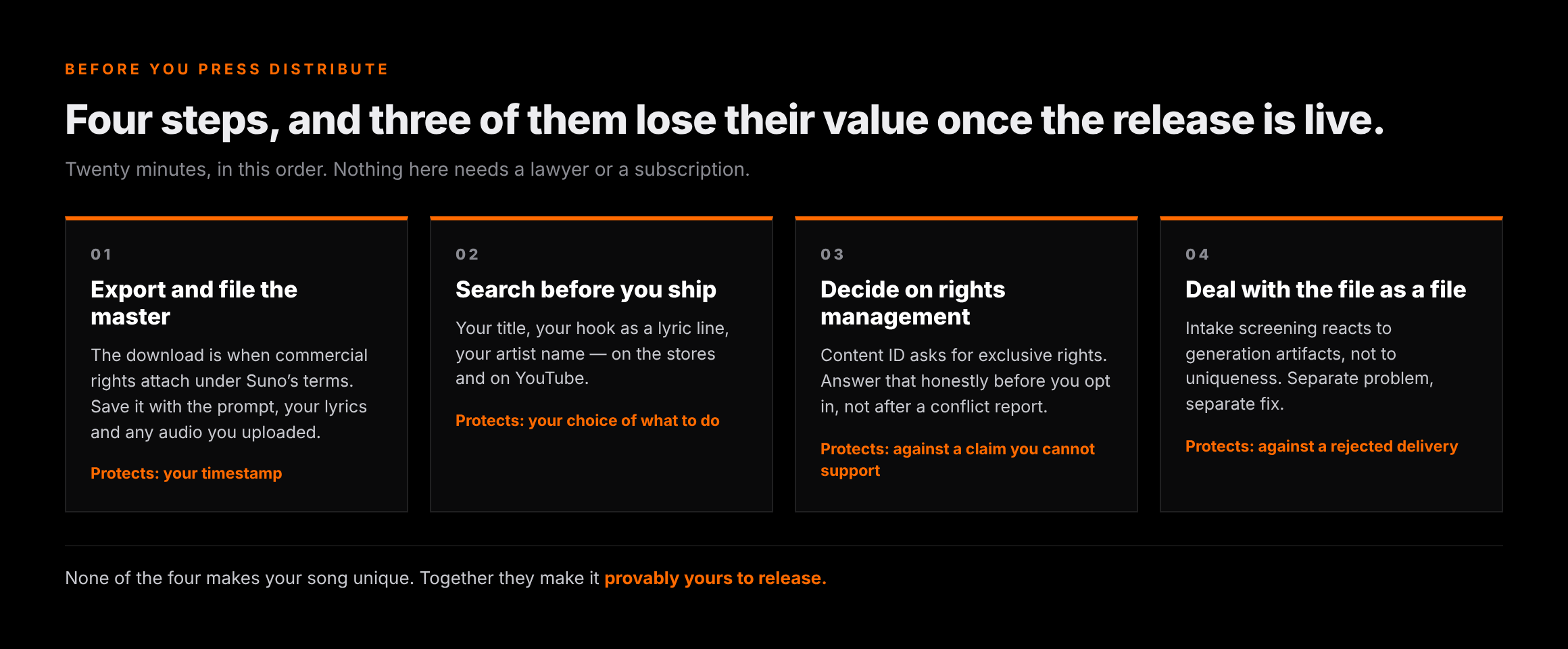
None of this needs a lawyer. It needs twenty minutes before you press distribute, spent in the right order.
First, export and file the master. The download is when commercial rights attach under Suno's terms, and it is a timestamp. Save it with the prompt text, your lyrics and any audio you uploaded. Second, search before you ship. Your title, your hook as a lyric line, your artist name — on the stores and on YouTube. Finding a match the week before release is a decision; finding it the week after is a dispute.
Third, decide about rights management deliberately. Content ID is opt-in through a distributor add-on, and the exclusivity requirement above is the question to answer honestly before you opt in, not after a conflict report lands. Fourth, deal with the file as a file. Distributor intake screening is looking for the fingerprints of generation — the smeared transients, the phasing, the signatures that come with a model rather than a microphone — and that is a separate problem from uniqueness. Our guide to distributing without getting flagged is the longer version. For the record, DistroKid's own help centre is unambiguous that AI is allowed at all: “Yes—DistroKid accepts music created with AI tools, but there are some rules”, the first of which is that you must own the rights.
The file-level step
Clean the generation artifacts before intake screening sees them
Undetectr processes an AI-generated master for the artifacts and model signatures that distributors' automated intake screening reacts to. It is a file-level job, and it is worth being exact about the limits: it does not make your track unique, it does not change who authored it, and no tool can change how a platform labels or credits a release.
Disclosure: Erasy is an independent guide and Undetectr is the tool we recommend and link to; we may earn a commission if you subscribe.
What a collision costs, and the routes that do not depend on it
Be honest about the size of this. A reference overlap on a track with four hundred plays costs almost nothing, because four hundred plays was already almost nothing. The cost scales with the track, so for most releases the real problem was never the collision — and the loudest complaint in the AI-music community is not about distribution at all. Getting distributed is solved. Being heard is not, and no amount of rights hygiene fixes it. Our numbers on a thousand streams versus one direct sale and on what AI music actually earns are the arithmetic behind that sentence.
Which points at where the energy is better spent. A paid sync placement — a track licensed into a show, a game, an ad — is a brief answered and a fee agreed, and it does not wait for an algorithm to notice you. Selling direct to the people who already like what you make sits beside it, and you keep what you charge. Both routes care about the thing this article has been circling: that you can say, with records, what is yours.
The one-line version
Suno will not promise your song is unique, the layer where that bites is fingerprinting rather than duplicate delivery, and the rule there is first delivery rather than best rights. Release early, keep the provenance, and make sure something of yours is audible in the track.
Related reading on Erasy
- Can you copyright AI music? What registration actually covers
- How to distribute AI music without getting flagged
- Selling Suno music on Spotify through DistroKid
- MLC royalties for AI music: what you can and cannot register
- Cleaning AI-generated music for release: the checklist
- Suno download limits: what counts against your allowance
Frequently asked questions

Eddie Mathews — Editor, Erasy
Eddie reads the terms of service and the help-centre article rather than the roundup, and marks the difference between what a company has said and what a tutorial has assumed. Where the public record does not settle a question, this site says so.
Are Suno songs unique to the person who generated them?+
Can two people get the exact same song from Suno?+
What happens if someone else releases the same Suno track I did?+
Does the duplicate-content rule mean my release gets taken down?+
Who owns a Suno track if the model gave it to two people?+
Can I report the other person for stealing my song?+
Does cleaning or remastering the file make my version unique?+
What should I do before releasing an AI-generated track?+
Sources read at source on 6 October 2026: the uniqueness clause, the same-output-for-a-third-party line, the paid-plan assignment, the no-infringement-warranty clause, the free-tier restriction and the download condition from Suno's Terms of Service (last revised 10 August 2026, effective 3 September 2026); the reference-overlap rule, the ownership-conflict definition, the reference-database description and the exclusive-rights eligibility requirement from YouTube's “Fix reference overlaps”, “Resolve Content ID issues” and “How Content ID works” help pages; the one-distributor-per-release rule from CD Baby's help centre (updated 16 June 2026); the ISRC definition, the AI-tools policy and the switching-distributors note from DistroKid's help centre (updated 31 July, 19 and 30 August 2026); the content mismatch form and its stated turnaround from Spotify's artist support; and the prompts-alone, human-authorship and selection-and-placement passages from the US Copyright Office's “Copyright and Artificial Intelligence, Part 2: Copyrightability”, January 2025. The revenue-hold behaviour during a Content ID conflict is attributed to distributors' own guidance, because neither YouTube page we read states it. The exposure argument in the second section is our inference and is labelled as such; Suno publishes no collision rate and we do not state one. The DistroKid and CD Baby pages return 403 to automated requests behind their help centres' bot wall; both are official URLs and their text was read through those help centres' public article endpoints. Nothing here is legal advice.