AI Music
Can You Sell Suno AI Music on Spotify & DistroKid? (2026)

Short answer: yes, you can sell Suno AI music on Spotify and DistroKid — but only if you clear four hurdles most people never hear about until a track gets pulled. The plan you used, the copyright status, the distributor’s AI policy, and the detection scanners each decide whether your release lives or dies.
Here is the full picture for 2026 — commercial rights, copyright, distributor rules, real earnings, and the exact workflow to get a Suno track live and earning.
The short version
You need a paid Suno plan at generation time to hold commercial rights. Pure AI music generally is not copyrightable, so Suno’s license is your only protection.
DistroKid accepts AI music with disclosure; TuneCore and CD Baby mostly reject it. And every distributor scans for AI watermarks — so clean the file first with Undetectr or risk a takedown.
Do you even own your Suno music?
For the clause-by-clause version, Suno Watermark keeps a dated audit of Suno’s terms covering what each tier grants and the Remix clause that overrides a paid subscription.
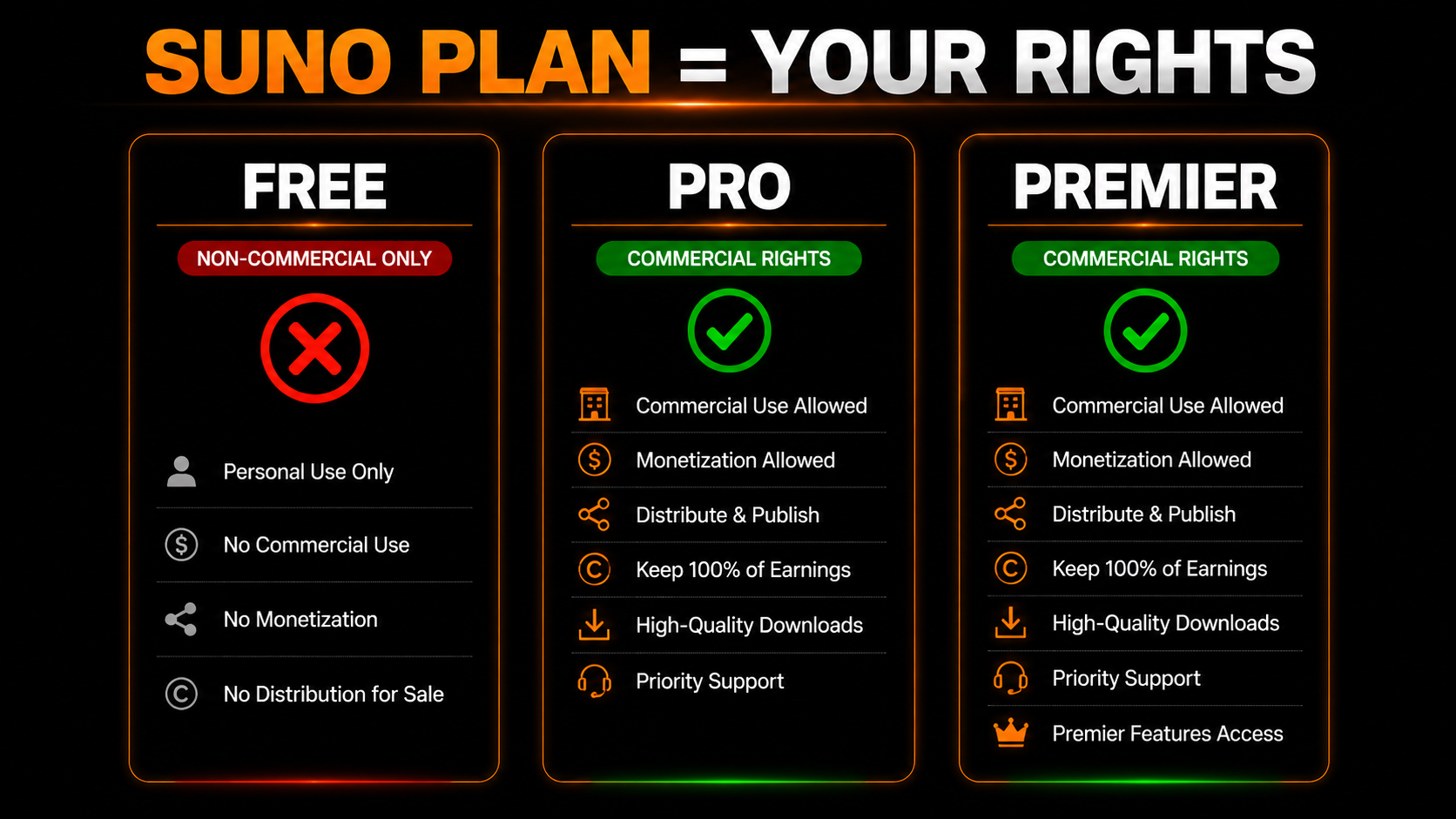
This is the first gate, and it trips up more people than any other. Per Suno’s own help center, ownership depends entirely on the plan you were subscribed to at the moment the song was generated — not when you download it, not when you upload it.
| Suno plan | Commercial rights? | Can you distribute? |
|---|---|---|
| Free / Basic | No — non-commercial only | No |
| Pro (paid) | Yes — you own the song | Yes, and you keep rights after cancelling |
| Premier (paid) | Yes — you own the song | Yes, and you keep rights after cancelling |
The key detail: if you generated a track on the free tier, upgrading later does not retroactively grant commercial rights to it. If you plan to sell it, make sure you are on Pro or Premier when you hit generate.
Can you actually copyright it?
Owning the commercial rights is not the same as holding a copyright. In its January 2025 guidance, the US Copyright Office was clear: music generated purely from prompts is not copyrightable, because prompts alone do not give a human enough control to count as the author. Works with meaningful human authorship — your own written lyrics, real arrangement, substantial creative editing — can be registered, but only the human-made parts are protected.
The practical consequence for a pure Suno track: no copyright means anyone could theoretically reuse it without infringing. What stops that from being a disaster is Suno’s commercial license — a contractual grant, not a copyright. It lets you distribute and monetize; it does not let you sue a copycat. Nothing here is legal advice, but that is the landscape.
Which distributors actually accept AI music
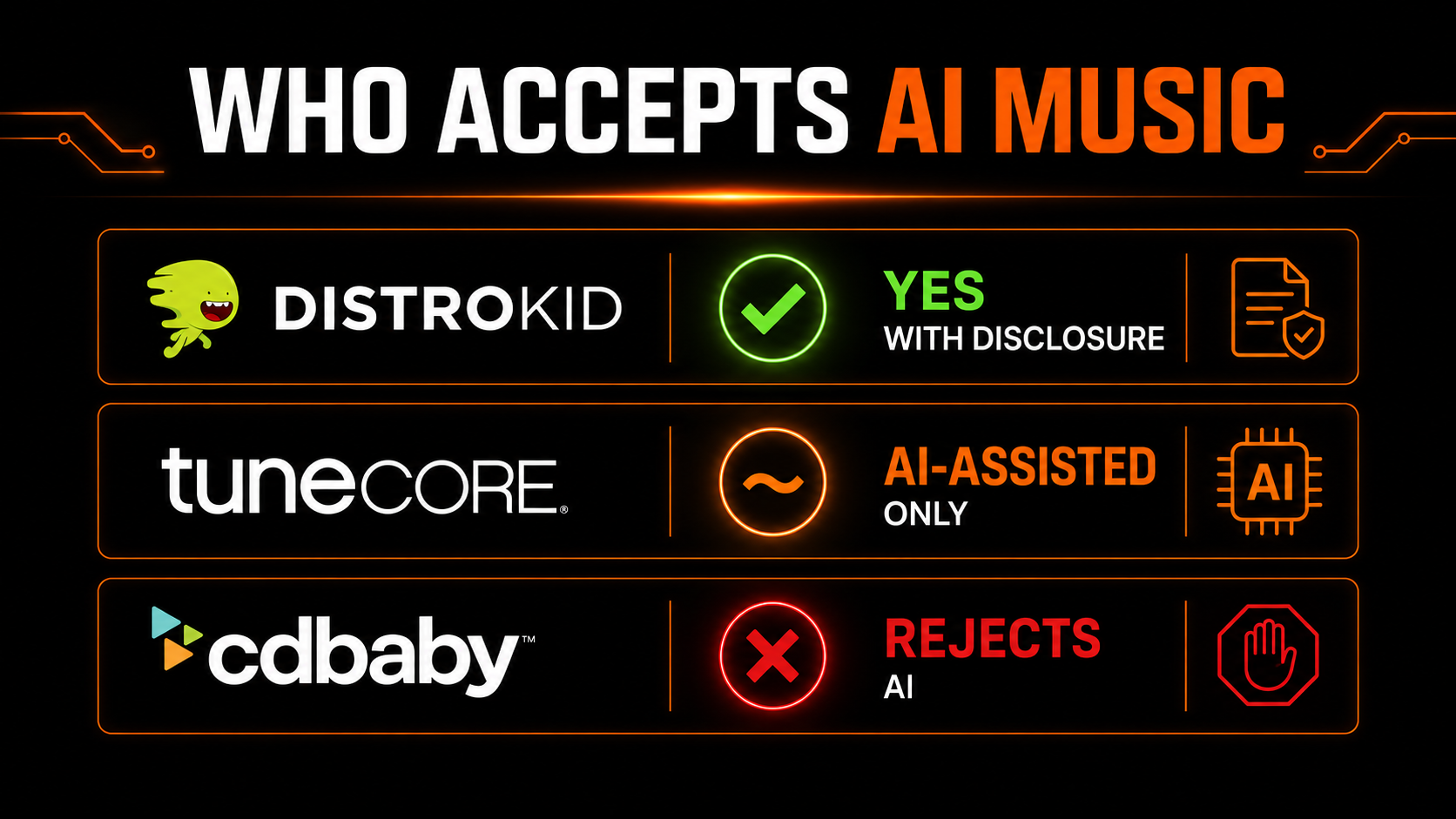
Not all distributors treat AI music the same, and picking the wrong one is a fast way to a rejection. Here is where the majors stand in 2026.
| Distributor | AI music stance (2026) |
|---|---|
| DistroKid | Most AI-friendly. Allows AI music with rights; added an AI disclosure step (lyrics / vocals / instrumental / full composition). |
| Spotify (via distributor) | Does not down-rank AI music; surfaces AI credits from April 2026; bans voice clones, deepfakes and spam. |
| TuneCore | Allows AI-assisted, but rejects fully AI-generated tracks. |
| CD Baby | Strictest — rejects AI-generated music broadly; only human-composed work using AI production tools. |
For a Suno release, DistroKid is the pragmatic choice: it accepts AI music, and its disclosure step is designed for exactly this. Be honest in that disclosure — misreporting is a Terms-of-Service problem, and it is the one risk cleaning your file will not solve.
The catch nobody mentions: detection
Even with the right plan and the right distributor, there is a scanner between you and a live release. Every distributor now runs automated AI detection on uploads, reading the inaudible SynthID-style watermark and spectral fingerprints in your file. A flagged track earns nothing — it gets rejected, or goes live and vanishes weeks later. Spotify alone removed over 75 million tracks it deemed spammy in a single year.
That is why the release-prep step matters. Running the file through an AI watermark remover like Undetectr clears the markers and masters to spec so the track passes the scan — while you still disclose AI use honestly to the distributor.
What you’ll actually earn
Set expectations before you go all in. Streaming pays fractions of a cent per play, and Spotify does not pay a track anything until it clears 1,000 streams in a rolling 12-month window.
From a cold start with no audience, that is coffee money, not a salary. It only becomes real if you build a catalog and let it compound over months. Anyone promising quick streaming riches from AI music is selling you something.
Suno to Spotify: the full workflow
Create the track while subscribed to Suno Pro or Premier so you hold commercial rights.
Run the export through Undetectr to strip the watermark and master to streaming loudness.
Search the major services for your melody and title yourself — no AI tool does this check for you.
Upload to DistroKid, disclose AI use honestly, and send it to Spotify, Apple Music and the rest.
Our recommended tool
Clear the scanner before you distribute
Clean and master your Suno track so it passes distributor detection, then send it live. Try Undetectr free — no credit card, 150+ platforms.
Keep reading