AI Music
Suno's New Watermark: What Lands, When, and What to Do Before 3 September
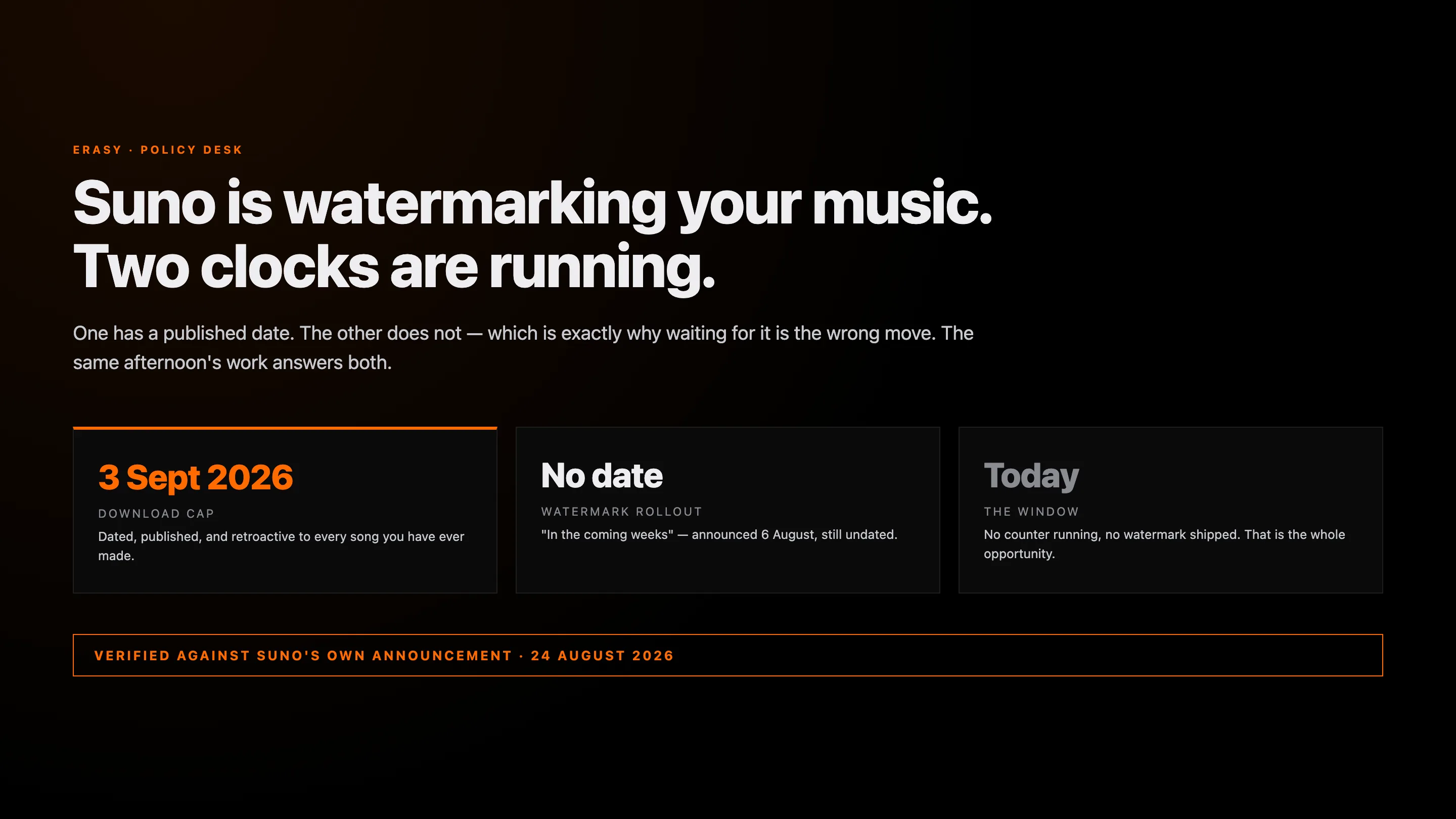
Suno is putting an inaudible, tamper-resistant watermark into the music you generate, and it is metering how much of that music you are allowed to take off the platform. Both were announced on 6 August 2026. Only one of them has a date — the download cap, which starts on 3 September 2026 and applies retroactively to every song you have ever made. The watermark has no date at all, which sounds like breathing room and is the opposite of it. The practical response to both is the same afternoon's work: get your back catalogue onto a drive you own with a bulk Suno export, then clean whatever you actually intend to release.
This piece works from Suno's own announcement and help centre rather than the coverage of them, because the coverage got one important thing wrong. Almost every article has merged two separate measures into a single dated event. They are not one event, they fail differently, and the difference decides what you should do this week.
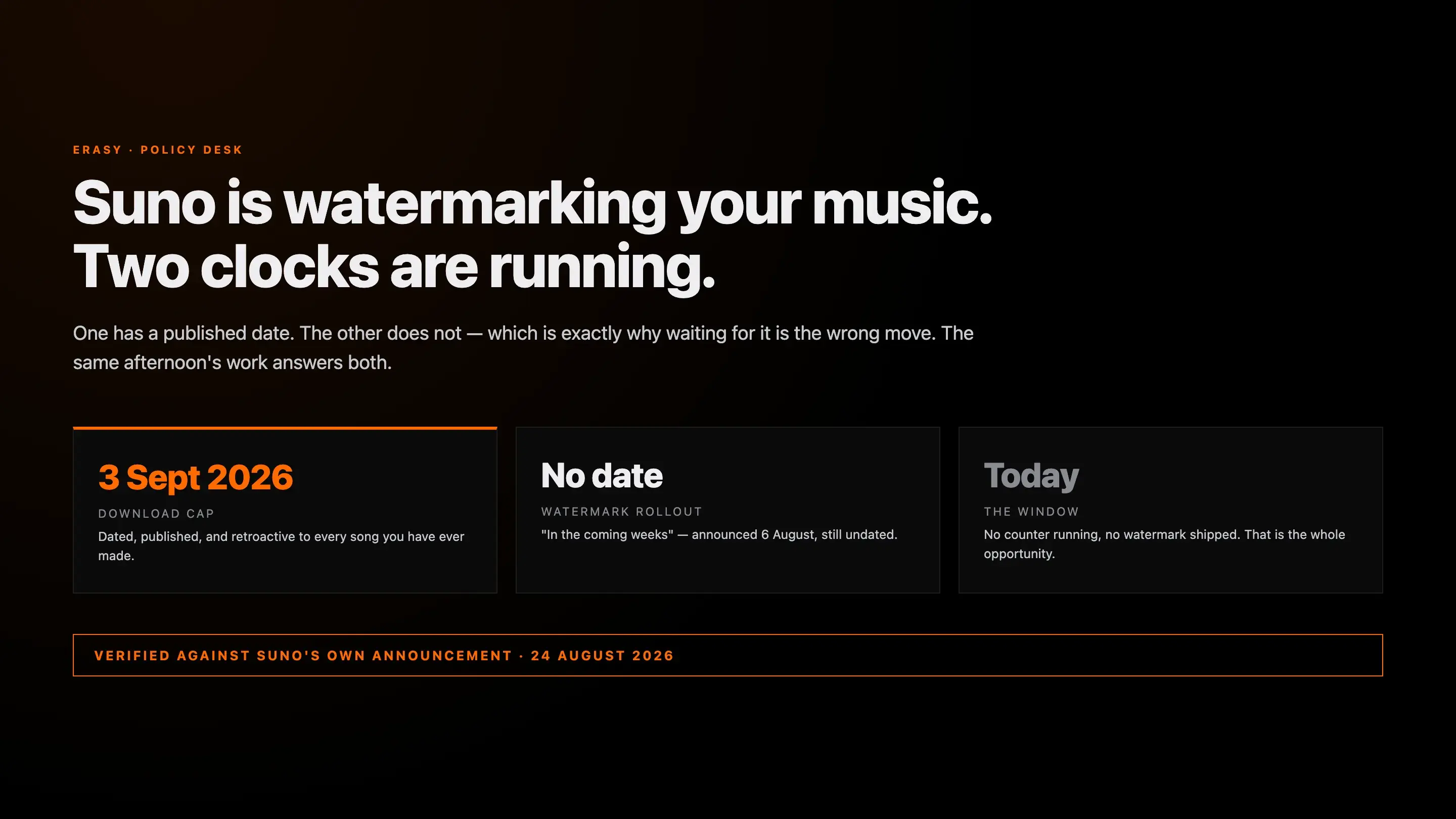
One window closes 3 September. The other has no date.
Export the catalogue while no counter is running and no mark has shipped.
Undetectr turns a public Suno playlist URL into one ZIP of your whole library — included with the €39 one-time Lifetime plan, alongside the signal-level cleanup that gets those files past distributor screening afterwards.
The short version
Watermarking is confirmed. Its date is not. Suno said "in the coming weeks" on 6 August 2026 and has not named a date, a standard or a provider since.
The 3 September date belongs to the download cap, not the watermark. Most coverage merged the two. They are separate measures with separate timelines.
The cap is retroactive. It applies to "all songs, including songs created before that date". Your back catalogue is not grandfathered.
An undated rollout cannot be beaten by waiting. There is no announcement to wait for. Files already on your own drive are the only ones a future policy cannot reach.
The fix is two moves and neither is clever. Bulk-export the library before 3 September, then clean what you release before you submit it.
Two clocks, one published date
On 6 August 2026 Suno published a post setting out four principles and five concrete measures. Two of those measures matter to anyone who exports music: audio watermarking with fingerprinting, and download limits. They arrived in the same announcement, which is why the coverage fused them — and the fusion is wrong in a way that changes your plan.
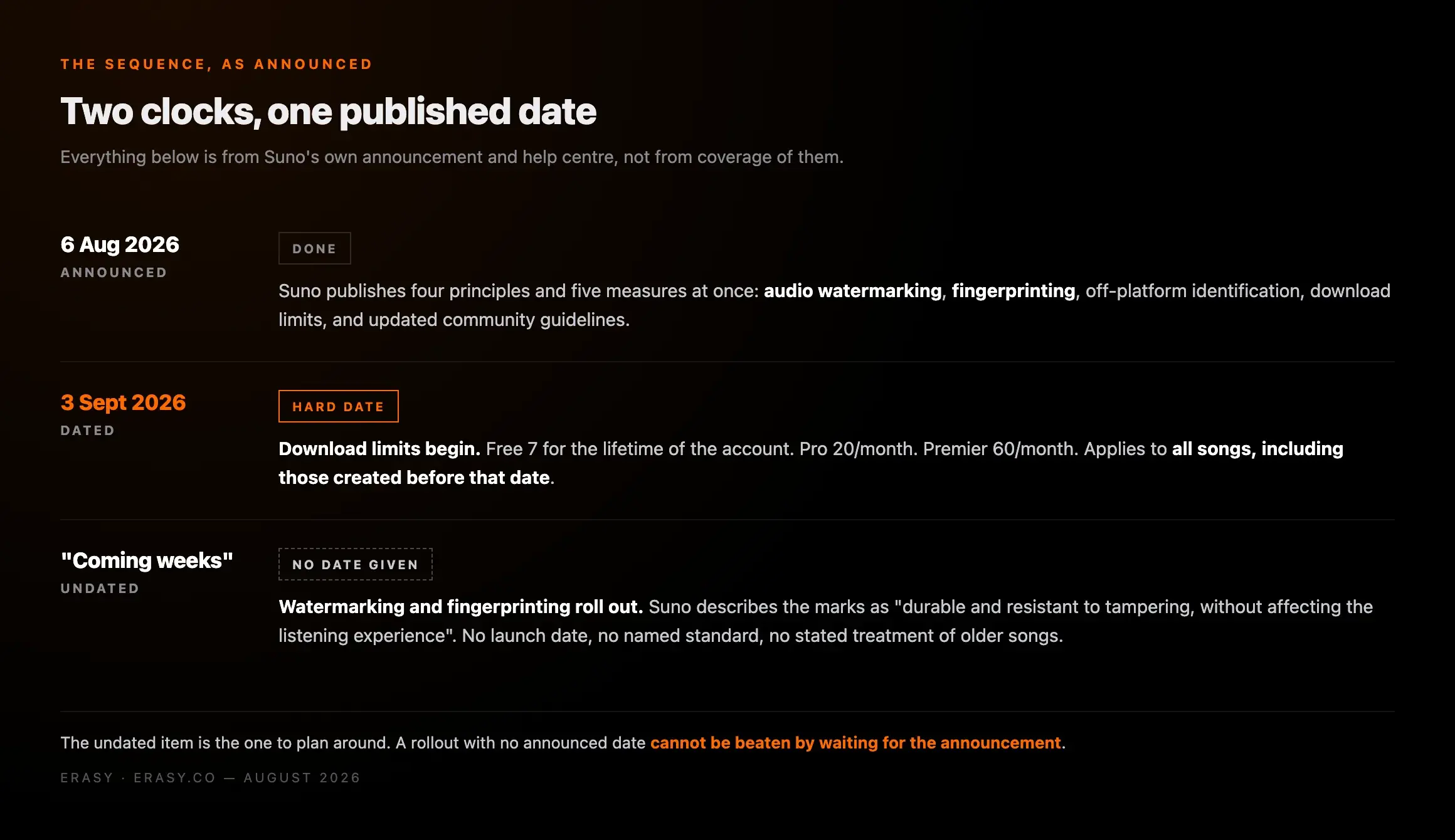
The download limits are dated to the day and specified to the number. Suno's help centre states them plainly: up to 7 total lifetime trial downloads on Free for personal, non-commercial use only; 20 per month on Pro; 60 per month on Premier; and Suno Studio, included with Premier, described as available without limitation. They begin on 3 September 2026 and, in Suno's own words, apply to "all music on Suno starting September 3, including songs created before that date".
The watermarking commitment is a different kind of sentence altogether. Suno says it is "adopting new audio watermarking and fingerprinting technology so we can partner more closely with distribution platforms on combatting fraud and misuse", and that the resulting marks are "durable and resistant to tampering, without affecting the listening experience". The timing given is "in the coming weeks". That is the entire published specification. No date, no standard, no provider.
What Suno actually announced
It is worth seeing all five measures together, because the watermark makes far more sense as one part of a package than as an isolated decision to tag your files.
An inaudible marker embedded into generated audio, stated as durable and resistant to tampering. This is the layer that travels with your file.
A reference signature of the track held in third-party matching databases, so a platform can identify a Suno song without Suno's involvement.
The stated goal: songs generated on Suno can be identified if they are shared on other platforms. Distributors and DSPs get to check for themselves.
The one hard date in the package. From 3 September 2026, exports are metered by tier and applied retroactively to your entire back catalogue.
Tiered enforcement running from warnings through temporary suspensions to permanent bans, prohibiting deceptive audio and unauthorised voice or likeness use.
Read as a package, this is a company building the infrastructure to answer a question it is currently being asked in court. Suno settled with Warner Music Group in November 2025 in a deal that explicitly included investment in watermarking and audio fingerprinting. It lost GEMA v Suno in the Munich I Regional Court on 31 July 2026, six days before this announcement. Universal and Sony actions are ongoing. The watermark is not a spontaneous product decision — it is a settlement commitment arriving on schedule.
The watermark is three things, not one
"Watermark" is doing an enormous amount of work in the headlines. What Suno described is three mechanisms with three different jobs, and they do not fail in the same way — which matters if your plan is to do something about them.
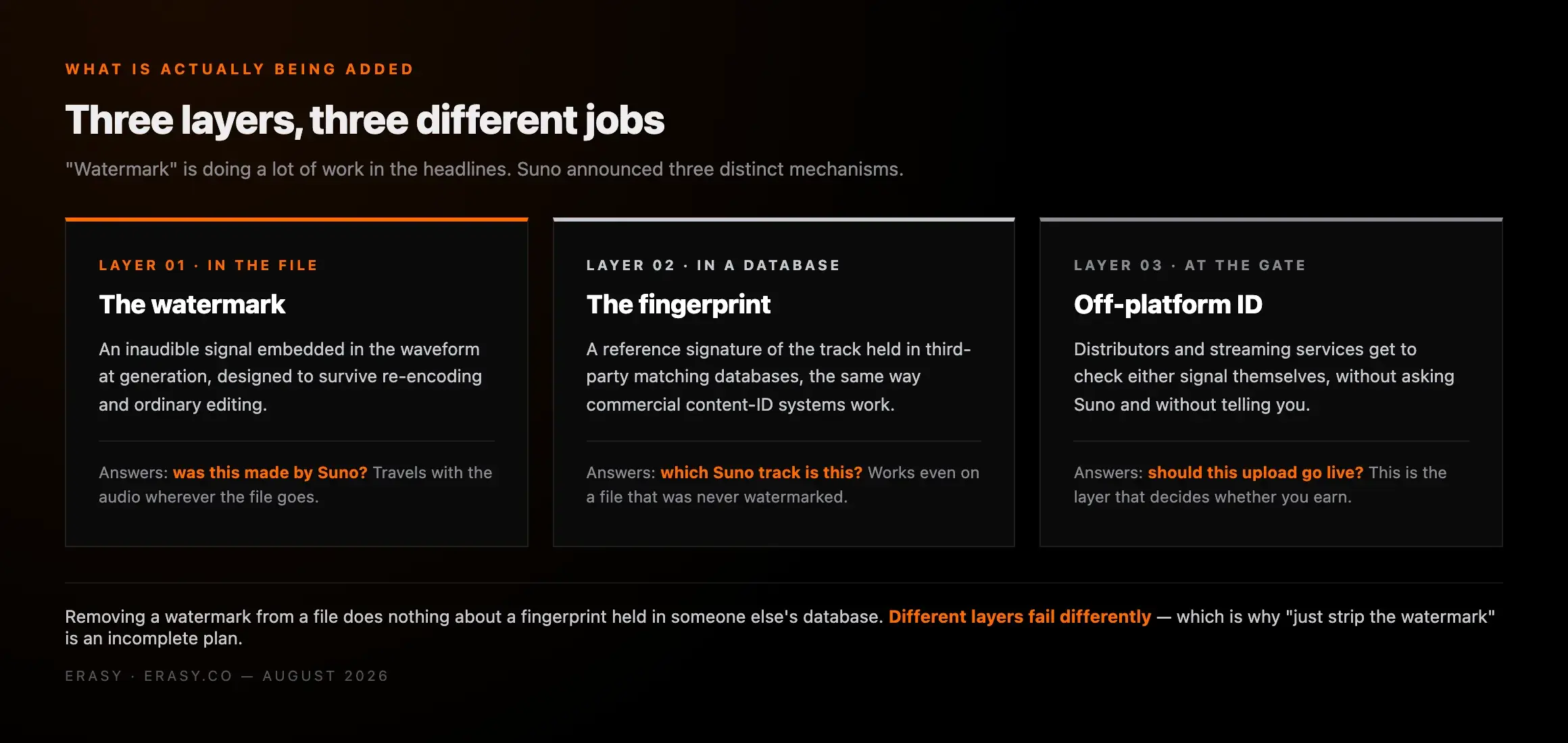
Layer one: the watermark, in your file
An inaudible signal woven into the waveform at generation. Conceptually this is the same family of technique as Google's SynthID for audio, though Suno has pointedly not confirmed whether it licensed SynthID or built its own. It answers one question — was this made by Suno? — and it travels with the audio wherever the file goes, which is the entire point of designing it to survive re-encoding and ordinary editing.
Layer two: the fingerprint, in someone else's database
A reference signature of the finished track, registered with matching services of the kind that already power content-ID systems across the industry. This one answers a sharper question: which Suno track is this? And critically, it works on a file that carries no watermark at all, because the match is made against the audio itself rather than against anything embedded in it.
Layer three: identification at the gate
The commercial purpose of the first two. Distributors and streaming services get to run the check themselves, without asking Suno and without telling you. This is the layer that decides whether an upload goes live, which means it is the layer that decides whether a track earns anything at all.
The reason to separate them is that removing an embedded watermark from a file does precisely nothing about a fingerprint sitting in a third party's database. Anyone selling you "just strip the watermark" as a complete answer is describing one third of the system. We would rather tell you that than let you find out at intake.
Confirmed versus not confirmed
Because so much secondhand coverage has smoothed over the gaps, here is the same information sorted by whether Suno actually said it.
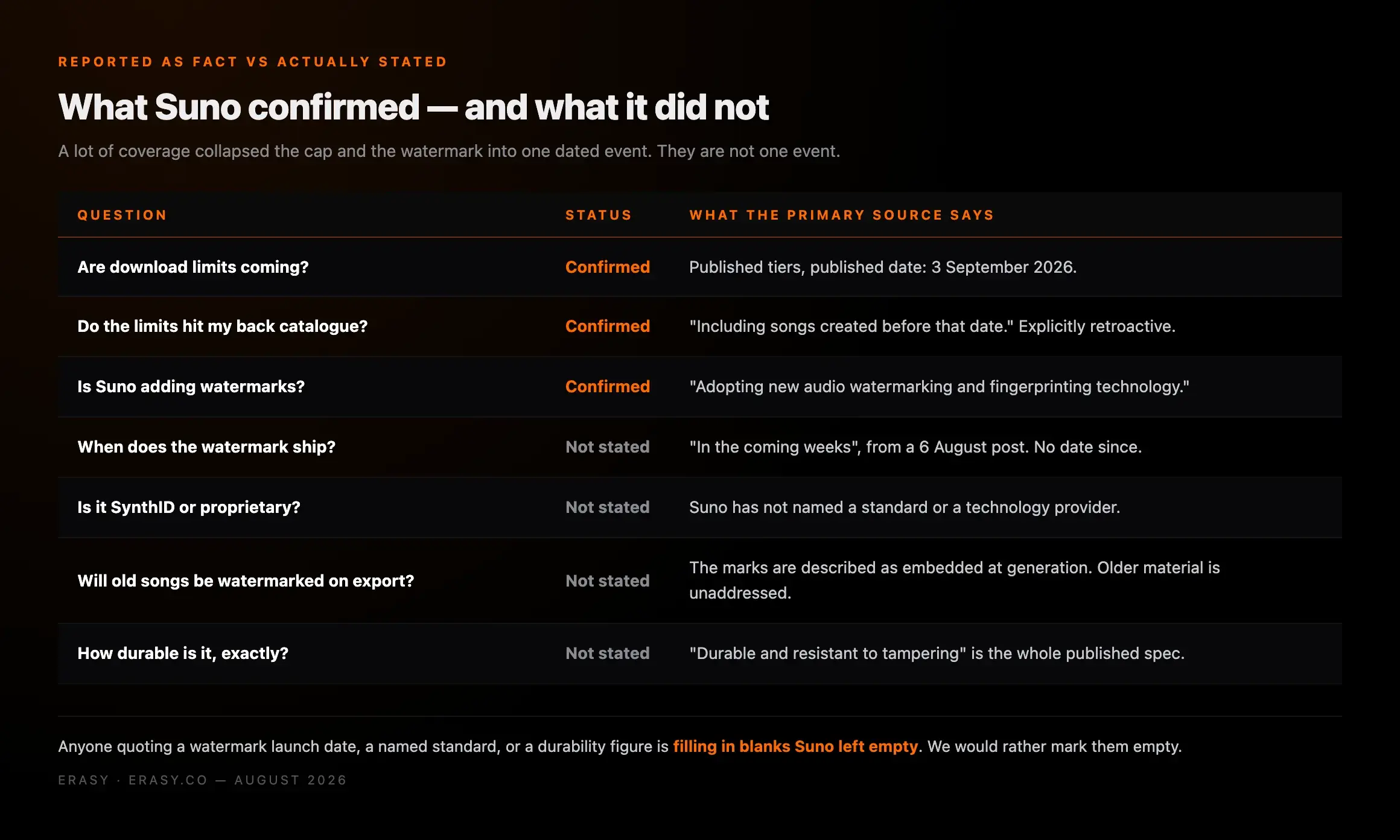
| Question | Status | What the primary source says |
|---|---|---|
| Are download limits coming? | Confirmed | Published tiers, published date: 3 September 2026. |
| Do the limits hit my back catalogue? | Confirmed | “Including songs created before that date.” Explicitly retroactive. |
| Is Suno adding watermarks? | Confirmed | “Adopting new audio watermarking and fingerprinting technology.” |
| When does the watermark ship? | Not stated | “In the coming weeks”, from a 6 August post. No date since. |
| Is it SynthID or proprietary? | Not stated | No standard and no technology provider has been named. |
| Will old songs be marked on export? | Not stated | Marks are described as embedded at generation. Older material is unaddressed. |
| How durable is it, exactly? | Not stated | “Durable and resistant to tampering” is the whole published spec. |
Four of the seven rows are blanks. That is not a criticism of Suno, which is under no obligation to publish an engineering roadmap. It is a warning about everyone who has filled those blanks in for you.
Why an undated rollout means acting sooner, not later
The instinct on reading "no date announced" is relief. It should be the opposite, and the reasoning is short enough to check.
A dated change can be planned around. You know when the 3 September cap starts, so you know exactly how long you have and can spend it accordingly. An undated change offers no such handle. There is no announcement scheduled, no countdown to watch, and nothing that obligates Suno to give notice before the first watermarked file leaves the platform. "In the coming weeks" was written on 6 August. We are now well inside that window.
Put the two together and the conclusion is unavoidable. The only files that are certainly unaffected by a rollout that has not happened are files already sitting on hardware you own. Every day you leave your catalogue on the platform is a day it can be exported under rules you have not read yet — and after 3 September, exporting it at all costs you quota you may not have.
The asymmetry, plainly
If you export now and nothing changes: you have spent an afternoon and gained a backup you should have had anyway.
If you wait and the rollout lands first: you are exporting marked files, from a metered counter, under rules published after you decided to wait.
One of those outcomes is recoverable at any time. The other is not recoverable at all.
The cap that sets your actual deadline
The watermark is the story, but the cap is the deadline — so it is worth being precise about the numbers that decide how long an export takes.
| Tier | Downloads | Period | Commercial use |
|---|---|---|---|
| Free | 7 | Lifetime — total, ever | No — personal only |
| Pro | 20 | Per month | Yes |
| Premier | 60 | Per month | Yes |
| Suno Studio (in Premier) | No stated limit | — | Yes |
The counting rules are more generous than the headline numbers suggest, and they are worth knowing: one song counts as one download regardless of format, so pulling both WAV and MP3 costs one; downloading the same song twice still counts once; all stems from a song bundle into that song's single download; and failed or interrupted downloads do not count at all. What Suno is metering is distinct songs leaving the platform, not files or operations.
Now apply that to a real library. A moderately active user who has been generating for a year sits on several hundred tracks. Take 400. On Free you may export seven of them, ever, and not commercially. On Pro at 20 a month, clearing that catalogue takes 20 months. On Premier at 60 a month, just under seven. Before 3 September it takes an afternoon, because no counter is running. We have covered the policy itself in detail in our review of Suno's download limits — the summary is that it is a defensible policy landed badly, and the retroactive clause is the failure.
Before 3 September there is no counter
Your back catalogue is not grandfathered. Get it onto a drive you own.
Gather what you want into a public Suno playlist, paste the link into Undetectr's bulk downloader, and take the whole library down as one ZIP. Before the deadline this uses no quota and breaks no rule — it is simply faster than several hundred clicks.
What actually changes at the distributor
Here is the part that matters commercially, and it has almost nothing to do with Suno. Once a track is off the platform, the constraint that decides whether it earns is your distributor's AI screening — and that screening got a significant upgrade the moment Suno agreed to hand distributors a reliable signal.
- ✕Distributors relied on statistical inference — spectral heuristics and probability scores
- ✕False positives and false negatives in both directions
- ✕No authoritative answer to “is this a Suno track?”
- ✕Enforcement was inconsistent between distributors
- ✓A deterministic signal a distributor can check itself, without Suno
- ✓Two independent routes to a match — embedded mark and database fingerprint
- ✓Consistent answers across every platform that adopts it
- ✓Screening becomes a lookup rather than a judgement call
That screening happens once, at the moment you submit, before a single listener hears anything. A flagged track does not come back with a warning and a chance to fix it. It does not go live, which means it never earns. This is why the timing of the watermark rollout is a commercial question and not a technical curiosity.
Worth saying clearly, though: identification is not prohibition. Distributors including DistroKid explicitly accept AI-assisted music in 2026 and have per-element disclosure flows for it. A properly disclosed, rights-clean track is in a far stronger position than an undisclosed one that a fingerprint match flags six months after release. Cleaning a file so it clears automated intake and disclosing what you made are not opposites — we set out where that line sits in our guide to distributing AI music without getting flagged.
The fix, in two moves
Neither move is sophisticated. Both stop being available on somebody else's schedule, which is the only reason this is urgent.
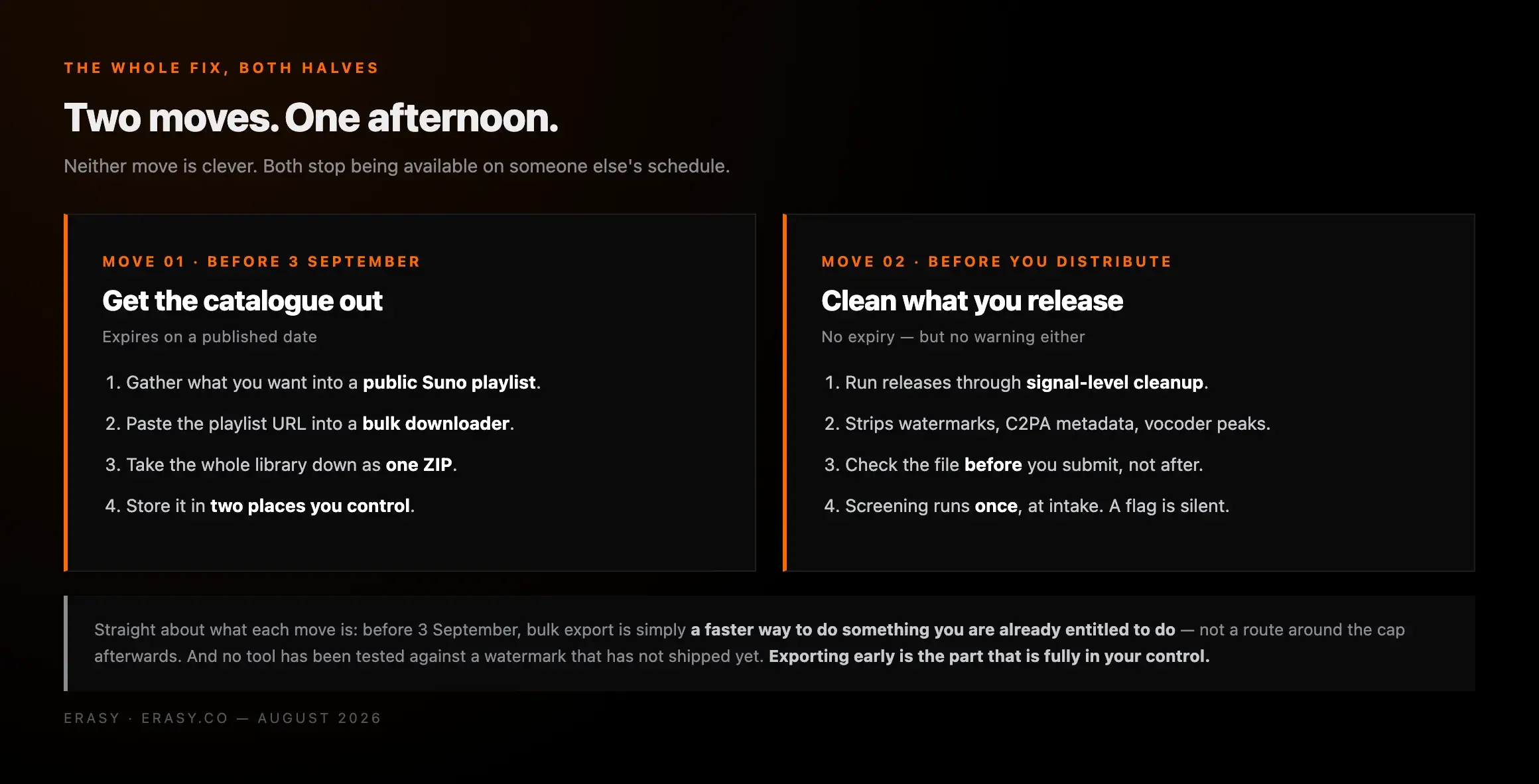
Move one: get the catalogue out
Until 3 September there is no cap of any kind. Exporting your own catalogue right now uses no quota and breaks no rule. That is the single most valuable fact in this article, and it has a shelf life measured in days.
The obstacle is not permission, it is tedium. Several hundred tracks pulled by hand is how this gets abandoned somewhere around song forty, and the tracks people abandon at are disproportionately the older ones they had forgotten were good. Undetectr's Suno library import exists for exactly this shape of problem, and it is refreshingly boring in operation:
On suno.com, gather what you want to keep into a playlist and set it public. This is the only step that touches your Suno account at all.
Straight from the browser address bar. No Suno login is handed over — the tool works from any public playlist link.
The tool reads the playlist and lists every track in it, so you can confirm the whole library is there before you commit to a download.
Take everything, or cherry-pick individual tracks. High-quality MP3 files pulled direct from Suno's CDN, packaged into a single ZIP.
A local drive and a cloud backup. Ordinary archival discipline, and this deadline is a decent excuse to finally do it.
The same 6 August announcement introduced tiered enforcement running to permanent bans. Risking the library you are protecting, to dodge a limit you can legitimately get ahead of this month, is a bad trade.
Two practical notes. Prioritise anything you would want to rework later: stems bundle into a song's single download after the cap starts, so they cost nothing extra, and they are the hardest thing to reconstruct if you lose them. And if a track has any future as a release, that is the one to pull first — regenerating is not the same thing, because the model will not hand you that take back.
Move two: clean what you actually release
Exporting solves storage. It does not solve the gate. Anything you intend to put through a distributor still has to clear automated intake screening, and that is a signal-level problem rather than a does-it-sound-good problem.
This is the layer Undetectr is built for: removing vocoder spectral peaks, phase-entropy anomalies, embedded watermark signals, C2PA provenance metadata and noise-floor signatures so a file clears intake and stays live. Processing takes roughly 90 seconds a track, output is available as MP3, WAV or FLAC, and the whole thing — including the bulk library import above — sits behind a single €39 one-time Lifetime plan rather than a subscription.
What we liked
- ✓Purpose-built for this exact signal class rather than adapted from general audio repair
- ✓One-time price with unlimited processing, so a 400-track catalogue does not become a metered cost
- ✓Bulk Suno playlist import included, which is the half of the job with an actual deadline
- ✓Does not alter your composition — arrangement, melody and performance come back unchanged
Where it stops
- —Cannot be proven against Suno's new watermark yet, because that watermark has not shipped
- —Does nothing about a fingerprint held in a third party's database — that is a different layer
- —Will not fool composition-based checker websites, which analyse musical structure rather than signal
- —Not a substitute for holding the commercial rights to the track in the first place
Why the DAW workarounds keep failing
The most common reaction to any watermark story is that a competent engineer with a good DAW can deal with it. It is a reasonable instinct and the bench data does not support it.
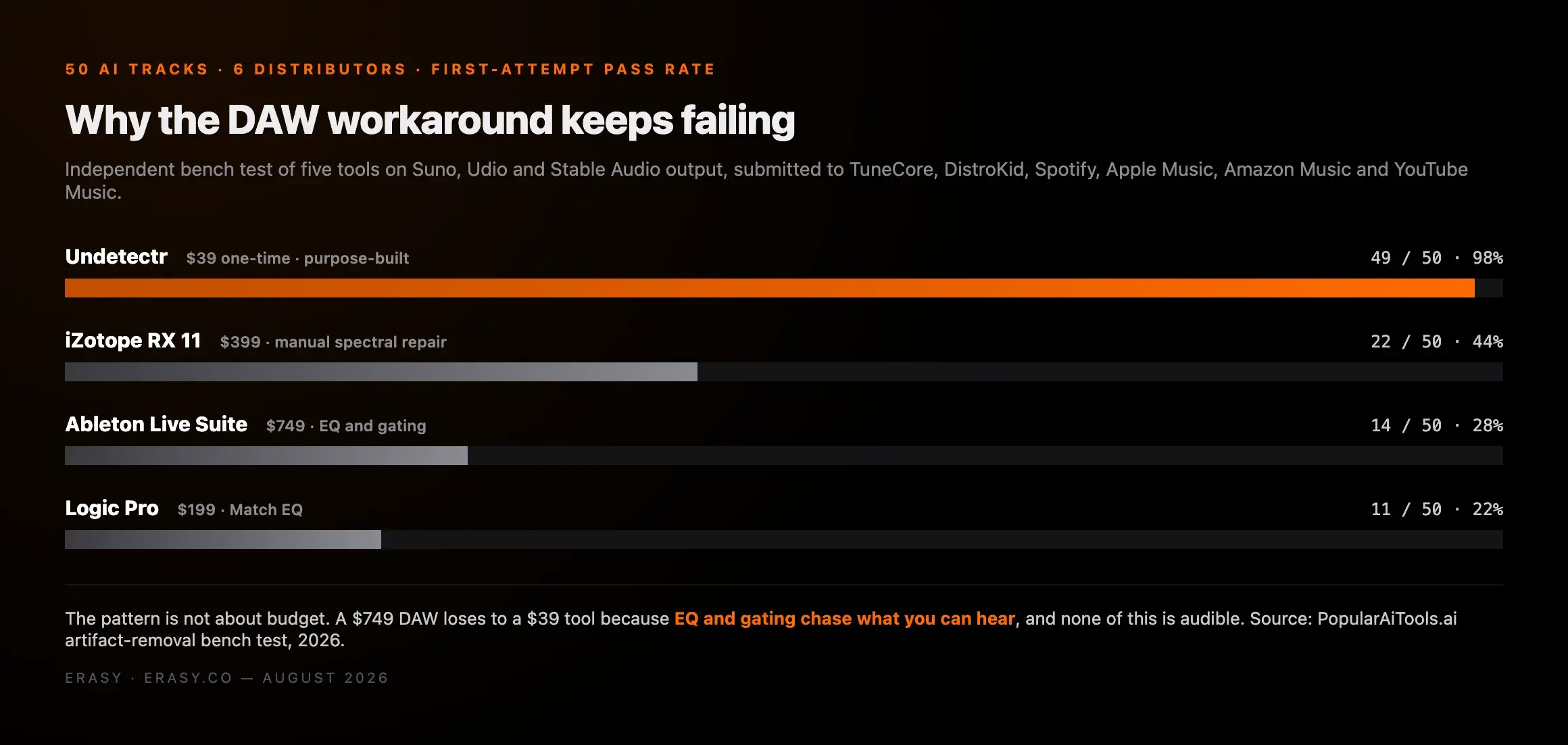
A bench test published by PopularAiTools.ai took 50 AI-generated tracks from Suno v5, Udio and Stable Audio, processed each through five different tools, and submitted the results to TuneCore, DistroKid, Spotify, Apple Music, Amazon Music and YouTube Music. Undetectr cleared first-attempt ingestion screening on 49 of 50. iZotope RX 11, at $399, managed 22. Ableton Live Suite, at $749, managed 14. Logic Pro managed 11.
The interesting thing about that spread is that it does not track budget. A $749 DAW loses badly to a $39 tool, and the reason is structural rather than a question of skill. As that test put it, AI generators "embed statistical fingerprints throughout the waveform — phase relationships, sub-threshold noise patterns, timing micro-variations that human ears can't detect but distributor scanners absolutely can". EQ, gating and spectral repair are tools for chasing things you can hear. None of this is audible, which is the whole design goal of a watermark that does not affect the listening experience.
The same logic disposes of the folk remedies. Re-encoding to MP3, adding a noise layer, nudging the pitch, running a limiter — all of these change audible qualities of a file whose markers were specifically engineered to survive exactly that. We walked through why each one fails in the Suno watermark removal walkthrough, and ranked the tools that actually target the signal in our comparison of six removers.
What we are not claiming
Three caveats, because this is a story where the temptation to oversell is considerable and the deadline does not need any help.
Nobody has tested anything against the new watermark
It has not shipped. Every tool on the market, Undetectr included, is proven against Suno's current output and nothing else. Any page telling you it already defeats Suno's 2026 watermark is describing something that does not yet exist. The honest claim is narrower and still useful: files you export before the rollout are files the rollout cannot reach.
A bulk downloader is not a way around the cap
Before 3 September it is a faster way to do something you are already entitled to do. After 3 September, Suno's policy is Suno's policy and the counter applies to you like everyone else. We are not going to dress that up.
Removal is not the same as anonymity
Stripping an embedded marker from a file you own does nothing about a fingerprint registered in a matching database, and it does not change the rights position of the track. Clean the files you have the right to release; that is the use case, and it is the one worth defending.
Do this today
If you read nothing else, read this. The list is short because the correct response to this announcement is short.
| Priority | Action | Why now |
|---|---|---|
| 01 | Bulk-export your whole Suno library | No counter is running until 3 September, and no mark has shipped yet. |
| 02 | Pull stems for anything reworkable | Hardest thing to reconstruct later, and they bundle at no extra cost. |
| 03 | Back up in two places you control | A drive and a cloud copy. The deadline is a good prompt to finally do it. |
| 04 | Decide your plan before your billing date | Allowances reset on your billing date, not the first of the month. |
| 05 | Clean anything headed for a distributor | Screening runs once, at intake, and a flag is silent — there is no second look. |
Lifetime · one-time €39
Bulk export before the deadline. Then clean what you intend to release.
One plan covers both halves: the bulk Suno playlist import that turns a library into a single ZIP, and signal-level processing that removes generation artifacts, embedded watermarks, C2PA metadata and noise-floor patterns before a distributor sees the file. Limits stated before you pay.
Where this leaves you
Suno is doing something defensible. Ninety thousand AI tracks arriving at a single streaming service every day, up to 70% of their streams fraudulent, and 75 million tracks pulled by Spotify in a year is a real abuse pattern, and identification technology is a reasonable lever against it. A settlement with Warner and a loss in Munich make it a commitment rather than a choice. We are not going to farm outrage about a company doing what it agreed to do.
What is genuinely badly handled is the pairing. The retroactive cap applies to catalogues built under different rules with under a month of notice, and the identification rollout it arrives alongside has no date at all. Between them they mean the archive you assumed was safe where it sat is subject to two policy changes, only one of which you can see coming.
Which leaves one action, and it expires. Until 3 September there is no counter, and as of today no watermark has shipped. Export what you care about while both of those things are still true, and clean whatever you intend to release once it is on a drive you own.
Keep reading
- Suno download limits review: what changes on 3 September 2026
- Suno watermark remover: how to actually remove it
- Best Suno watermark removers 2026, ranked
- What SynthID is and whether you can remove it
- How to distribute AI music without getting flagged
- What AI music detectors actually see, and why they disagree
- How to sell Suno music: generation to sold in ~15 minutes
Frequently asked questions

Cara Whelan — Policy Editor, Erasy
Cara covers platform policy for Erasy — pricing changes, terms updates and the rules that decide what you can actually do with the music you generate. They work from primary announcements and FAQs rather than the coverage of them, and date every figure so you know when it was last checked.
Does Suno put a watermark on your music?+
When exactly does the Suno watermark start?+
Are my old Suno songs watermarked retroactively?+
How do you get rid of the Suno watermark?+
Is the watermark the same as the download limits?+
Can I bulk download my whole Suno library before 3 September?+
Why is Suno adding watermarks at all?+
Does removing a watermark break Suno's terms?+
Disclosure: Erasy is an independent guide to AI music cleanup, and Undetectr is the tool we recommend and link to throughout this article. We have stated plainly what it does and does not do — a bulk playlist import is a faster route to an export you are already entitled to make before 3 September, not a way around Suno's cap afterwards, and no tool has been validated against a watermark that has not yet shipped. Watermarking and download-limit details verified against Suno's own 6 August 2026 announcement and help centre. Distributor pass-rate figures from PopularAiTools.ai's 50-track artifact-removal bench test. Figures current as of 24 August 2026.