AI Music
ElevenLabs Music: What It Is and How to Actually Release a Track

Almost everything written about AI music assumes you are using Suno or Udio. ElevenLabs Music arrived late, from a company with a very different background, and it is the generator most likely to surprise people who have not tried it.
Here is what it actually is, where it beats the incumbents, where it does not, and — the part nobody covers — what you need to do to a track before you can realistically release one.

Key takeaways
Vocals are the standout. A speech- synthesis company building a music model produces exactly the strength you would predict.
You can still export. That is a real advantage over Udio, which disabled downloads after its UMG settlement.
Commercial rights and distributor acceptance are separate. Your plan can permit a release that ingestion still holds.
Assume the export identifies itself. Marker material differs by generator, so multi-generator tooling matters.
What ElevenLabs Music is
ElevenLabs spent years as the reference name in AI voice — text-to-speech, dubbing, voice cloning — before it shipped a music product. ElevenLabs Music generates complete tracks from a text description, vocals included.
That lineage is the most useful thing to know about it. Vocal synthesis is the hardest part of AI music and the part listeners notice first, and it happens to be the exact problem ElevenLabs had already spent years solving. Diction, consonant clarity and breath behaviour are where its output tends to separate itself.
The trade-off is maturity. Suno has been iterating on full-song structure far longer, and the accumulated public knowledge about prompting it is enormous by comparison. You are choosing a stronger voice against a deeper ecosystem.
How it compares to Suno and Udio
| ElevenLabs Music | Suno | Udio | |
|---|---|---|---|
| Vocal realism | Strongest of the three | Very good | Very good |
| Song structure | Developing | Most mature | Strong |
| Community knowledge | Thin | Extensive | Moderate |
| Can you export a file? | Yes | Yes | No — streaming only |
| Ingestion screening applies | Yes | Yes | Not applicable |
The export row is the one that changes decisions. Udio's settlement with Universal Music Group moved it to a streaming-only model and disabled downloads, which means there is no file to master or distribute — we covered the fallout in our Udio explainer. Against that backdrop, a generator that still hands you a file is competing on something more fundamental than audio quality.
What we liked
- ✓Vocal realism and diction are the best of the mainstream generators
- ✓Exports a real file you can master and distribute
- ✓Backed by a company with a long, serious audio engineering record
Where it stops
- —Structural control is behind Suno's more mature model
- —Very little accumulated public prompting knowledge to draw on
- —Exports carry identifying material like every other generator
The licensing position
Commercial rights depend on your plan tier. That is the pattern across the whole category and ElevenLabs is not an exception, so read the terms attached to the tier you are actually on rather than a summary of them anywhere — including this one, since these terms change.
The distinction worth internalising is between permission and acceptance. A commercial licence is the generator telling you it will not object to you selling the output. Distributor acceptance is a different company deciding whether to put the file on Spotify. Those are separate decisions, made by separate parties, on separate evidence — and people conflate them constantly. Our guide to selling AI music on Spotify and DistroKid works through the same split for Suno.
Exports, downloads and what is in the file
When you export from any mainstream generator you are not receiving a plain audio file. You are receiving a mix plus identifying material that travels with it.
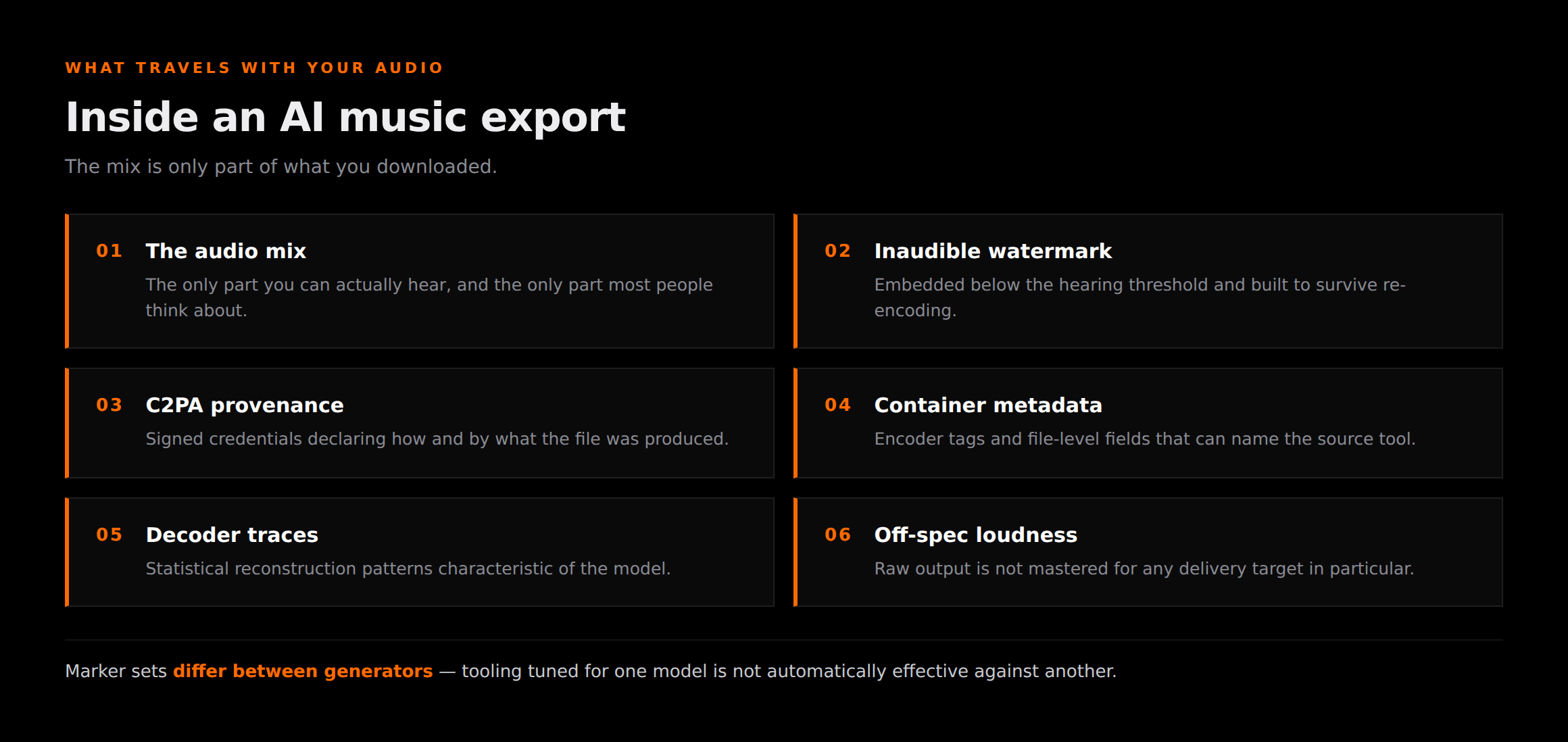
None of that is audible and none of it comes out with EQ, re-encoding or trimming. This is the same layer we document in our explainer on audio watermarking, and it behaves the same way regardless of which company generated the track.
One detail specific to using a newer generator: marker sets are not identical between models. Tooling tuned against Suno's output is not automatically effective against a different company's exports, which is why multi-generator coverage is worth verifying rather than assuming.
Releasing an ElevenLabs track
Distributors do not keep an approved-generator list. Nobody at DistroKid is deciding whether ElevenLabs is acceptable in principle — the pipeline reads your file and reacts to what it finds.
That is good news, because it means the problem is concrete rather than political. You are not appealing to a policy. You are dealing with material in a file, and material in a file can be dealt with. The mechanics of the ingestion side are in how to distribute AI music without getting flagged.
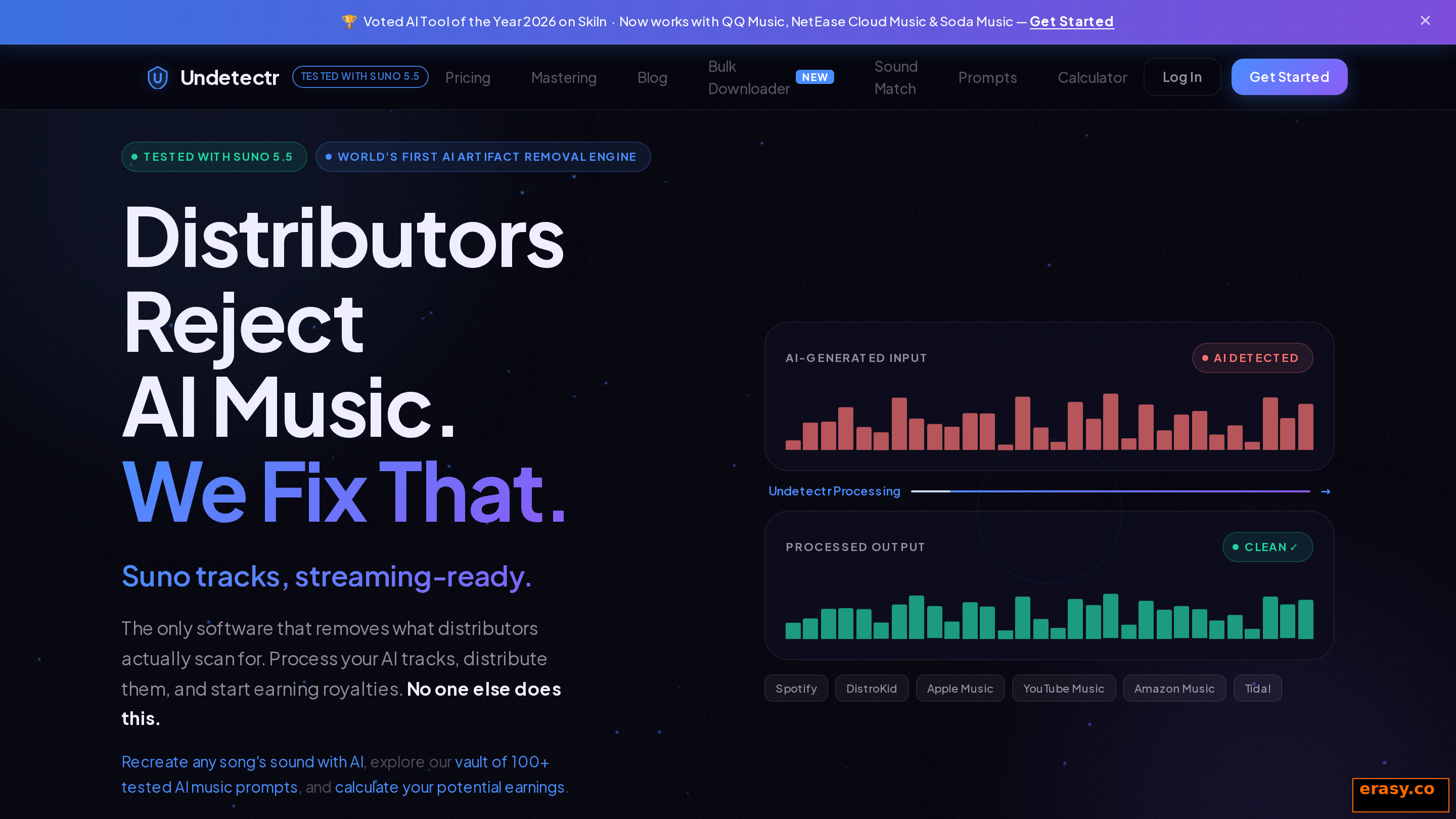
Undetectr is the tool I use for this step and the only one I have found built for the marker layers rather than adapted from audio repair. It covers Suno, Udio and ElevenLabs Music, runs in the browser in under a minute, and masters to the destination platform's loudness specification in the same pass. Our scored comparison covers why the DAW alternatives score so much lower on this specific job.
The release workflow
1. Generate, and generate more than once
Vocal takes vary more than instrumental beds. Generate several and keep the one whose lead vocal holds up, because that is where this model earns its place.
2. Export the highest quality available
Every re-encode discards information and makes later processing work harder. Start from the best file you can get rather than a convenience MP3.
3. Clean the marker layers before anything else
This is the step that decides whether ingestion goes through, and doing it before mastering means the master reflects the file you are actually releasing.
4. Master to the destination spec
Off-spec loudness is not a detection marker, but it is a quality signal that attracts attention. Our LUFS reference for streaming platforms has the numbers.
5. Distribute, and disclose where asked
Declaring AI involvement where a platform asks for it is a separate obligation from cleaning the file, and it costs you nothing.
Before you upload
Works with ElevenLabs Music, Suno and Udio exports
Marker sets differ between generators. Undetectr covers all three in one browser pass, with platform mastering included.
Verdict
ElevenLabs Music is the most interesting new entrant in a category that had settled into a two-horse race, and the vocal quality is a genuine reason to try it rather than a marketing line. It is behind Suno on structure and badly behind on community knowledge, both of which will close with time.
Run it alongside Suno rather than instead of it. And do not expect switching generators to solve distribution — every mainstream export carries identifying material, so the work before upload is the same whichever model made the track. That is the part people learn last and should learn first.