AI Music
Suno and Record Labels: Why Tracks Get Rejected (2026)
Three tracks go out to a label. The reply comes back that they were rejected because the AI-generated content was “considered too high”. No threshold, no detector report, no list of what to fix — and nothing published anywhere that tells you what the sentence means. That is where most people looking up Suno and record labels start, and the search results do not help, because the best page on the query is about distributors.
The stakes are not abstract. Deezer says it now receives nearly 90,000 fully AI-generated tracks a day, more than half of all deliveries on peak days, and in July 2026 the three majors and nine other labels and distributors proposed that only tracks that are “substantially human made” should be chart-eligible. The proportion of a record that came out of a model has become a thing the industry measures in public. What nobody has written down is how a single A&R desk applies it to your three tracks.
So we read the published positions at source on 19 October 2026 — Suno's help centre on stems and ownership, the chart proposal, the RIAA and IFPI labelling framework, Deezer's October announcement, Bandcamp's ban and Ableton's own manual for the rebuild — and put them beside one real term sheet an artist published this month. One of those documents settles what “too much AI” is actually measuring.
The short version
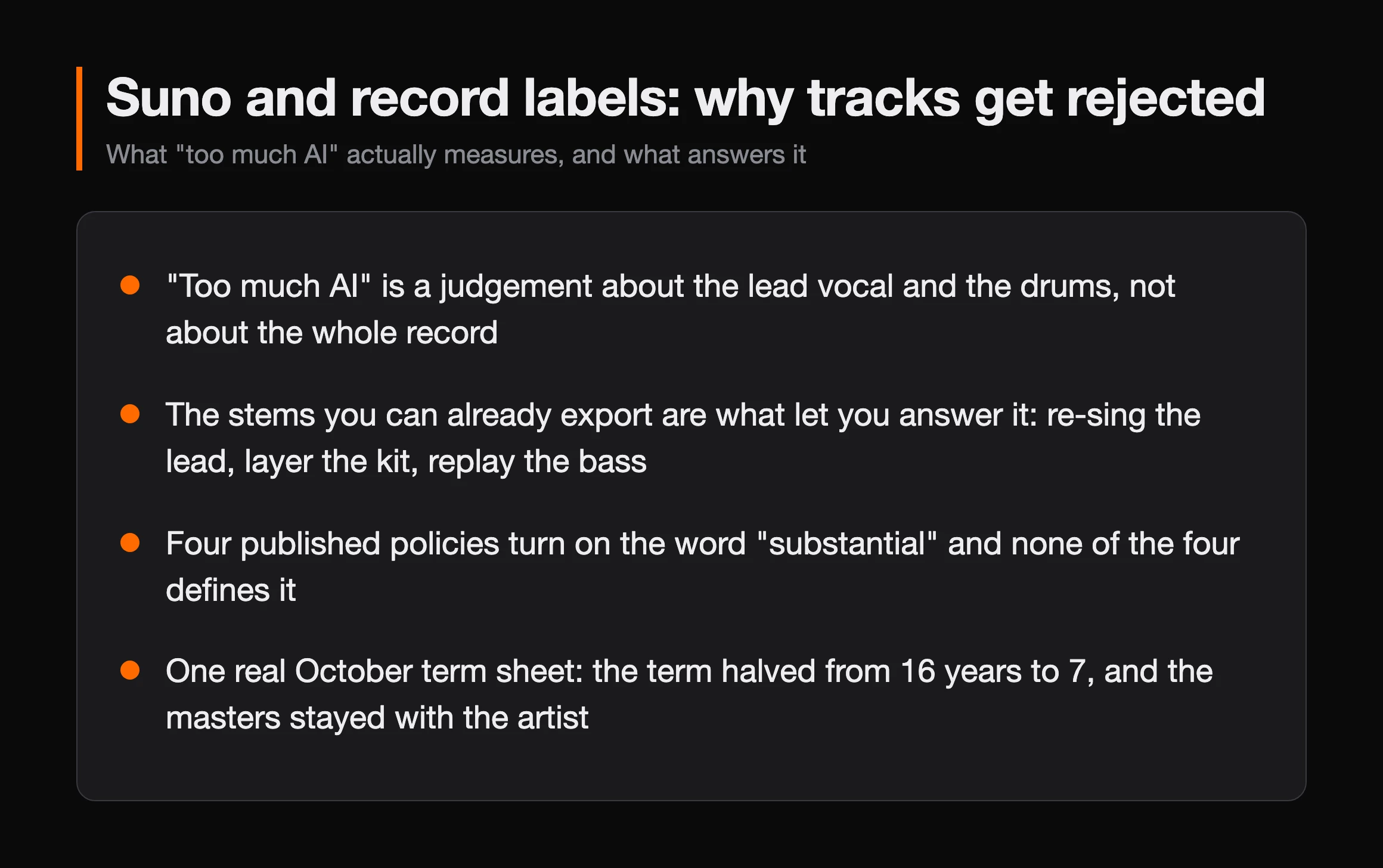
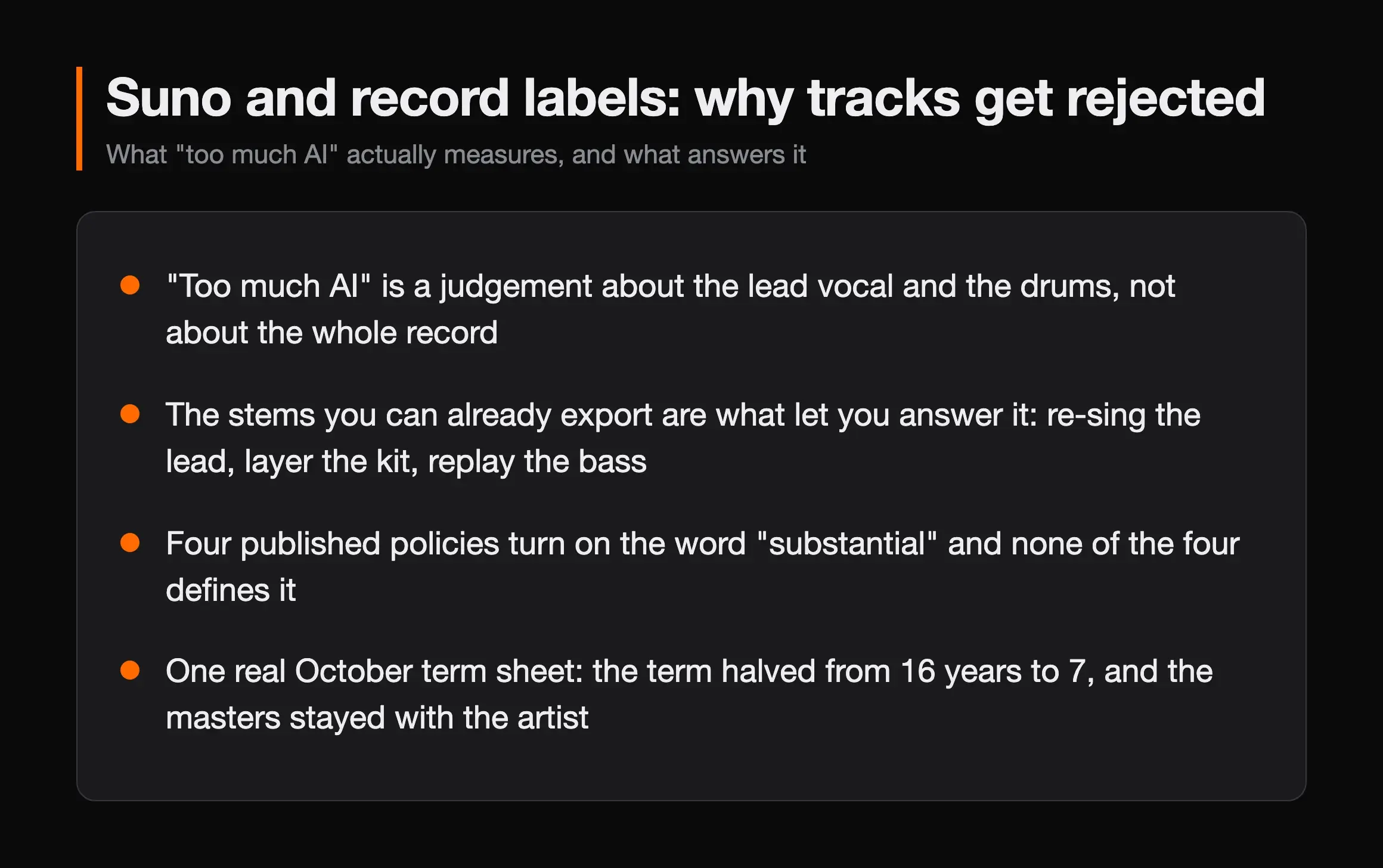
- A label rejection is a human judgement, not a screen. STVDIO's distributor survey puts it plainly: major label and large independent distribution partners “do not have public policies and rely on human review”. There is no threshold to get under.
- The published industry line is proportion, not prohibition. The July 2026 chart proposal allows “substantially human made” records and excludes fully AI-generated ones; the RIAA/IFPI framework splits recordings into AI-Generated and AI-Assisted on the same axis.
- Stems are a paid feature. Get Stems is Pro and Premier only: Auto Split gives up to 12 stems for 50 credits, Split from Mix gives one part plus a complement for 10, Advanced Split is Premier-only.
- The rebuild is where the objection actually gets answered. Replacing the lead vocal and the drums with played or sung parts changes what an A&R hears. Cleaning the file does not.
- One real October offer: 7 years, $12,000, masters retained. Negotiated up from 16 years and $10,000 with no recoupment split. One offer, one artist — a structure to compare against, not a market rate.
Two rejections, two different problems
The single most useful thing on this page is a distinction almost nobody draws. A distributor rejection and a label rejection come from different machinery, fail for different reasons, and are fixed by completely different work.
A distributor rejection is automated and mostly binary. Something in the intake pipeline reacted — a match against an existing recording, a screen on the audio, a declaration you did or did not make — and the upload stops. It happens in minutes, it produces a code or a canned sentence, and the remedy is usually mechanical. We keep the release-side version of that in distributing AI music without getting flagged.
A label rejection is a person who listened. There is no pipeline, no threshold and no appeal — and, crucially, nothing published to argue with. STVDIO's June 2026 survey of fifteen distributors ends up conceding exactly this: “Major label distribution and large independent distribution partners do not have public policies and rely on human review”. If you have been reading distributor policies to work out what a label wants, you have been reading the wrong documents — and the highest-ranking guide on this query makes the same substitution, which is why it never mentions labels at all.
What “too much AI” means to an A&R
Two readings are available, and they point at different work. The first is provenance: the label has a position, published or private, about how much of a record may come from a model. The second is craft: the record sounds unfinished in the specific ways a generated render sounds unfinished, and “too much AI” is the shorthand for it.
The published evidence favours the first reading existing and the second one deciding. On provenance, the industry has settled on a proportion test rather than a ban. In July 2026, Universal, Sony and Warner, with Believe, BMG, Concord, Dirty Hit, Glassnote, HYBE, Mom+Pop and Partisan, proposed that chart-eligible tracks be “substantially human made”, with fully AI-generated tracks excluded, AI tools properly authorised, and the use of AI declared. Days earlier the RIAA and IFPI had published the labelling vocabulary for the same axis: an AI-Generated recording is one where “generative AI was used to generate the entirety or the primary portion of the creative elements”, while AI-Assisted means “the recording was created substantially by humans and expresses human creativity”.
Read those definitions against a prompt-to-export track and the arithmetic is unkind: the lead vocal and the primary instrumental performances are the examples both documents reach for, and in a Suno render they are the model's. A reasonable guess at what the rejection meant is therefore not “we detected AI” but “on the only axis the industry has agreed on, this sits on the wrong side”. Which is useful, because that side can be moved — not by processing the file, but by replacing performances.
What you can export from Suno
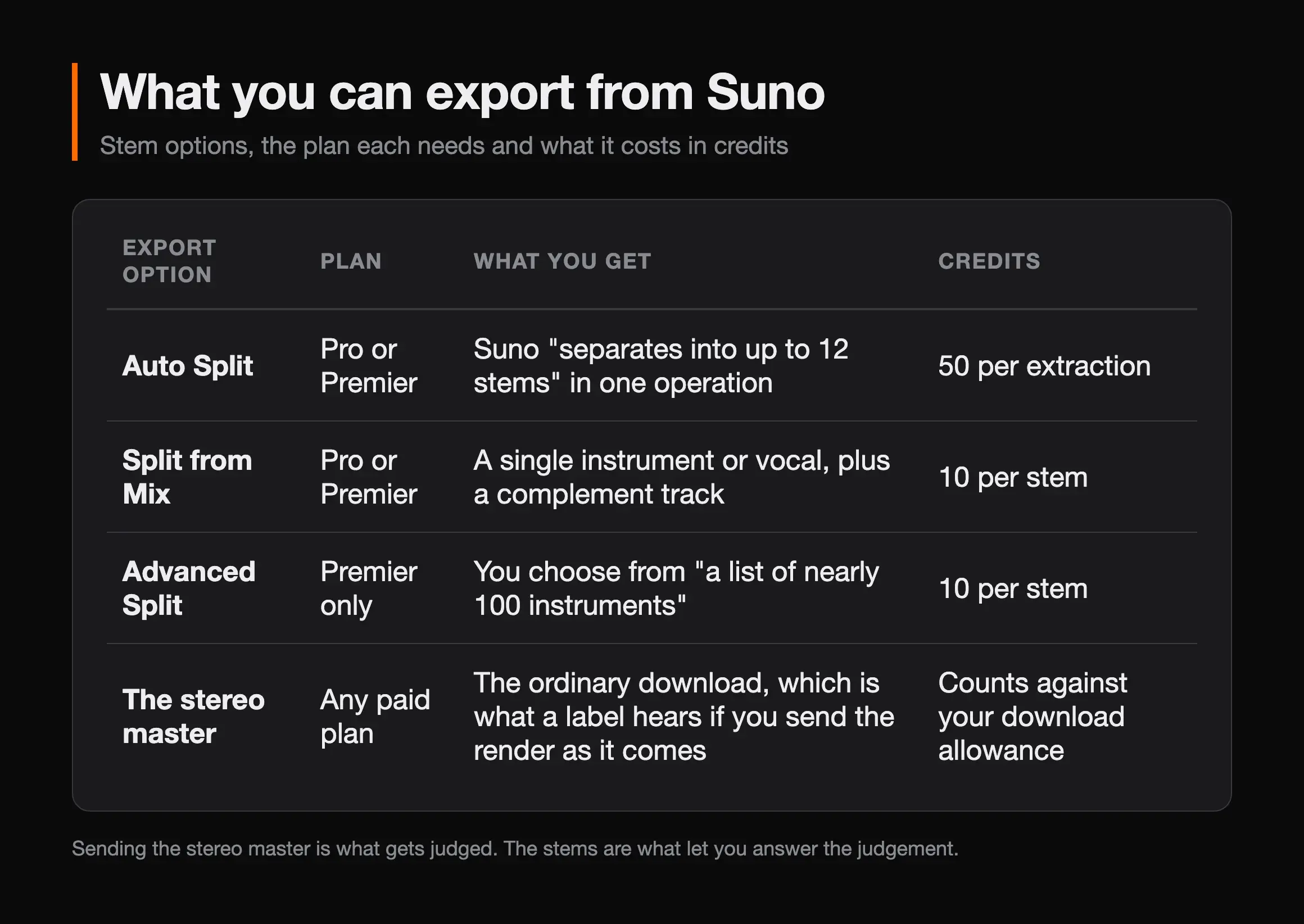
The question asked twice in the source thread and answered nowhere on the SERP: what comes out of Suno if you want to rebuild rather than resubmit. Stems are a paid feature and the three modes are not interchangeable. Read at source in Suno's help centre on getting stems on 19 October 2026:
| Export option | Plan | What you get | Credits |
|---|---|---|---|
| Auto Split | Pro or Premier | Suno “separates into up to 12 stems” in one operation | 50 per extraction |
| Split from Mix | Pro or Premier | “A single instrument or vocal, plus a complement track” — the part and everything else | 10 per stem |
| Advanced Split | Premier only | You choose the stems from “a list of nearly 100 instruments”; described as “more precision and cleaner results” | 10 per stem |
| The stereo master | Any paid plan | The ordinary download — what a label hears if you send the render as it comes | Counts against your download allowance |
Two things the help centre does not say, and both matter before you spend credits. It names no file format for the stems, so do not plan a delivery folder around an assumption about WAV. And it sets no expectation about separation quality on a mix the model generated rather than recorded — our sister site walks through what actually comes back, and why a stem can sound worse than the mix it came from, in its guide to Suno stems. The download arithmetic is its own trap on the lower tiers; we put numbers on it in Suno download limits.
Rebuilding a Suno track in a DAW
This is the part the thread asked for and nothing on the first page of results supplies. Taking Suno to Ableton is mechanically simple and musically the whole job, so the mechanics first.
Drop the stems into one Live set together. Live's Auto-Warp Long Samples option “is enabled by default”, so long files are warped on load and the manual notes that “the Auto-Warp algorithm usually estimates the audio clip's tempo correctly”. Convenient for one file, a problem for twelve: each stem is analysed on its own evidence, and a drum stem and a string pad will not always agree. Let Live analyse one rhythmic stem, set the project to the tempo it finds, then switch warp off on the rest so every file plays at the rate it was rendered at and stays phase-aligned with its siblings. Where a downbeat lands wrong, the manual's own remedies are the context-menu Set 1.1.1 Here and Warp From Here, which “runs the Auto-Warp algorithm for the audio to the right of the selected marker”. Beats is the default warp mode and suits material with “a dominant rhythm”; a full-band or vocal stem wants Complex or Complex Pro.
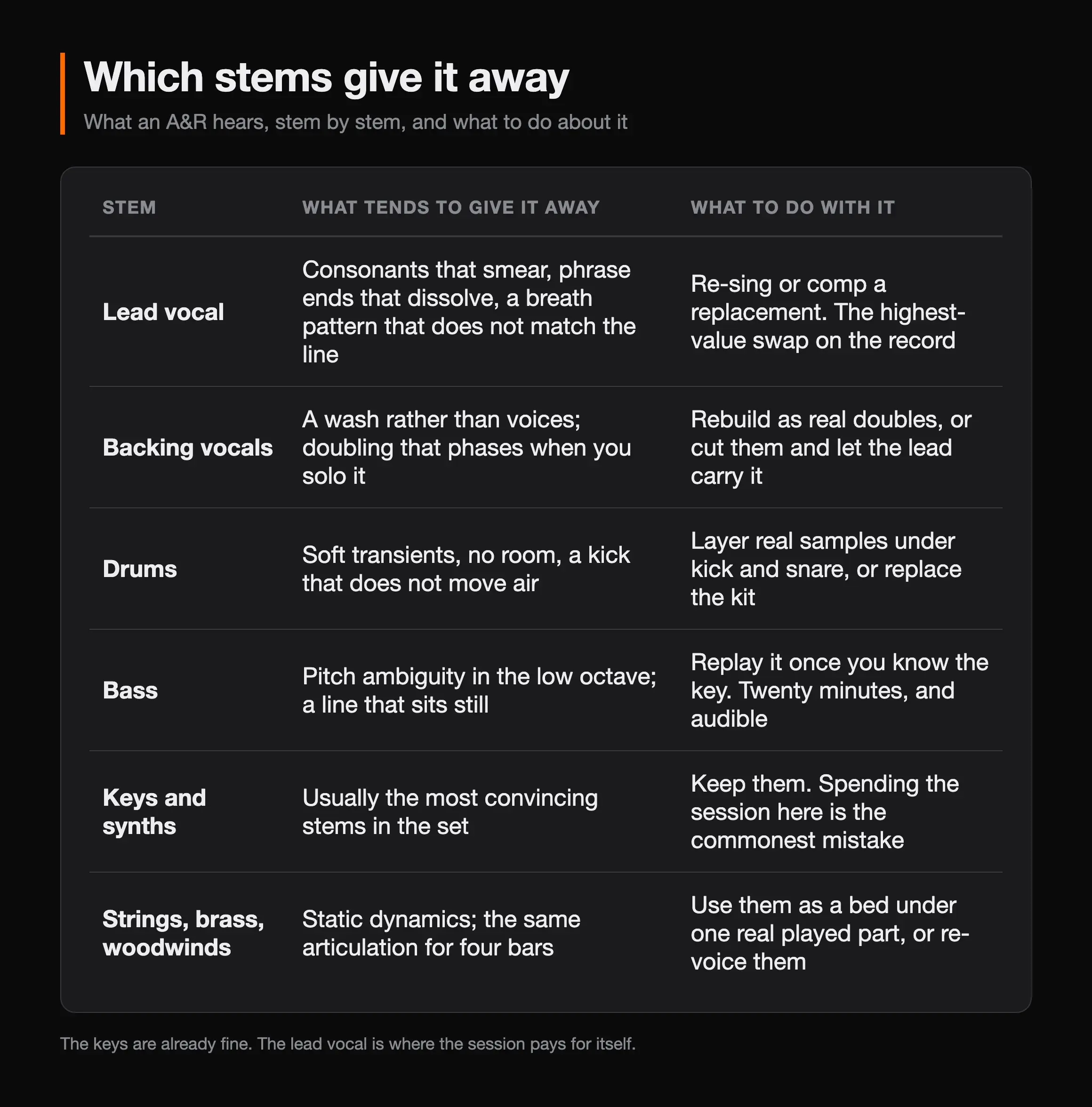
Then the actual work, which is replacement rather than repair. If the rejection was a judgement about performance, EQ will not answer it — and the stems tell you where to spend your time.
| Stem | What tends to give it away | What to do with it |
|---|---|---|
| Lead vocal | Consonants that smear, phrase ends that dissolve, a breath pattern that does not match the line | Re-sing or comp a replacement. The highest-value swap on the record |
| Backing vocals | A wash rather than voices; doubling that phases when you solo it | Rebuild as real doubles, or cut them and let the lead carry it |
| Drums | Soft transients, no room, a kick that does not move air | Layer real samples under kick and snare, or replace the kit and keep the pattern |
| Bass | Pitch ambiguity in the low octave; a line that sits still | Replay it once you know the key. A DI or synth bass is twenty minutes, and audible |
| Keys and synths | Usually the most convincing stems in the set | Keep them. Spending the session here is the commonest mistake |
| Strings, brass, woodwinds | Static dynamics; the same articulation for four bars | Use them as a bed under one real played part, or re-voice them |
Mix it as a record, then bounce one stereo master and treat the finish as a separate pass — the loudness side of that is in AI music mastering, and the pre-release tidy-up is in cleaning AI music for release.
A file job, in its right place
Artifact clean-up is a production step, not a route past a person
Undetectr processes a finished AI-generated master for audible generation artifacts and the model signatures that distributors' automated intake screening reacts to. The boundary matters: that is a file problem at the distribution step. An A&R's ear is not an automated screen, no processing makes a performance more human, and nothing here changes how a platform labels or credits a release. Use it on the master you are about to upload, not as an answer to a label that said no.
Disclosure: Erasy is an independent guide and Undetectr is the tool we recommend and link to; we may earn a commission if you subscribe.
Do you tell the label?
The thread asks how labels react to disclosure, and the honest answer is that the record is nearly empty. We looked for published label submission policies on AI and found none from any major or large independent — which is not the same as finding a ban, and is worth saying in those words. What does exist is a set of adjacent positions, and they are the best available evidence of where the line is being drawn.
| Who | What is actually published | Date |
|---|---|---|
| UMG, Sony, Warner + Believe, BMG, Concord, Dirty Hit, Glassnote, HYBE, Mom+Pop, Partisan | Chart proposal: tracks should be “substantially human made” to chart, fully AI-generated tracks excluded, AI tools authorised and lawful, and the use of AI declared | 29 July 2026 |
| RIAA and IFPI, with A2IM, WIN, IMPALA, the Recording Academy, SAG-AFTRA and the Human Artistry Campaign | Voluntary labelling: AI-Generated where AI made “the entirety or the primary portion of the creative elements”, AI-Assisted where it is “created substantially by humans”. Adoption by streaming services unsettled at announcement | 10 July 2026 |
| Deezer | A listener switch that “exclude[s] fully AI-generated tracks, albums and related artists from Deezer search results”; music with “limited AI-assisted elements” is treated differently | 13 October 2026 |
| Bandcamp | “Music and audio that is generated wholly or in substantial part by AI is not permitted on Bandcamp.” The post does not define “substantial” | 13 January 2026 |
| Major label and large independent distribution partners | No public policies — they “rely on human review”, per STVDIO's survey of fifteen distributors | 3 June 2026 |
| Any individual label's A&R submission policy | Nothing we could find published, by anyone, in any market | — |
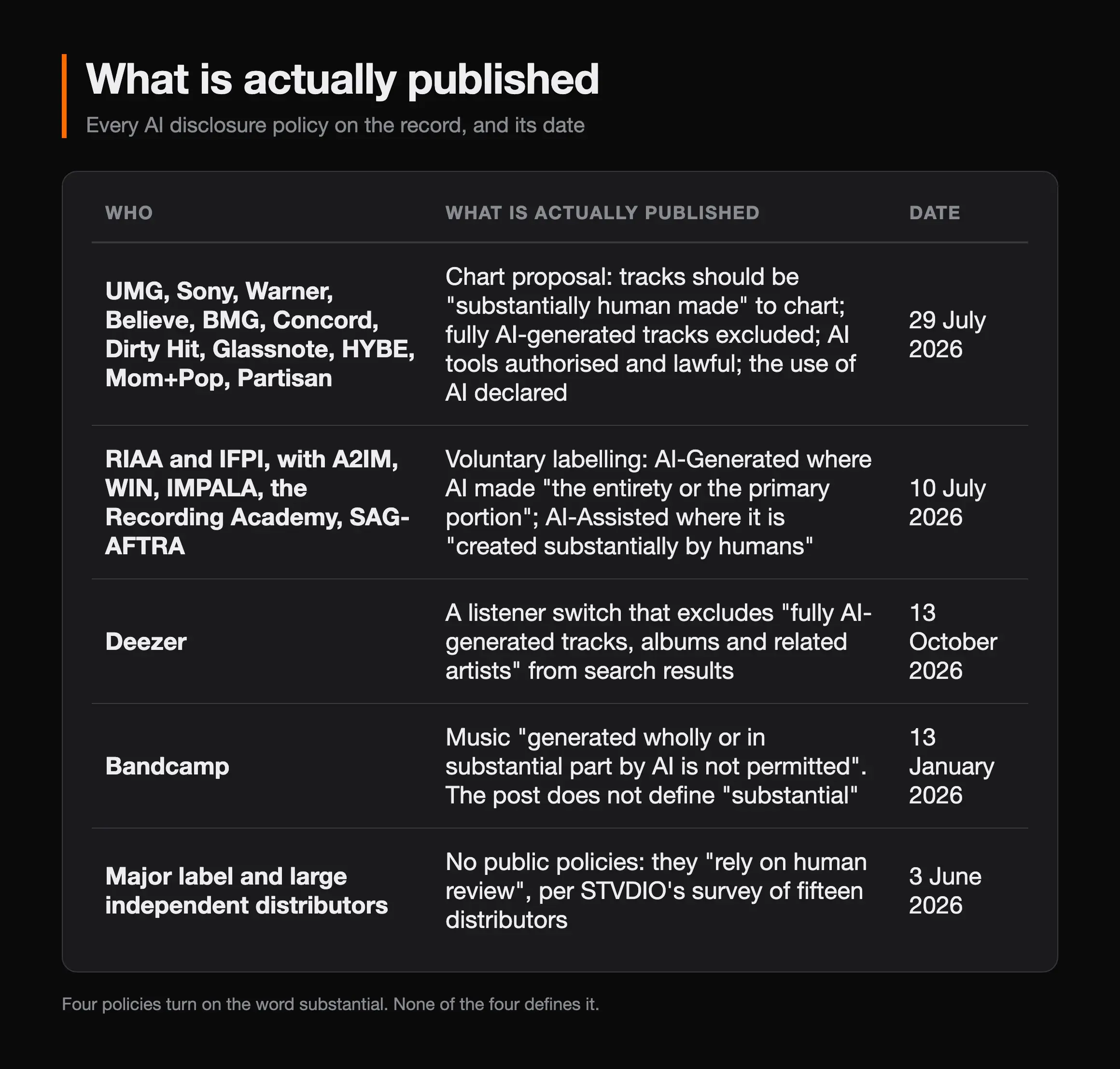
Which points one way. Every published position asks for a declaration rather than forbidding the tool, and the paperwork will ask you anyway: a licence carries warranties about what you own and what you cleared, and the chart proposal asks for the AI use to be declared. Volunteering it in the first email costs you one conversation. Discovering it in a warranty clause after an advance has been agreed costs you the deal, and possibly more.
What a real offer looked like
The second reader on this page already has an offer in hand and no reference points, because nobody publishes terms. On 15 October 2026 an artist posted a complete set, including what the label opened with and what it looked like after negotiation. Read it for its structure, not its numbers: it is one offer from one small label, reported by the artist, and nothing in the post says AI was involved in the music at all.
| Term | Opening offer | After negotiation | Why it matters |
|---|---|---|---|
| Licence term | 16 years | 7 years | A licence, not an assignment — the length is how long they control the recording |
| Advance | $10,000 | $12,000 | Recoupable. The number people quote, and the least important line here |
| Marketing spend | Not stated | $15,000 minimum, up to $20,000 | A written minimum is a commitment; “we'll push it” is not |
| Recoupment split | None — artist side only | 50/50 on marketing | Who pays back the marketing money, and out of whose share |
| Royalty split | Not stated | 50/50 | What you earn once the advance and the marketing are recouped |
| Masters | — | Artist retains full ownership throughout | The thing you cannot get back if you sign it away |
| Reversion | — | All rights revert at the end of the term | Turns a long deal into a long rental |
| Scope | — | 2 collaborations, 1 catalogue song, 2 future singles | How much of your output the deal reaches |
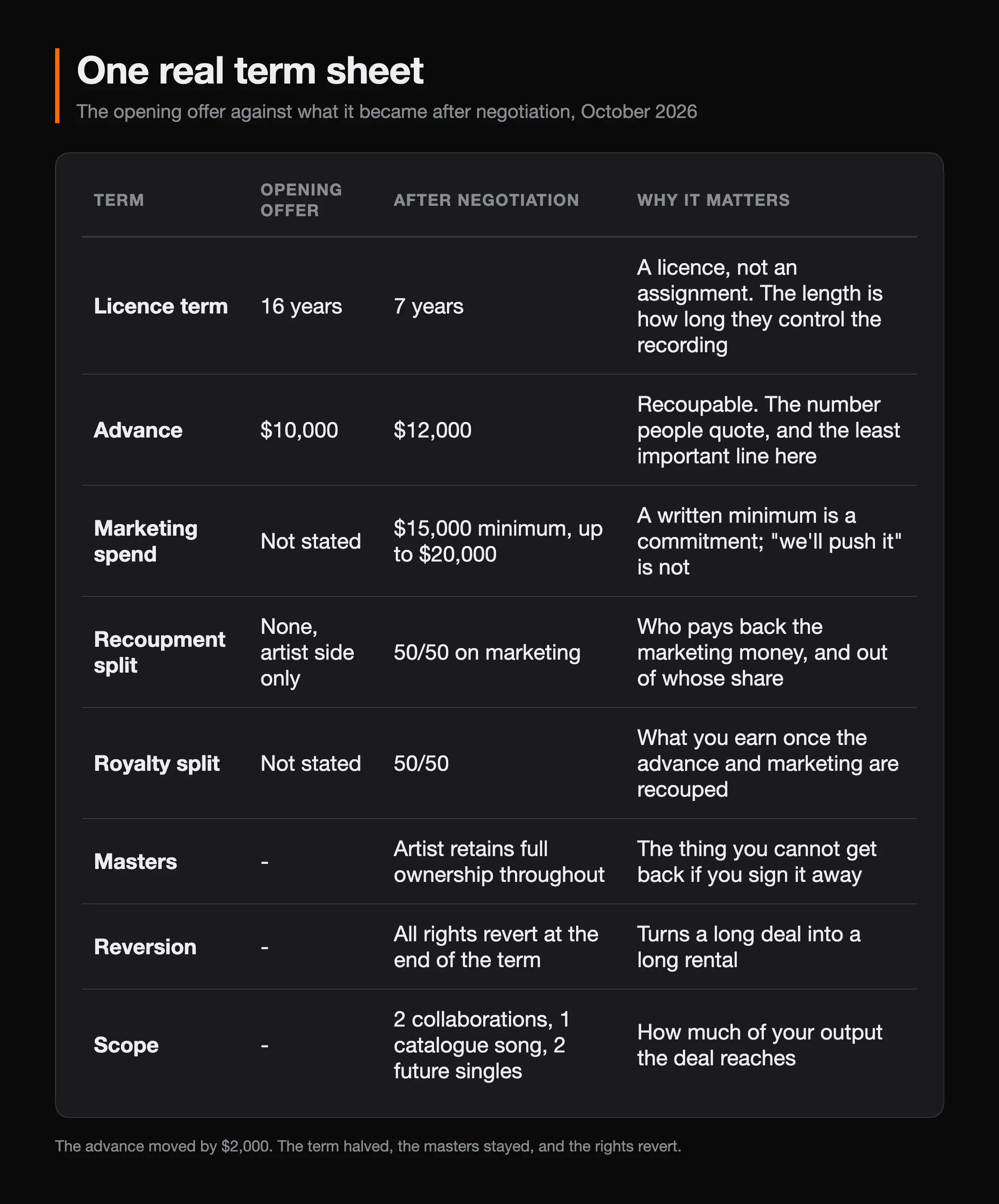
The negotiation moved four things and only one of them was the advance. Nine years came off the term, the marketing became a floor instead of an intention, and the recoupment split changed who carries that spend. If you take one habit from this page, take that: the advance is the headline and the term, the reversion and the recoupment are the deal. And whoever the counterparty is, the ownership question underneath it is worth settling first — Suno's help centre says that on Pro or Premier “you own the songs”, while whether that ownership is a registrable copyright is a different argument, which we work through in can you copyright AI music.
Is this A&R legit?
The third question in this cluster arrives as a cold approach and a meeting the same night. There is no register of legitimate A&Rs to look anybody up in, so the checks below are the ones that are actually checkable in twenty minutes — and the speed of the approach is itself a signal worth sitting with.
Search the label on a DSP, not on its own site. A real label has releases, dates and artists you can play. A brand-new page with no catalogue is not a label yet.
The email should come from the label's own domain. A free-mail address claiming a label's name is the cheapest red flag there is.
Pick someone on the roster and look at what happened to their releases after signing. Message them. Artists answer this question honestly more often than you would expect.
Advances and marketing flow to you. A submission fee, a “contract processing” charge or a paid studio package flows the other way, and that is a different business model.
A real offer survives being put on paper and read slowly. If urgency is doing the work — sign tonight, the slot closes — the urgency is the product.
The route that needs no label
Worth naming what the label was being asked for. Distribution is not the wall any more — it is a form and a fee, and six distributors take AI music openly. What an artist is really asking a label for is an audience, which is the one thing AI music does not have. We covered that side of it in the AI music backlash, and Deezer's new listener switch makes it concrete: a filter that hides fully AI-generated tracks from search makes discovery harder, not easier.
So the routes that do not depend on being discovered are the ones worth building. A paid sync placement — a track licensed into a show, a game, an ad — is a person reading a brief and choosing a cue — the same human judgement an A&R applies, aimed at a question you can answer: does this fit the scene. Selling direct to the listeners you already have sits beside it, and keeps all of the money rather than a split. We did that arithmetic against streaming in 1,000 streams versus selling direct. Neither route needs a label to say yes, and neither pretends the discovery problem is solved — they route around it.
The one-line version
“Too much AI” is a judgement about how much of the record a person performed, so the fix is performances, not processing: pull the stems, replace the vocal and the drums, and send a record rather than a render.
Related reading on Erasy
Frequently asked questions

Eddie Mathews — Editor, Erasy
Eddie reads the help-centre article and the contract rather than the roundup, and marks the difference between what a company has documented and what a tutorial has assumed. Where the public record does not settle a question, this site says so.
Will a record label sign a song made with Suno?+
Why was my track rejected for having too much AI in it?+
Do I have to tell a label that I used Suno?+
Can I export stems from Suno?+
Does rebuilding a Suno track in Ableton make it label-ready?+
Who owns a Suno track I pitch to a label?+
Is a seven-year licence with a $12,000 advance a good deal?+
Read at source on 19 October 2026: Suno's help centre on getting stems and on song ownership by plan; Complete Music Update on the 29 July 2026 chart proposal; Music Ally on the 10 July 2026 RIAA/IFPI labelling framework; Deezer's newsroom announcement of 13 October 2026; Bandcamp's “Keeping Bandcamp Human” post of 13 January 2026; STVDIO's 3 June 2026 distributor survey; and the Ableton Live 12 manual on audio clips, tempo and warping. The term sheet is one offer reported by one artist in r/musicmarketing on 15 October 2026, anonymised here, and no per-track maths is built on it. The stem-by-stem table is our own listening judgement rather than a measurement. No label has published a submission policy on AI music that we could find — where this page says the record is silent, that absence is the finding.