AI Music
Can You Monetise Suno Music Beyond YouTube?
A Premier subscriber asked the question in the plainest possible terms on 12 November: he paid for the plan believing he could monetise on Spotify, Apple and Amazon, heard on YouTube that this is “no longer possible because music is flagged as ai”, and wanted to know whether Suno is only good for YouTube.
The thread’s top reply, at 25 points, is a factual claim list: only Tidal and Bandcamp refuse to pay, Spotify and Deezer will not recommend you but will still pay, everything else pays fine. We spent this evening checking it line by line against the platforms’ own pages, and it holds up better than most upvoted replies do — with one gap large enough to change the answer.
So: can you monetize Suno music beyond YouTube? Yes, almost everywhere. But the question has a gate in front of it that nobody in the thread mentioned, and it is not the platform’s — it is your distributor’s. Every figure and quotation below was read at the publisher’s own page or help-centre API on 23 November 2026 and is dated.
The short version
The short version: exactly one streaming service publishes a rule that withholds money from AI music, and it is Tidal — recordings it identifies as wholly AI-generated are “not eligible for royalty attribution”. Bandcamp bars the music outright. Nowhere else we could read ties payment to AI.
The AI label costs reach, not royalties. Spotify and Deezer both withhold recommendation rather than payment, and Deezer demonetises fraudulent streams, which is a different thing.
The gate that actually stops people is the distributor. LANDR publishes nine platforms that will not take AI music through it and caps you at 20 or 60 AI tracks a month; TuneCore carries only licensed-dataset models, which Suno is not one of.
Your own vocals over a Suno bed clears Tidal’s threshold and nothing else. Tidal only acts on wholly generated recordings. You still declare the generated part everywhere that asks.
And the YouTube route doubles in price on 1 February 2027 for new Partner Program applicants.
The short answer, and the long one
No, Suno is not a YouTube-only generator. A paid Suno plan carries commercial rights, a distributor takes the file to the streaming services, and almost all of them pay on it exactly as they pay on anything else. The belief in the question — that being flagged as AI switches the money off — is not what any platform publishes, and on the one platform where something like it is true, the rule is narrower than the rumour.
The long answer is that “can I monetise this” is really three questions stacked, and mixing them up is what produces threads like this one. Will your distributor deliver the track to a given platform at all? Will that platform pay on it once it arrives? And will that platform put it in front of anybody? Those three have different answers on the same release, they are set by different companies, and only the middle one is what people mean by monetisation.
The thread also contains the sentence that matters most, tacked on to the end of that 25-point reply: “That’s the least of your worries because getting enough traction is harder than you think.” Four other commenters said the same thing in their own words. They are right, and the rest of this page tries not to talk past them.
Three gates, not one
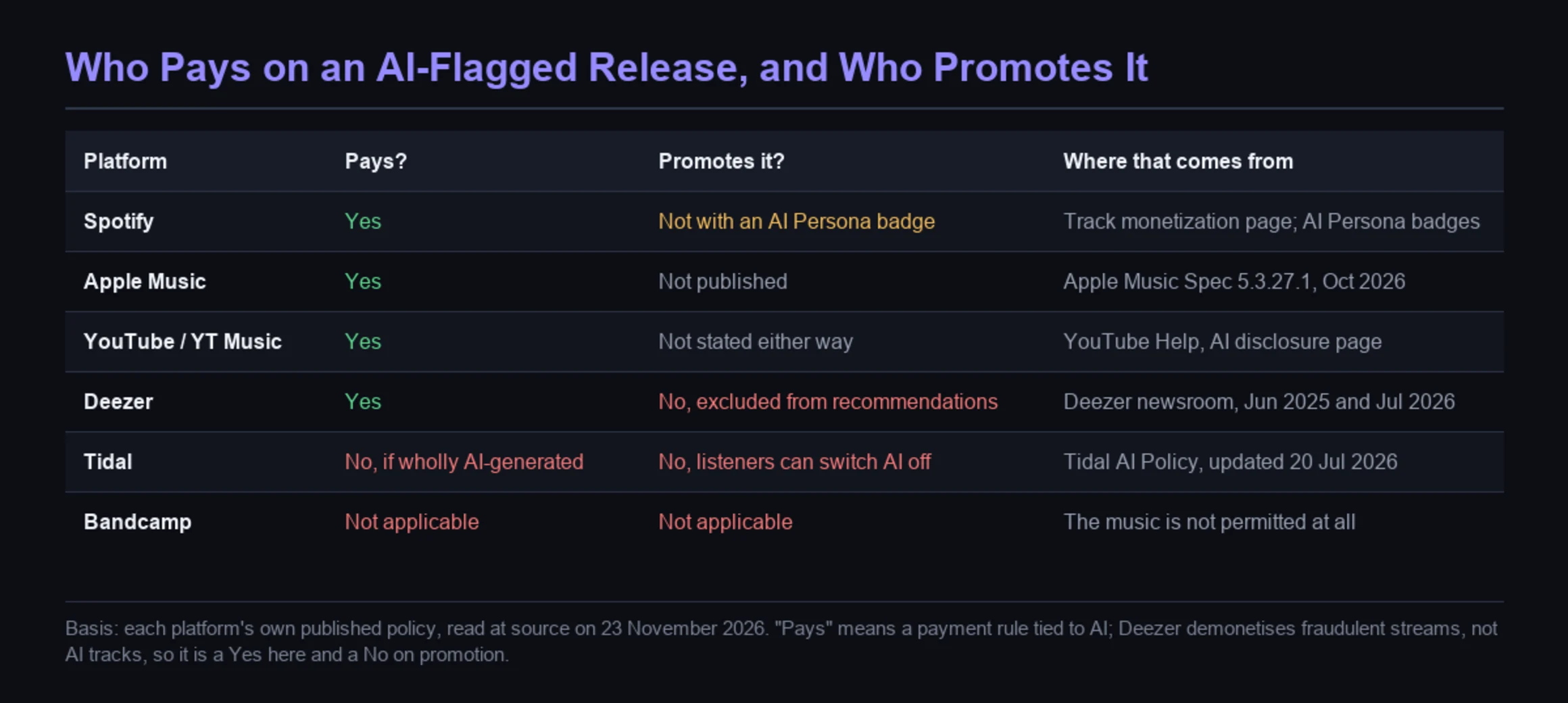
Here is every platform the thread named, against the three gates. The “pays” column is what the platform publishes about payment on a release it has identified as AI-generated — not what a round-up says, and not an inference from the fact that it tags them. Where nobody has published an answer, the cell says so rather than guessing.
| Platform | Pays on an AI-flagged release? | Promotes it? | Where that comes from |
|---|---|---|---|
| Spotify | Yes — no AI condition published anywhere | Not if you carry an AI Persona badge | Track monetization eligibility; AI Persona badges (read 23 Nov 2026) |
| Apple Music | Yes — nothing in the delivery spec ties payment to AI | Not published | Apple Music Specification 5.3.27.1, October 2026 |
| YouTube / YouTube Music | Yes — disclosure "won't… impact its eligibility to earn money" | Not stated either way | YouTube Help, AI disclosure page |
| Deezer | Yes — it demonetises fraudulent streams, not AI tracks | No — excluded from editorial and algorithmic recommendations | Deezer newsroom, 17 Jun 2025 and 21 Jul 2026 |
| Tidal | No, if wholly AI-generated — "not eligible for royalty attribution" | No — and listeners can switch AI off entirely | Tidal AI Policy (created 23 Jun 2026, updated 20 Jul 2026) |
| Bandcamp | Not applicable — the music is not permitted | Not applicable | "Keeping Bandcamp Human", 13 Jan 2026 |
| SoundCloud | Yes — no AI payment rule in 429 help articles | Not published | SoundCloud help centre, EU AI Act guidance (26 Oct 2026) |
| Amazon Music | Not published anywhere we could read | Not published | Artist help centre does not open from here — stated, not inferred |
One cell deserves the asterisk it is not getting. Amazon is a genuine blank: its artist help centre returns 404 on the obvious paths and a JavaScript shell on the one that answers, so we have no Amazon statement either way and will not borrow one from a vendor blog. Note too that the YouTube row is about disclosure rather than detection, and that the same page requires that disclosure whenever a video “creates music that’s the main focus” — every lyric video in this niche.
The two that really say no
The commenter put Tidal and Bandcamp in one bucket. They belong in two, because one of them is a payment rule with a measurable threshold and the other is a door.
Tidal’s AI Policy allows AI music on the platform and then declines to pay for part of it. Its own words: “Recordings that Tidal identifies as wholly AI-generated are not eligible for royalty attribution.” It defines those as recordings “wholly generated using generative artificial intelligence”, and it is unusually candid about why the line sits there: “Due to limitations in AI-detection technology, and to avoid false positives, we will only be taking action with respect to wholly AI-generated recordings.” It adds that it will widen that as detection improves, and that it is “taking no actions as to AI-generated compositions”. Tidal Upload is inside the same rule: a recording it reads as wholly generated is “not eligible for direct-to-fan monetization” either. There is an appeal route through Tidal’s support form for a track wrongly identified, and a separate reporting route for listeners who think a track is AI and untagged.
The policy’s quietest line is the one with the most teeth for a reader thinking about audience rather than royalties: a Tidal listener can turn AI-labelled recordings off in Settings, after which they “won’t play” and drop out of that person’s recommendations. No other platform we read gives the listener that switch.
Bandcamp is not a payment question at all. “Keeping Bandcamp Human”, published 13 January 2026, says “music and audio that is generated wholly or in substantial part by AI is not permitted on Bandcamp”, and reserves the right “to remove any music on suspicion of being AI-generated”, enforced through a listener report button. A commenter in the thread reports exactly that outcome at 12 points — a profile “starting to gain some real traction… then without warning one day it was all gone”. Worth knowing that Bandcamp never defines “substantial part”: the word appears twice on that page, once in the rule and once in an unanswered comment asking what it means.
Your distributor decides where it goes
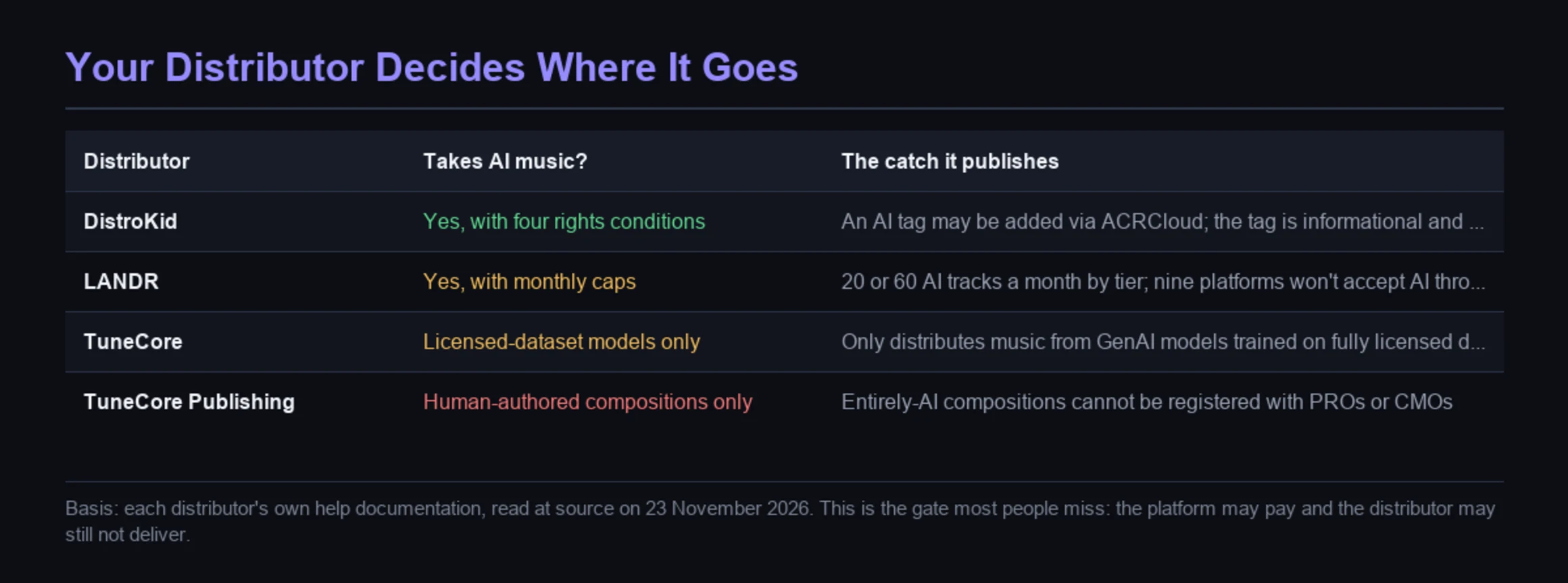
This is the gate the thread missed, and it is the one that produces the “my music never appeared” posts. Before any platform gets to decide whether to pay you, your distributor decides whether to send the track there at all — and three of the big ones publish very different answers.
| Distributor | Takes AI music? | The catch it publishes | Read at source |
|---|---|---|---|
| DistroKid | Yes, with four rights conditions | An AI tag may be added by platforms via ACRCloud; "the tag is informational. It doesn't affect distribution" | Help article 57059105736083, edited 13 Nov 2026 |
| LANDR | Yes, with monthly caps | 20 or 60 AI tracks a month by tier; nine platforms won't accept AI through it; no AI cover songs | "Does LANDR accept AI-generated tracks?", updated 21 Nov 2026 |
| TuneCore | Licensed-dataset models only | "TuneCore only distributes music created using GenAI models trained on fully licensed datasets" | GenAI Music Content Framework, updated 23 Nov 2026 |
| TuneCore Publishing | Human-authored compositions only | Entirely-AI compositions "cannot be registered with PROs/CMOs"; flagged songs "may not be processed" | GenAI and TuneCore Publishing, Explained |
The LANDR list is the single most useful thing we read tonight, because it is a distributor publishing other companies’ refusals. Platforms currently not accepting AI-generated music through LANDR: YouTube Content ID, Meta, TikTok, Deezer, Lissen, Pandora, Tencent, Beatport and Qobuz. That list ran to seven entries when we last read it; Beatport and Qobuz are new. So a Deezer row that says “pays” is true of Deezer and irrelevant to you if you went out through LANDR, which is precisely what one commenter reported at three points. Note also that LANDR asks for the declaration in two axes — Composition and Sounds, each None, AI-assisted or AI-generated — with Suno given as the worked example in the tools field.
TuneCore’s position is the one that explains another thread report, that “TuneCore turned their Suno tracks down the other week”. Its framework makes licensed training data the condition of carriage, and names Google Flow Music as its partnered route. Suno makes no fully-licensed-dataset claim about its models, so that is a closed door rather than a flag. One more corpus-level finding worth having: we searched all 421 DistroKid help articles and none of them mentions Tidal’s royalty rule — “royalty attribution”, “wholly AI” and “demonetis/demonetiz” all return zero — while Tidal is on DistroKid’s published delivery list. You can send a wholly generated track to a service that will not pay for it, through a distributor that never says so.
What the AI label actually costs
On the two platforms that have published most about AI music, the cost of being identified is discovery. That is a real cost — arguably a worse one than a royalty haircut — but it is not the thing the original question was afraid of.
Spotify’s AI Persona page is explicit on both halves. The consequence: “Music from AI Personas isn’t included in editorial or personalized recommendations unless a listener intentionally engages with the artist, for example by following them.” And the trigger, which most people get wrong: the badge is “about the identity you present as an artist, not whether you use AI to make your music”, and it “doesn’t apply if you only use AI tools to make your music, but your artist profile represents a real person”. What sets it is AI-generated artist imagery — profile pictures, headers, cover art that looks like a photograph of someone who does not exist. Your profile photo is a distribution decision on Spotify, not a design one.
Spotify’s separate AI credits system is per-role rather than per-track, optional, in beta, and “only visible to listeners on mobile”; they “don’t appear on artist profiles or as track-level labels”. Meanwhile the thing that genuinely gates payment on Spotify has nothing to do with AI: tracks between 1 and 1,000 annual streams average $0.03 a month.
Deezer is where the commenter’s wording was loosest and the truth is more interesting. Deezer tags AI albums, keeps them out of editorial playlists and algorithmic recommendations, and — the part people turn into “Deezer doesn’t pay for AI” — filters fraudulent streams out of royalty payments. Its own January 2026 release puts that at “up to 85%” of streams on AI-generated music, against 8% fraud across the whole catalogue. Genuine plays on a tagged track are not the target. One rule from July 2026 does bite a quiet catalogue, though, and nobody writes it up: Deezer says it will take down AI tracks used for fraud and those that have not been streamed for six months or more. Our sister site tracks Deezer’s policy in detail, and our Spotify policy page covers the badge rollout.
The YouTube money, and the channel you don’t own
The original question had YouTube backwards in a specific, common way, and a five-point reply fixed it: when you distribute to YouTube Music, your audio is not on your channel at all. DistroKid’s own explainer confirms the mechanism — your release becomes an Art Track on an auto-generated Topic Channel, which “neither the Topic channel nor the art tracks are created by DistroKid – they are generated by YouTube and cannot be edited/claimed”. It is worth having, because it is where the money is: “earnings generated from ads on art tracks and royalties generated from YouTube Music”.
You link it to yourself by claiming an Official Artist Channel, after which every Art Track shows on both. DistroKid includes that on all three plans, asks for a dedicated channel with at least one real upload — Shorts do not count — and warns that it “cannot assist in undoing Official Artist Channel claims” and to allow up to six weeks. Smaller artists often find their music on Various Artists — Topic until YouTube moves it.
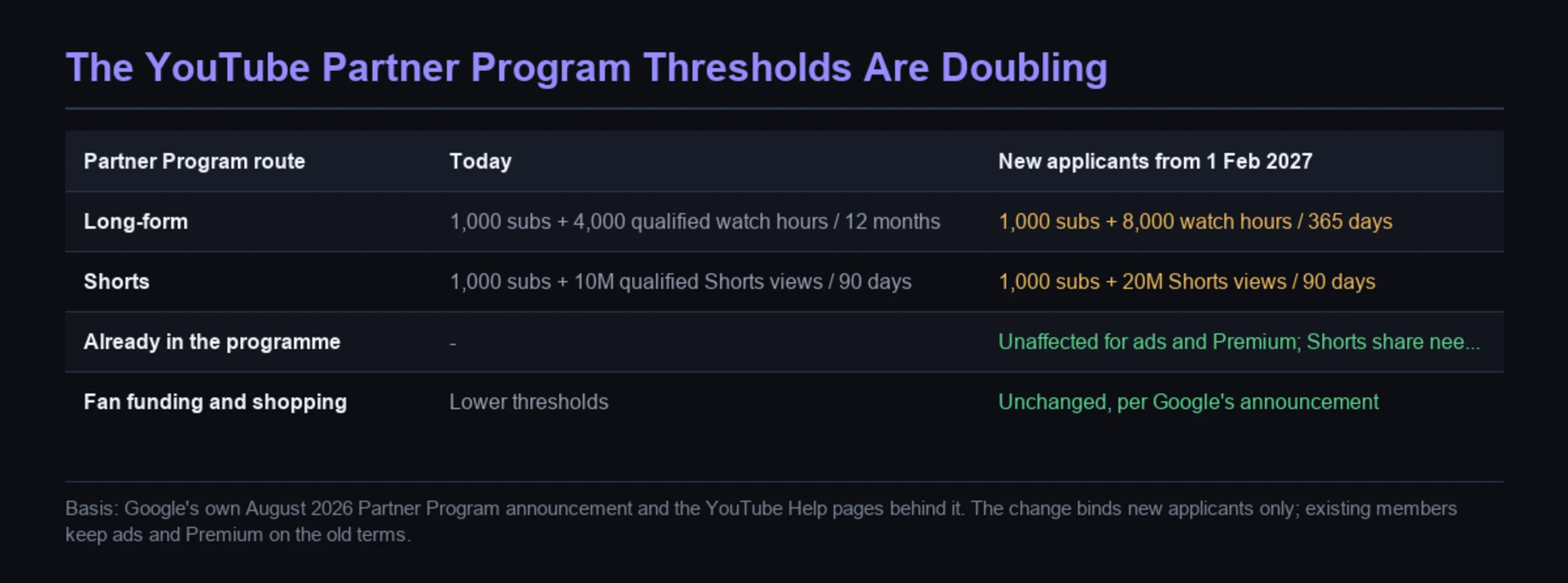
Separately, there is the ad money on videos you upload yourself, and a commenter flagged a change to it that turns out to be real and is not yet on YouTube’s own eligibility page. Google announced it on 11 August 2026; the new terms take effect 1 February 2027.
| Partner Program route | Today | New applicants from 1 Feb 2027 |
|---|---|---|
| Long-form | 1,000 subscribers + 4,000 qualified watch hours / 12 months | 1,000 subscribers + 8,000 qualified watch hours / 365 days |
| Shorts | 1,000 subscribers + 10M qualified Shorts views / 90 days | 1,000 subscribers + 20M qualified Shorts views / 90 days |
| Already in the programme | — | Unaffected for ads and Premium; Shorts revenue share needs 10M views / 90 days |
| Fan funding and shopping | Lower thresholds | Unchanged, per Google's announcement |
Two things follow. Google’s post says the update “won’t impact creators already in YPP”, so if the YouTube route is your plan, the cheapest version of it closes in about ten weeks. And Shorts watch time from the Shorts feed still does not count toward the long-form hours, which is the trap for anyone planning to get there on clips. Our YouTube monetisation page does the rest of that arithmetic, including the reach problem that arrives long before the policy one.
What a Suno track has actually earned
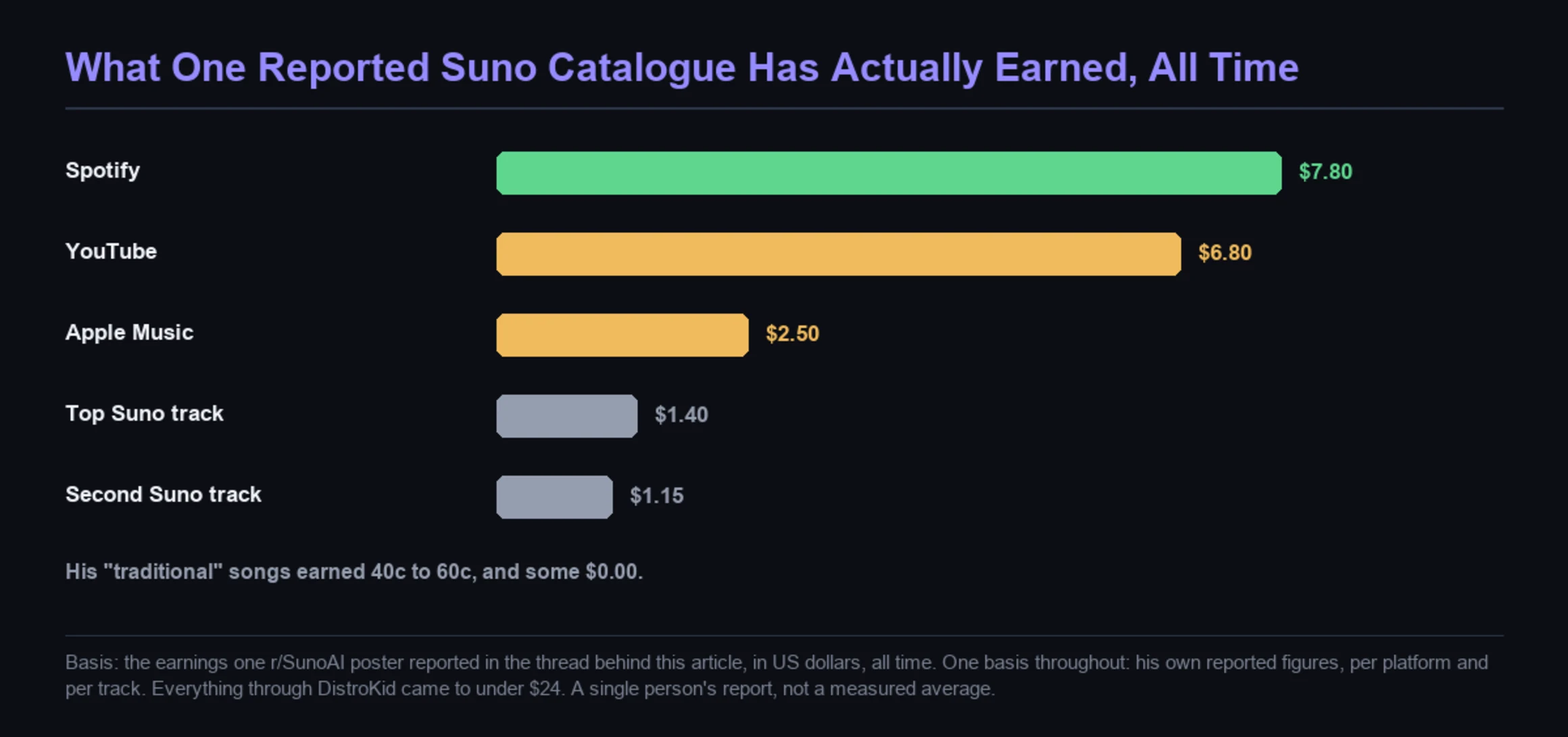
One commenter, at nine points, did the thing nobody else in the niche does and read his DistroKid cut sheet out loud. These are one artist’s self-reported lifetime figures, not a benchmark, not ours, and not a rate card — but they are from a real statement, which beats every projection on this search results page.
| What he reported | Amount | Note |
|---|---|---|
| Two Suno tracks, his own lyrics | $1.40 and $1.15 | His top six songs by earnings |
| His "traditional" songs | 40c to 60c, some $0.00 | His words: they do better, but "haven't made a dollar yet" |
| Spotify, all time | $7.80 | His highest-paying platform |
| YouTube, all time | $6.80 | Second |
| Apple Music, all time | $2.50 | Third; "pennies and cents elsewhere" |
| Everything through DistroKid, all time | Under $24 | His summary: "I'm not trying to get rich" |
Two more accounts in the same thread, same caveat: “about $4 in 8 months”, and one artist who made “just enough in one year on Spotify & Apple to cover my distrokid base subscription”. Against those, the only large number anyone posted is about audience rather than money — one commenter at nearly four million streams says most of it comes from YouTube music videos rather than Spotify, and that writing the lyrics yourself is part of what made that work. If you want the arithmetic on what streams are worth at all, we did it properly in 1,000 streams versus one sale, and per-platform royalty rates live on our sister site.
What to fix before blaming the label
A flag and a rejection are different events, and so are the fixes. If your release came back from the distributor, that is a screening outcome at the intake stage and it has causes you can act on: rights you cannot evidence, a cover you are not cleared for, an artist name that collides, or audible generation artifacts that make a submission look mass-produced. If it went out and simply carries a tag, there is nothing to fix — DistroKid says plainly “I used AI. Is that a problem? Nope”, and the tag “doesn’t affect distribution”.
What nothing on this page can do is change a platform’s label, and most advice on this question pretends otherwise: no audio tool changes whether Spotify shows an AI Persona badge, or whether Tidal attributes royalties. Those are set by what you disclose on delivery and by what the platform decides about your public identity. A cleanup pass is for the screening step and the audible artifacts — the hiss, the smeared transients, the metallic top end that makes a generated master sound like one. If your problem is a rejected submission rather than a tag, start with the screening checklist and what a review queue actually means.
Independent · We recommend Undetectr
Clear the screening step, not the label
Undetectr processes a generated master for distributor screening and audible generation artifacts. It does nothing about a platform's AI tag or badge — nothing can — but a clean file is the half of this problem you control.
Where the money doesn’t need a feed
Add the gates up and the pattern is clear: the money is mostly available and the attention is not. Spotify will pay you and not recommend you. Deezer will pay you and not recommend you, assuming your distributor sends it there. Tidal will tag you and let listeners switch you off. Every one of those is a discovery problem wearing a policy costume, which is exactly what five people in a 39-reply thread said in plainer language.
The routes that do not run through a recommendation engine are therefore worth more to this catalogue than they are to anyone else’s. The biggest of them is paid sync placement — a music supervisor on a TV, film, game or ad brief is looking for a track that fits a scene, and no algorithm stands between your file and that decision. A single placement fee is in a different category from the cut sheet two sections up. Selling direct to the people who already like your work is the other, and you keep all of it; note that the storefront most advice points at, Bandcamp, is the one door this catalogue cannot use at all.
None of that replaces distribution. Release the track, declare what you used, take the royalties the platforms do pay — and stop budgeting your effort against a monetisation ban that, on the evidence of every policy page we could open tonight, exists on one service and only for recordings made entirely by machine.
Related reading
Frequently asked questions

Eddie Mathews — AI Music Editor, Erasy
Eddie covers the money side of AI music for Erasy — distribution, screening, payouts and the gap between what a platform publishes and what creators report. He reads every policy at the publisher’s own page and dates the figure.
Can you monetize Suno music on Spotify?+
Which platforms don't pay for AI music?+
Does the Spotify AI Persona badge stop my royalties?+
If I put my own vocals over a Suno instrumental, does that fix it?+
Will my distributor send AI music everywhere?+
Does disclosing AI on YouTube demonetise the video?+
Can AI-generated songs collect publishing royalties?+
Disclosure: Erasy is an independent guide to AI music cleanup, and Undetectr is the tool we recommend and link to. Every policy on this page was read at the publisher’s own source on 23 November 2026 and dated as the tables above show: Tidal’s AI Policy, Bandcamp’s “Keeping Bandcamp Human”, four Spotify for Artists articles, two Deezer newsroom releases, the Apple Music Specification 5.3.27.1 (70,204 words, in which no royalty rule touches AI), SoundCloud’s EU AI Act guidance, two YouTube help pages, Google’s YPP announcement of 11 August 2026, and six DistroKid, LANDR and TuneCore help articles. Tidal’s, SoundCloud’s, DistroKid’s, LANDR’s and TuneCore’s help centres refuse this connection in a browser, so those were read through each publisher’s own public help-centre API and the links go to the pages a reader can open. Amazon Music could not be read at all: its artist help paths return 404 or an empty JavaScript shell, so its row says “not published anywhere we could read” rather than “no policy”. Quotations, scores and counts come from all 39 comments on one r/SunoAI thread of 12 November 2026 (7 points, 39 replies, 32 distinct authors at the time of writing), read through the public arctic-shift mirror because reddit.com serves this container a bot-check page; the thread link goes to Reddit for readers. Earnings figures are one creator’s self-reported cut sheet. We ran no test and distributed no release for this article, and nothing here is legal or financial advice.